The De Minimis Exemption Is Gone and What a Small Shipment Costs Now

The de minimis exemption is gone. Since August 29, 2025 no shipment entering the United States has cleared duty-free on the strength of being worth $800 or less, whatever country it came from and whatever mode it arrived by. In June 2026 CBP wrote the suspension into its regulations, and a statute passed in July 2025 removes the exemption from the law itself on July 1, 2027. A parcel that used to arrive with no duty, no fees and no entry now needs a customs entry, a bond behind that entry, the full duty on its value, a processing fee and, in most cases, someone paid to file it.
This guide is for US importers, ecommerce brands and marketplace sellers whose landed cost was built on Section 321. It covers how the exemption was shut down, why the Supreme Court's tariff ruling did not bring it back, what a low-value shipment must do now, and what the numbers look like on a real order. If you have never built a landed cost from scratch, start with our landed cost calculator and come back to the worked example below.
What de minimis was and why it carried so much volume
Section 321 of the Tariff Act of 1930 let CBP waive duty and formal entry on shipments below a set value. Congress raised that value from $200 to $800 in 2016, and the low-value channel grew into the largest import lane by count. CBP processed over 1.36 billion de minimis shipments in 2024, roughly four million a day, most of them direct-to-consumer parcels from Asia.
The duty on a $40 item was never the point. The point was that a parcel skipped the entry, the bond and the filing fee that every commercial import pays, and once the exemption went, the fixed cost of clearing customs attached itself to every single box.
How the exemption was shut down, step by step
The shutdown happened in stages over 14 months, and each stage closed a door that sellers had been using. The sequence explains why nothing in 2026 reopened the channel.
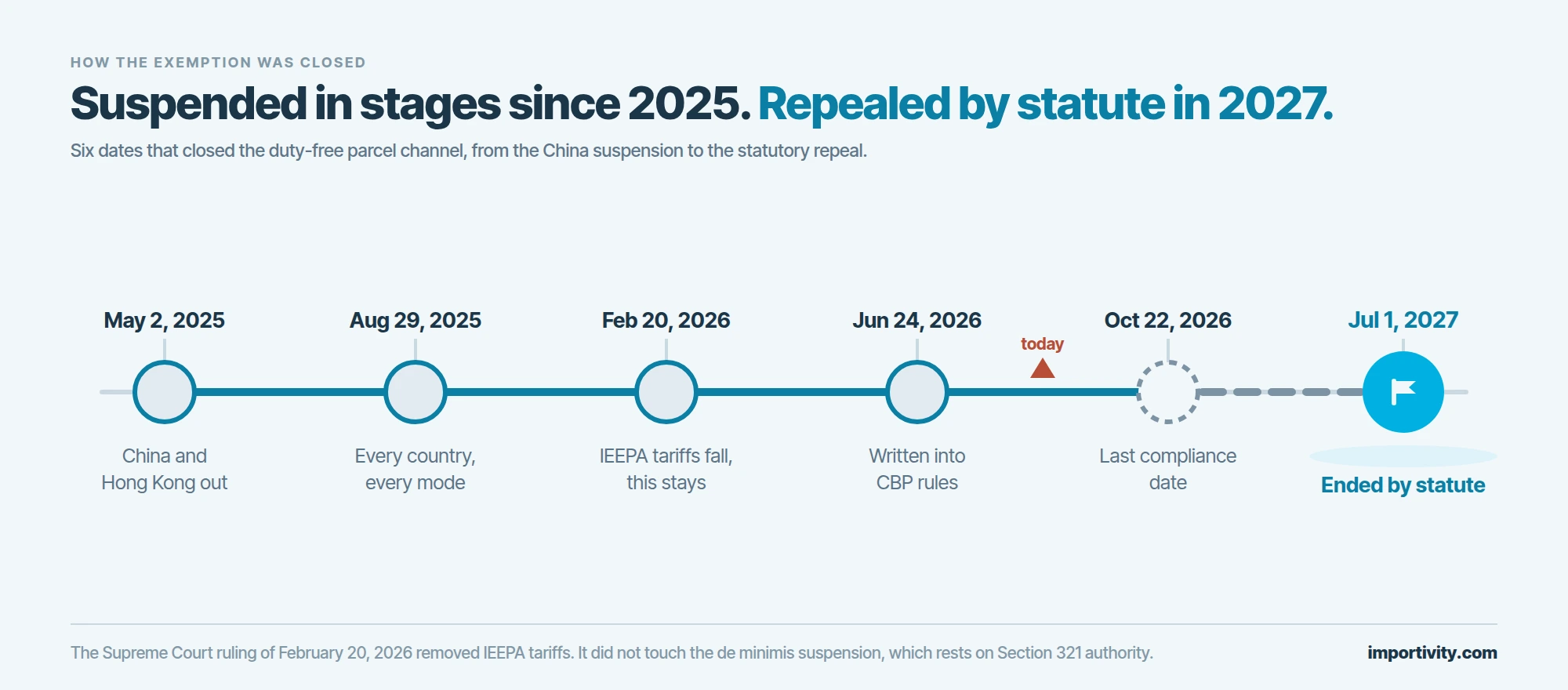
- May 2, 2025. Duty-free treatment ended for goods from China and Hong Kong. Every parcel from those origins needed an entry and paid the tariffs then in force.
- August 29, 2025. Executive Order 14324 suspended the exemption for all countries. ACE began rejecting Section 321 manifest filings and Entry Type 86 releases. Postal shipments got a six-month choice between the ad valorem rate and a flat duty of $80, $160 or $200 per item by origin tariff band.
- February 20, 2026. The Supreme Court held in V.O.S. Selections v. Trump that the International Emergency Economic Powers Act does not authorize tariffs. The IEEPA tariffs fell. The suspension did not, because it rests on CBP's own authority under Section 321.
- February 28, 2026. The flat per-item postal option expired and every postal shipment moved to ad valorem duty.
- June 24, 2026. CBP published two interim final rules that suspend the exemption indefinitely for every mode and create a new postal informal entry process, effective July 24, 2026, with a delayed compliance date of October 22, 2026 for certain shipments.
- July 1, 2027. The July 2025 budget act repeals the exemption in statute. From that date there is nothing left to reinstate.
Two things happened around the edges. A Court of International Trade case, Axle of Dearborn v. Department of Commerce, argues the executive branch had no power to switch the exemption off, and in March 2026 the court let it proceed. And on July 24, 2026 new Section 301 duties of 10 or 12.5 percent took effect on goods from 60 trading partners, so the tariff layer a small parcel pays did not get lighter when IEEPA went away. Our guide to Section 301 tariffs explains how those layers stack.
Is it really gone
Yes, on three separate legal footings. Many importers read the February 2026 Supreme Court decision as the end of the whole 2025 tariff program and assumed duty-free parcels were back. They were not. The suspension was carried forward by executive action, codified by CBP as a regulation in June 2026, and the 2027 statutory repeal sits behind both. Do not plan a 2026 or 2027 launch on the assumption that low-value parcels will clear duty-free again. Plan on paying duty and fees on every unit, then decide which import model makes those fees smallest.
What a low-value shipment has to do now
A shipment of $800 or less is now an ordinary import. It needs a party with the right to make entry, a customs bond, an entry filed in ACE and the duties, taxes and fees paid before release. Which entry depends on value, mode and what is in the box.
- Express, air cargo, ocean and truck. Shipments valued at $2,500 or less file an informal entry, Entry Type 11. Anything over $2,500, or subject to antidumping or countervailing duty, quota or a partner government agency such as FDA or CPSC, files a formal entry, Entry Type 01. Entry Type 86 is dead for goods that used to qualify.
- International mail. Goods valued at $2,500 or less can use the new postal informal entry. Only the owner or purchaser, or a licensed customs broker acting for them, may file it. The filer needs a basic importation and entry bond in ACE eBond, and duties are paid monthly through Pay.gov by the seventh of the month after arrival. Quota, AD/CVD, PGA-regulated goods, alcohol and tobacco and FTA claims are excluded and go to a normal entry.
- Entry Type 13. CBP is testing a fully electronic informal mail entry for shipments of $2,500 or less, live in ACE production from September 22, 2026. It changes how the postal entry is filed, not what it costs.
- The bond. Formal entries and postal informal entries both need one. A single transaction bond covers one shipment; a continuous bond covers a year. Our guide on customs bonds covers sizing and cost.
Two obligations travel with the entry. The importer of record is legally responsible for classification, value and origin, and CBP now sees every parcel at the ten-digit HTS level that used to pass on a one-line manifest. If your product data was never classified properly, fix that first with our HTS classification guide. And someone has to be the importer of record in the first place; our guide on the importer of record walks a foreign seller through the options.
What it costs now, on a real order
Duty is the same whether you clear a parcel at a time or a pallet at a time. The fixed costs of an entry are not, and that is the whole cost story. Take 1,000 units of a $40 item and assume a combined duty rate of 25 percent across the base HTS rate and the trade-remedy layers. Assume $25 of carrier brokerage per parcel, the low end of what carriers and brokers charge for an informal entry, and a $150 broker fee for one consolidated formal entry.
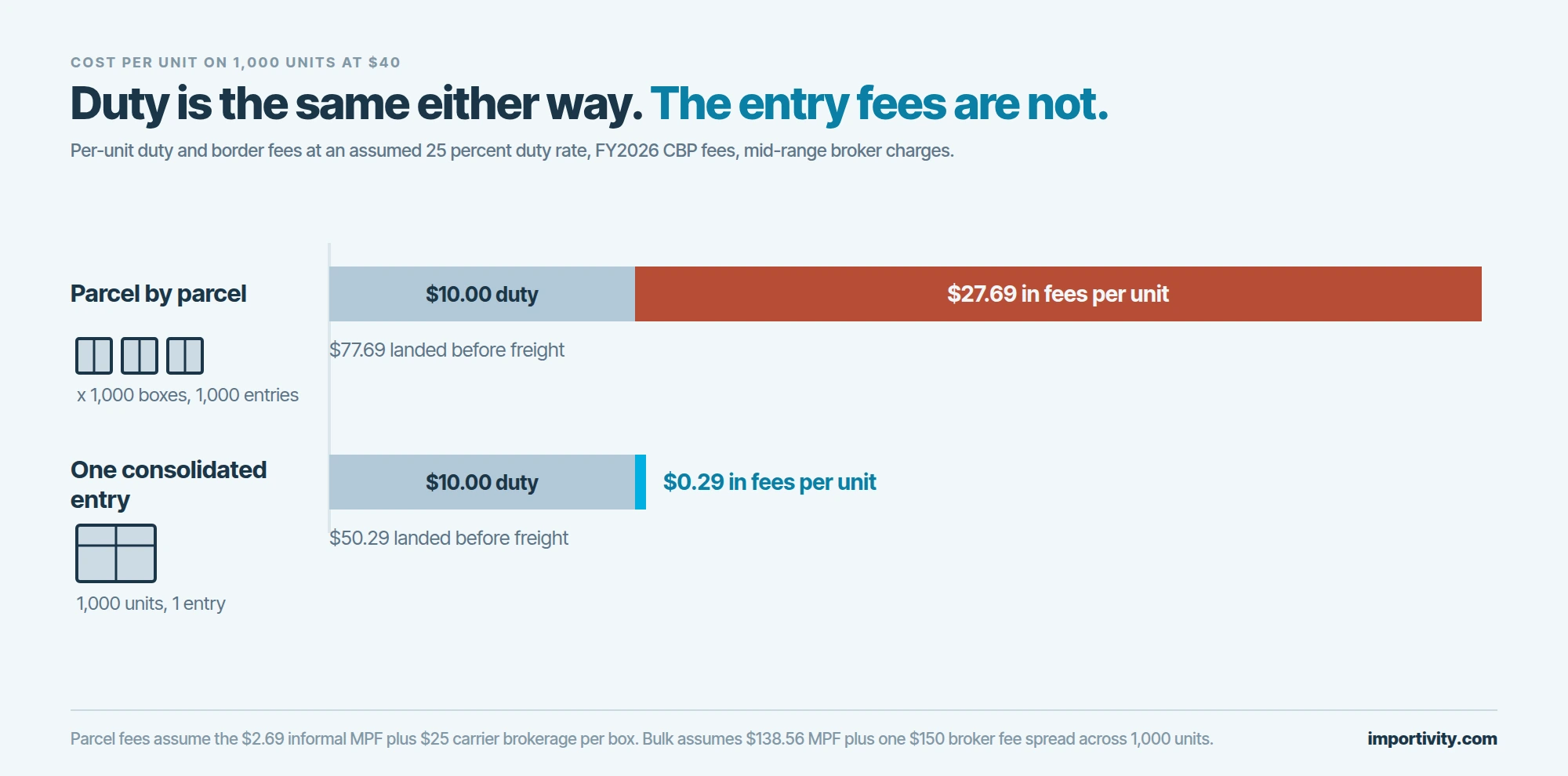
Parcel by parcel, every box pays $10.00 in duty, the $2.69 automated informal entry MPF and the $25 brokerage, so $27.69 of fees on top of $10.00 of duty. Landed before freight, the $40 item becomes $77.69. Consolidated into one entry of $40,000, the duty is the same $10,000, the MPF is 0.3464 percent, $138.56, and the broker charges $150 once. The fees come to $0.29 per unit and the item lands at $50.29 before freight. The duty did not move. The fees fell from $27.69 to $0.29 because there was one entry instead of a thousand.
Freight moves the same way. A thousand parcels flown individually cost far more per unit than a pallet by air or a few cubic meters by ocean, and the ocean route adds a harbor maintenance fee of 0.125 percent that a parcel never paid. Our guide on what a customs broker costs gives current fee ranges by entry type.
| Route | What happens at the border | What it costs on a $40 unit |
|---|---|---|
| Parcel under de minimis (until August 2025) | Manifest or Type 86 release, no duty, no MPF, no bond, no broker | $0 in duty and fees; freight only |
| Parcel by express carrier now | Type 11 informal entry per parcel, duty on full value, $2.69 MPF, carrier brokerage | $10.00 duty plus about $27.69 in fees on the assumptions above |
| Parcel by international mail now | Postal informal entry filed by the owner or a broker, bond required, monthly duty remittance | $10.00 duty, no per-parcel MPF, filing labor or a broker fee per parcel |
| Consolidated formal entry to a US warehouse | One Type 01 entry, continuous bond, 0.3464 percent MPF capped at $651.50, one broker fee | $10.00 duty plus about $0.29 in fees per unit |
Which model replaces the parcel-first one
Every business that relied on de minimis was running one of three models, and each has a plain replacement. None is a workaround; they are the ordinary way commercial goods enter the country, applied to products that used to skip it.
- Direct-from-factory dropshipping. Replace it with a bulk import to a US third-party warehouse, cleared on one entry, with domestic fulfillment from stock. Cash is tied up sooner, and per-unit duty and fees are a fraction of the parcel route.
- Cross-border DTC from a foreign hub. Replace single-order posting with a monthly consolidated shipment sized to sell-through, and decide who the importer of record is. A US entity under its own bond keeps control of classification and duty; a foreign seller can appoint an importer of record service but pays for it on every entry.
- Marketplace sellers on low-value goods. The margin that made a $12 product work was the absence of duty and fees. Re-run the landed cost with duty and one entry's fees per unit. Some products survive at a higher price, some only in bulk, and some should leave the catalog before the next purchase order.
The importers who came through the last year in good shape stopped treating the border as a per-parcel cost and started treating it as a per-entry cost, then put as many units as possible on each entry. Jordan has been re-quoting these models since the China suspension in May 2025, and his sourcing desk now starts every low-value product with the consolidated landed cost rather than the factory quote.
How to re-quote your landed cost this week
You do not need a compliance team. You need the right numbers in the right order, once per SKU, and again whenever the tariff layers change.
- Classify every SKU to ten digits. The HTS code drives the base rate and tells you which Section 301, 232 or other layers apply.
- Add the duty layers in force today. Base rate, any Section 301 list rate for China-origin goods, the July 2026 forced-labor Section 301 rate for the origin, and any Section 232 rate on the material. AD/CVD orders force a formal entry regardless of value.
- Add the entry fees per entry, not per unit. MPF, broker fee, ISF and harbor maintenance fee for ocean, then divide by the units on that entry. Spread a continuous bond across a year of entries.
- Price freight for the consolidated mode. A pallet by air, LCL or FCL by ocean, never parcel rates.
- Decide the importer of record before you book. The entity on the entry owns the compliance and the duty bill. Settle it, bond it and put a customs power of attorney in place with the broker.
- Reprice or drop. Any SKU whose consolidated landed cost still misses your margin floor gets repriced, redesigned or removed, before the purchase order rather than after the goods are on the water.
Frequently Asked Questions
Is the $800 de minimis exemption still available in 2026?
No. Duty-free de minimis treatment was suspended for goods from China and Hong Kong on May 2, 2025 and for all countries on August 29, 2025. In June 2026 CBP codified an indefinite suspension for every mode of transport, and a statute passed in July 2025 repeals the exemption on July 1, 2027. Shipments valued at $800 or less now require an entry and pay all applicable duties, taxes and fees.
Did the Supreme Court ruling on IEEPA tariffs bring de minimis back?
No. The February 20, 2026 decision held that IEEPA does not authorize tariffs, so the IEEPA duties fell, but the de minimis suspension rests on CBP's separate authority under Section 321 and was later codified by regulation. A Court of International Trade case is challenging the suspension, but as of September 2026 the exemption remains off and the 2027 statutory repeal stands behind it.
What entry does a shipment under $800 need now?
By express, air, ocean or truck, a shipment valued at $2,500 or less files an informal entry, Entry Type 11, and anything above that or subject to AD/CVD, quota or a partner government agency files a formal entry, Entry Type 01. By international mail, goods of $2,500 or less can use the new postal informal entry, filed only by the owner or purchaser or a licensed broker, backed by a bond, with duties remitted monthly.
How much does it cost to import a small shipment now that de minimis is gone?
Duty on the full value at the rate for the HTS code and origin, plus a merchandise processing fee of $2.69 for an automated informal entry or 0.3464 percent for a formal entry, plus whatever the carrier or broker charges to file, commonly $50 to $150 for an informal entry and $100 to $250 for a formal one. Those filing costs are per entry, so clearing many units on one entry is far cheaper per unit than clearing each parcel.
What should a dropshipping or cross-border DTC brand do instead?
Consolidate. Import stock in bulk to a US warehouse on one formal entry under a continuous bond, then fulfill domestically. Duty per unit stays the same, but entry fees and freight per unit fall to a fraction of the per-parcel route. Decide who the importer of record will be, classify every SKU to ten digits, and re-run the landed cost before the next purchase order rather than after.
About the author
Jordan Lewis
Chief Operating Officer, Importivity
Runs Importivity's sourcing operations across China, Vietnam, Mexico and India, from supplier negotiation through landed delivery.
Press and media inquiries: press@importivity.com