Bonded Warehouse vs Foreign Trade Zone and Which One Fits Your Imports

A bonded warehouse and a foreign trade zone both let you defer duty until imported goods leave for sale in the United States, and neither charges duty on goods you re-export. The differences sit in the fine print that decides the bill. A bonded warehouse caps storage at five years and charges the rate in effect on the day you withdraw. A foreign trade zone has no time limit, allows assembly and manufacturing, and locks the rate at admission for goods under Section 232 or Section 301 duties. Pick the warehouse for a few SKUs with a re-export share. Pick the zone when volume, processing or a rising rate pays back the setup cost.
This guide is for US importers weighing the two in a year when rates have changed several times. It sits under our broader page on foreign trade zones as a tariff mitigation strategy, which covers the zone program on its own terms. Here the job is the head-to-head decision, with duty drawback as the third route for goods you have already entered.
What each one actually is
A customs bonded warehouse is a building, or part of one, that CBP has approved to hold imported goods under bond before duty is paid. The regulations sort them into eleven classes, and an importer meets three: class 2, a private warehouse for your own goods; class 3, a public warehouse that stores anyone's imports for a fee; and class 8, where goods can be cleaned, sorted, repacked or otherwise changed in condition, but not manufactured. The proprietor posts a bond covering the duty inside, and CBP supervises the premises directly.
A foreign trade zone is a site inside the United States that customs law treats as outside the customs territory for duty purposes. A local grantee, usually a port authority, sponsors the zone, and a company rents space in a general purpose zone or has its own facility designated as a subzone or usage-driven site. Goods are admitted rather than entered, and entry happens only when they leave for the US market. The operator, not CBP, runs daily control under an operator's bond and an inventory system CBP audits.
What differs is how much you can do to the goods, how long they can sit, how the rate is set and what it costs to start. Those four questions are the rest of this article, alongside the wider options on our tariff mitigation strategies page.
Where the duty goes in each
Picture one container arriving at either facility. From there the goods take one of three routes, and the first two cost the same in both instruments.
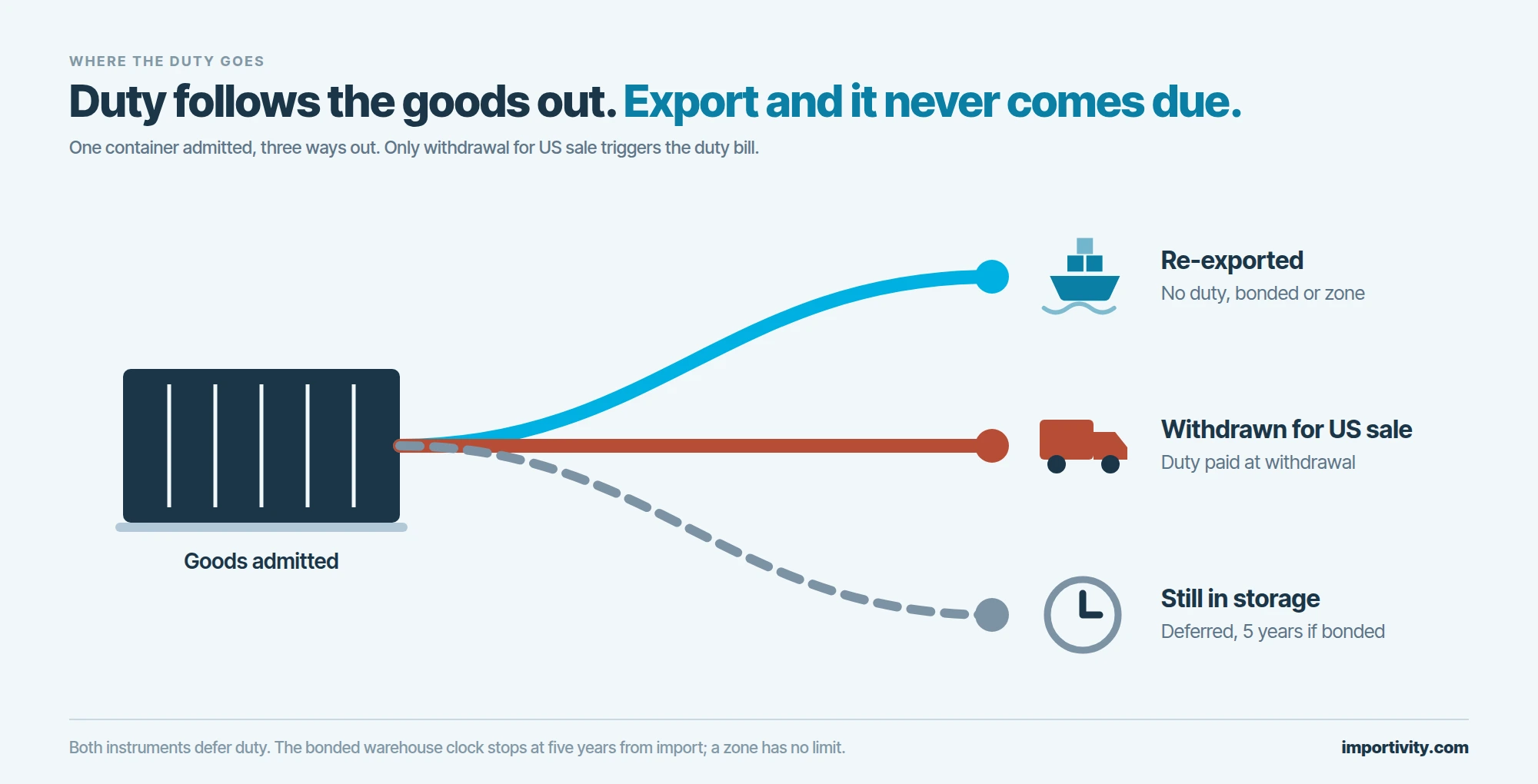
Goods you re-export pay no duty in either instrument, the strongest benefit the two share. An importer serving Canada or Latin America from US stock pays duty only on the share that stays. Goods withdrawn for US sale pay full duty plus the merchandise processing fee. Goods still in storage owe nothing.
The third route is where the two split. In a bonded warehouse the clock is running: merchandise must be withdrawn, exported or destroyed within five years of the import date, and CBP will compel abandonment or destruction of anything left past that point. In a zone there is no statutory limit. Slow-moving spares and goods waiting on a tariff decision can sit as long as the zone stays active and compliant.
The 2026 rate question that decides most cases
Here is the difference most comparisons miss, and this year it is the one that matters: the two instruments set the duty rate at different moments.
A bonded warehouse assesses duty at the rate in effect on the date of withdrawal, not the date of import. That rule sits in the statute on warehouse entries, and it cuts both ways: a rate cut lowers the bill, a rate increase raises it on goods you already own.
A foreign trade zone offers a choice of status at admission. Privileged foreign status fixes the classification and rate on the admission day; non-privileged foreign status takes the rate in effect when the goods finally enter. The choice is not always yours. CBP requires goods subject to Section 232 or Section 301 duties to be admitted in privileged foreign status unless they qualify as domestic, so for those goods the zone locks the rate at admission whether you want it locked or not. Our guide to Section 232 tariffs covers which products sit on that list.
Consider how rates moved in the last year. The Supreme Court ruled on February 20, 2026 that IEEPA does not authorize tariffs. A 10 percent Section 122 surcharge replaced those duties four days later and expired on July 24, 2026, when new Section 301 duties of 10 or 12.5 percent took effect on imports from about 60 economies and lifted the aggregate Section 301 rate on Chinese goods to 37.5 percent. The 178 remaining China Section 301 product exclusions expire on November 9, 2026. Goods in a bonded warehouse across those dates paid the rate of the day each pallet was withdrawn; the same goods in a zone under privileged status kept their admission-day rate throughout.
So the decision is partly a bet on direction. Expect the rate to rise, or an exclusion to lapse, and a zone admission in privileged status before the change protects that inventory. Expect relief, and a bonded warehouse lets the rate float down to meet you. Settle with your broker before admission whether a specific exclusion travels with privileged status; the status cannot be changed once the goods are in.
What you can do to the goods while duty waits
A bonded warehouse is a storage instrument with a short list of permitted manipulations. Under CBP supervision, with a permit on CBP Form 3499, goods can be cleaned, sorted, repacked, relabeled or otherwise changed in condition, and manufacturing is excluded by the regulation itself. A blanket permit can cover a repetitive operation for up to a year, which suits repacking bulk cartons into retail units, but the line is firm: if two imported inputs become a new article, you have left what a class 8 warehouse may do.
A zone is a processing instrument. Goods can be stored, tested, relabeled, kitted, assembled, manufactured and destroyed inside it, with production activity reviewed by the FTZ Board case by case. Destruction matters more than it sounds: returns, damaged units and obsolete stock destroyed under CBP oversight never incur duty, the cleanest answer for a high-return category. Manufacturing also opens the inverted tariff benefit, where a finished product with a lower rate than its components is entered at the finished rate, though Section 232 duties still apply to the covered inputs. If your plan involves touching the product, the zone is usually the only instrument that fits.
Setup cost, time and the compliance load
This is where the bonded warehouse wins. Establishing one means a written application to the port director naming the class and premises, a bond sized to the duty at risk, and CBP's approval of the building. Public class 3 warehouses already exist at every major port, so an importer with a few pallets pays a third party's storage rate and files warehouse entries through a broker. The ongoing burden is an entry per shipment, a permit per manipulation and a records trail CBP can inspect.
A zone has a heavier front end and a lighter back end at volume. Site designation itself is fast: within an approved service area, the FTZ Board can designate a usage-driven site or subzone within about 30 days on a short form. CBP activation is the long pole. The operator needs an operator's bond, a written procedures manual, background checks and an inventory control and recordkeeping system that CBP tests before the first admission, and that stage runs months rather than weeks. After that comes an annual reconciliation and unit-level tracking from admission to entry.
The payback at volume comes from weekly entry.
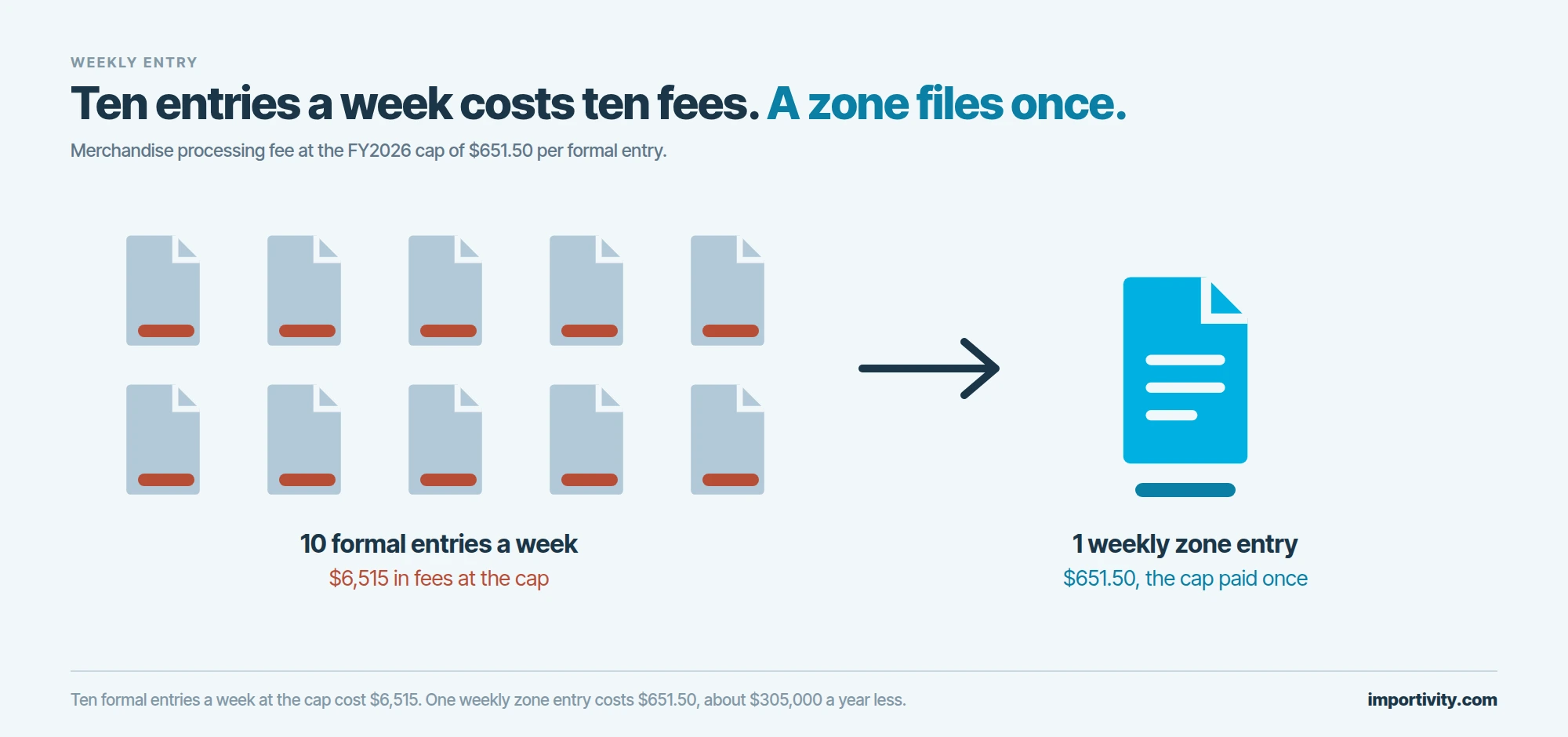
The merchandise processing fee is 0.3464 percent of entered value per formal entry, with a floor of $33.58 and a cap of $651.50 for fiscal year 2026. A zone user files one consolidated entry for a week of withdrawals, so the cap applies once a week rather than once a shipment. An importer clearing ten formal entries a week at the cap pays $6,515 in fees. The same goods on one weekly zone entry cost $651.50, about $305,000 a year less before any duty saving. Below a few entries a week the fee gain is small, and the fixed compliance cost of a zone is about the same whether you run $2 million or $200 million through it, which is why the zone is a volume decision. Both instruments also need a continuous customs bond, covered in our guide to customs bonds.
Which one fits, with drawback as the third option
Duty drawback is the route for goods you have already entered and paid on. If those goods, or products made from them, are later exported or destroyed, you can claim up to 99 percent of the duties, taxes and fees back, with five years from the import date to file. You pay first and recover later, and one exclusion matters: Section 232 duties are not eligible for drawback, while Section 301 duties are. The mechanics are on our duty drawback page.
| Route | Duty timing and limit | Best for |
|---|---|---|
| Bonded warehouse | Deferred to withdrawal, rate set on the withdrawal date, five year limit | A few SKUs, a re-export share, no processing, a start within weeks |
| Foreign trade zone | Deferred to entry, rate locked at admission for 232 and 301 goods, no time limit | High volume, assembly or kitting, returns destruction, weekly entry |
| Duty drawback | Paid at import, up to 99 percent refunded on export or destruction, five years to claim | Goods already entered, exporters with clean records, no Section 232 duty |
- Choose a bonded warehouse when part of the shipment will be re-exported, entries are few, nothing needs assembly, the goods turn inside five years, and you expect rates to fall or hold.
- Choose a foreign trade zone when entries arrive most days, you kit or manufacture, returns are high, your Section 232 or 301 exposure is likely to rise, or inventory sits longer than five years.
- Choose drawback when the duty is already paid, the goods leave the country, your records tie each export to an import, and the duty is not Section 232.
How to decide this month
- Pull twelve months of entries. Count them, total the merchandise processing fees, and split the duty by program: general rate, Section 232 and each Section 301 layer.
- Split the goods by destination. What stayed in the United States, what was re-exported, and what was returned or destroyed. The last two are the duty either instrument would have avoided, and our landed cost guide shows what deferring the rest is worth.
- Read the rate direction for your HTS codes. An exclusion expiring on November 9, 2026 argues for locking the rate in a zone before then. Likely relief argues for letting it float in a bonded warehouse.
- Price both routes and check the bond. A public bonded storage quote plus your broker's warehouse entry fee, against the grantee fee, operator setup, inventory system and months of activation. A continuous bond sized for last year's duty may be short for this year's.
If the answer keeps coming back to where the goods come from rather than where they wait, that is a sourcing decision, one Jordan works through with importers before a container is booked, from Austin, Guangzhou and Ho Chi Minh City. Moving a product line off a rising rate often beats storing it in the hope the rate falls.
Frequently Asked Questions
Is a bonded warehouse cheaper than a foreign trade zone?
For a small program, yes. Public bonded warehouses exist at every major port, so an importer with a few pallets pays a third party's storage rate and files warehouse entries through a broker. A zone carries a grantee fee, an operator's bond, an inventory control system and an activation that runs months, so it is cheaper only once volume, weekly entry or processing spreads that fixed cost over enough goods.
How long can goods stay in a bonded warehouse compared with an FTZ?
Merchandise in a bonded warehouse must be withdrawn, exported or destroyed within five years of the import date, and CBP will compel abandonment or destruction of anything left past that point. A foreign trade zone has no statutory time limit, so goods can remain as long as the zone stays active and the records stay in order, which is why slow-moving stock favors the zone.
Do I still pay Section 301 or Section 232 tariffs in a foreign trade zone?
Yes, when the goods enter the US market. CBP requires goods subject to Section 232 or Section 301 duties to be admitted in privileged foreign status, which fixes the classification and rate on the day of admission. Duty is deferred until entry and never charged on goods re-exported from the zone, but manufacturing inside the zone does not remove Section 232 duty from covered inputs, and no drawback is available on those duties.
Can I manufacture in a bonded warehouse?
No. The regulation allows goods in a class 8 bonded warehouse to be cleaned, sorted, repacked or otherwise changed in condition under a CBP permit, and excludes manufacturing in the same sentence. Relabeling bulk cartons into retail units is fine, while turning two imported inputs into a new article is not. Assembly, kitting, manufacturing and duty-free destruction belong to a foreign trade zone.
What happens to the duty rate if tariffs change while my goods are stored?
It depends on the instrument. A bonded warehouse assesses duty at the rate in effect on the withdrawal date, so a rate cut lowers your bill and an increase raises it on goods you already own. Goods admitted to a zone in privileged foreign status keep the admission-day rate through any later change, and that status is mandatory for Section 232 and Section 301 goods. In a year like 2026, that rule is often the whole decision.
About the author
Jordan Lewis
Chief Operating Officer, Importivity
Runs Importivity's sourcing operations across China, Vietnam, Mexico and India, from supplier negotiation through landed delivery.
Press and media inquiries: press@importivity.com