
How to Write a Manufacturing RFQ That Gets Better Quotes

A manufacturing RFQ, or request for quotation, is a document you send to suppliers asking each one to price the exact product you want made, built to your written specification. You use it when the design is already settled and you need comparable numbers, not ideas. Done well, it turns a vague back and forth into a clean set of quotes you can line up side by side and actually trust.
This guide explains what belongs in a strong RFQ, how it differs from an RFP and an RFI, and how to score the quotes that come back. It includes a free fill in template you can copy, plus a simple scorecard for comparing suppliers on more than price alone. It reflects how we run product sourcing for clients, where a tight RFQ is the difference between three usable quotes and three that cannot be compared.
Which document?
RFQ, RFP, or RFI: which should you send?
Match your stage to the right document:
What Is a Manufacturing RFQ?
A request for quotation is a formal ask: here is exactly what I want made, tell me your price to make it. Because the specification is fixed, every supplier quotes against the same target, and the numbers come back apples to apples. That comparability is the whole point. If one factory quotes a different material or a different quantity, its price means nothing next to the others.
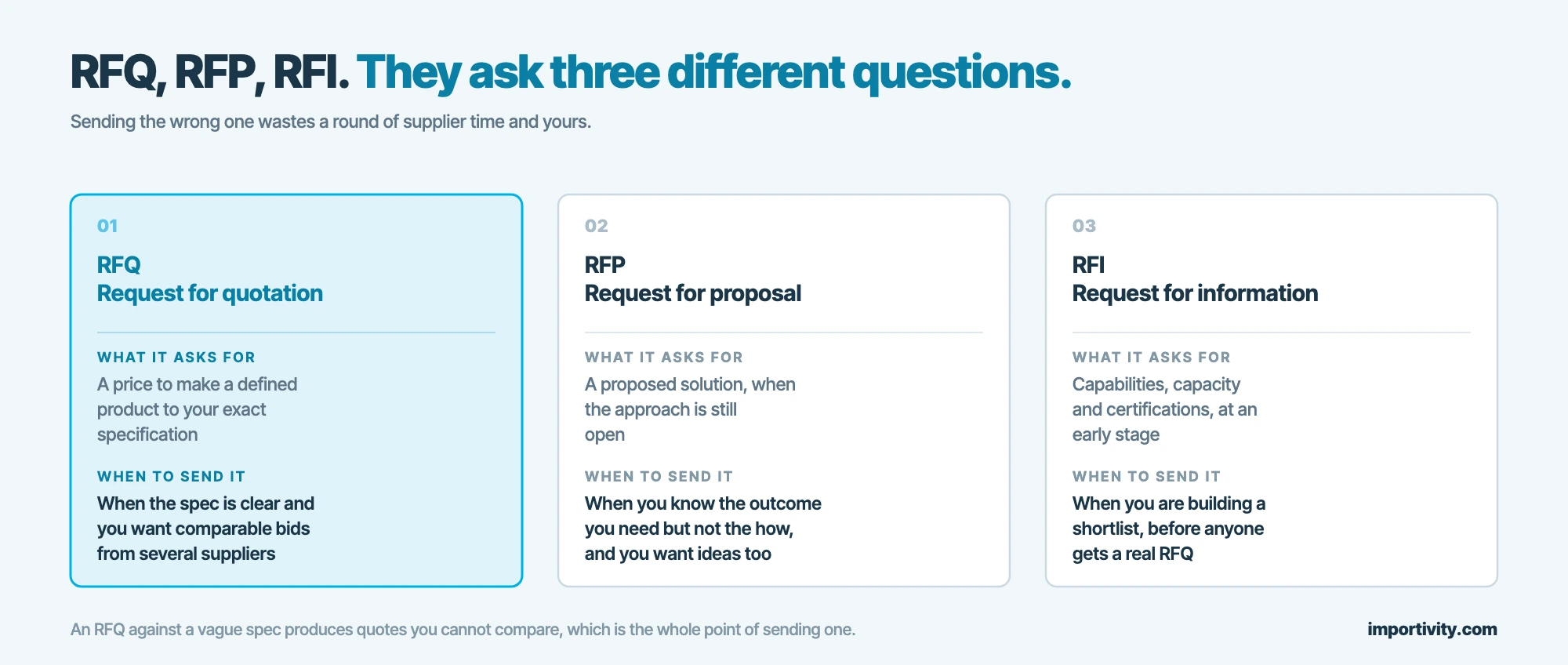
An RFQ is one of three sourcing documents, and mixing them up costs you weeks. The right one depends on how much you already know about what you want built.
- RFQ (request for quotation). Asks for a price to make a defined product to your exact specification. Use it when the spec is clear and you want comparable bids from several suppliers.
- RFP (request for proposal). Asks suppliers to propose a solution when the approach is still open. Use it when you know the outcome you need but not the how, and you want ideas as well as pricing.
- RFI (request for information). An early stage query to learn about a supplier's capabilities, capacity, and certifications. Use it to build a shortlist before you send anyone a real RFQ.
The rule of thumb is simple: send an RFI to learn, an RFP to explore an approach, and an RFQ to price a finished spec. This article is about the last one, because that is where most sourcing dollars are actually won or lost.
What to Include in a Manufacturing RFQ
A strong RFQ removes ambiguity so quotes come back comparable and complete. Every field below closes a gap a supplier would otherwise fill with an assumption, and every assumption is a hidden price difference. Treat this as a checklist and do not skip fields to save time.
- Company and contact. Who you are and who to reply to, so quotes route back cleanly.
- Product name and description. A one line name plus a short plain description of what the item is and does.
- Drawings and BOM reference. Attach dimensioned drawings and a bill of materials so the factory prices your parts, not its guesses.
- Materials, specs, and tolerances. Exact grades, finishes, and the tolerances that matter, because loose tolerances and tight ones price very differently.
- Quantity tiers. Ask for pricing at several volumes so you can see the price breaks before you commit.
- Quality standard. State your acceptable quality limit, such as AQL 2.5, so defect expectations are on the table upfront.
- Packaging. Inner pack, master carton, labeling, and any retail requirements.
- Target price. Share the number you are aiming for, so suppliers self select and tell you what is realistic.
- Incoterm. Specify the trade term, such as FOB or DDP, so every quote covers the same scope of freight and duty.
- Required delivery date. The date you need goods in hand, which drives lead time and any expedite cost.
- Payment terms. Your proposed deposit and balance structure, tied to milestones.
- Certifications required. Any compliance you cannot ship without, such as CE, RoHS, FDA, or a factory audit standard.
Free RFQ Template
Prefer a ready-to-use file over building your own from scratch? Download our free manufacturing RFQ template, then use the field guide below to fill it in.
Copy the table below into a document or spreadsheet and fill the middle and right columns for your product. The example column shows the level of detail suppliers need to quote accurately on the first pass. Fill every row, then send the same completed version to each factory on your list.
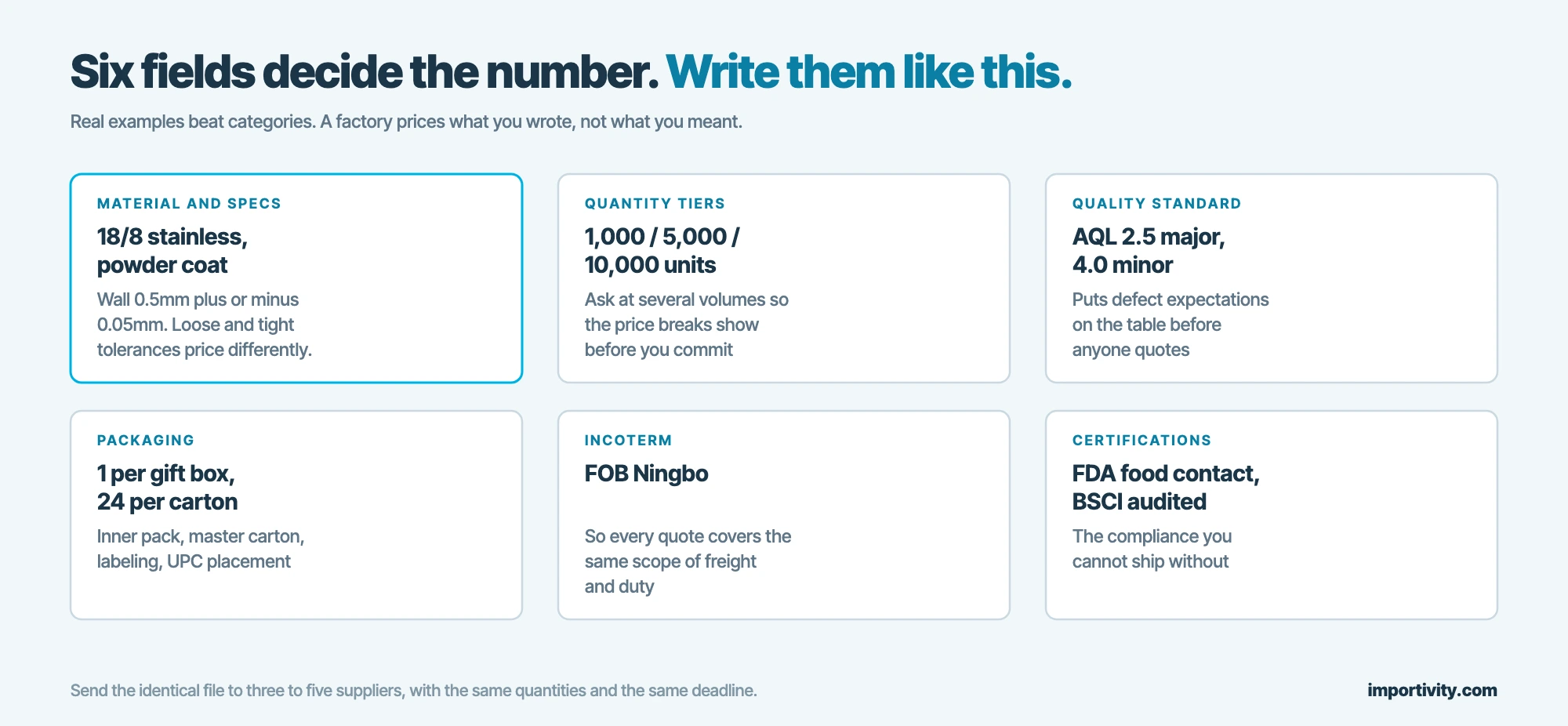
| Field | What to include | Example |
|---|---|---|
| Company & contact | Your business, name, email, and phone for the quote | Acme Goods, Jordan Lee, jordan@acmegoods.com |
| Product name / description | Short name plus one line on what it is | Insulated 20oz steel tumbler with press fit lid |
| Drawings & BOM reference | Attached drawing and bill of materials file names | tumbler_rev_C.pdf, BOM_v2.xlsx |
| Material & specs | Grades, finishes, and critical tolerances | 18/8 stainless, powder coat, wall 0.5mm plus or minus 0.05mm |
| Quantity tiers | Volumes you want priced, to reveal breaks | 1,000 / 5,000 / 10,000 units |
| Quality standard (AQL) | Acceptable quality limit for inspection | AQL 2.5 major, 4.0 minor |
| Packaging | Inner, master carton, and labeling | 1 per gift box, 24 per carton, UPC on box |
| Target price | Your goal unit price | 4.20 USD per unit at 5,000 |
| Incoterm | Trade term defining freight and duty scope | FOB Ningbo |
| Required delivery date | Date goods must be ready or delivered | Ready to ship by 15 Oct |
| Payment terms | Deposit and balance structure | 30% deposit, 70% before shipment |
| Certifications required | Compliance you cannot ship without | FDA food contact, BSCI audited factory |
Sending Your RFQ to Multiple Suppliers
Send the identical RFQ to at least three to five suppliers. One quote gives you no leverage and no benchmark, and more than about six turns comparison into a chore. Use the same file, the same quantities, and the same deadline for everyone, because the moment you tweak the spec between suppliers you lose the apples to apples comparison you built the RFQ to create.
Give each supplier a firm reply window, usually five to seven business days, and ask them to flag any spec they cannot meet rather than silently substituting a cheaper option. Vet the factories in parallel while you wait: run a factory audit checklist against each one, and start a lightweight supplier onboarding checklist for the two or three you like most, so a strong quote is not held up later by missing paperwork.
Keep every RFQ in one tracker with the send date, the quantity tiers requested, and the reply due date. A shared sheet beats a scattered inbox, and it makes the next step, comparison, far faster.
How to Compare the Quotes You Get Back
Never compare raw factory prices. Normalize every quote to landed cost first, so freight, duty, and any inspection sit inside the number you are weighing. A quote that looks cheapest at the factory gate often lands more expensive once an EXW term shifts freight onto you. Run each quote through a full landed cost calculation before you rank anything.
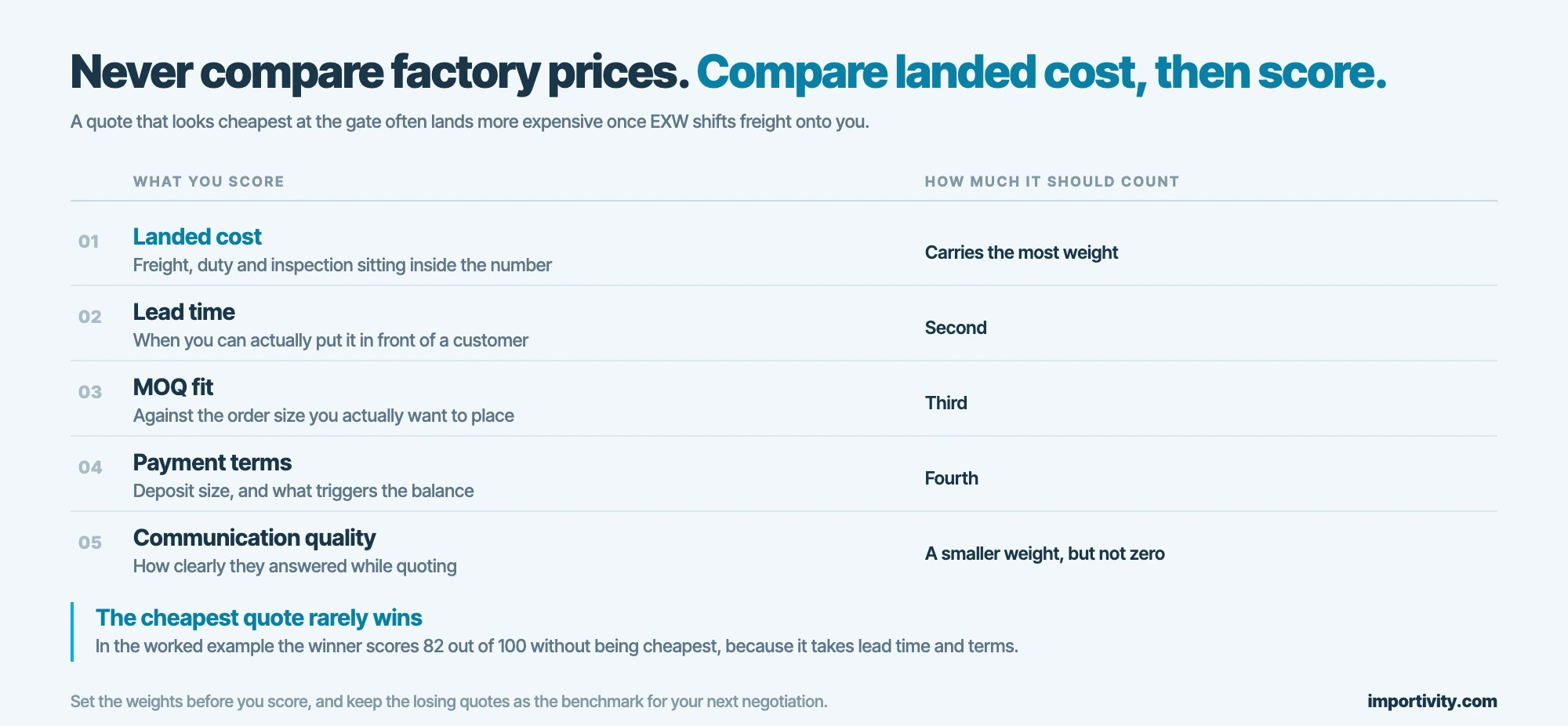
Then score on more than price. The best supplier is rarely the cheapest one. Weigh price, lead time, minimum order quantity, communication quality, and payment terms together, and let the total tell you where to place your first order. The scorecard below shows three sample quotes scored out of 100 on that weighted basis.
How the score is built: landed price carries the most weight, then lead time, then MOQ fit against your order size, then payment terms, with a smaller weight for how clearly the supplier communicated during quoting. Supplier A here is not the cheapest, but wins on lead time and terms, which is why it edges out the field. Set the weights to match your priorities before you score.
Once you pick a winner, keep the losing quotes on file. They are your benchmark for the next negotiation and your backup if your first choice stumbles on the first order. If you would rather hand the whole loop to a partner, our product sourcing team runs RFQs, vetting, and quote comparison end to end.
For a worked example running from a drawing to a first article, see our 420seven prototyping case study, and Source With Jordan for the sourcing behind it.
Frequently Asked Questions
What is a manufacturing RFQ?
A manufacturing RFQ, or request for quotation, is a document you send to suppliers asking each one to price a defined product built to your exact specification. You use it when the design is already settled and you want quotes you can compare apples to apples. A strong RFQ includes drawings, a bill of materials, materials and tolerances, quantity tiers, quality standard, packaging, target price, Incoterm, delivery date, payment terms, and any required certifications.
What is the difference between an RFQ, an RFP, and an RFI?
An RFQ asks for a price to make a defined product to your exact specification, and you use it when the spec is already clear. An RFP asks suppliers to propose a solution when the approach is still open, so you get ideas as well as pricing. An RFI is an early stage query to learn about a supplier's capabilities and certifications before you shortlist. The rule of thumb is RFI to learn, RFP to explore, and RFQ to price a finished spec.
How many suppliers should I send an RFQ to?
Send the identical RFQ to at least three to five suppliers. One quote gives you no benchmark, and more than about six makes comparison a chore. Use the same file, the same quantity tiers, and the same reply deadline for everyone, because changing the spec between suppliers destroys the apples to apples comparison the RFQ is meant to create.
What information do I need before I can send an RFQ?
You need a settled specification: dimensioned drawings, a bill of materials, exact materials and tolerances, the quantities you want priced, a quality standard such as an AQL level, packaging requirements, a target price, an Incoterm, a required delivery date, proposed payment terms, and any certifications you cannot ship without. If any of these are still undecided, use an RFI or an RFP first, then send the RFQ once the spec is locked.
How do I compare quotes that come back at different prices?
Normalize every quote to landed cost first, so freight, duty, and inspection sit inside the number, then score on more than price. Weigh landed price, lead time, minimum order quantity, communication quality, and payment terms together and let the weighted total rank the suppliers. The cheapest factory gate price often lands more expensive once the Incoterm shifts freight onto you, so the lowest quote is not always the best deal.
About the author
Jordan Lewis
Chief Operating Officer, Importivity
Runs Importivity's sourcing operations across China, Vietnam, Mexico and India, from supplier negotiation through landed delivery.
Press and media inquiries: press@importivity.com