What a Manufacturing Purchase Order Must Include (With Checklist)
A manufacturing purchase order is your written offer to buy a defined product from a factory, and once the factory signs and stamps it, it becomes the contract you will rely on when something goes wrong. To protect you, it must name the drawing revision and golden sample, the inspection standard and AQL, packaging and labels, the Incoterm, a payment schedule tied to milestones, the ship date with a late penalty, how changes get approved, and who owns the designs and tooling.
This guide is for US brands placing production orders with factories in China, Vietnam, Mexico or India after the quoting stage. A manufacturing RFQ gets you prices you can compare; the PO turns the winning quote into terms the factory has agreed to. It covers where the PO sits among the other trade documents, what each clause should say and why, and a checklist to run before you send one.
Why the PO, not the proforma invoice, should be the contract
In many factory relationships the buyer sends a PO, the factory replies with its own proforma invoice, and the buyer pays the deposit against the proforma. If the two documents disagree, the one you paid against may be the one that counts. Both the United States and China have been parties to the UN Convention on Contracts for the International Sale of Goods (CISG) since 1 January 1988, according to the UNCITRAL status table. It applies to sales between businesses in two member countries unless the contract excludes it, and Article 3 says an order for goods to be manufactured counts as a sale unless the buyer supplies a substantial part of the materials.
Two of its rules matter most for a PO. Under CISG Article 19, a reply that claims to accept your order but changes the price, payment, quality, quantity, delivery place or date, liability or dispute terms is a rejection and a counter-offer. Under Article 18, conduct that shows assent counts as acceptance. So if the proforma moves your ship date back three weeks and you pay the deposit anyway, you have probably accepted the later date. Mexico and Vietnam are also CISG members. India is not, so the governing law clause carries more weight in an Indian contract.
China's Civil Code adds a formation rule: under Article 490, a written contract is formed when both parties sign, stamp or fingerprint it, and if one side performs its main obligation before signing and the other accepts it, the contract is formed when that performance is accepted. In practice, get the PO countersigned and stamped with the factory's company chop before any money moves. Our guide to the NNN agreement explains how to check that a chop belongs to the company you think you are dealing with.
| Document | Who issues it | What it commits the parties to |
|---|---|---|
| RFQ | You | Nothing. It asks for prices on a defined spec |
| Quotation | The factory | An offer on the factory's terms, usually valid for a limited time |
| Purchase order | You | Your offer. Once signed and stamped by the factory, the contract for this order |
| Proforma invoice | The factory | A request for payment. If its terms differ from the PO, paying it can accept those terms |
| Commercial invoice | The factory | The record of the sale that US Customs uses at entry. It should match the PO and the goods |
The fix is simple. Ask the factory to put your PO number on the proforma and to state that the PO terms govern. If the proforma changes anything material, issue a revised PO and get it stamped before you pay. Our guide to proforma vs commercial invoices covers what each document has to show for customs.
Spell out exactly what the factory must build
The PO itself can be short if it points to the right documents. Cite each document by number and revision, not by name. A PO that says "per latest drawing" lets the factory decide which drawing that is, and the inspector has nothing fixed to check against.
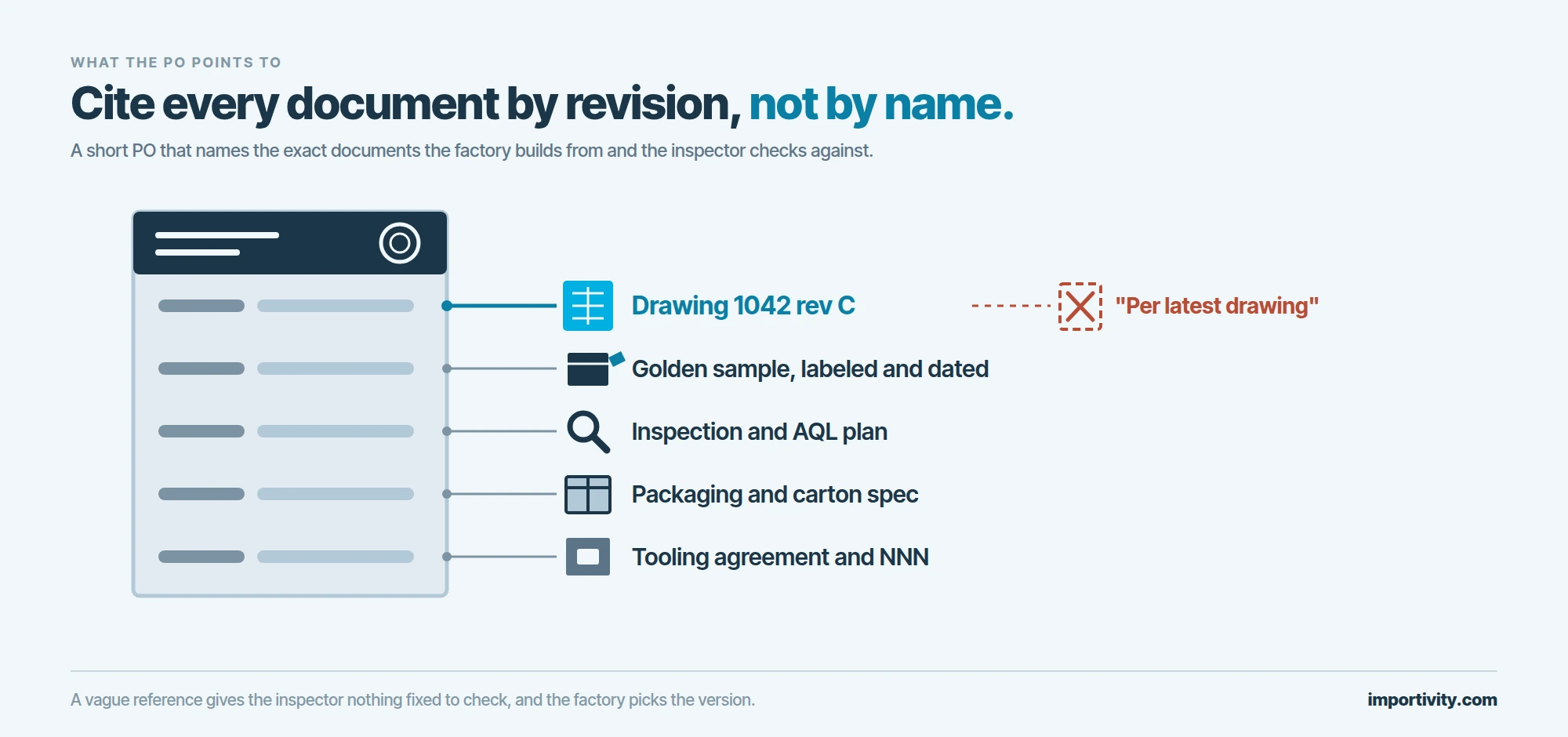
- Product and drawing. Your part number, a plain description, materials, color references and finish, and the drawing by number and revision, for example "drawing 1042 rev C". Attach the bill of materials if the factory buys components for you.
- Golden sample. Name the approved pre-production sample by its label and approval date, and say that production must match it. CISG Article 35 already requires goods to match a sample the seller held out; naming yours removes any doubt about which one. Our pre-production sample guide covers how to label and store it.
- Quantity and tolerance. The order quantity per SKU, how far over or under the factory may ship, and how overs and shortfalls are priced.
- Inspection and AQL plan. Who inspects, at what stage, to which standard and AQL levels, and what a failure triggers. The exact clause wording is in our AQL sampling guide, and the timing and report are covered in our pre-shipment inspection guide.
- Packaging and carton spec. Inner pack, master carton, carton marks, barcodes and country of origin marking, by document number. Carton marks and barcodes are hard to correct once goods have shipped, so they belong in the PO, not in a later email.
- Compliance. The US standards the product must meet and the test reports you need before shipment, from a lab you approve.
Price, Incoterm and the ship date
State the unit price, the currency and what the price includes, such as packing and any tooling charge recovered per unit. Name the Incoterm with its place and edition, for example "FOB Shenzhen, Incoterms 2020", because the term decides where your cost and risk begin. Our Incoterms guide covers which term puts which cost where. On a DDP order the factory pays the US duty, and US duty rates have changed several times in 2026. Say in the PO whether the price is fixed if a rate changes between the order and the entry, or how a change is shared.
Then define the date. "Ship date" can mean the day goods are ready at the factory, the day they leave it, or the day they are loaded on the vessel. Pick one and tie it to the Incoterm. Make the date depend on your own approvals too: if you approve the pre-production sample five days later than the PO schedule allows, the ship date moves by five days. That is fair to the factory and removes an easy excuse for a late order.
Add a penalty for late shipment as a set amount or percentage of the order value for each week late, with a cap, plus your right to cancel and recover the deposit after a stated date. Article 585 of China's Civil Code lets parties agree liquidated damages, and lets a court raise the figure if it is lower than the loss or reduce it if it is excessively higher. It also says a party that pays damages for delay must still perform. Base the figure on a cost you can show, such as an air freight upgrade or a missed retail date, so a court has less reason to reduce it.
Tie every payment to a milestone you can check
A payment schedule protects you when each payment is released by an event you can verify, not by a date on the calendar. A common structure is a deposit with the stamped PO and the balance after the goods pass inspection, for example 30 percent and 70 percent. The percentages are negotiable. The milestones should not be.
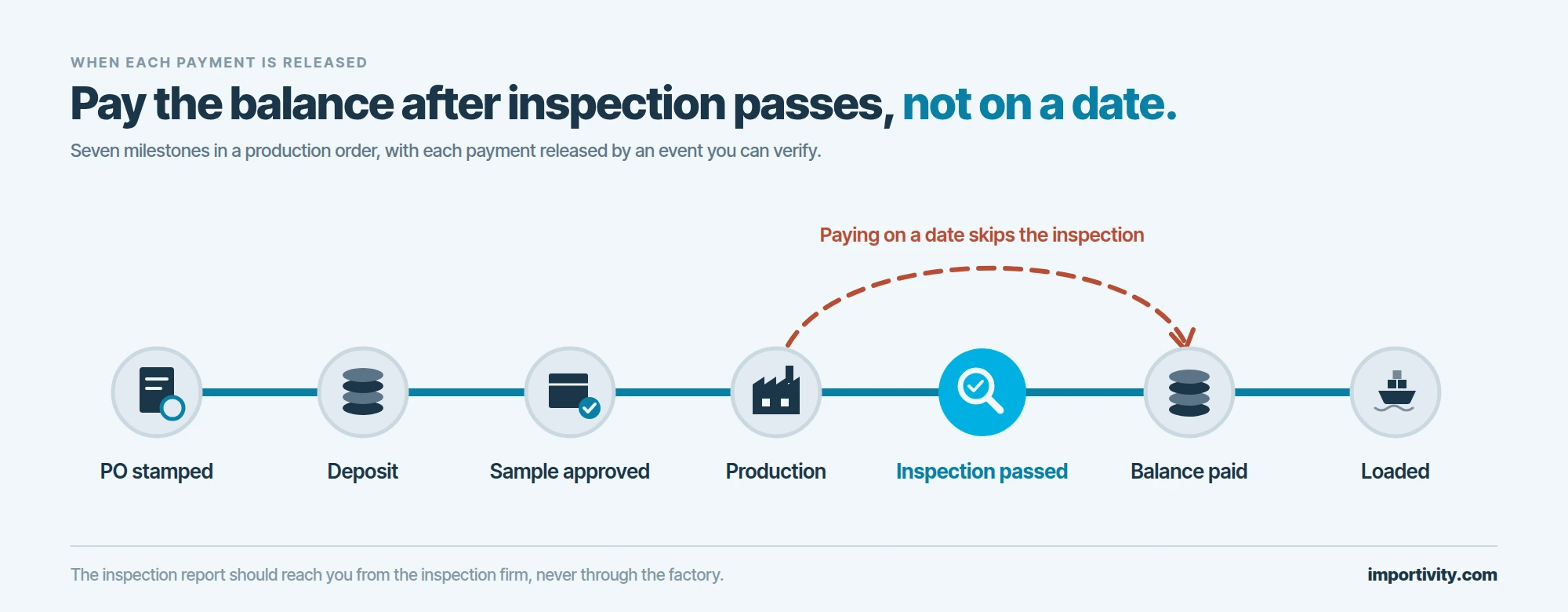
Write the balance condition as a document: a passing inspection report sent to you directly by the inspection firm, never through the factory. For FOB orders, pay the balance after inspection and before loading. If the factory insists on payment against a copy of the bill of lading, the inspection still comes first. Our quality control team books and runs these inspections.
Name the bank account in the PO, in the factory's registered company name, and state that any change to bank details must be confirmed by a phone call to a number already on file. Payment terms themselves, including net terms for established buyers, are covered in our guide to negotiating payment terms with your supplier.
Changes, IP and tooling
Orders change. The PO should say how. Under CISG Article 29, a written contract that requires changes to be made in writing cannot be changed any other way, although a party's conduct can still prevent it from relying on that clause. Use it: state that changes are valid only through a numbered change order signed by both sides, and that each change order shows what changes, the price effect and the new ship date. A chat message that says "ok" is not a change order. The same clause should require your written approval before the factory substitutes a material or a component supplier, or moves any production to another facility.
Then cover ownership. The PO should say that your drawings, designs and specifications belong to you, that the factory may not make or sell the product or close copies for anyone else, and that any molds you paid for are held under your tooling agreement. Our guide to tooling and mold ownership lists what that agreement needs. If an NNN agreement is already signed, reference it by date so the PO and the NNN read as one set of terms. The language, governing law and court clauses should follow the same logic as the NNN: a Chinese version that governs, and a court where the factory and its assets are.
Finally, set a claim window. CISG Article 38 requires the buyer to examine the goods as soon as is practicable, and Article 39 says the buyer loses a claim for nonconforming goods if it does not notify the seller within a reasonable time after it found or should have found the problem, with an outside limit of two years. Replace "reasonable" with a number of days after arrival, and state the remedy: replacement, credit or refund.
Purchase order checklist
Run this list before you send a PO, and again when the factory's proforma comes back.
- Parties. The factory's registered legal name and address, matching its business license, and your company as buyer.
- PO number and date, referenced on the proforma, the commercial invoice and the cartons.
- Product, drawing and revision for each SKU, plus the bill of materials where relevant.
- Golden sample by label and approval date.
- Quantity per SKU and the allowed over or under shipment.
- Unit price, currency and Incoterm with its named place and edition.
- Inspection and AQL plan, who books it, and what a failure triggers.
- Packaging and carton spec by document number.
- Compliance standards and test reports required before shipment.
- Ship date definition, the date itself, and how late approvals move it.
- Late penalty, its cap, and your cancellation right.
- Payment milestones and the factory's bank account in its own name.
- Change order rule: written, numbered, signed by both.
- IP, tooling and no-subcontracting clauses, with references to the NNN and tooling agreement.
- Claim window and remedy for defects found after arrival.
- Language and governing law, with the factory's signature and company chop.
Frequently Asked Questions
What is a manufacturing purchase order?
It is the buyer's written offer to buy a defined product from a factory at a set price, quantity, quality and date. Once the factory signs it and stamps it with its company chop, it is the contract for that order. A good one references the drawing revision, golden sample, inspection plan and packaging spec by document number instead of repeating them.
Is a purchase order legally binding with a Chinese factory?
Yes, once the factory accepts it. China's Civil Code forms a written contract when both parties sign or stamp it, and the UN sales convention (CISG), which covers sales between US and Chinese businesses unless the contract excludes it, treats conduct that shows assent as acceptance. Get the PO countersigned and stamped before you pay the deposit.
What if the factory's proforma invoice has different terms from my PO?
Under CISG Article 19, a reply that changes price, payment, quality, quantity, delivery or dispute terms is a counter-offer, and paying against it can count as accepting it. Ask the factory to put your PO number on the proforma and state that the PO governs, or issue a revised PO and have it stamped before you pay.
How should payment terms be written in a purchase order?
Tie each payment to an event you can verify. A common structure is a deposit with the stamped PO and the balance only after a passing inspection report arrives directly from the inspection firm. Name the factory's bank account in its registered company name and require phone confirmation of any change to bank details.
Should a purchase order include a late delivery penalty?
Yes. Set an amount per week of delay with a cap, define which ship date counts, and keep the right to cancel after a stated date. Article 585 of China's Civil Code lets a court adjust agreed damages that are far above or below the real loss, so base the figure on costs you can show, such as an air freight upgrade.
About the author
Jordan Lewis
Chief Operating Officer, Importivity
Runs Importivity's sourcing operations across China, Vietnam, Mexico and India, from supplier negotiation through landed delivery.
Press and media inquiries: press@importivity.com