Mold Ownership Agreements and Who Owns the Tooling You Paid For
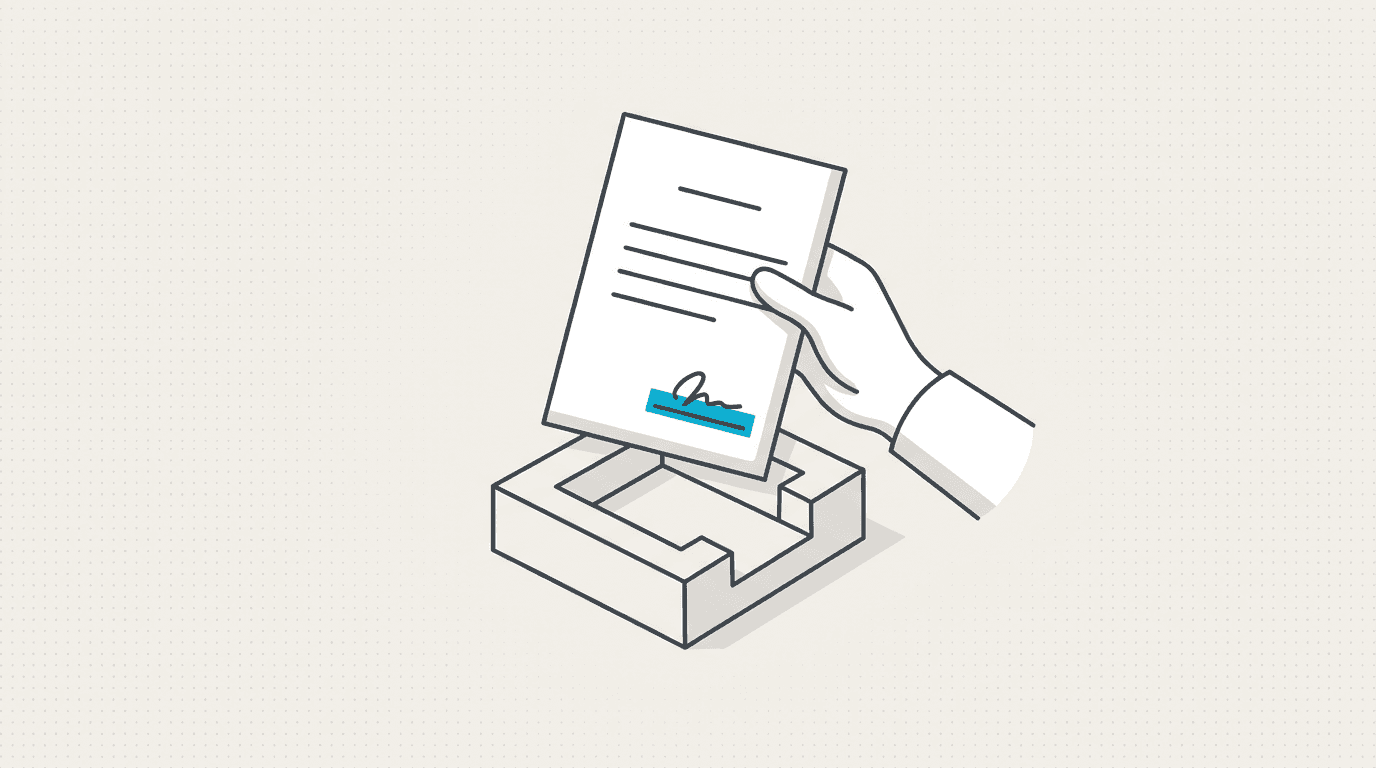
You own a mold you paid for in China only when a signed mold ownership agreement says the factory holds it on your behalf, because the factory has the mold and Chinese law lets a factory that is owed money keep it. The agreement has to list each tool, mark it as yours, rule out any lien or use for other buyers, and set the terms for releasing it when you ask.
This guide is for US brands paying for injection molds, die-casting dies or stamping tools at an overseas factory. It covers what the law does when nothing is written down, how paid and amortized tooling differ, the clauses to put in the agreement, how tooling affects your customs value, and how to move a mold to a new factory. For what molds cost and how steel and cavity count change the price, start with our guide to plastic injection molding sourcing.
Why paying for a mold is not the same as owning it
Four articles of China's Civil Code explain most mold disputes. Ownership of movable property passes on delivery unless the law says otherwise (Article 224), and a mold you paid for is never delivered to you: it stays in the factory's press. A creditor may keep a debtor's movable property that is already in its lawful possession when the debt is due (Article 447). Between two companies, the property held does not have to relate to the debt (Article 448). And under the contract for the mold work itself, a factory that has not been paid may keep the finished work or refuse to hand it over unless the parties agreed otherwise (Article 783).
Put those together and the risk is plain. If your company owes the factory for a late production invoice, the factory has a legal basis to hold the mold you paid for in full. The same code also gives you the fix. Article 228 says that when the parties agree the party transferring an item keeps possession of it, ownership passes when that agreement takes effect, which is exactly the case of a mold that never leaves the factory. Article 449 says property that the parties agree may not be held under a lien cannot be held. Article 784 makes the factory liable for loss or damage to work it keeps for you through poor care. You can read the official English text on the State Council website, and a China-qualified lawyer should review your final draft.
None of this helps unless it is written down. A quotation line that says "mold fee" proves you paid. It does not say what you bought, who holds it, or when you can take it. The governing language, governing law and company chop rules that make any China contract enforceable are covered in our guide to the NNN agreement, and a mold agreement needs the same treatment.
Paid, amortized and factory-owned tooling
How you pay for tooling decides what you can claim later. Quotes often mix these arrangements without naming them, so ask which one you are being offered before you pay anything.
| How the tooling is paid | Who owns it if nothing is written | What to write down |
|---|---|---|
| Paid up front by you | Unclear. The invoice proves payment, not ownership, and the mold never leaves the factory | You own each listed tool from the final tooling payment, the factory holds it for you, no lien |
| Amortized into the unit price | The factory, at least until the agreed quantity has shipped | The quantity after which ownership passes, and a buyout figure for the unrecovered balance if you leave early |
| Fee refunded after a volume target | Unclear. You paid, but a refund promise says nothing about who holds title | That the refund does not change ownership, and what happens to it if you leave before the target |
| The factory's own mold (catalog or ODM product) | The factory. You are buying its product | Exclusivity for any change made to your design, such as a logo insert or a new color |
| Your insert in the factory's mold base | Split, and easy to dispute | Each insert listed by number as your property, and how it will be removed and handed over |
Amortized tooling is a reasonable deal for a new product. It lowers your cash outlay and keeps the factory invested in your reorders. The cost is control: until the tooling is paid off, moving production means paying the rest first. Put the starting tooling figure and the amount recovered per unit in the agreement, and ask for the per-unit tooling charge to appear as its own line on every invoice. Then the remaining balance is a calculation, not an argument. If you are signing an exclusive supply deal at the same time, our list of questions to ask before an exclusive manufacturing agreement covers the commercial side.
What the mold ownership agreement must say
A tooling agreement can be two pages. Make it a separate document or a schedule to your supply agreement, signed and stamped with the factory's company chop, with a Chinese version that governs. Most of its clauses point at something you or an inspector can check on the mold itself.
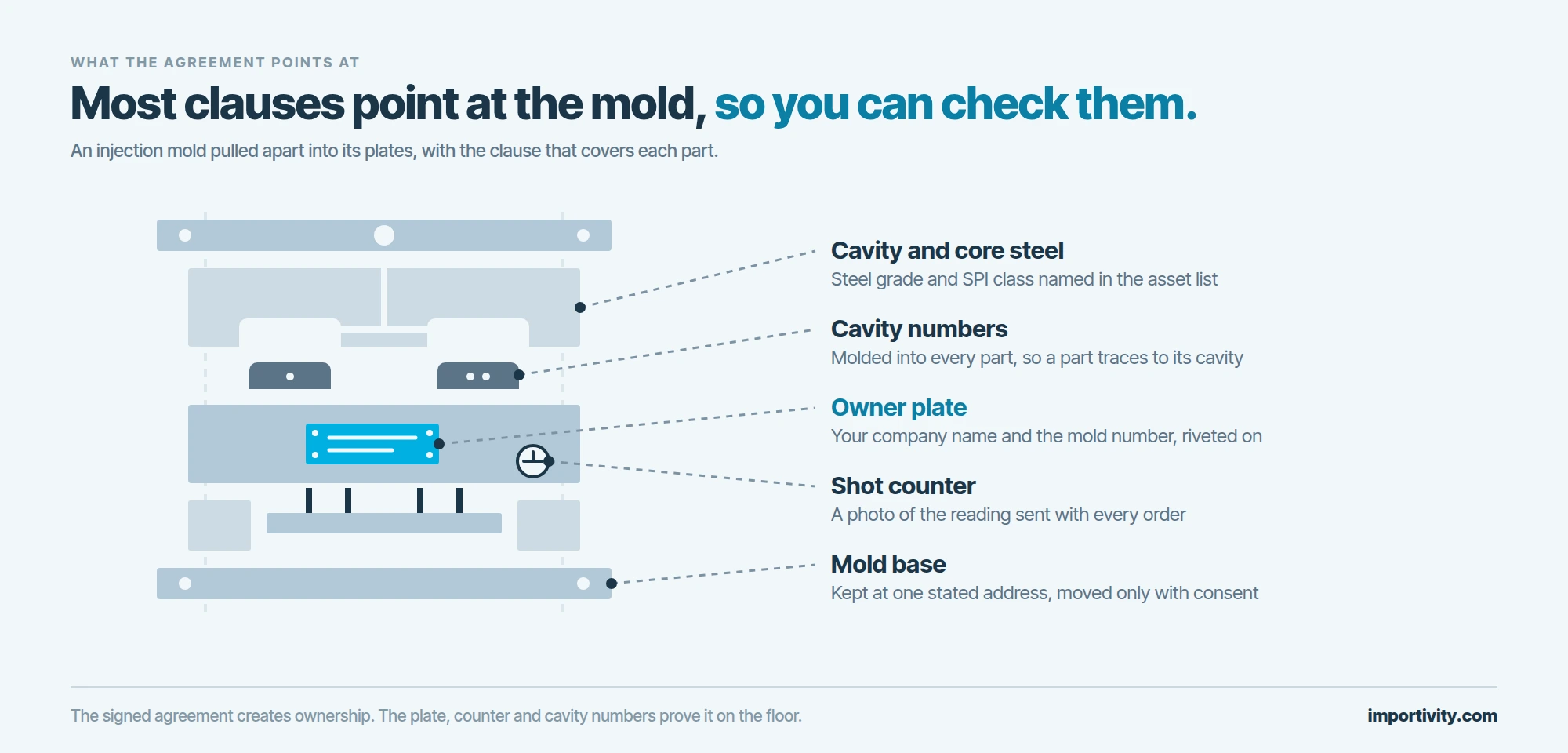
- Asset list. One row per tool: mold number, part name and number, cavity count, steel grade for the cavity and core, mold base size, weight, hot or cold runner, the date it was finished, the price paid, and photos. Add the mold design files as a deliverable.
- Ownership and possession. You own each listed tool from the date of the final tooling payment, and the factory holds it on your behalf at no charge. This is the Article 228 arrangement in plain words.
- No lien and no set-off. The factory may not hold the molds against any claim, including an unpaid production invoice. Money disputes get settled separately.
- Owner plate. Your company name and the mold number on a metal plate riveted to the mold base, or engraved into it. Cavity numbers molded into every part, so a part found in the market can be traced to a cavity.
- Location. The address where the molds are kept. No moving them to another plant or to a subcontractor without your written consent. Quiet subcontracting is how molds end up in factories you have never seen.
- Use only for your orders. No parts for other buyers, no copies of the mold, and no keeping your design data after the relationship ends. Article 785 already bars a contractor from keeping copies or technical data without permission; restate it.
- Shot life. A guaranteed number of shots, with repair or replacement at the factory's cost if the mold fails sooner under normal use.
- Maintenance. Routine maintenance at the factory's cost, a written maintenance log, and a shot counter reading sent with every order.
- Release. On written notice, the factory hands over the molds within a fixed number of days, packed for export, for a handling fee agreed now. The drawings and spare parts go with them, and so do the last-shot samples.
- No scrapping. The factory may not scrap, sell or modify a mold without your written consent, however long the gap between orders.
A factory that will not sign clear ownership terms is likely to hold the mold back when you need it most. Treat that refusal as part of vetting, the same way you would treat a refusal to sign an NNN. Our supplier vetting work checks this before a deposit goes out.
Shot life, maintenance and the shot counter
The SPI classes, set by the Society of the Plastics Industry (now the Plastics Industry Association), give both sides a shared vocabulary for how long an injection mold should last. As summarized in Fictiv's guide to tooling life, Class 101 is built for one million cycles or more, Class 102 for medium to high volume up to one million, Class 103 for under 500,000, Class 104 for under 100,000, and Class 105 is prototype tooling for under 500 cycles. Name the class in the asset list. It tells the factory what standard of steel and build you paid for and gives you a yardstick when it later says the mold is worn out.
The shot counter is the cheapest audit tool you have. It is a counter mounted on the mold that adds one for every cycle. Ask for a photo of it with each order, then compare it with your own numbers: shots multiplied by cavities should roughly equal the parts you were invoiced for, plus setup and scrap. A counter running far ahead of your orders means the mold is making parts for someone else.
Split maintenance costs into three buckets in the agreement. Routine cleaning, polishing and lubrication belong to the factory as part of the unit price. Wear parts such as ejector pins and springs are the factory's cost within the guaranteed shot life. Refurbishment or a replacement mold after the guaranteed life is yours, quoted in advance. The same structure works for die-casting dies and stamping tools, with the guaranteed life taken from the toolmaker's own estimate.
Tooling money is part of your customs value
US Customs counts tooling in the value of the goods it helps make. Under 19 CFR 152.102, a mold you supply to the factory free or at reduced cost is an "assist", and its value is added to the declared value of the imports. Money you pay the seller for a mold is generally treated as part of the price actually paid or payable, which is the total paid to the seller for the goods. Either way, the tooling money belongs in customs value.
The regulation also tells you how to spread it. 19 CFR 152.103(e) lets you apportion the value over the first shipment, over the units produced up to the first shipment, or over the entire anticipated production, or by another method that follows generally accepted accounting principles. Pick one, tell your customs broker before the first entry, and keep the tooling invoices. If you supply a mold you have already used to a new factory, the regulation values it at its original cost adjusted down for that earlier use. Our guide to the commercial invoice shows where assists go on the paperwork.
How to move a mold to another factory
Moving a mold goes smoothly when the paperwork was finished before the relationship cooled. The order of steps matters, because each one depends on the one before it.
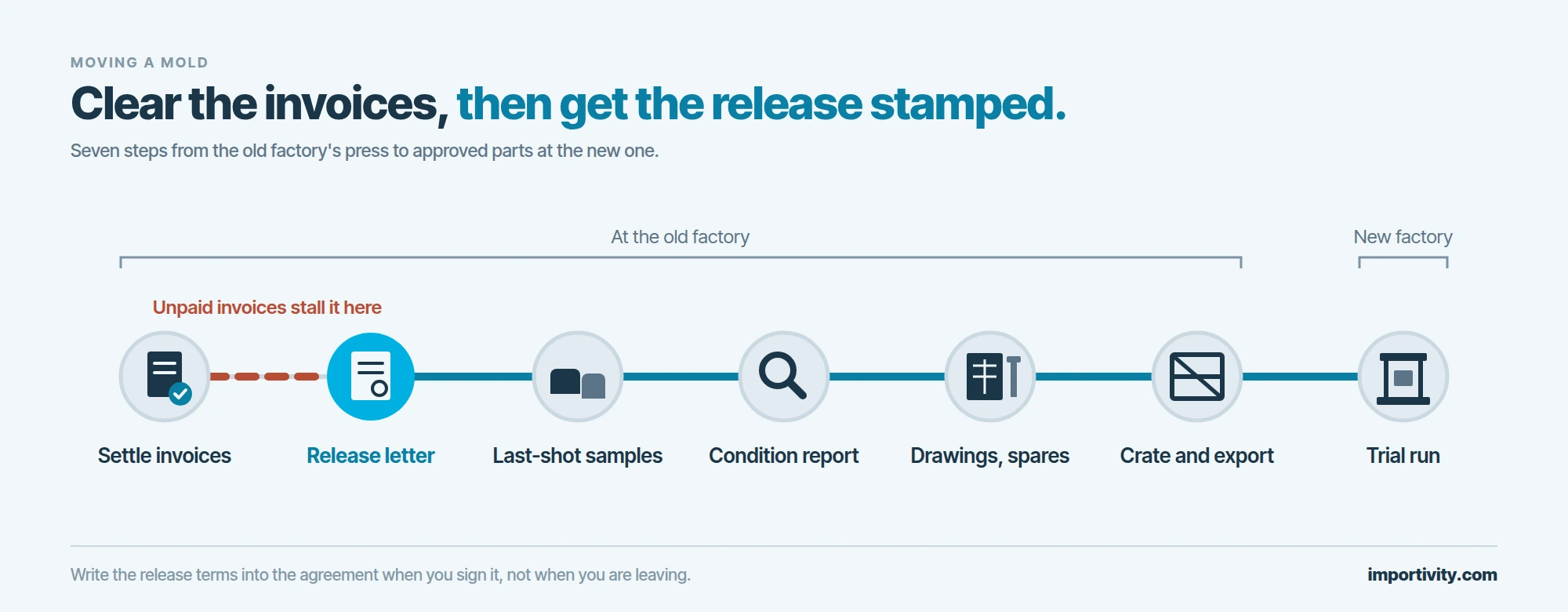
- Settle every open invoice first, or agree in writing how the balance will be handled. Any unpaid amount gives the old factory grounds to hold the tool.
- Send a written release request that cites the agreement and the asset list, and get a release letter back stamped with the factory's chop, naming the molds and the handover date.
- Order last-shot samples, parts from the final run before the mold comes out of the press. They show how the tool performed before it moved.
- Get a condition report with photos of the cavity and core surfaces, the shot counter reading, and a list of worn or damaged parts. Have an inspector witness it if the relationship is tense.
- Collect the support material: mold drawings, spare inserts and pins, and the process sheet that records the settings the mold ran at, such as melt temperature and cycle time.
- Crate and export. Coat the steel against rust, crate it, and let your forwarder handle the export paperwork, since the mold leaves as cargo with its own declaration.
- Run a trial at the new factory. Confirm its press fits the mold (clamp tonnage, platen size, tie-bar spacing), then approve trial parts against your golden sample before placing a volume order.
The easiest move is the one you prepared for. Some brands build a second mold at a factory in another country before they need it, so a tariff change or a dispute becomes a scheduling decision. Our case study on a backup mold in Vietnam shows how that works on a real program. If a factory refuses a release despite a clear agreement, the signed asset list, the payment records and the chopped release terms are your evidence in a Chinese court, which is the same enforcement route covered in our guide to protecting your intellectual property in China.
Frequently Asked Questions
Who owns a mold I paid for in China?
You do only if a signed agreement says so. A paid invoice proves payment, but the mold stays at the factory, and under China's Civil Code ownership of movable property passes on delivery. Article 228 lets an agreement that the factory keeps possession on your behalf take the place of delivery, so put that in a mold ownership agreement stamped with the factory's chop.
Can a Chinese factory refuse to release my mold?
It can hold the mold if your company owes it money. Under Articles 447 and 448 of the Civil Code, a company owed a due debt may keep the debtor's movable property in its possession, even when the property has nothing to do with that debt. Article 449 lets the parties agree that property may not be held this way, so include a no-lien clause and clear open invoices before you ask for a release.
What is the difference between amortized and paid tooling?
With paid tooling you pay the mold cost up front and should own the mold from the final payment. With amortized tooling the factory carries the cost and recovers it through a charge built into each unit, so it usually owns the mold until the agreed quantity ships. Amortizing saves cash but makes leaving early expensive, so write the buyout figure into the agreement.
Do I have to declare mold costs to US Customs?
Yes. A mold you supply to the factory is an assist under 19 CFR 152.102, and money you pay the seller for tooling is generally part of the price of the goods. 19 CFR 152.103(e) lets you spread the value over the first shipment, the units made up to the first shipment, or the whole expected production. Agree the method with your customs broker before the first entry.
How long should an injection mold last?
It depends on the class you pay for. Under the SPI classes, a Class 101 mold is built for one million cycles or more, Class 103 for under 500,000, Class 104 for under 100,000, and Class 105 prototype tooling for under 500. Write the class and a guaranteed shot count into the agreement so the factory repairs or replaces a mold that wears out early.
About the author
Jordan Lewis
Chief Operating Officer, Importivity
Runs Importivity's sourcing operations across China, Vietnam, Mexico and India, from supplier negotiation through landed delivery.
Press and media inquiries: press@importivity.com