Where Is Lululemon Made (Countries, Fabric and Who Makes It)
Lululemon is made by independent factories in Asia: in fiscal 2025, Vietnam made 40% of its products, Cambodia 18%, Sri Lanka 11%, Indonesia 11% and Bangladesh 7%. Most of the fabric came from Taiwan (34%) and mainland China (29%), and Lululemon owns none of the factories or mills.
This guide is for founders building an activewear or apparel line who want to see how a brand with $11.1 billion of fiscal 2025 revenue gets its product made, and which parts of that a small brand can copy. The figures come from Lululemon's 10-K for fiscal 2025, the year that ended February 1, 2026, plus its published supplier list and its earnings releases. For a larger network built the same way, see our guide to where Nike makes its shoes and clothes. Importivity is not affiliated with Lululemon.
Where Lululemon products are made in fiscal 2025
Lululemon's fiscal 2025 10-K splits production by country, based on cost. Five countries made 87% of its products. Vietnam alone made 40%, more than Cambodia and Sri Lanka combined.
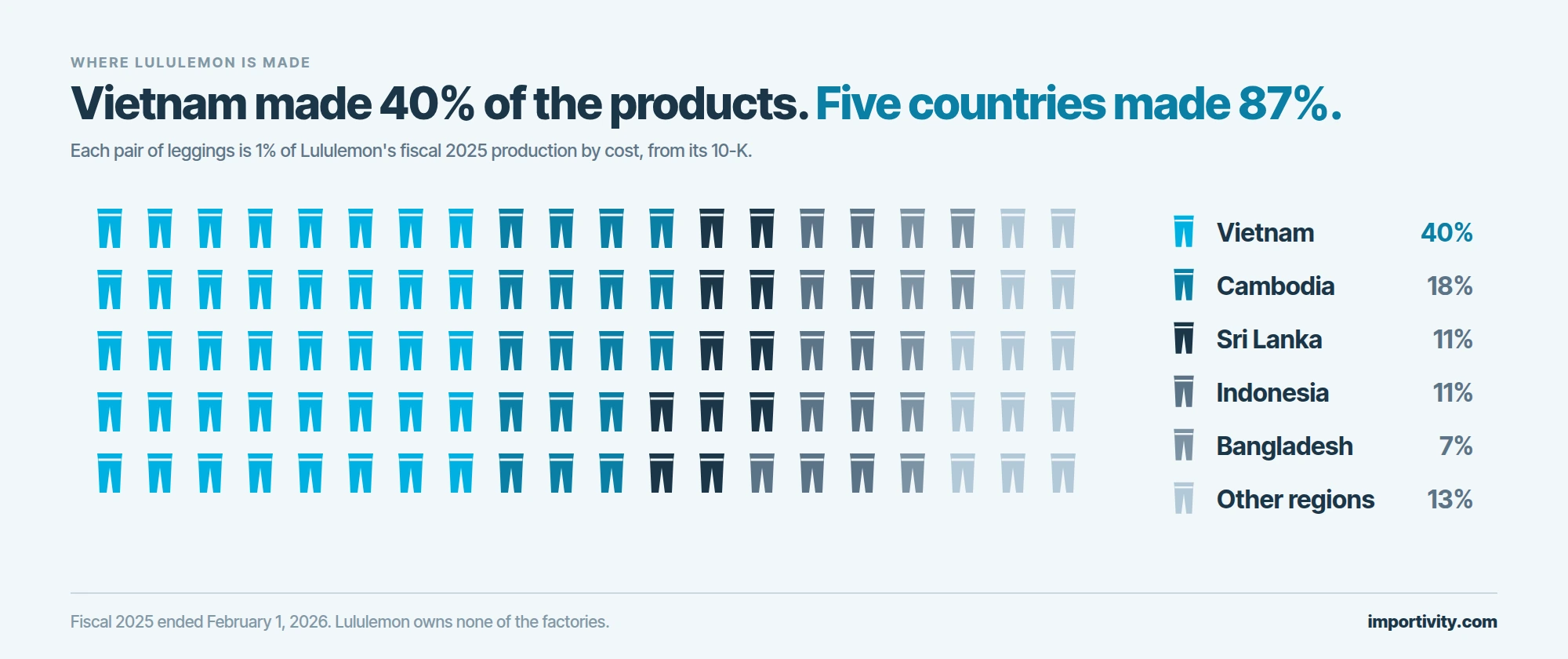
The mix barely moved in a year. In fiscal 2024 the split was Vietnam 40%, Cambodia 17%, Sri Lanka 11%, Indonesia 11% and Bangladesh 7%. Cambodia gained one point in fiscal 2025, and the other four stayed the same. The remaining 13% came from other regions that the filing does not list one by one.
Mainland China is not one of the five named countries for finished products, even though it supplied 29% of the fabric. Canada, where Lululemon is based, is not on the list either.
Next to Nike, Lululemon relies more on Vietnam and Cambodia. Nike's fiscal 2026 filing puts Vietnam at about 34% of Nike apparel and Cambodia at about 15%. Lululemon's figures for the same two countries are 40% and 18%. Nike's numbers cover apparel only and Lululemon's cover all of its products, so read this as a rough comparison.
Who makes Lululemon clothes
Lululemon's 10-K filings say the company does not own or operate any manufacturing facilities and has no long-term contracts with most of its suppliers. Lululemon designs the product, and independent vendors make it. In fiscal 2025 it worked with about 51 vendors that made finished products and about 65 suppliers that made fabric.
A small group of those suppliers does most of the work:
- Top five vendors. They made about 47% of Lululemon's products in fiscal 2025, down from 49% in fiscal 2024.
- Largest vendor. One vendor made about 15% of products, the same share as the year before.
- Top five fabric suppliers. They made about 48% of the fabric, down from 52% in fiscal 2024.
- Largest fabric supplier. One mill made about 20% of the fabric in fiscal 2025.
The 10-K does not name these companies. Lululemon does publish a supplier list at the facility level. It covers Tier 1 facilities, which make finished products, and Tier 2 facilities, which make and finish the materials that Tier 1 factories use. The company's 2025 modern slavery statement, published in May 2026, says the latest list covers facilities active as of May 2026.
Use the list to see which countries and regions already sew technical knit apparel at volume. Do not read it as a list of factories looking for new customers. A plant on a large brand's list may have no room for a new brand or a small order, a point our Nike guide covers in more detail.
Where Lululemon's fabric comes from
The fabric comes from a different set of countries than the sewing. In fiscal 2025, 34% of Lululemon's fabric came from Taiwan, 29% from mainland China, 10% from South Korea and 10% from Vietnam, and the remaining 17% came from other places. Only Vietnam appears on both lists, and the label on the finished garment names only the sewing country.
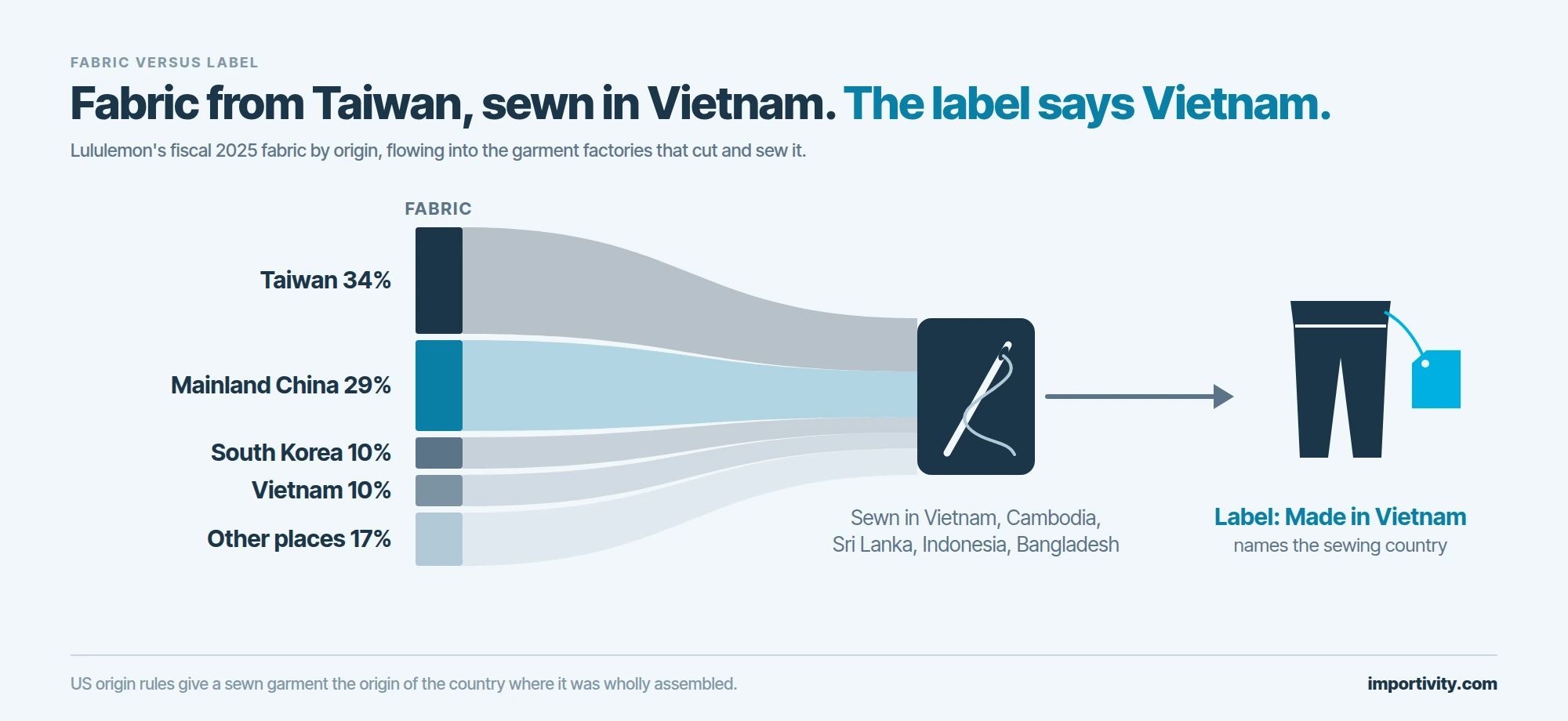
The year before, Taiwan supplied 35%, mainland China 28% and South Korea 11%. Like the garment split, the fabric split moved by about one point.
Performance leggings and tops like Lululemon's are knit from synthetic yarns blended with elastane. The fabric has to stretch, recover its shape, hold its color and feel the same from one lot to the next. That depends on the knitting, dyeing and finishing mills more than on the sewing floor. For Lululemon, 73% of the fabric came from mills in Taiwan, mainland China and South Korea, and garment factories in Vietnam, Cambodia, Sri Lanka, Indonesia and Bangladesh cut and sewed it.
For a new brand, this is the part to copy first. The fabric often sets the minimum order and the lead time, because the garment factory cannot start cutting until the fabric arrives. Choose and test the fabric, then choose the factory that will sew it, and record both in your tech pack.
What "Made in" means on a Lululemon label
The country on the label is the country of origin under US customs rules. For a garment sewn from two or more cut pieces, 19 CFR 102.21 generally gives origin to the country where it was wholly assembled. A garment knit to its final shape takes the origin of the country where it was knit. So a pair of leggings sewn in Vietnam from Taiwanese fabric is labeled Made in Vietnam.
The Federal Trade Commission's textile rules require three things on clothing sold in the US:
- Fiber content. The generic fiber names, with the percentage of each by weight.
- Country of origin. On a garment with a neck, it goes on the front of a label at the inside center of the neck.
- The responsible company. Its name, or the Registered Identification Number (RN) that the FTC issued to it.
Vietnam on one Lululemon item and Sri Lanka on another is normal for a brand with about 51 vendors in several countries. The country alone does not tell you whether an item is genuine. It does decide which US duties the importer paid, so origin matters more to a brand than to a shopper. Our guide to country of origin rules covers the harder cases, such as garments cut in one country and sewn in another.
How tariffs changed Lululemon's costs
Tariffs changed Lululemon's costs more than its country mix. With its fourth-quarter results on March 17, 2026, the company reported $275 million of gross tariff costs in fiscal 2025, of which it offset $62 million through sourcing adjustments and cost savings. It expected $380 million of gross tariff costs in fiscal 2026.
- De minimis. In September 2025, Lululemon's finance chief said about two-thirds of its US online orders were shipped from Canada, and most of them had qualified for duty-free de minimis entry. The exemption was suspended for all countries on August 29, 2025. The company put the change at about 170 of the 220 basis points of tariff-related gross margin decline it then expected for fiscal 2025.
- Refunds. The Supreme Court struck down the IEEPA tariffs on February 20, 2026. In the quarter that ended August 2, 2026, Lululemon recorded $134.5 million of IEEPA tariff refunds plus $4.1 million of interest. Our guide to IEEPA tariff refunds explains who can claim.
- New duties. Since July 24, 2026, goods from all five of its main sewing countries pay a Section 301 forced-labor duty on top of the normal rate: 12.5% for Vietnam and 10% for Cambodia, Sri Lanka, Indonesia and Bangladesh, unless an exemption applies.
The table shows what the duty looks like on one common product: women's synthetic knit leggings under HTS 6104.63.20, which carry a normal (MFN) rate of 28.2% in the US tariff schedule.
| Sewing country | Share of Lululemon products, fiscal 2025 | US duty on synthetic knit leggings, Nov 5, 2026 | What to watch |
|---|---|---|---|
| Vietnam | 40% | 40.7% (28.2% + 12.5%) | USTR also has a separate Section 301 investigation open on Vietnam's intellectual property practices. |
| Cambodia | 18% | 38.2% (28.2% + 10%) | USTR said it will set a tariff-rate quota for Cambodia when feasible. |
| Sri Lanka | 11% | 38.2% (28.2% + 10%) | The July 2026 notice did not name Sri Lanka for a tariff-rate quota. |
| Indonesia | 11% | 38.2% (28.2% + 10%) | USTR said it will set a tariff-rate quota for Indonesia when feasible. |
| Bangladesh | 7% | 38.2% (28.2% + 10%) | USTR said it will set a tariff-rate quota for Bangladesh when feasible. |
On a pair of leggings with a $20 customs value, that is $8.14 of duty from Vietnam and $7.64 from any of the other four countries, a 50 cent difference. Both rates are charged on the same value and added together. Our guide to tariff stacking walks through the method. Importers have challenged the forced-labor duties at the Court of International Trade, which heard argument on September 30, 2026. As of early November 2026, the court had not ruled, and CBP was still collecting the duty.
What a new activewear brand can take from Lululemon
You cannot buy from Lululemon's vendors on Lululemon's terms, and you do not need to. The parts that work at small scale are the order in which it makes decisions and the countries it uses.
- Choose the fabric first. Ask each mill for its minimum per fabric and per color, and whether it sells stock colors. Divide the per-color minimum by the yards of fabric your pattern uses per garment. The answer is the smallest run of one color you can make in a custom fabric. Stock colors cut that minimum, and you choose from what the mill already makes.
- Look in the same countries, not the same factories. Smaller factories in Vietnam, Cambodia, Sri Lanka, Indonesia and Bangladesh sew stretch knits too. Our guide to manufacturers in Vietnam shows where the garment and footwear plants are, and our Vietnam clothing suppliers guide puts small-batch factories at 50 to 300 pieces per style, mid-tier factories at 300 to 1,000, and large export plants at 3,000 or more.
- Price the duty before you pick a country. On leggings, Vietnam pays 2.5 points more than the other four countries as of November 5, 2026. On a $20 pair that is 50 cents, so a Vietnamese factory that quotes $1 less still comes out ahead.
- Plan a second factory early. Lululemon's largest vendor made about 15% of its products in fiscal 2025, and the top five made about 47%. A new brand usually starts with one factory. Qualify a second one for your best seller before the first runs out of capacity or a tariff change forces a move.
- Put the spec on paper. Fabric, fit, stitch types and tolerances go in the tech pack and then in the purchase order. Our private label clothing manufacturer guide covers the production models and sampling steps.
If you want a factory that already sews stretch knits in one of these countries, send us your product and order size. Our manufacturer sourcing team finds and vets factories that make your product type.
Frequently Asked Questions
Is Lululemon made in China?
Mostly not, for finished products. Mainland China is not one of the five countries that made 87% of Lululemon's products in fiscal 2025, which were Vietnam, Cambodia, Sri Lanka, Indonesia and Bangladesh. China matters for fabric, though. About 29% of Lululemon's fabric came from mainland China in fiscal 2025, second only to Taiwan at 34%, according to the company's 10-K.
Is Lululemon made in Canada?
Lululemon is based in Vancouver, but Canada is not among the countries it names for production. Its 10-K says it owns no manufacturing facilities, and in fiscal 2025 five Asian countries made 87% of its products, led by Vietnam at 40%. Canada's role is distribution: in September 2025 the company said about two-thirds of its US online orders shipped from Canada.
Who manufactures Lululemon clothing?
Independent vendors make it. In fiscal 2025 Lululemon worked with about 51 vendors for finished products and about 65 fabric suppliers. The top five vendors made about 47% of its products, and the largest made about 15%. The 10-K does not name them, but Lululemon publishes a facility-level supplier list that covers finished goods factories and fabric suppliers.
Why does my Lululemon say Made in Vietnam or Made in Cambodia?
The label shows the country where the garment was sewn, which is its country of origin under US customs rules. The fabric often comes from somewhere else, most often Taiwan or mainland China. Lululemon uses about 51 vendors in several countries, so different items show different countries. The country alone does not tell you whether an item is genuine.
Where does Lululemon get its fabric?
In fiscal 2025, 34% of Lululemon's fabric came from Taiwan, 29% from mainland China, 10% from South Korea and 10% from Vietnam, with the rest from other places. About 65 suppliers made the fabric. The top five made about 48% of it, and the largest single supplier made about 20%, according to the company's fiscal 2025 10-K.
About the author
Jordan Lewis
Chief Operating Officer, Importivity
Runs Importivity's sourcing operations across China, Vietnam, Mexico and India, from supplier negotiation through landed delivery.
Press and media inquiries: press@importivity.com