Where Are Legos Made (Six LEGO Factories and a US Plant Due in 2027)
LEGO bricks are made in six factories that the LEGO Group owns: Billund in Denmark, Nyíregyháza in Hungary, Kladno in the Czech Republic, Monterrey in Mexico, Jiaxing in China and Binh Duong in Vietnam. A seventh factory is under construction in Chesterfield County, Virginia, and the company says it is on track to open in 2027.
This guide is for founders who want a toy or another molded plastic product made. It shows how LEGO sets up its own production and which parts of that a small brand can copy. The facts come from the LEGO Group's 2025 annual report, published in March 2026, its results for the first half of 2026, published on August 25, 2026, and its own press releases and history pages. We read some figures, including revenue and the Virginia numbers, in news coverage, and the text says where. If you are ready to look for a factory, start with our guide to toy manufacturers in China. Importivity is not affiliated with the LEGO Group.
Where Legos are made as of LEGO's August 2026 results
The LEGO Group is a Danish company with its head office in Billund. In an April 2025 article on its own site, From Production to Play, the company said it operates six factories, in Denmark, Hungary, the Czech Republic, Mexico, China and Vietnam, and that a new US factory will bring the count to seven. The table lists each site, the work LEGO says is done there and the market it mainly supplies.
| Factory | What LEGO says is done there | Market it mainly supplies |
|---|---|---|
| Billund, Denmark | Molding only (LEGO factory facts page, figures from 2015) | Europe, the Middle East and Africa |
| Nyíregyháza, Hungary | Molding, element processing and decoration, and packing, including DUPLO bricks (LEGO releases, 2019 and 2023) | Europe, the Middle East and Africa |
| Kladno, Czech Republic | Molding and packing. Model builders there also make display models for LEGOLAND parks (LEGO history page) | Europe, the Middle East and Africa |
| Monterrey, Mexico | Molding, processing, prepack and final pack (LEGO release, 2022) | The Americas, including the US |
| Jiaxing, China | Molding, processing and packing, opened in 2016 (LEGO release, 2022) | China and the rest of Asia |
| Binh Duong, Vietnam | Molding and packing, opened on April 9, 2025 (LEGO release, 2025) | Asia-Pacific |
| Chesterfield County, Virginia | Under construction and due to open in 2027. A temporary packing site already runs in the Richmond area. | Not open yet |
The company does not publish how much each factory makes or which sets come from which plant. It does report the size of some sites. About 4,300 people worked at Nyíregyháza in September 2025, according to a LEGO release. Monterrey had more than 5,000 employees in 2022, and Jiaxing had about 1,200 that year.
Billund is the head office site, and LEGO's factory facts, in figures from 2015, list molding as the only production work there.
Which LEGO factory supplies which region
LEGO places its factories close to the people who buy the sets. The April 2025 article describes a region-based network of factories and distribution centers on three continents, close to the company's major markets. Each group of plants mainly supplies the region it sits in.
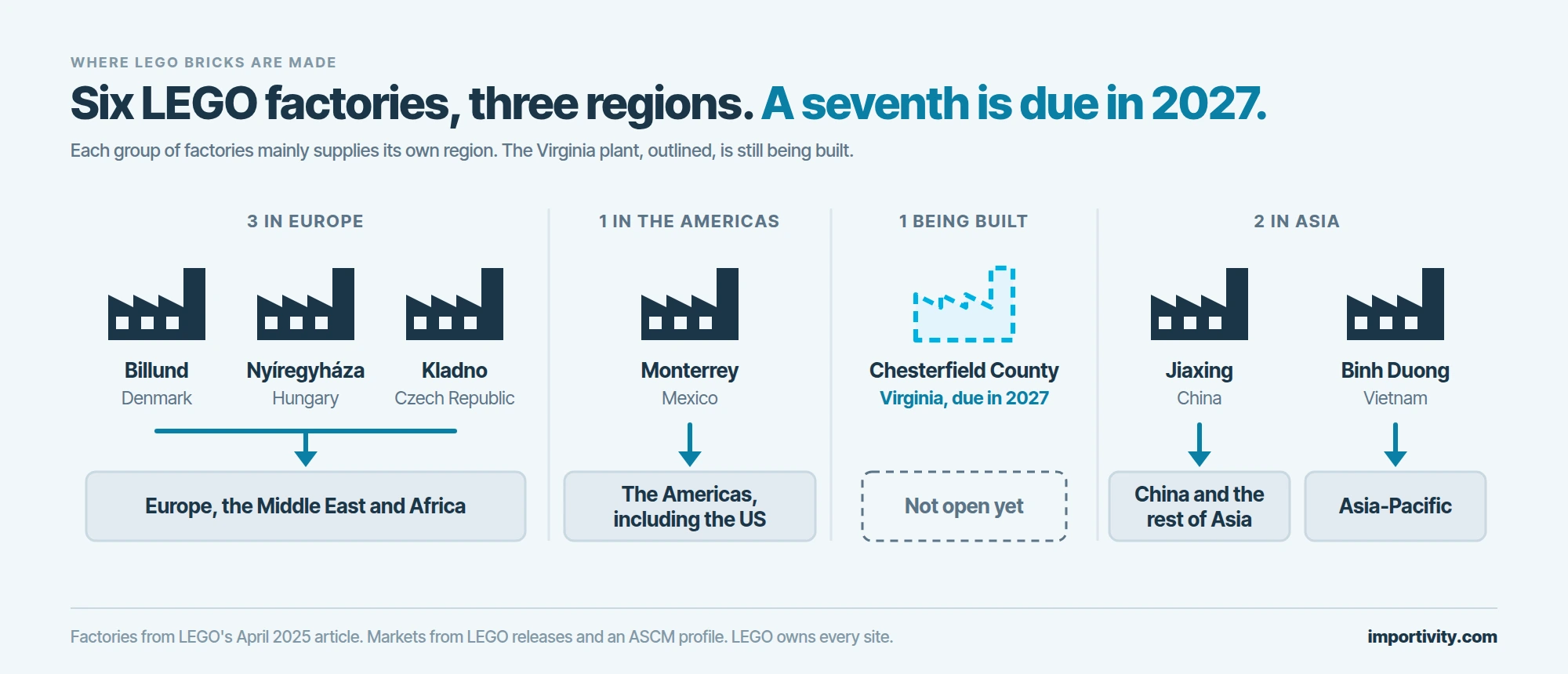
The split works like this:
- Europe, the Middle East and Africa. The plants in Denmark, the Czech Republic and Hungary supply this region, according to a profile of LEGO's supply chain by the Association for Supply Chain Management. In June 2024 LEGO said the Nyíregyháza and Kladno factories would supply its new distribution center in Tessenderlo, Belgium.
- The Americas. Monterrey supplies the Americas, which include the US. Our guide to manufacturing plants in Mexico covers the Monterrey area, where trucks reach the Laredo border crossing by highway.
- Asia. Jiaxing supplies China and the rest of Asia. When LEGO opened the Binh Duong plant in 2025, its chief executive said the plant would bring products to children and fans in the Asia-Pacific region.
Are Legos made in China
Some are. One of the six factories is in Jiaxing, China. LEGO opened it in 2016, and it handles molding, processing and packing. In 2022 the company said it would expand the plant to meet long-term growth in China and Asia, and its 2025 results list further expansions in China, Mexico and Hungary.
The second Asian factory is in Vietnam. On April 9, 2025, LEGO held the opening of LEGO Manufacturing Vietnam in Binh Duong province. It is the company's sixth factory and its second in Asia. Fortune put the cost at $1 billion, and other reports give a higher figure. Binh Duong became part of Ho Chi Minh City when Vietnam merged provinces on July 1, 2025, and our guide to manufacturers in Vietnam lists plastics among the industries of that area.
What LEGO's country list means
LEGO marks its sets with a list of countries. It does not print one country of origin. A printed insert that LEGO published in 2026 carries a "Components made in" line with six countries: Denmark, Mexico, Hungary, the Czech Republic, China and Vietnam. It gives the LEGO Group's address in Billund as the manufacturer. The six countries are the six factory countries.
This kind of marking is old. US Customs ruling 734165, issued in 1991, accepted the line "Contents made in Denmark, Switzerland, and USA" on LEGO's retail boxes, so the single bricks did not need their own mark. The line tells you which countries the parts can come from. It does not tell you which plant molded the bricks in your box. Our guide to country of origin rules explains how US marking works for other products.
Are Legos made in the USA
No LEGO bricks are molded in the US as of the company's August 2026 results. A temporary packing site already runs in the Richmond area of Virginia. LEGO made bricks in the US for many years. Its history page on production in North America says LEGO Systems Inc. set up a molding shop in Enfield, Connecticut in 1980 with 10 molding machines. In 2006 the company said it would end production in Enfield and move the work to Mexico. The Enfield packing plant closed in 2007.
The US factory now being built is in Meadowville Technology Park in Chesterfield County, Virginia. The numbers come from several sources:
- Size. Reports on the project, including Manufacturing Today and the Virginia Economic Development Partnership, describe a $1 billion plant of 1.7 million square feet that is expected to create about 1,760 jobs over 10 years.
- Distribution. Virginia Business reported a second site: a $366 million, 2 million square foot distribution center in Prince George County.
- Total cost. Coverage of LEGO's results for the first half of 2025 put the investment in the factory and the distribution center at more than $1.5 billion. These figures come from different sources and do not add up exactly.
- Timing. A 2022 LEGO release expected seven manufacturing sites by the end of 2025. In its first-half 2026 results, the company said both Virginia sites were on track to open in 2027.
- People. Virginia Business reported in March 2026 that LEGO had about 500 workers in the Richmond region, at the building site and at a temporary packing facility, and expected about 900 by the end of 2026.
The Virginia plant will be LEGO's first US factory since Enfield closed in 2007. With Monterrey, it will give the company two factories in North America. The plan is older than the tariffs of 2025: a LEGO release from 2022 was already counting on seven sites.
Why LEGO owns its factories
LEGO molds and packs its bricks in factories that it owns and runs. Nike works the other way: it owns none of the factories that make its finished shoes, as our guide to where Nike makes its shoes and clothes explains. LEGO tried that model once and began to reverse it within two years.
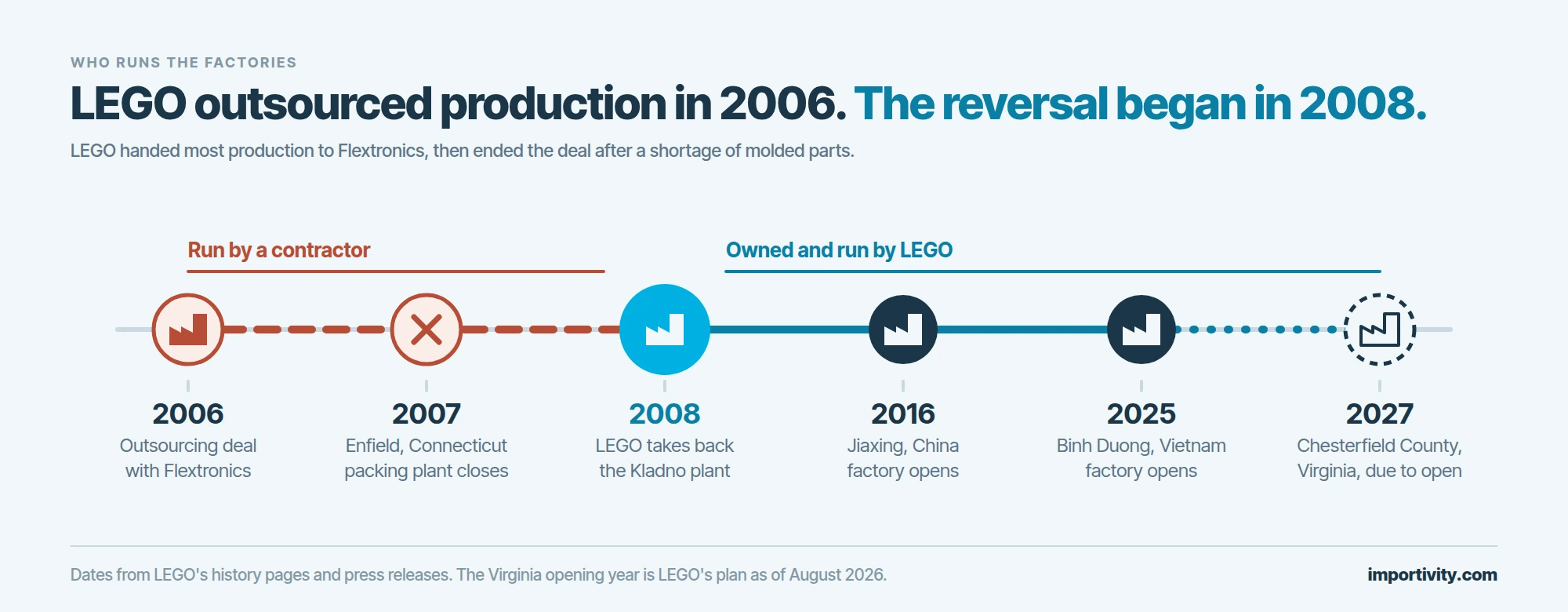
LEGO's history page on outsourcing and insourcing gives the account. In 2006 LEGO agreed to hand most of its production to Flextronics, a contract manufacturer. Flextronics ran the Kladno plant and made LEGO products at its own plants in Nyíregyháza, Hungary and Juárez, Mexico. The work from Enfield went to Juárez. According to LEGO, start-up problems led to a shortage of molded parts.
LEGO ended the partnership. Its history page says it took back the Kladno plant in 2008. LEGO also took over the Flextronics factory in Nyíregyháza, and a new LEGO plant in Monterrey replaced the Juárez production. Every factory LEGO has opened since then, including Jiaxing in 2016 and Binh Duong in 2025, has been its own.
Owning plants costs money. LEGO's 2025 results show DKK 9.2 billion invested in factories and other facilities, against DKK 9.0 billion in 2024. News coverage of those results gave revenue of DKK 83.5 billion, so by our arithmetic the investment was about 11% of revenue. Coverage of the first-half 2026 results gave DKK 4.6 billion for that half, against DKK 4.2 billion a year earlier. The 2025 annual report has the full accounts.
Can a small brand use these factories
No. LEGO's plants make LEGO products, and they are not contract manufacturers, so an outside brand cannot place an order with them. A small brand has its toy or plastic product made by a contract molder. These are the parts of LEGO's setup that still apply at small scale:
- Pick the right cluster. In China, molded plastic toys come mainly from Chenghai district in Shantou, and electronic toys from Dongguan and Shenzhen. Our guide to toy manufacturers in China maps the four clusters and the checks to run in each.
- Budget for the molds first. Every molded part needs its own mold. Our toy guide puts a production mold in multi-cavity steel at $5,000 to $15,000 or more per part, and typical minimums at 500 to 5,000 pieces. Our guide to plastic injection molding shows how mold cost and order size set the unit price.
- Own the tooling in writing. You cannot own the factory, but you can own the molds you paid for. The purchase order should say that the molds are yours and that you can collect them. See our guide to mold ownership agreements.
- Treat a factory move as a project. LEGO's 2006 handover ended in a shortage of molded parts. If you move molds to a new plant, build stock first and approve trial parts from the new plant before the old one stops.
- Compare a plant near your customers. LEGO's Monterrey plant supplies the Americas, which include the US. Get a quote from Mexico or Vietnam next to the one from China, and compare the landed cost with duty and freight included. Our page on import tax from China to the US has the current duty layers.
- Prepare the file set. A molder needs 3D CAD files, the plastic you want, color references, the order quantity and the packaging. In the US, a toy for children 12 and under also needs third-party testing to ASTM F963-23 and a Children's Product Certificate.
If you want a molded toy or plastic product made, send us your drawings and order size. Importivity helps US brands find and vet factories, run quality control, arrange shipping and handle tariffs. Our manufacturer sourcing team finds and vets molders that make your product type.
Frequently Asked Questions
Are Legos made in China?
Some are. The LEGO Group opened its own factory in Jiaxing, China in 2016, and that plant molds, processes and packs bricks mainly for China and the rest of Asia. It is one of six LEGO factories. The others are in Denmark, Hungary, the Czech Republic, Mexico and Vietnam. The Monterrey plant in Mexico supplies the Americas, which include the US.
Are Legos made in the USA?
No bricks are molded in the US as of LEGO's August 2026 results. A temporary packing site runs in the Richmond area of Virginia. LEGO set up a molding shop in Enfield, Connecticut in 1980, said in 2006 that it would end production there and closed the Enfield packing plant in 2007. A new LEGO factory is under construction in Chesterfield County, Virginia, and in those results the company said it was on track to open in 2027.
Who makes Legos?
The LEGO Group makes them in factories it owns. It is a Danish company with its head office in Billund. In 2006 it handed most production to a contract manufacturer, Flextronics, and it began taking the plants back in 2008 after start-up problems caused a shortage of molded parts. As of LEGO's August 2026 results, it runs six factories, in Denmark, Hungary, the Czech Republic, Mexico, China and Vietnam.
Where are Legos made for the US market?
LEGO's Monterrey plant in Mexico supplies the Americas, which include the US. LEGO runs a region-based network, and the Monterrey plant handles molding, processing and packing. The packaging does not name one plant. LEGO's printed material lists six countries where components are made: Denmark, Mexico, Hungary, the Czech Republic, China and Vietnam. A US factory in Virginia is due to open in 2027.
Are Legos still made in Denmark?
Yes. LEGO still molds bricks in Billund, Denmark, where the company has its head office. LEGO's factory facts, in figures from 2015, list molding as the only production activity at the Billund site. Together with the factories in Nyíregyháza, Hungary and Kladno, Czech Republic, Billund supplies Europe, the Middle East and Africa.
About the author
Jordan Lewis
Chief Operating Officer, Importivity
Runs Importivity's sourcing operations across China, Vietnam, Mexico and India, from supplier negotiation through landed delivery.
Press and media inquiries: press@importivity.com