Where Are Coach Bags Made (Countries, History and What the Label Says)
Coach bags are made mostly in Vietnam, Cambodia, the Philippines and India, in independent factories that Coach does not run itself. Tapestry, Inc., the company that owns Coach and Kate Spade, names those four countries in its annual report for fiscal 2026, which ended June 27, 2026, and says no single supplier provided 10% or more of Coach's inventory purchases.
This guide is for founders and product teams who want their own bag line made overseas and want to see how a large brand does it. It uses Tapestry's filings to show where Coach bags are made, how Coach left US manufacturing, what the label and creed patch tell you, how other handbag brands compare, and what a smaller brand can copy. Coach works much like Nike, which designs in-house and buys from contract factories, as our guide to where Nike makes its shoes and clothes shows. Importivity is not affiliated with Coach or Tapestry.
Where Coach bags are made in 2026
Tapestry's fiscal 2026 10-K answers the question in one sentence: manufacturers of Coach products were primarily located in Vietnam, Cambodia, the Philippines and India. The company also runs sourcing management offices in Vietnam, mainland China, the Philippines and Cambodia, and those offices work with the factories. The 10-K does not give a percentage for each country. The shares below come from what Tapestry told investors in 2025.
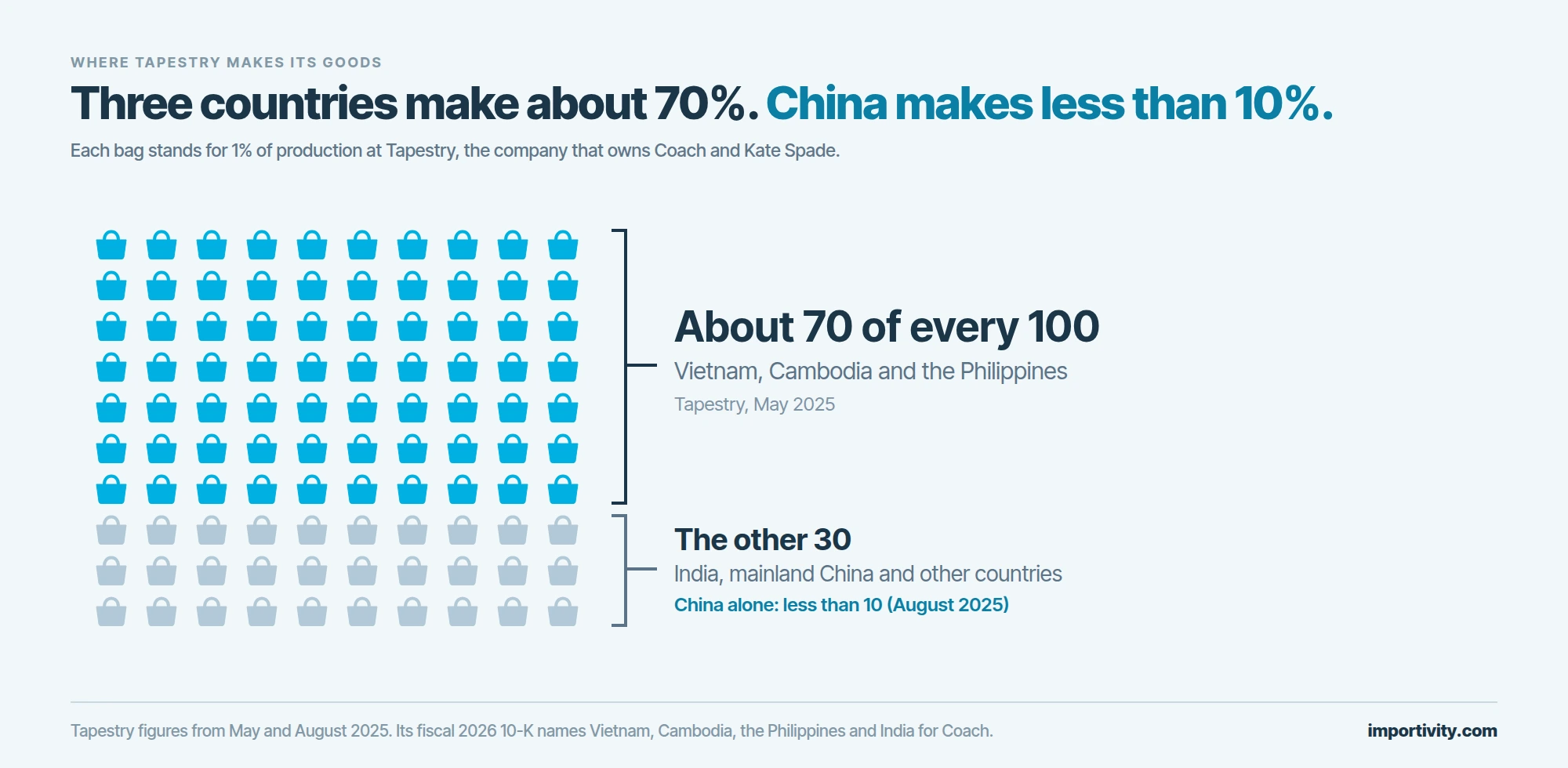
- About 70% from three countries. In its May 2025 earnings release, Tapestry said Vietnam, Cambodia and the Philippines together made about 70% of its production.
- Less than 10% in China. In August 2025, it said less than 10% of its production was in China.
- A longer list behind the main four. Tapestry's fiscal 2024 modern slavery statement lists the countries of the manufacturers it contracts with: Vietnam, Cambodia, the Philippines, China, India, Indonesia, Myanmar, Bangladesh, Peru, Spain and Thailand. Spain is on the list because of Stuart Weitzman, whose shoes were made mainly there. Tapestry sold that brand to Caleres on August 4, 2025.
Those percentages cover all of Tapestry, not Coach alone. Coach is most of the company. In fiscal 2026 it brought in $6.91 billion of Tapestry's roughly $8 billion in revenue, up 24% on the year, and Kate Spade made up nearly all of the rest. If you are looking at the same countries for your own bags, our guide to manufacturers in Vietnam explains where the factories are and who owns them.
How Coach moved its production out of the United States
Coach's own history says it began in 1941 as a workshop in a loft on West 34th Street in Manhattan, where six leather workers made wallets and billfolds by hand. Later it ran its own plants, including ones in Medley, Florida and Lares, Puerto Rico. Its SEC filings record when those plants closed and how the supplier base changed after that.
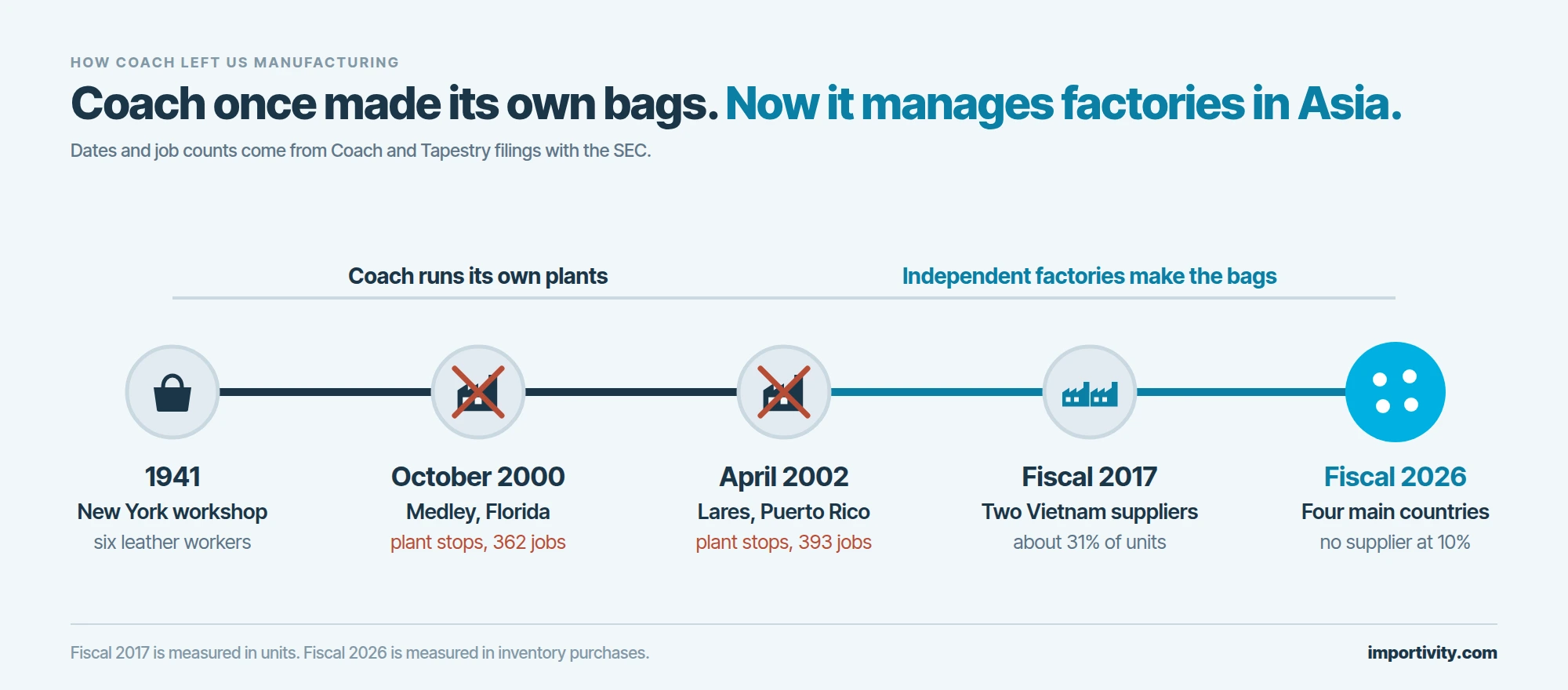
- October 2000. Coach stopped production at its plant in Medley, Florida. All 362 employees there had been let go by June 2001.
- April 2002. Coach stopped production at its plant in Lares, Puerto Rico, with 393 jobs cut. Its fiscal 2002 10-K described the closure as part of Coach's change from a manufacturer into a marketer, and said the work moved to lower-cost third-party manufacturers.
- Fiscal 2017. Coach's 10-K for that year reported two vendors, both in Vietnam, that each supplied more than 10% of Coach brand units, about 31% between them.
- Fiscal 2026. Tapestry's 10-K names four main countries, and no single supplier reached 10% of Coach's inventory purchases.
Coach still employs craftspeople in the US, but they repair bags rather than make new ones. Its repair workshop is in North Bergen, New Jersey, and Coach says restored Coachtopia products are repaired by US-based craftspeople before they are sold again. The shift took Coach from owning plants to managing suppliers, which is also how the other US brands in the table below work.
What the made-in label and the creed patch tell you
A Coach bag can carry two marks that people confuse. The made-in label tells you where the bag was made. The creed patch tells you which bag it is.
- The made-in label. US customs rules require every imported bag to show its country of origin in a place where a buyer can find it easily and read it (19 CFR Part 134). For handbags, CBP rulings accept a fabric label sewn into the lining. The country on it is where the bag was made, which can differ from where the leather was tanned. Our guide to country of origin rules explains how customs decides that.
- The creed patch. Many Coach bags carry a stamped leather patch with the Coach creed and a code. Resale and collector guides read the part after the dash as the style number, so the code is shared by many bags of the same style and does not identify one bag. Smaller bags and wallets often have no creed patch at all.
- What Coach will check. Coach's brand protection page says it does not respond to requests to authenticate a product. It points buyers to Coach stores, coach.com and authorized department stores, and it takes counterfeit reports through an online form.
Why the country on the label does not prove a Coach bag is fake
No country on the label proves a Coach bag is real or fake. Most genuine Coach bags made today carry Vietnam, Cambodia, the Philippines or India, and Tapestry said in August 2025 that less than 10% of its production was in China. Tapestry's fiscal 2018 10-K still listed mainland China among the main countries for Coach products, so an older genuine bag can say Made in China. A counterfeiter can also sew in any label, including Made in Vietnam.
These checks tell you more than the country does:
- Where it was bought. A receipt from a Coach store, a Coach outlet, coach.com or an authorized department store is the best evidence you can have.
- Whether the code matches the bag. If the creed code points to a different style than the bag in your hand, ask the seller to explain it.
- How it is built. Look at the stitching, the stamping on the patch, the edge finish and the weight of the hardware. Authentication guides flag blurry stamping and uneven stitches.
- A paid authentication. For an expensive vintage piece, use a resale platform's authentication service or an independent authenticator, since Coach does not offer one.
Where other handbag brands make their bags
The US brands below work the same way as Coach: they design in-house and buy from independent factories, mostly in Southeast Asia. Hermès does the opposite and makes its leather goods in its own workshops. The table lists only brands whose own filings or statements name the countries.
| Brand (owner) | Where the company says its goods are made | Source |
|---|---|---|
| Coach (Tapestry) | Vietnam, Cambodia, the Philippines and India. No supplier reached 10% of purchases. | Tapestry 10-K, fiscal 2026 |
| Kate Spade (Tapestry) | Vietnam, Cambodia, mainland China and the Philippines | Tapestry 10-K, fiscal 2025 |
| Michael Kors (Capri Holdings) | Nearly all in Asia by dollar value, with Vietnam, Cambodia and Indonesia named as the main countries | Capri supply chain disclosure for fiscal 2026, and executives' remarks as reported in 2026 |
| Jimmy Choo (Capri Holdings) | The vast majority in Italy | Capri executives' remarks as reported in 2026 |
| Steve Madden | China 56.1% and Cambodia 24.6% of all product purchases in 2025, with China down from 76.6% in 2024 | Steven Madden 10-K, 2025 |
| Hermès | Leather goods made in France, in workshops Hermès owns | Hermès company statements |
Two rows stand out. China's share of Steve Madden's purchases fell from 76.6% to 56.1% in one year, according to its 2025 10-K, and China still supplied more than half. Hermès sits at the other end: it owns its workshops and keeps its leather goods in France. For India, which makes leather goods in Agra, Chennai and Kolkata, see our guide to sourcing from India.
What a new bag brand can take from Coach
Coach is far bigger than a startup, but its setup answers three questions every new bag brand faces: which country, how many factories, and what to hand them before quoting.
- Choose the country by product and duty. Vietnam, Cambodia, the Philippines and India all make bags for Coach, and China still makes some of Tapestry's goods; see our guide to manufacturers in China. As of November 8, 2026, a bag from China or Vietnam pays its base duty plus a 12.5% Section 301 forced-labor duty unless an exemption applies, and one from Cambodia or India pays the base duty plus 10%. Chinese bags can also pay a China Section 301 list duty. Our tariff stacking guide prices a $10.00 backpack at 55.1% duty from China and 30.1% from Vietnam. The forced-labor duty faces a court challenge that had not been decided by early November.
- Spread volume once you can. Coach keeps every supplier under 10% of its purchases. A new brand cannot do that with one style, but it can qualify a second factory for its best seller before the first reorder. Our manufacturer sourcing team finds and checks those factories.
- Ask where the leather comes from. Tapestry reports that more than 90% of its leather comes from tanneries rated Gold or Silver by the Leather Working Group, which audits tanneries. Ask your factory to name its tannery and show the rating, because you will not see the leather until the bags are made.
- Price for duty from the first quote. Tapestry's August 2026 outlook for fiscal 2027 assumed a tariff rate in the mid-20% range on its US inventory receipts. Put a duty line in your cost sheet before you set a retail price.
- Know the margin you are up against. Tapestry's gross margin was above 75% in fiscal 2026, so its cost of sales was less than 25 cents of each dollar of net sales. A brand buying a few hundred bags per style pays more per unit and has less room.
Before you ask any factory for a price, prepare these:
- A tech pack. Dimensions, materials and hardware, plus the lining, the stitch type and where the logo goes. Our tech pack guide covers the pages a factory needs.
- A reference sample or clear photos. Show the exact leather finish, edge paint and hardware color you want.
- Quantity per style and per color. Sourcing agents in China that publish their terms quote about 50 pieces per color to put a logo on an existing bag, and about 300 to 500 per style for a new pattern.
- A budget for samples and inspection. Pay for a sample before you pay a deposit, and book a pre-shipment inspection before you pay the balance.
To get quotes for your own bag line, send us your product and order details. Our team finds and vets factories that make your product type.
Frequently Asked Questions
Are Coach bags made in China?
Some Tapestry goods still are, but China is a small share. In August 2025, Tapestry, the company that owns Coach, said less than 10% of its production was in China. Its fiscal 2026 10-K names Vietnam, Cambodia, the Philippines and India as the main countries for Coach products, and Tapestry still runs a sourcing office in mainland China. A Coach bag labeled Made in China can be genuine, so judge it by where it was bought and how it is made.
Is a Coach bag made in Vietnam real?
It can be. Vietnam is one of the four main countries Tapestry names for Coach products in its fiscal 2026 10-K, and in May 2025 Tapestry said Vietnam, Cambodia and the Philippines together made about 70% of its production. The label proves nothing on its own, because counterfeiters copy labels too. Check where the bag was bought, whether the creed code matches the style, and the stitching and hardware.
Are any Coach bags made in the USA?
Tapestry's filings do not list the United States as a manufacturing country for Coach. Coach stopped production at its plant in Medley, Florida in October 2000 and at its plant in Lares, Puerto Rico in April 2002, and moved the work to third-party manufacturers. Its US craftspeople now work in a repair workshop in North Bergen, New Jersey, and Coach says they restore Coachtopia products before resale.
Who owns Coach, and does it own its factories?
Coach is owned by Tapestry, Inc., which also owns Kate Spade. Tapestry sold Stuart Weitzman to Caleres in August 2025. Coach products are made by independent manufacturers, mostly in Vietnam, Cambodia, the Philippines and India, and Tapestry works with them through sourcing offices in Vietnam, mainland China, the Philippines and Cambodia. In fiscal 2026 no single supplier provided 10% or more of Coach's inventory purchases.
Where are Coach outlet bags made?
Tapestry does not report where products are made by store channel. Its fiscal 2026 10-K gives one list for all Coach products: Vietnam, Cambodia, the Philippines and India. The country for any single bag is printed on the made-in label sewn inside it, which US customs rules require on every imported bag, so that label is the place to check.
About the author
Jordan Lewis
Chief Operating Officer, Importivity
Runs Importivity's sourcing operations across China, Vietnam, Mexico and India, from supplier negotiation through landed delivery.
Press and media inquiries: press@importivity.com