Where Are Adidas Shoes Made (Countries, Factories and the Speedfactory)
Most adidas shoes are made in Vietnam, Indonesia and China by independent factories that adidas does not own. In 2025, factories in Vietnam made 41% of adidas footwear, Indonesia 31% and China 14%, according to the company's 2025 annual report.
This guide is for buyers who want to know where their pair came from and for founders studying how a large shoe brand sources. It covers how many factories adidas uses, where its shoes and clothes are made, why its robot Speedfactory closed, what it still makes in Germany, and what a new shoe brand can copy. For the same picture at its biggest rival, read our guide to where Nike makes its shoes and apparel. Importivity is not affiliated with adidas.
Does adidas own its factories?
Almost none. The sourcing section of the adidas Annual Report 2025 says the company outsources almost 100% of its production to independent manufacturing partners, most of them in Asia. adidas keeps design and selling in house and leaves the manufacturing to its partners.
In 2025 adidas worked with 123 independent manufacturing partners, down from 124 in 2024, producing in 279 manufacturing facilities, down from 283. Only 29 of those partners made footwear, against 67 for apparel and 36 for accessories, and some partners work in more than one category. Of those partners, 78% are in Asia.
The relationships are long. adidas reports that 65% of its manufacturing partners have worked with it for at least ten years, and 37% for more than 20. No single site dominates: the largest factory produced about 6% of total sourcing volume in 2025.
Where adidas shoes are made
adidas footwear comes mainly from three countries. In 2025, Vietnam made 41% of adidas shoes, Indonesia 31% and China 14%, so Vietnam and Indonesia together made 72 of every 100 pairs. The remaining 14% came from other countries.
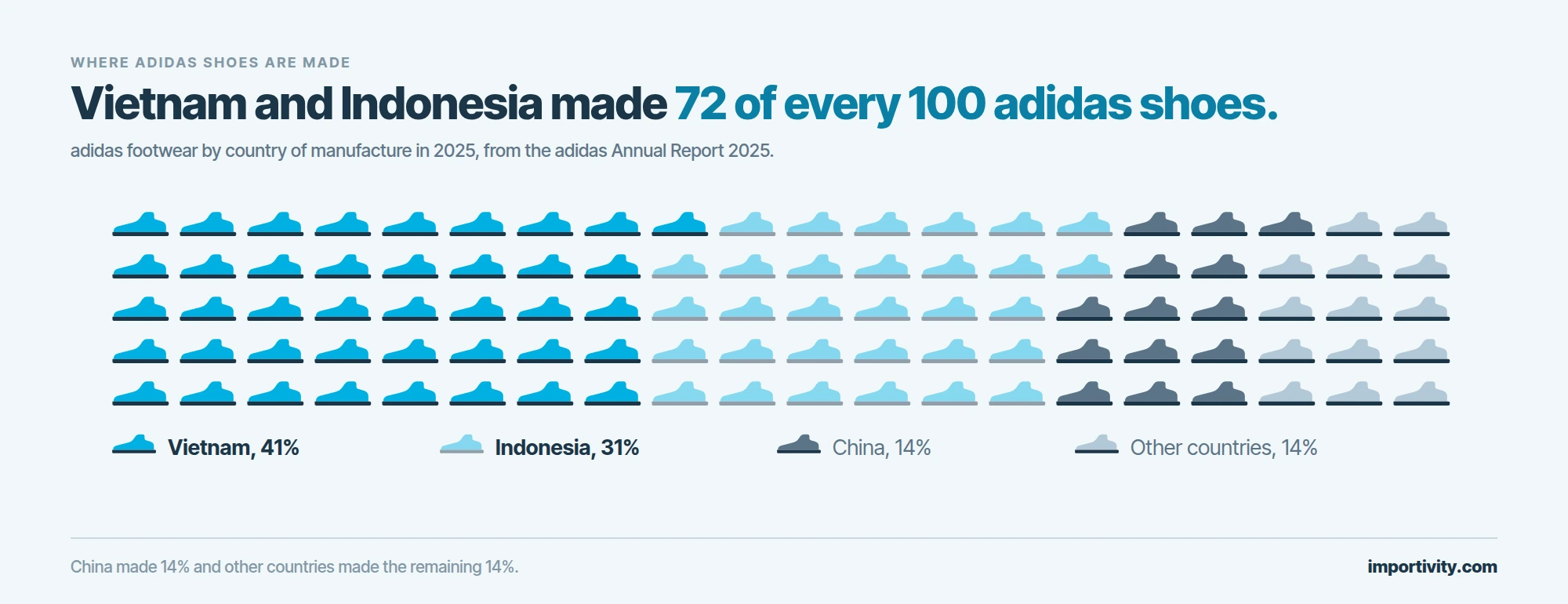
Part of the production is made close to where it is sold. adidas says it has kept increasing local-for-local sourcing, which means making product in the market that buys it, in Greater China, India, Brazil and Argentina. A pair bought in the United States will usually carry a Vietnam, Indonesia or China label, since those three countries made 86% of adidas footwear and 92% of total adidas volume in 2025 was produced in Asia.
| adidas sourcing measure | 2025 | 2024 |
|---|---|---|
| Independent manufacturing partners | 123 | 124 |
| Manufacturing facilities used by those partners | 279 | 283 |
| Partners making footwear | 29 | 30 |
| Share of total volume produced in Asia | 92% | 92% |
| Vietnam share of total volume, all products | 27% | 27% |
| Indonesia share of total volume, all products | 18% | 19% |
| China share of total volume, all products | 16% | 16% |
The table shows a stable base. adidas used one fewer partner in 2025, the country shares barely moved, and Vietnam stayed the largest source for the company overall. Vietnam's footwear factories cluster in the south around Ho Chi Minh City and Dong Nai, as our guide to manufacturers in Vietnam shows.
Where adidas clothing is made
Apparel comes from a different mix of countries. In 2025, Cambodia made 20% of adidas apparel, Vietnam 18% and China 17%, so the top three countries made 55% of the clothing, against 86% of the footwear.
Put the categories together and the answer to "where is adidas made" is Asia first: Vietnam made 27% of the company's total 2025 volume, Indonesia 18% and China 16%. Cambodia and other countries make most of the rest.
For a US importer of clothing, that spread matters. As of November 18, 2026, goods made in Cambodia pay a 10% Section 301 forced-labor duty on top of their base rate, against 12.5% for goods made in Vietnam or China.
The Speedfactory experiment and why it closed
adidas tried to bring shoemaking back to Germany and the US with the Speedfactory, a highly automated plant built to make shoes close to the customer. The first opened in Ansbach, Germany, in 2016 and a second in Atlanta in 2017. News reports at the closure said a German plastics manufacturer ran both plants for adidas.
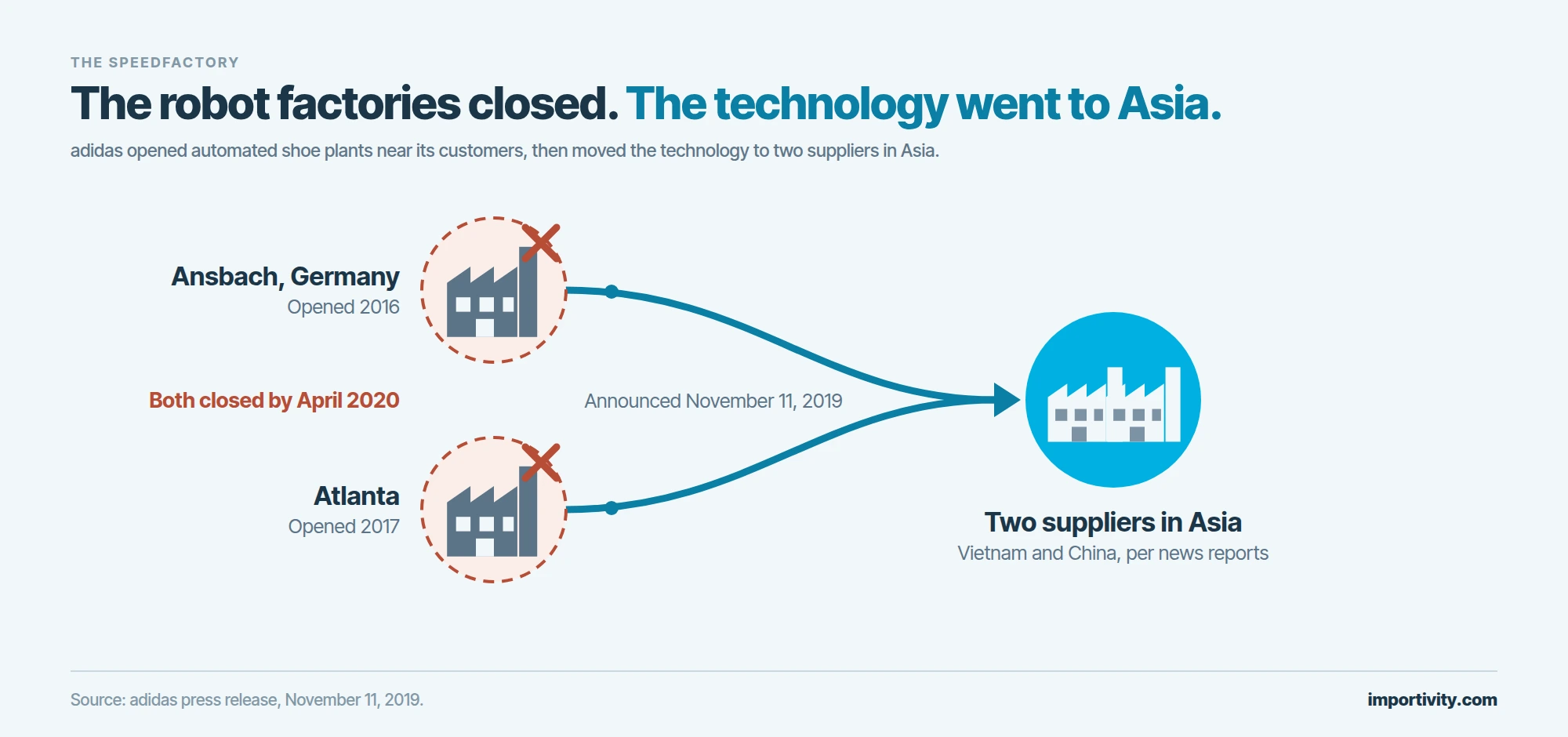
The plan did not last. On November 11, 2019, adidas announced that production in Ansbach and Atlanta would stop by April 2020 at the latest, and that the Speedfactory technology would move to two of its suppliers in Asia, with production there starting at the end of 2019. News reports placed those suppliers in Vietnam and China.
adidas said the change would let it use its suppliers' existing capacity better and give it more flexibility in product design. Reporting at the time pointed to two limits: the plants could make only a small range of models, and the materials know-how and component suppliers for shoes are concentrated in Asia, where adidas already made more than 90% of its products. Development work did not stop. adidas said process development would continue at its site in Scheinfeld, Germany.
The suppliers mattered more than the machines. A shoe needs outsoles, foams, textiles, laces and packaging from many suppliers, and an adidas spokesperson said at the time of the closure that the know-how and the suppliers are in Asia. An automated plant in Germany or the US does not move that supplier base with it.
What adidas still makes in Germany
Very little. In 2024, adidas released a limited "Made in Germany" series of Predator and Copa boots built at its factory in Scheinfeld, Bavaria, to mark 75 years of German craftsmanship, as football boot site SoccerBible reported. These are limited runs, not the shoes most people buy.
A label that says Germany is therefore the exception. If you hold an adidas running shoe or sneaker bought in a US store, the tag will usually say Vietnam, Indonesia or China, and that says nothing bad about the pair. The country on the tag does not tell you whether a pair is genuine. The seller and the product code do.
How adidas compares with Nike
Both companies leave production to independent factories in the same three countries. Factories in Vietnam made about 52% of Nike Brand footwear in Nike's fiscal 2026, against 41% of adidas footwear in 2025, while adidas leaned more on Indonesia, at 31% against Nike's 27%. Nike's shoes came from 15 contract manufacturers and adidas used 29 footwear partners, so Nike's footwear volume is concentrated in fewer companies. Our guides to where Jordans are made and where Hoka shoes are made show the same pattern at other brands.
What a new shoe brand can take from adidas
The first lesson is the Speedfactory one: adidas moved its automated shoemaking out of Germany and the US to suppliers in Asia, where the material suppliers already were. Our guide to American manufactured shoes covers when making shoes in the US still makes sense. For most new brands, the realistic choice is a smaller factory in Vietnam, Indonesia or China that already makes your construction.
The second lesson is that adidas keeps partners for a decade or more and spreads volume so no single factory holds much of it. A small brand cannot spread volume across 29 footwear partners, but it can qualify a second factory once the first style sells, and keep the molds and specifications under its own control.
Then budget for the minimums. Shoemakers Academy, a footwear development school, puts the usual factory minimum at around 500 pairs per model or colorway, and its guide to development contracts prices each rubber outsole mold at $1,500 to $2,000 per size, with ten or more sizes needed. A custom outsole in ten sizes therefore costs $15,000 to $20,000 in molds alone. A stock outsole that the factory already owns avoids most of that cost.
The same school's guides add two points on timing and cash. Development starts with a separate sample mold to confirm the design before the factory cuts the production set, and mold costs are paid before the tools are cut. Material minimums also push the order size up, because a factory may have to buy about 1,000 square feet of one suede to make your color.
Finally, price the duty before you choose a country. As of November 18, 2026, shoes made in Vietnam pay their base rate plus a 12.5% Section 301 forced-labor duty, shoes made in Indonesia pay their base rate plus 10%, and Chinese shoes pay 12.5% plus any China Section 301 list duty on their code. Footwear base rates under HTS chapter 64 depend on the upper, the sole and the price, so classify each style first. Our guide to tariff stacking shows how the layers add up.
Have these ready before you ask a footwear factory for a quote:
- A tech pack per style. Drawings with every material named, plus the size run. Our tech pack guide shows what goes in it.
- Order size per colorway. State the pairs per color, since minimums are set per colorway. Our guide to what MOQ means explains how minimums move the unit price.
- Outsole choice. Stock outsole, or your own molds and who will own them.
- Target factory price. The price per pair you need to hit, so the factory can choose materials to match.
- Construction. Cupsole, cemented runner or vulcanized, so you only talk to factories that already make it.
To get quotes from footwear factories that match your volume, send us your product and order details. Our manufacturer sourcing team finds and vets factories that make your product type.
Frequently Asked Questions
Where is adidas made?
Mostly in Asia. adidas outsources almost all of its production to independent manufacturing partners, and 92% of its total 2025 volume was produced in Asia. Across all products, Vietnam made 27% of the volume, Indonesia 18% and China 16%. Shoes come mainly from Vietnam and Indonesia, while Cambodia was the largest source of adidas clothing in 2025, at 20%.
Are adidas shoes made in China?
Some are. China made 14% of adidas footwear in 2025, behind Vietnam at 41% and Indonesia at 31%, according to the company's 2025 annual report. A China label on an adidas shoe is normal and does not mean the pair is fake. Check the seller and the product code instead of the country.
Who makes adidas shoes?
Independent manufacturing partners make them. adidas says it outsources almost 100% of its production. In 2025 it worked with 123 manufacturing partners in 279 facilities, and 29 of those partners made footwear. Most partners are in Asia, and 65% have worked with adidas for at least ten years.
Does adidas still make shoes in Germany?
Only in small numbers. adidas released a limited Made in Germany series of Predator and Copa football boots in 2024, built at its factory in Scheinfeld, Bavaria. Its automated Speedfactory in Ansbach, Germany, which opened in 2016, was set to stop production by April 2020, and almost all adidas shoes are now made in Asia.
Why did the adidas Speedfactory close?
adidas announced on November 11, 2019 that its Speedfactories in Ansbach and Atlanta would stop production by April 2020 at the latest. It moved the technology to two suppliers in Asia, saying this would use existing capacity better and give more flexibility in design. Reports also cited the small range of models the plants could make.
About the author
Jordan Lewis
Chief Operating Officer, Importivity
Runs Importivity's sourcing operations across China, Vietnam, Mexico and India, from supplier negotiation through landed delivery.
Press and media inquiries: press@importivity.com