What Is MOQ (Minimum Order Quantity) and How It Sets Your Unit Price
MOQ means minimum order quantity: the smallest number of units a supplier will make or sell in one order at the price it quoted. Factories set it at the order size where their setup costs and their own material minimums are covered, so an order below it either costs more per unit or gets turned down.
This guide is for US brands reading their first factory quotes. It shows where a minimum comes from, the kinds you will see, typical minimums by product type, and what to do when your order is smaller. Once you know which minimum you face, our guide to getting a lower MOQ from a manufacturer is the next step.
What is MOQ on a quote or a listing
An MOQ is always tied to three things: a unit, a price and a specification. Change any one of them and the minimum can change.
- The unit. Most minimums are counted in pieces, pairs or sets. Fabric is sold by the yard, meter or kilo, and furniture is often quoted by the container.
- The price. The quoted unit price assumes you order at least the minimum. Below it, the factory refuses or quotes a new price.
- The specification. A stock item and the same item with your logo carry different minimums, because custom work needs its own materials and setup.
Alibaba.com listings show the split. Each listing states a minimum order and price tiers that fall as the quantity rises, and Alibaba's help center says customized products need an inquiry before you can order. On listings we checked in November 2026, a skincare set with a 12-set minimum from stock needed 100 pieces to carry a custom logo. Our guide to buying from Alibaba shows how to read the rest of a listing.
Why factories set a minimum order quantity
Some costs stay the same whether a factory makes 100 units or 2,000. The minimum is the order size where those costs are spread over enough units for the quoted price to work. Three costs set most minimums.
- Setup. Every run needs a pattern or machine program, a changeover from the last job, and first pieces that get checked and often scrapped. The factory pays for that once per order.
- Material minimums. The factory's own suppliers have minimums. A mill dyes fabric in lots, a resin supplier sells by the bag, and a carton printer has a minimum press run. If your order uses a tenth of a lot, someone still pays for the whole lot.
- Tooling. Molds, dies and cutting knives are paid for once. Our guide to injection molding says most factories want to recover a mold's cost within one to three production runs.
Capacity matters as well. A small order takes a slot on the schedule, so busy factories keep their minimums high. A trading company can quote below a factory's minimum because it pools orders or holds stock, as our guide to buying direct or through a trading company explains.
What one bag costs at 100, 500 and 2,000 pieces
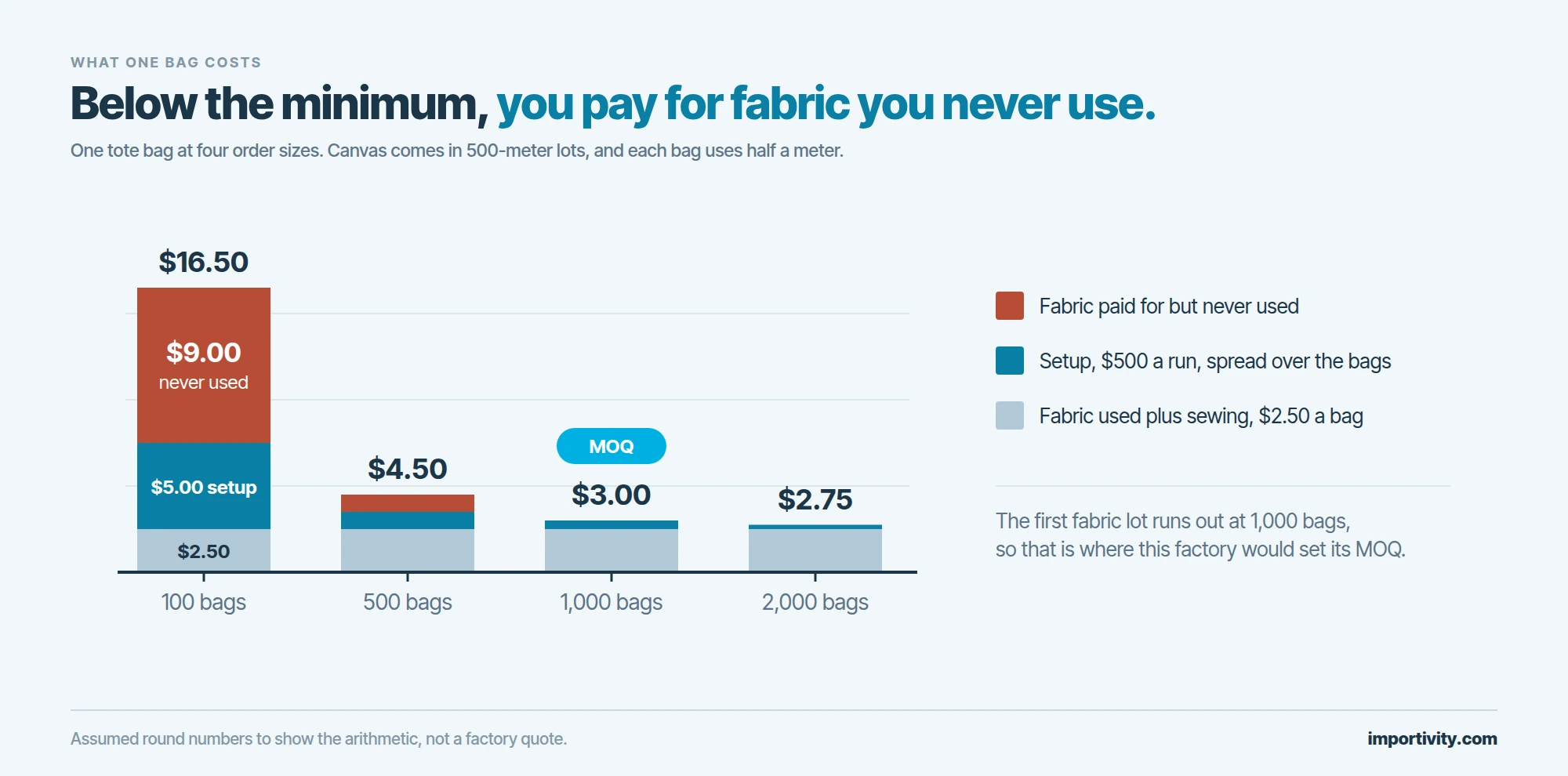
Here is a worked example. Every input in it is an assumption: round numbers chosen to show the arithmetic, not a real factory's prices. The product is a printed canvas tote bag in a custom color. The mill dyes the canvas in lots of 500 meters at $2.00 a meter, and each bag uses half a meter. Setup costs $500 per order, for the pattern, print screens, line changeover and first-piece checks. Sewing, printing, trims and packing cost $1.50 a bag.
Run each quantity through the same three costs:
- 100 bags. The factory must buy a full 500-meter lot for $1,000, although the bags use only 50 meters. Add $500 of setup and $150 of sewing (100 times $1.50). The order costs $1,650, or $16.50 a bag. Of that, $5.00 a bag is setup and $9.00 a bag pays for fabric that is never used.
- 500 bags. The fabric is still one lot at $1,000, and the bags use 250 meters of it. Add $500 of setup and $750 of sewing. The order costs $2,250, or $4.50 a bag.
- 2,000 bags. The bags use 1,000 meters, exactly two lots, for $2,000. Add $500 of setup and $3,000 of sewing. The order costs $5,500, or $2.75 a bag.
At every quantity, the fabric a bag uses plus its sewing comes to $2.50, and the rest is setup and unused fabric. The first lot runs out at 1,000 bags: $1,000 of fabric, $500 of setup and $1,500 of sewing, or $3.00 a bag. That is where this factory would likely set its MOQ.
This is how MOQ moves the unit price. Going from 100 to 1,000 bags takes $13.50 off each bag. Going from 1,000 to 2,000 takes off 25 cents, because past the minimum the only saving left is the $500 setup spread over more bags. So price tiers on a quote drop steeply up to the minimum and level off after it. The factory's margin sits on top of these costs and does not change the pattern.
The kinds of MOQ you will see
A quote often sets more than one minimum at once. Say a factory quotes 300 pieces per style and 100 pieces per color. You want 300 T-shirts in five colors, which is 60 of each, so every color falls 40 short of its minimum. Ordering the same 300 shirts in three colors gives 100 of each and clears both minimums.
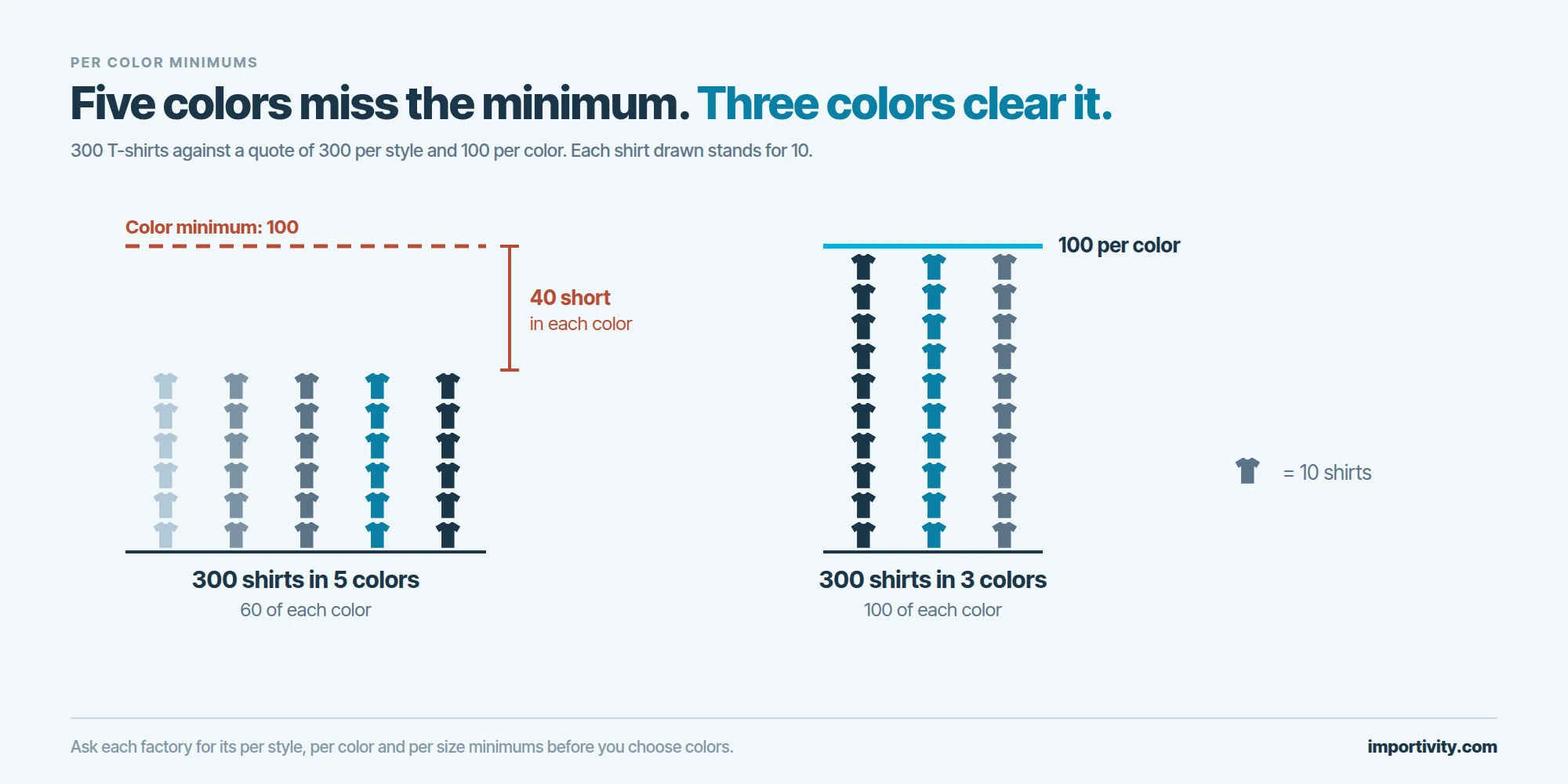
Each kind of minimum comes from a different cost, so ask the factory which one sets its number:
- Per order. The smallest total the factory will run at one time, set by setup time and paperwork.
- Per style. Each design needs its own pattern and samples, and the line is set up again for it, so each style has to reach its own number.
- Per color. Fabric, yarn and plastic are dyed or mixed in batches, so each color has to use up a batch.
- Per size. Some apparel factories set a minimum for each size. At 20 per size, a run from XS to 3XL is seven sizes and 140 pieces of one color.
- Per material. A custom fabric, alloy or resin carries the supplier's minimum, usually in yards, meters or kilos rather than pieces.
- By order value. Some suppliers, often wholesalers and trading companies that sell mixed goods, set a minimum dollar amount instead of a unit count.
Typical MOQ by product type
Each product type has a usual range, and each figure below has a dated source. Use them to plan quote requests, and expect each factory to give its own number.
| Product type | Typical minimum | Source |
|---|---|---|
| Clothing from US cut-and-sew shops | From 25 pieces per style at the smallest shops. Many small-batch shops start at 50 to 100 | Maker's Row guides, 2026 |
| Clothing from Vietnam factories | 50 to 300 pieces per style at small-batch factories, 300 to 1,000 at mid-tier factories, 3,000 or more at large export plants | Our Vietnam clothing suppliers guide, 2026 |
| Fabric in a custom color | 500 to 5,000 meters per color at a mill | Blog posts by fabric suppliers, November 2026 |
| Bags | About 50 pieces per color for your logo on an existing bag. 300 to 500 pieces per style for a new pattern | Sourcing agents in China that publish their terms, November 2026 |
| Footwear | 300 to 1,000 pairs per style at mid-tier factories in Vietnam | Our guide to sourcing from Vietnam, 2026 |
| Skincare with your label | 25 to 500 units per product on a stock formula. Semi-custom from 250 and full custom from 2,500 at two labs | Published terms of US private label labs, November 2026 |
| Injection-molded plastic parts | About 500 pieces for simple parts on low-cost tooling at some Chinese factories. 1,000 or more to cover a mold, 5,000 or more to be comfortable | Our guide to injection molding, 2026 |
| Stock goods with your logo on Alibaba.com | 2 to 1,000 pieces | Listings we checked, November 2026 |
The table shows two patterns. Custom work starts higher than stock work, and the material often sets the number before the factory does. If a style uses 1.5 meters of fabric and the mill's minimum is 500 meters per color, the fabric alone sets a floor of 333 pieces in that color.
Packaging can set the number too. One of the skincare labs starts its stock formulas at 50 units, but its page also mentions a packaging minimum of around 1,000 pieces. Our guide to private label cosmetics manufacturers says a private packaging mold usually needs 12,000 to 50,000 units to make economic sense. Ask for the formula minimum and the packaging minimum as separate numbers.
What factories do with an order under the minimum
An order below the minimum usually gets one of five answers:
- A refusal. Large export plants often say no, and some never reply.
- A higher unit price. The quote follows the arithmetic above: $16.50 a bag at 100 bags instead of $3.00 at 1,000.
- A separate setup fee. A one-time charge for setup or tooling keeps the unit price close to the standard tier.
- Stock material or an existing design. Canvas the factory already stocks has no lot minimum. In the example, if stock canvas costs $2.40 a meter, 100 bags need $120 of fabric, $500 of setup and $150 of sewing, or $7.70 a bag. Starting from a design the factory already makes also cuts setup, and our guide to OEM vs ODM manufacturing covers what you give up.
- A slot between larger orders. Your run waits for a gap in the schedule, so the lead time gets longer.
Be careful when a factory takes a small order at its normal price. The goods may come from leftover stock or a workshop you have not approved, so ask where the order will be made and inspect it before you pay the balance.
You have choices of your own when the order is small:
- Order the full minimum. In the example, 1,000 bags cost $3,000 against $1,650 for 100. That is $1,350 more cash for 900 more bags, which makes sense only if you can sell them.
- Buy through a trading company or a wholesaler. They pool orders or hold stock, and they charge for it. Our guide to buying direct or through a trading company cites trade press that puts the markup at 10 to 25 percent.
- Start with white label. A product that many sellers already buy ships in small lots, often 25 to 500 units, according to our guide to private label vs white label. You give up exclusivity.
- Use a US small-batch shop. For clothing, the smallest US cut-and-sew shops listed by Maker's Row start at 25 pieces per style, at a higher price per piece.
MOQ vs EOQ and how to choose your first order size
MOQ is the supplier's floor. EOQ, or economic order quantity, is your own calculation of the order size with the lowest combined cost of placing orders and holding stock. Multiply 2 by your annual demand and by the cost of placing one order, divide by the yearly cost of holding one unit, and take the square root of the result. When your EOQ comes out below a supplier's MOQ, you either order the minimum and hold the extra stock or pay more per unit for a smaller run.
Before you send a quote request, work through these steps:
- Ask for prices at three quantities. Use your test size, the factory's minimum and twice the minimum. The gaps between the three prices show where the setup and material costs sit. Our guide to writing a manufacturing RFQ shows how to lay out the tiers.
- Multiply out your styles, colors and sizes. Three styles in four colors means twelve color minimums, even if each style clears its own.
- Work out landed cost at each quantity. Freight, duty, inspection and broker fees add to every order, and some of them barely change with order size. Our guide to calculating landed cost shows each line.
- Decide what the first order has to prove. A test of whether a product sells can carry a higher unit price. A launch that has to earn a margin cannot.
When you know your quantities, our guide to getting a lower MOQ covers what to ask the factory for. To get quotes at your own quantities, send us your product and order details. Our product sourcing team finds and vets factories that make your product type.
Frequently Asked Questions
What does MOQ stand for?
MOQ stands for minimum order quantity: the smallest number of units a supplier will make or sell in one order at its quoted price. It can be counted in pieces, pairs, meters or kilos, or set as a dollar amount. Below it, a factory either charges more per unit or refuses the order.
What does MOQ mean on Alibaba?
On Alibaba.com, the MOQ is the minimum order shown on each listing, next to price tiers that fall as the quantity rises. It applies to the product as listed, and a custom logo or package usually needs more. On listings we checked in November 2026, custom logo minimums ran from 2 to 1,000 pieces.
Can I order less than the minimum order quantity?
Often, yes, but it costs more. A factory may quote a higher unit price, charge setup as a separate fee, switch you to a stock material or an existing design, or fit your run between larger orders. A trading company, wholesaler or white label supplier can also sell smaller lots.
Is MOQ per style or per color?
It can be both. Many factories quote a minimum per style and a separate one per color, and some apparel factories add one per size. Each color has to clear its own number because fabric, yarn and plastic are dyed in batches. A quote of 300 per style and 100 per color allows 300 pieces in three colors but not in five.
What is the difference between MOQ and EOQ?
MOQ is the supplier's minimum order. EOQ, or economic order quantity, is the buyer's own calculation of the order size with the lowest combined cost of ordering and holding stock. Multiply 2 by annual demand and by the cost of one order, divide by the yearly cost of holding one unit, and take the square root. If your EOQ is below the MOQ, you order the minimum or pay more per unit.
About the author
Jordan Lewis
Chief Operating Officer, Importivity
Runs Importivity's sourcing operations across China, Vietnam, Mexico and India, from supplier negotiation through landed delivery.
Press and media inquiries: press@importivity.com