Is Alibaba Safe for US Importers and How to Protect an Order
Alibaba is safe enough to transact on and not safe enough to trust blindly. The platform runs a real escrow product, Trade Assurance, that holds your payment until you confirm the goods arrived as agreed, and it runs three tiers of supplier verification that confirm a company legally exists and, at the higher tiers, that a third party walked its factory floor. What none of that does is guarantee the quality of the specific product you ordered, and almost every US importer who loses money on Alibaba lost it after stepping outside those protections voluntarily.
This guide is for US brands and ecommerce sellers placing a first or second order with an overseas factory found on Alibaba. It covers what the badges actually certify, how a Trade Assurance dispute really works, the four patterns that cost importers money, and what changed in US import rules in 2025 and 2026. If you want the wider process around it, start with our guide to importing products from China.
What Alibaba Actually Guarantees
Alibaba is a marketplace, not a manufacturer and not an inspector. Its guarantee is financial and procedural. Trade Assurance is free to use and works as an escrow layer: you pay into funds Alibaba holds, and the supplier is paid only once you confirm receipt or the claim window closes without a dispute. According to Alibaba's own policy guide, it covers late shipment measured against the contracted ship date, product quality that does not match an agreed written specification, missing items or short quantities, in transit damage where the seller arranged shipping, and breaches of DDP contract terms.
The exclusions matter more than the inclusions. Trade Assurance does not cover force majeure delays, subjective quality complaints with no objective specification to measure against, your own counting errors after delivery, damage you caused after delivery, or customs problems that were never written into the order terms. Read that list again and notice the pattern: the protection only reaches as far as the specification you wrote down. A vague purchase order is an uninsured purchase order.
This is the single most useful reframing for a new importer. Alibaba does not decide whether your goods are good. It decides whether your goods match what you and the supplier agreed in writing on the platform. Everything you do to make that agreement precise, before you pay, is what converts the escrow from a formality into real cover.
What the Supplier Badges Really Prove
Three badges appear on Alibaba supplier profiles and they are not the same thing. Gold Supplier is a paid membership tier combined with a basic business license and registration check. It confirms a company is legally registered and it involves no on site inspection at all. Verified Supplier means a third party inspection firm went to the site, confirmed the business license and address, and walked the production floor. Assessed Supplier is the deepest tier, covering production facilities and processes, quality control systems, management structure, headcount and export markets. The audit firms named across Alibaba's verification material are the usual global names, including SGS, Intertek, Bureau Veritas and TUV Rheinland.
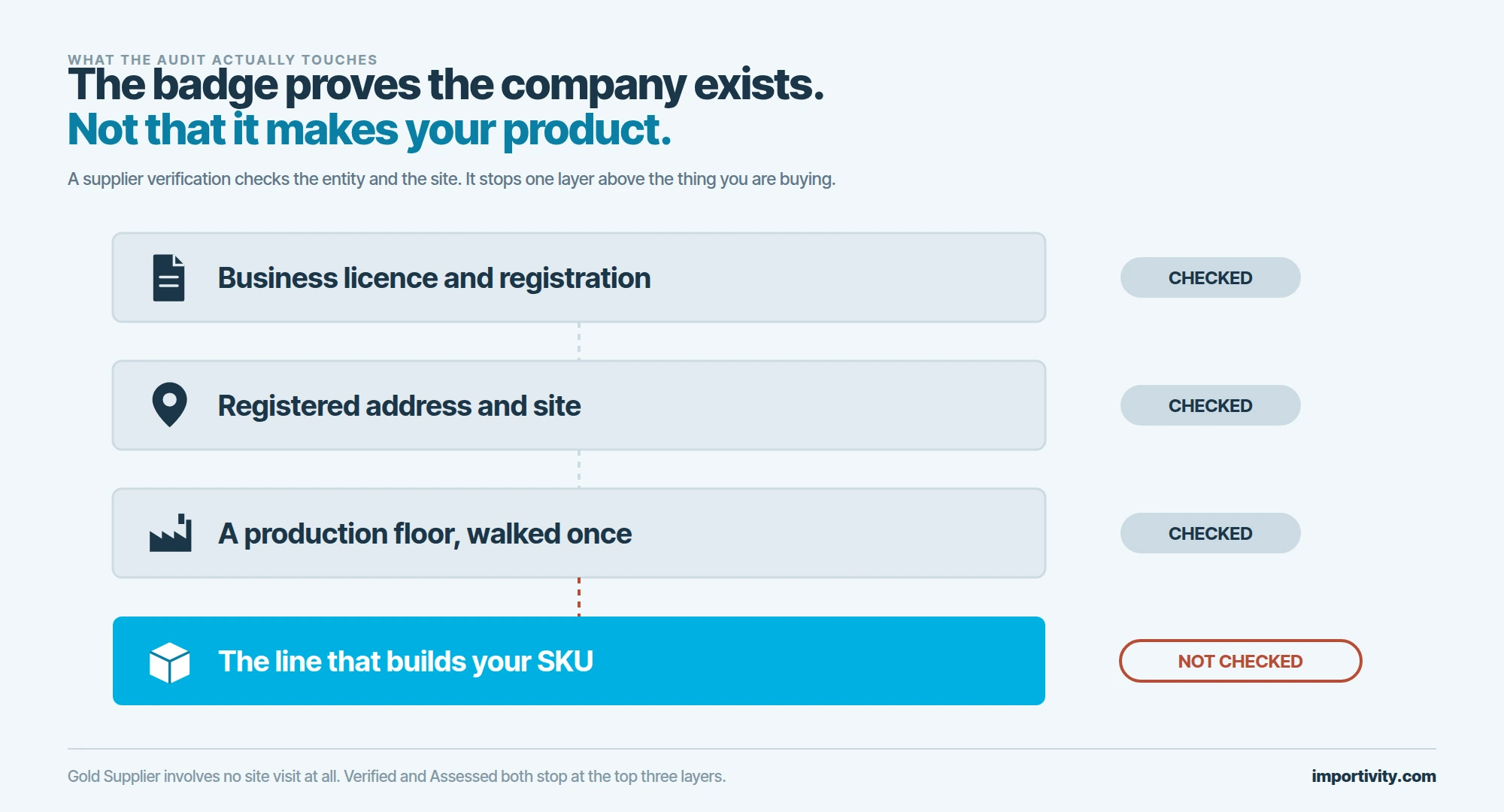
Here is the limit that catches people. Every one of those checks confirms that an entity exists, is registered, and operates a facility. None of them confirms that the specific product line you are ordering is made in that facility, and none of them prevents a substitution on the bulk run. That is not a theoretical objection. In litigation brought by the maker of Squishmallows, a federal judge in the Southern District of New York allowed the case to proceed on allegations that Alibaba had granted Gold Supplier and Verified status to merchants selling counterfeit goods. The badge is a filter, not a guarantee.
| Signal on the profile | What is actually checked | What it does not prove |
|---|---|---|
| No badge | Nothing beyond a created account | That the company exists at all |
| Gold Supplier | Paid membership plus business license and registration check, no site visit | That there is a factory, or any production capability |
| Verified Supplier | Third party on site audit of license, address and production floor | That your product line is made there |
| Assessed Supplier | On site audit of processes, QC systems, management and export markets | That the bulk run will match your sample |
| Trade Assurance | Escrow on the order and a dispute route | Anything you did not write into the order terms |
Treat the badge as a way to shorten a long list, then do your own work on the two or three suppliers that survive. Our factory audit checklist covers what to actually look for, and the factory visit checklist is the version you take with you or hand to an agent on the ground.
How Trade Assurance Works When an Order Goes Wrong
The dispute path is a sequence with deadlines, and the deadline is where most claims die. You file a claim with evidence, meaning photographs, video, and the contract terms. The supplier gets a few days to respond. You negotiate through online mediation. If that fails you escalate to Alibaba, which issues a decision. Once a refund is approved, the money moves back on a timetable that depends on how you paid: roughly ten working days for a credit card, about seven business days for a bank transfer, and about three working days for e-checking.
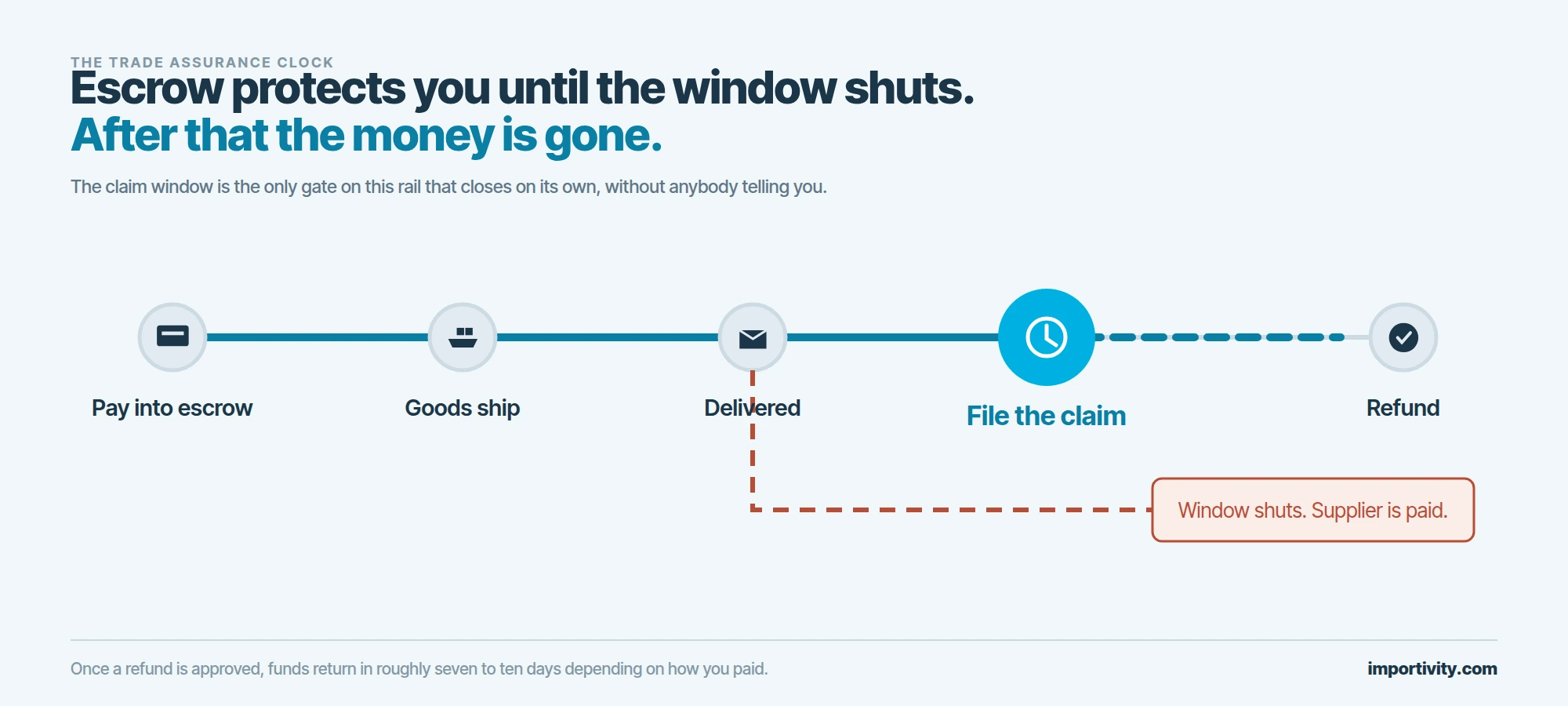
One number you should not trust from any third party guide is the length of the claim window. Alibaba's own material states inspection and dispute must be started within fifteen days of delivery, while widely circulated sourcing guides state thirty days, and sixty for higher tier buyer accounts. That discrepancy is real and unresolved in public documentation, which strongly suggests the window varies by account level. Do not plan around a number you read anywhere, including here. Open your order page and read the window shown on that specific order, then set a calendar reminder two days before it closes.
The practical consequence is that your inspection has to happen before the goods clear the window, not when you get around to unpacking them. That is the argument for a pre shipment inspection rather than a post delivery one. Catching a defect while the goods are still in the factory gives you leverage and an intact escrow. Catching it three weeks after delivery may give you neither.
The Four Ways US Importers Actually Lose Money
The losses cluster into a small number of repeatable patterns. None of them are exotic and all of them share a shape: the buyer left the platform's protection before the loss happened.
- The off platform payment push. The supplier moves the conversation to WhatsApp or WeChat early, then asks for a wire to a personal rather than a company bank account, usually citing escrow fees or a company account under audit. This is the single highest risk signal in the whole process.
- The golden sample switch. A flawless, often hand finished sample wins the order, and the bulk run is built with cheaper materials. The defence is procedural: keep the approved sample, and inspect the production run against it physically before the goods ship.
- The trading company posing as a factory. A listing does not require proof that you own the facility in the photographs. A live video walkthrough where you ask them to name and show the specific machinery your product needs will usually settle it. Evasion is the answer.
- Escrow bypass under time pressure. A supplier who specifically discourages Trade Assurance on a first order is asking you to remove the only enforceable dispute mechanism you have. Treat it as disqualifying.
Our guides on supplier red flags and paying an overseas supplier go deeper on the payment side, which is where the irreversible mistakes happen.
What Changed in 2025 and 2026
Two shifts changed the risk picture for anyone sourcing small orders from Chinese platforms, and neither is about Alibaba itself.
The first is the end of duty free de minimis treatment. Under Executive Order 14324, the exemption was suspended for shipments from all countries for goods entered on or after 12:01 a.m. on August 29, 2025, as set out in the Federal Register implementation notice. Small parcels and sample orders that used to slip under an 800 dollar duty free threshold now need formal entry, correct classification and paid duty. The cost of a classification mistake on a trial order went up sharply. If you are not confident on your codes, read our guide to HTS codes and customs classification before you place one.
The second is forced labor enforcement reaching further up the supply chain. In its 2025 strategy update, the Forced Labor Enforcement Task Force reported the UFLPA Entity List had grown to 144 Chinese entities, with 78 added in the preceding year, and designated caustic soda, copper, lithium, red dates and steel as new high priority sectors. The presumption applies to inputs, not just to your direct supplier, so a clean Alibaba supplier can still ship you goods built from a listed entity's material. Our guide to forced labor import compliance covers what documentation actually holds up.
The Checks to Run Before You Wire Anything
None of this requires a compliance department. It requires a sequence you refuse to skip when a supplier is being charming and the price is good.
- Keep every payment inside Trade Assurance on the first two orders. No exceptions, no personal accounts, no split payments off platform.
- Write a specification you could win an argument with. Materials, dimensions with tolerances, finish, packaging, labelling, and the acceptance standard. Attach it to the order, do not email it.
- Buy a sample and keep it sealed. The approved sample is your evidence. Our pre production sample process sets out how to run this properly.
- Ask for the business license and check the legal name matches the account. A mismatch between the trading name and the registered entity is worth a hard question.
- Book a pre shipment inspection on the first production run. It costs a few hundred dollars and it is the only check that happens while you still hold the money.
- Verify capability, not just existence. Ask what else they make, who else they export to, and what their monthly capacity is on your specific process.
Doing all six on your own is realistic for one supplier and unrealistic for ten. That is the point at which most brands bring in help. Our supplier vetting service exists for exactly that gap, and our guide to verifying supplier reliability covers the parts you can do yourself. A live walkthrough is also the part we do in person, and the factory visits we publish through Source With Jordan are the same check run at the supplier's own gate.
So Is Alibaba Safe
Yes, for a buyer who stays inside the protections and writes precise orders. It is a genuine channel to a very large number of real factories, and the escrow layer is real money held by a real intermediary. It is unsafe for a buyer who treats a Gold Supplier badge as due diligence, wires money to a personal account, and inspects the goods a month after they land.
The platform is a filter and a payment rail. The vetting is still your job, or your partner's. Judge suppliers on what you verified rather than on what the profile claims, and the failure modes above stop being your failure modes.
Frequently Asked Questions
Is Alibaba safe for a first time importer?
Yes, provided you keep the whole transaction inside Trade Assurance and write a detailed written specification into the order. The escrow layer holds your payment until you confirm the goods match what was agreed. The risk for a first time importer is not the platform, it is agreeing to pay outside it, or ordering against a vague description that gives you nothing to measure a claim against.
What does the Verified Supplier badge actually mean?
It means a third party inspection firm visited the site and confirmed the business license, the address and the existence of a production floor. It does not confirm that the specific product you are ordering is made there, and it does not guarantee quality on the bulk run. Gold Supplier is weaker still, being a paid membership plus a registration check with no site visit at all.
How long do I have to file a Trade Assurance claim?
It varies and the public documentation conflicts. Alibaba material states fifteen days from delivery, while third party guides commonly state thirty days, or sixty for higher tier buyer accounts. Because the window appears to depend on account level, check the figure shown on your own order page rather than relying on a general number, and diarise it before the goods arrive.
Can I get my money back if the bulk order does not match the sample?
You can if the agreed specification is on the order and you file inside the claim window with evidence. Photographs, video and the sealed approved sample are what carry a claim. If the order only described the product loosely, the mismatch becomes a subjective quality complaint, which Trade Assurance explicitly does not cover.
Why would a supplier ask me to pay outside Alibaba?
Sometimes to avoid platform fees, and sometimes because the escrow makes fraud impossible. You cannot tell which from the message. A request to wire to a personal account, or to skip Trade Assurance on a first order, removes your only enforceable dispute route and should be treated as disqualifying rather than negotiable.
About the author
Jordan Lewis
Chief Operating Officer, Importivity
Runs Importivity's sourcing operations across China, Vietnam, Mexico and India, from supplier negotiation through landed delivery.
Press and media inquiries: press@importivity.com