Alibaba Alternatives for US Importers and What Each One Is For

The useful Alibaba alternatives are not one substitute site but four different kinds of channel, and each verifies something Alibaba does not. Made-in-China.com publishes free third party audit reports on its audited suppliers. Global Sources checks export history rather than just registration. IndiaMART, Kompass and Thomasnet reach suppliers Alibaba barely lists. Trade shows let you handle the product and meet the person. Government trade agencies will introduce you to pre screened exporters for a fee. Used together they answer the question Alibaba leaves open, which is whether the company you found actually manufactures anything.
This guide is for US importers who already use Alibaba and want better or additional channels. It covers what each one genuinely verifies, the trade show calendar worth planning around, the accreditation change that happened in January 2026, and how to separate a factory from a trading company on any platform. If you want the Alibaba side of this first, read our guide to whether Alibaba is safe.
Why You Want a Second Channel At All
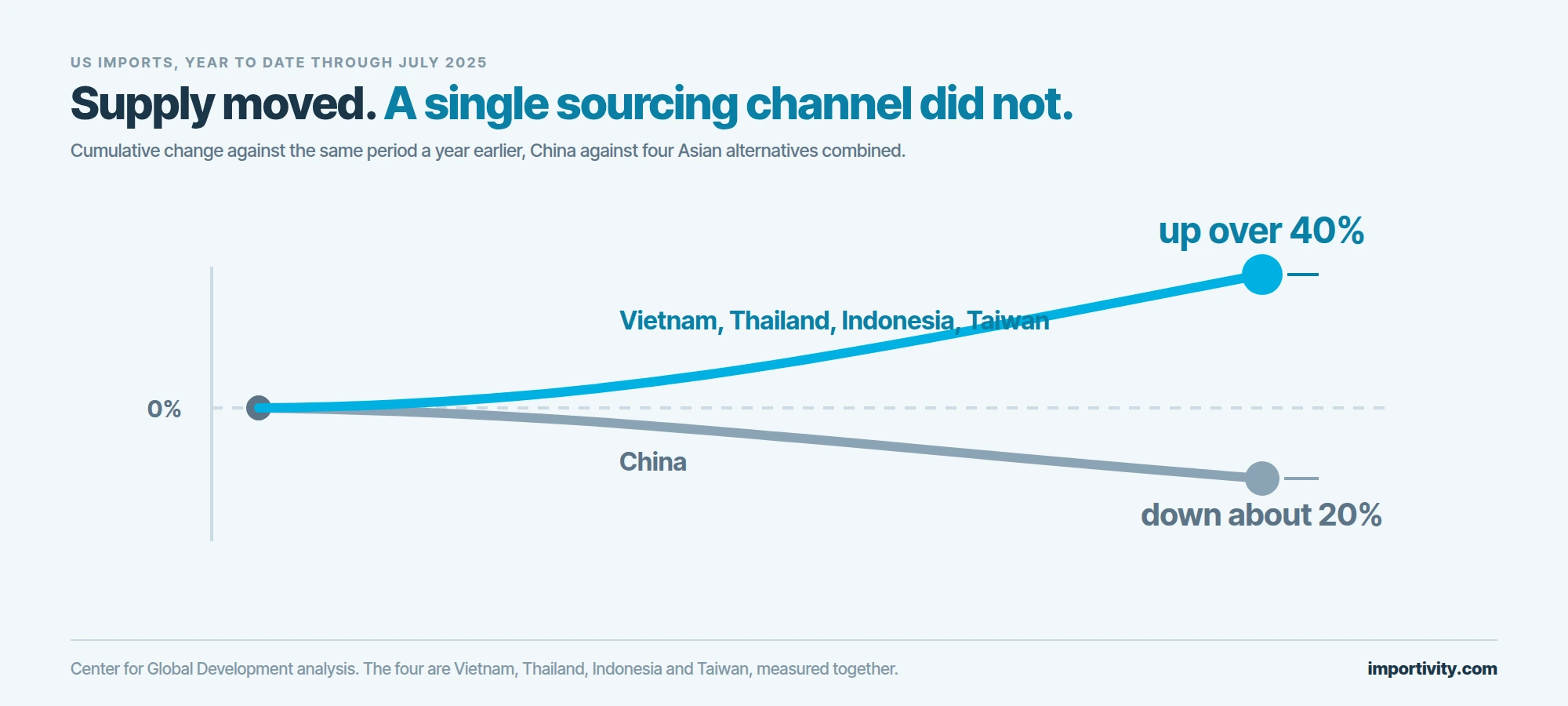
Supply is moving and a single channel keeps you looking where it used to be. Analysis by the Center for Global Development found US imports from China fell about 20 percent on a cumulative year to date basis through July 2025, while combined imports from Vietnam, Thailand, Indonesia and Taiwan rose more than 40 percent year on year over the same period, more than double the growth rate of the comparable stretch in 2024.
Alibaba's supplier base is overwhelmingly Chinese. That is a strength when China is where your product should be made and a blind spot when it is not. If you are evaluating a move, our guides to sourcing from Vietnam and sourcing from India cover what actually transfers and what does not.
The second reason is verification depth. Alibaba's badges confirm a company exists and, at the higher tiers, that somebody visited a site. Other channels verify different things, and stacking two weak signals from independent sources beats trusting one.
The Marketplaces and What Each Actually Verifies
Treat these as search tools with different coverage and different evidence standards, not as competitors offering the same thing.
| Channel | What it verifies or covers | Where it falls short |
|---|---|---|
| Made-in-China.com | Audited Supplier status from an on site inspection across eight capability areas, run by SGS, Bureau Veritas, TUV Rheinland or CTI, with the report published free on the profile | Still China only, and an audit of capability is not an audit of your product |
| Global Sources | Supplier verification covering company registration, business license and export history and reputation, plus a strong Hong Kong trade show business | Smaller supplier base, and consumer electronics weighted |
| IndiaMART | India at scale, reporting 8.7 million supplier storefronts and 220,000 paying suppliers as at 31 March 2026 | Domestic Indian trade first, export readiness varies widely |
| Kompass | A business directory rather than a marketplace, reporting over 60 million companies across 70 plus countries | No transaction layer, no escrow, no supplier verification tier |
| Thomasnet | North American industrial suppliers, useful when the answer to a tariff problem is domestic production | Higher unit costs, and thin coverage of consumer goods |
Made-in-China.com's audited supplier programme is the one genuinely differentiated feature in that list. The published audit report covers general company information, export capacity, manufacturing capability, service, quality control, research and development, financial standing and sustainability, and you can read it before you make contact. That is more disclosure than any comparable badge gives you.
The Verification Layer Most Buyers Skip
Independent registries let you check a supplier's claims without asking the supplier. Three things are worth knowing here, and one of them changed recently.
Certification registries are the first stop. If a supplier claims ISO 9001 or ISO 14001, the certificate number can be checked against the certification body's own database and the body's accreditation checked in turn. The structure behind that changed on 1 January 2026, when the International Accreditation Forum ceased operations and merged with ILAC into a single body, Global Accreditation Cooperation Incorporated, which now runs certificate verification. If you are following an old bookmark or an old article referencing IAF CertSearch, that is why the branding has moved.
Testing house directories are the second. SGS operates a public certified client directory searchable by certificate number or company name, so a claimed management system certificate can be confirmed at source. Treat any certificate supplied only as a PDF with suspicion. Scanned certificates are trivially forged and the whole point of a registry is that you do not have to trust the copy you were sent.
The third is a negative finding worth knowing before you waste a morning on it. There is no public lookup for FDA food facility registration. Registrations are confidential and only the account holder can view them, so a food supplier's claim to be FDA registered cannot be independently confirmed from a public database the way a device or drug listing can. Ask for the registration number and the account holder's confirmation instead. Our factory audit checklist covers what to verify on site once the paperwork checks out.
Trade Shows, Still the Fastest Way to Qualify a Factory
Two days at the right show does more supplier qualification than two months of messaging, because you handle the samples, meet the people, and see who brings an engineer rather than a salesperson.
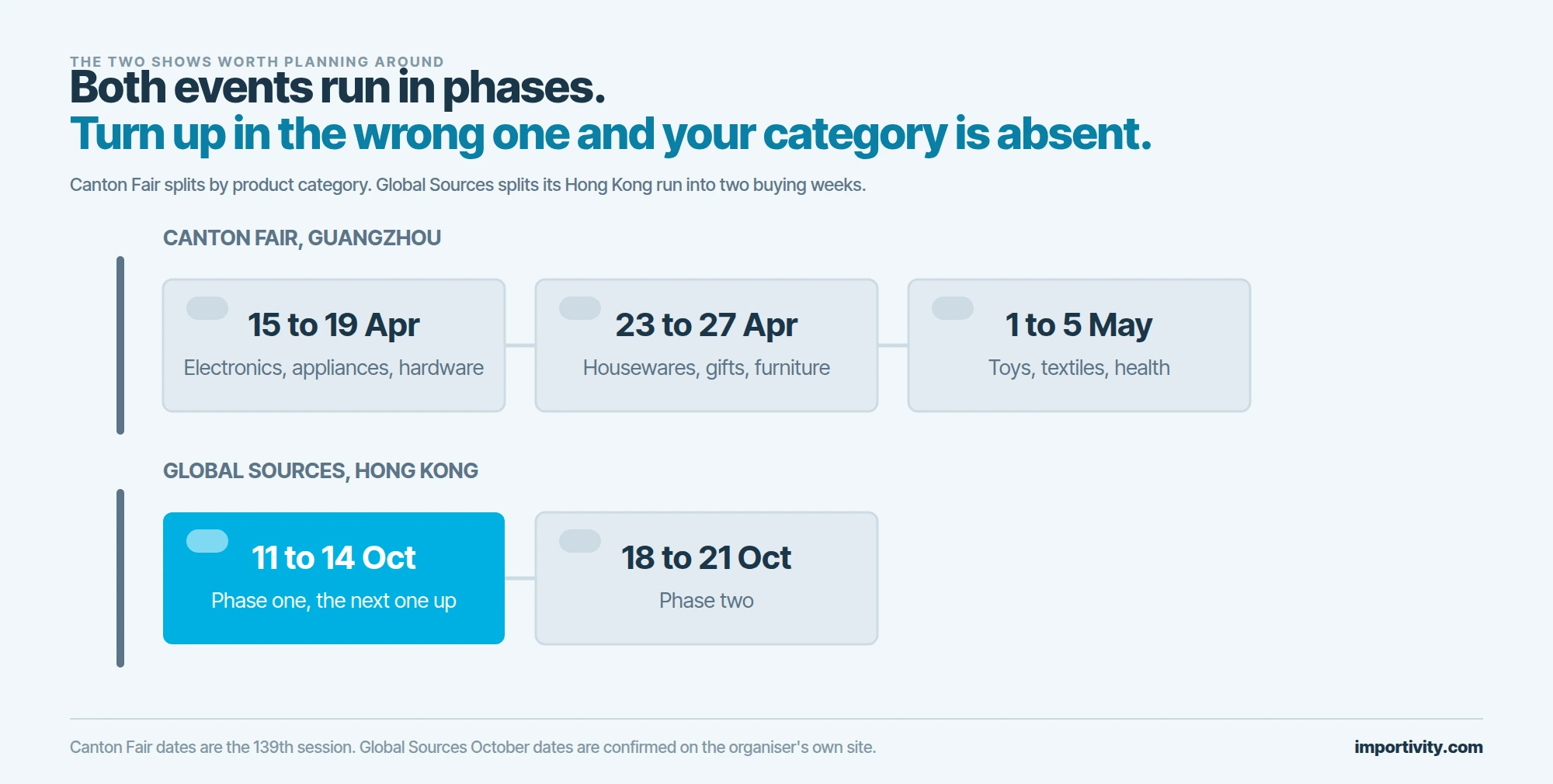
The Canton Fair remains the largest. The 139th session ran across three phases in 2026, from 15 April to 5 May, split by category: electronics, appliances and hardware in the first phase, housewares, gifts and furniture in the second, and toys, textiles and health products in the third. For scale, the preceding 138th session drew more than 310,000 buyers from 223 countries with 25.65 billion dollars in intended export transactions reported. Check the phase before you book, because attending the wrong week means your category is not in the building.
Global Sources runs the other major Hong Kong buying event, with October 2026 phases confirmed on its own site as 11 to 14 October and 18 to 21 October. Hong Kong is the easier trip for a first time buyer, with simpler entry and a more international exhibitor mix. Whichever you choose, go with a shortlist and a specification rather than an open mind, and use our guide to writing a manufacturing RFQ to make sure every booth quotes the same thing.
We work these halls rather than writing about them from a desk. Our own archive from recent Canton editions runs to more than 120 filmed stalls, booth by booth, which is also the fastest way to see what a category really looks like before you book a flight. Those walkthroughs go out through Source With Jordan.
Government Matchmaking, the Channel Nobody Uses
National trade promotion agencies exist to introduce foreign buyers to their own exporters, and they are structurally biased toward real manufacturers, because listing usually requires a registered business license tied to a government export programme.
The US Commercial Service runs the Gold Key Service, which arranges pre screened meetings with interested suppliers in a target market. Pricing is tiered by company size, but the only fee schedule we could find in public is years out of date, so request a current quote through trade.gov rather than budgeting from any figure published online. On the supply side, KOTRA operates the buyKOREA platform listing Korean suppliers and runs matchmaking events with travel support for qualifying buyers, and Vietnam's VIETRADE maintains a searchable company directory.
One correction worth carrying, because stale advice on this circulates widely: JETRO's Trade Tie-up Promotion Programme, the TTPP database that older sourcing guides still recommend, was discontinued in December 2021. The current Japanese equivalent is JETRO e-Venue. If a guide tells you to search TTPP, it has not been updated in five years, which is a reasonable prompt to check what else in it is out of date.
How to Tell a Factory From a Trading Company
No platform reliably distinguishes the two, because status is self declared and neither a verified badge nor an audited badge confirms who owns the production line. You will see figures claiming that some large majority of marketplace listings are traders. Those numbers come from sourcing agency marketing content, disagree with each other by thirty percentage points, and have no methodology behind them, so treat the pattern as real and the percentage as unknowable.
The checks that actually work are cheap and fast.
- Read the business license, not the profile. A Chinese company's registered name carries its business type. Manufacturing and technology characters in the name point one way, trading characters another.
- Look up the registered address. An industrial park is a different signal from a floor in an office tower. Map it before the call.
- Cross check the unified social credit code. The code on the license should resolve on China's own national enterprise registry, and the registered scope of business should include manufacturing.
- Ask for a live video walkthrough naming your machinery. Not a recorded tour. Ask them to walk to the specific process your product needs and describe it. Evasion is the answer.
- Ask who else they export to in your category. A factory answers with product types and volumes. A trader answers with countries.
- Compare the audit report to your product. A published audit that lists capability in a different process than yours is telling you they will subcontract.
A trading company is not automatically the wrong answer. For small volumes, mixed containers or a category where you need one point of contact across several factories, a good trader earns its margin. The problem is only ever paying factory-direct prices for trading company service without knowing which you bought. Our guides on supplier red flags and how sourcing agent fee models work cover the rest of that judgement, and our supplier vetting service is what to use when the shortlist gets longer than you can personally visit.
Frequently Asked Questions
What is the best alternative to Alibaba?
There is no single replacement, because the useful alternatives do different jobs. Made-in-China.com publishes free third party audit reports on audited suppliers, which is the strongest disclosure of any marketplace badge. Global Sources verifies export history and runs the main Hong Kong trade shows. IndiaMART and Kompass reach suppliers outside China. Thomasnet covers North American industrial manufacturers. Use two or three rather than swapping one platform for another.
Is Made-in-China.com better than Alibaba for verification?
On one specific measure, yes. Its Audited Supplier programme publishes the full inspection report free on the supplier profile, covering general company information, export capacity, manufacturing capability, service, quality control, research and development, financial standing and sustainability, with audits run by firms such as SGS, Bureau Veritas, TUV Rheinland and CTI. You can read the evidence before making contact rather than trusting a badge.
When is the Canton Fair in 2026?
The 139th session ran from 15 April to 5 May 2026 across three phases split by product category: electronics, appliances and hardware first, then housewares, gifts and furniture, then toys, textiles and health products. Confirm the phase for your category before booking, since attending the wrong week means your product type is not exhibiting. Global Sources runs Hong Kong shows in October, on 11 to 14 and 18 to 21 October 2026.
How can I tell if a supplier is a factory or a trading company?
No platform reliably marks the difference, because status is self declared. Read the registered business license rather than the profile, look up the registered address to see whether it is an industrial site or an office, cross check the unified social credit code on China's national enterprise registry, and ask for a live video walkthrough where they name and show the specific machinery your product needs. Evasion on that last request is the answer.
Can I verify a supplier's ISO certificate independently?
Yes, and you should. Certificate numbers can be checked against the issuing certification body's own database, and the body's accreditation can be checked in turn. Note that the International Accreditation Forum ceased operations on 1 January 2026 and merged with ILAC into Global Accreditation Cooperation Incorporated, which now handles verification. Never accept a PDF certificate as proof, since scanned certificates are trivially forged.
About the author
Jordan Lewis
Chief Operating Officer, Importivity
Runs Importivity's sourcing operations across China, Vietnam, Mexico and India, from supplier negotiation through landed delivery.
Press and media inquiries: press@importivity.com