Country of Origin Rules and How Substantial Transformation Sets Your Duty

The country of origin of an imported product, for US duty purposes, is the last country in which it was substantially transformed: the place where processing produced a new and different article with a distinctive name, character or use. Simple assembly, repackaging, testing or cutting to size in a second country does not move the origin, so a product screwed together in Vietnam from finished Chinese parts is Chinese at the border and pays the China tariff stack. Origin for the label follows the same test under a different statute, and origin under a free trade agreement uses a third set of rules, which is why one product can have more than one honest answer.
This guide is for US importers and sourcing teams whose product touches two or more countries before it ships, and who need to know which origin to declare, which to print, and how to prove both. It covers the substantial transformation test, the marking rules, free trade agreement rules, what a wrong origin costs, and how to lock an answer in with a binding ruling. It sits alongside the broader plan in our tariff mitigation strategies resource.
Why origin decides the duty bill in 2026
For most of the last decade origin was a labeling question. It is now the largest variable in landed cost for a product that could be made in more than one place. Goods of Chinese origin carry the original Section 301 lists at 7.5 to 25 percent, and since July 24, 2026 a further Section 301 action on 60 economies adds 10 or 12.5 percent depending on whether the country of origin bans forced labor imports. The IEEPA tariffs fell when the Supreme Court struck them down on February 20, 2026, and the 10 percent Section 122 surcharge that bridged the gap expired on July 23, 2026. What remains is a tariff system keyed almost entirely to where the product is from. Section 232 adds a second origin question for metal articles, the country where the metal was melted and poured, which is covered in our guide to Section 232 tariffs.
The substantial transformation test
The rule comes from a 1908 Supreme Court case about imported corks, and the wording has barely changed since. To be the product of a country, the article must have emerged from processing there as "a new and different article, having a distinctive name, character, or use." CBP applies it case by case on the whole picture of what was done, and all three of name, character and use do not have to change. The trap is that the test measures what happened to the inputs, not how much work or money was spent. Two factories can run identical inputs through operations of similar cost and get different origins.
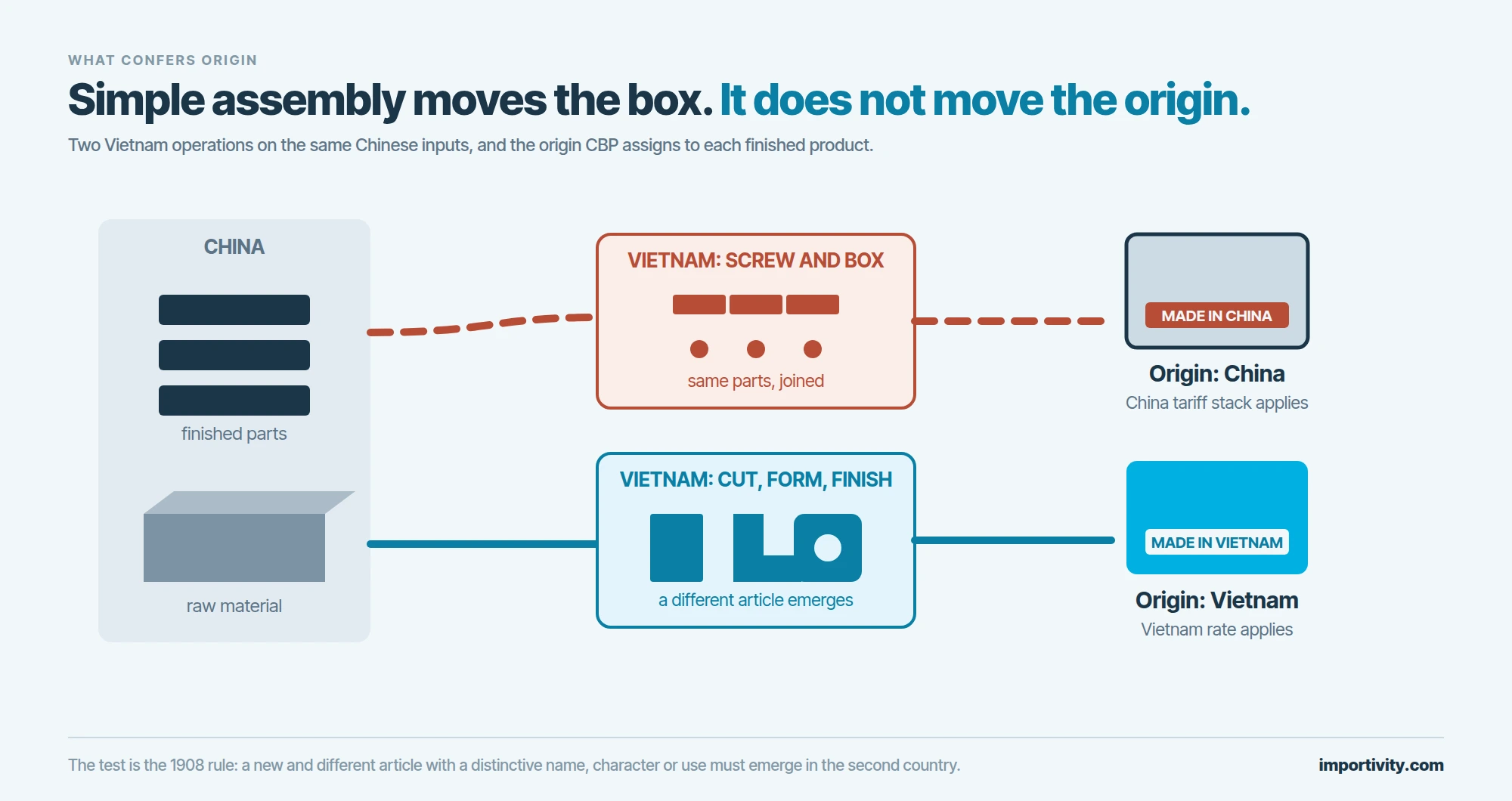
The clearest modern illustration is Energizer Battery v. United States, decided by the Court of International Trade in 2016. A military flashlight was assembled in the United States from components that were almost all Chinese, including the LED that gave it its function. The assembly was inserting, attaching and fastening. The court held that no component changed shape, material, name or use by being joined, so the flashlight was Chinese. Energizer's argument that the parts could not work as a flashlight until assembled was rejected because that describes every assembly.
- Usually confers origin. Converting raw material into a finished good: fabric into cut and sewn garments, resin into molded housings, sheet metal into welded enclosures. Complex assembly of unfinished subassemblies with real fitting, calibration and finishing.
- Usually does not. Screwing or plugging finished components together. Packaging, labeling, sorting, testing. Cutting to length, dilution, mixing without a chemical change, painting. Adding a battery, a cord or a manual.
Where the product is electronics, the component layer carries its own origin questions, covered in how to verify component origin. Classification feeds the answer too, since several CBP findings turn on whether the tariff heading changed; see our HTS classification review.
Four rules, four possible answers
Importers get into trouble by assuming one origin serves every purpose. Four rules written by different agencies decide the duty origin, the marking origin, the free trade agreement origin and the advertising claim, and they can point to different countries for one product.
| Rule | What it decides | The test and where it lives |
|---|---|---|
| Substantial transformation | Origin for regular duty, Section 301 and most trade remedies | New name, character or use in the last country of processing. Case law and CBP rulings under 19 CFR Part 177 |
| Marking rule | What the product and its container must say | The same transformation test applied to the ultimate purchaser. 19 U.S.C. 1304 and 19 CFR Part 134 |
| Free trade agreement origin | Whether the product gets a preferential rate | Product specific tariff shift and regional value content. USMCA in 19 CFR Part 182; each FTA has its own |
| Made in USA claim | Whether you may advertise the product as American made | All or virtually all of the product made in the US. FTC rule at 16 CFR Part 323 |
The marking statute defines the person who matters as the ultimate purchaser, "generally the last person in the United States who will receive the article in the form in which it was imported." Build a Chinese motor into a pump in Ohio and you are the ultimate purchaser of the motor; resell it in a blister pack and the consumer is, so the pack must say China.
What the marking rule actually requires
Every imported article, or its container where the article is excepted, must be marked in English with its country of origin in a way that is legible, permanent and conspicuous. CBP's wording is that the mark must be "of an adequate size, and clear enough, to be read easily by a person of normal vision," applied "as indelibly and permanently as the nature of the product will permit," and placed where it "can be seen with a casual handling of the article." A sticker on a hidden surface fails the last part.
- "Made in" is not always required. The country name alone is enough unless another place name appears, such as a US company address or a "Designed in California" line. Then the origin must read "Made in" or "Product of" and sit "in close proximity to, and in comparable size letters of, the other locality." This rule, 19 CFR 134.46, catches more brands than any other.
- Containers must be marked when the article is not. The exceptions in 19 U.S.C. 1304(a)(3) cover articles that cannot be marked without injury or prohibitive expense, crude substances, articles over 20 years old, and the J-List classes such as bolts, buttons, eggs and lumber. In every case the outermost container that reaches the ultimate purchaser carries the origin.
- The penalty is a marking duty. Unmarked goods are held until they are marked, exported or destroyed under CBP supervision, and goods released without proper marking pay an additional duty of 10 percent of their value under 19 U.S.C. 1304(i). Deliberately removing a mark after import is a separate offense.
- "Made in USA" is a different agency's rule. The FTC allows an unqualified Made in USA claim only when all or virtually all of the product was made here, including final assembly, all significant processing and nearly all components. A product that is American for customs purposes can still be illegal to advertise as Made in USA, and a March 2026 executive order ordered tougher enforcement.
Free trade agreements use a different test
A free trade agreement does not ask whether the product was substantially transformed. It asks whether the product meets the rule of origin written for its tariff line, and those rules are mechanical. Under USMCA, implemented in 19 CFR Part 182, most rules are a tariff shift: every non-originating material must be classified in a different heading or subheading from the finished good. A finished motor of heading 8501 dropped into a pump of heading 8413 shifts, even though the pump would fail substantial transformation.
Many rules add a regional value content requirement, 60 percent of transaction value or 50 percent of net cost for most goods and far higher for vehicles. A de minimis allowance lets up to 10 percent of the value be non-originating material that fails the shift, and the importer holds a certification of origin with the nine required data elements for five years. The practical result is that a Mexican plant can qualify a product for zero duty under USMCA while the same product is Chinese under substantial transformation for a Section 301 question. Both answers are correct at once, and the entry declares each in its own field.
What a wrong origin costs now
Origin is the claim CBP spends the most effort testing, because it is the claim with the most money behind it. The Enforce and Protect Act gives the agency a formal investigation track, and a July 2026 finding against a solar importer held that evasion occurred even though the importer cooperated in full, because its supplier's records could not support the origin declared. The Department of Justice has added False Claims Act cases, and CBP now uses supply chain mapping, laboratory testing of materials and factory visits.
The exposure stacks: the duties owed at the true origin's rate, penalties under 19 U.S.C. 1592 scaled by culpability, and the 10 percent marking duty. A shipment held for verification also misses its season. The Vietnam version of this problem, with the transshipment patterns CBP looks for and the documents that prove real production, is in our guide to proving Vietnam origin. The rates the origin decides are in Section 301 tariffs explained.
How to get certainty with a binding ruling
You do not have to guess. Under 19 CFR Part 177 an importer can ask CBP to rule on the origin of a specific product before it ships, and the ruling binds CBP on your entries until the facts change or it is revoked. Requests go through the eRulings portal to the National Commodity Specialist Division, which aims to answer within 30 calendar days of receipt. Novel cases go to Headquarters and take longer, often months. If CBP asks for more information you get 30 days to supply it, and the clock restarts.
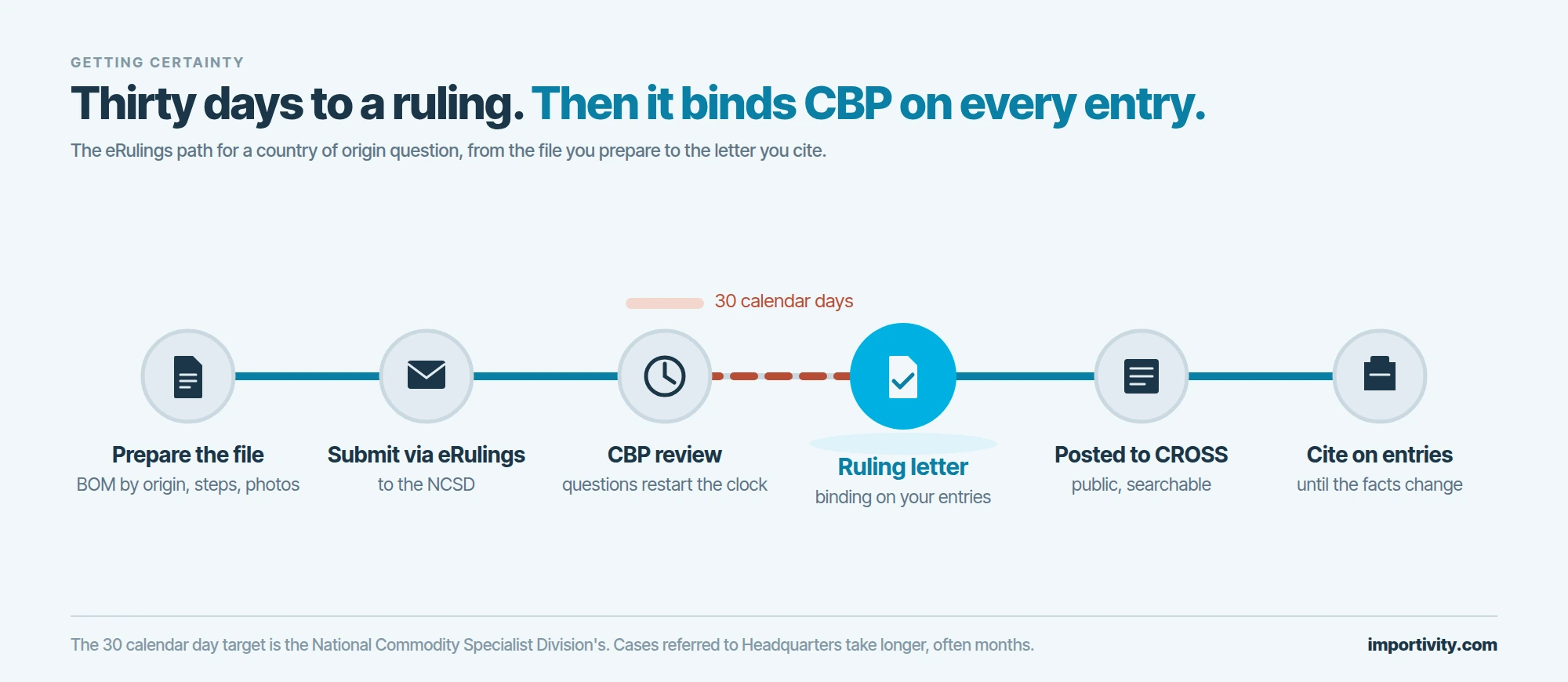
The quality of the request decides the speed of the answer. A file that gets a ruling on the first pass holds a bill of materials naming every significant component with its origin and cost, the manufacturing steps in each country in order, photos or drawings at each stage, the classification you believe applies, and the origin you believe is correct with your reasoning. Before filing, search CROSS at rulings.cbp.gov, which holds more than 250,000 rulings; one on a close product often settles the question.
- Keep the origin file for every product, not only the ones you ruled on. The bill of materials by origin, the process description, supplier declarations naming the factory and country for each input, certificates of origin, and photos from the floor. These are the records an EAPA inquiry asks for, and a supplier cannot recreate them honestly afterward.
- Write origin into the purchase order. Require the supplier to declare the origin of each component and the finished good, to notify you before any change of sub-supplier or country, and to open production records. A supplier that resists the clause is telling you something.
- Re-run the test when anything moves. A new sub-supplier, a new assembly site or a redesign that shifts work between countries can change the answer.
If the origin answer is deciding which country gets your next order, have the fit check before the tooling is cut. Jordan runs sourcing from Austin, Guangzhou and Ho Chi Minh City and has walked enough factories to tell a production line from a repacking bench.
Frequently Asked Questions
What is substantial transformation in customs?
Substantial transformation is the test CBP uses to decide the country of origin of a product made in more than one country. Processing in a country confers origin only if it produces a new and different article with a distinctive name, character or use. Simple assembly, repackaging, testing, cutting to length or dilution does not qualify, so the product keeps the origin of its components.
Does assembling Chinese parts in Vietnam make the product Vietnamese?
Not by itself. If the Vietnamese operation is screwing, plugging and boxing finished Chinese components, CBP treats the product as Chinese and the China tariff stack applies. The assembly has to change the character of the inputs, such as turning raw material or unfinished subassemblies into a different article. Keep process records and a bill of materials by origin so you can show which one happened.
Do I have to write Made in China on my product?
You have to mark the country of origin in English, legibly, permanently and in a place the buyer will see it. The words Made in are only mandatory when another place name on the product or packaging could mislead the buyer, and then the origin must sit close to that name in letters of comparable size. If the product cannot be marked, the container that reaches the buyer must be.
What happens if my goods arrive without a country of origin mark?
CBP holds the entry until the goods are marked, exported or destroyed under its supervision, and it charges an additional duty of 10 percent of the value on goods released without proper marking. Deliberately removing or hiding a mark after import is a separate offense. A marking violation also draws attention to the origin claim itself, which is the larger exposure.
How do I get a binding ruling on country of origin?
File a request through CBP's eRulings portal with a description of the product, a bill of materials by origin, the manufacturing steps in each country and photos or drawings. The National Commodity Specialist Division aims to answer within 30 calendar days; complex cases go to Headquarters and take longer. The ruling binds CBP on your entries and is published in the CROSS database.
About the author
Jordan Lewis
Chief Operating Officer, Importivity
Runs Importivity's sourcing operations across China, Vietnam, Mexico and India, from supplier negotiation through landed delivery.
Press and media inquiries: press@importivity.com