How to Prove Vietnam Origin and Avoid Transshipment Risk
A Vietnamese address on the invoice does not make your goods Vietnamese. Origin is decided by substantial transformation, which asks whether the work done in Vietnam changed the name, character, and use of the inputs, and a factory that cuts and sews from Vietnamese-milled fabric passes that test while one that screws together a Chinese kit does not. That distinction is what separates a real China plus one move from a paperwork exercise that collapses the first time CBP asks for production records, and in 2026 it is being asked about more often, because Vietnam is one of the economies inside the current Section 301 investigations.
This guide is for importers who have already decided Vietnam is worth exploring and now need to prove origin defensibly. It covers what confers Vietnamese origin, why input dependence is the real risk, the evidence file you should hold per product, and how to test a supplier's claim before you place an order. If you are earlier in the process and want the cost, MOQ, region, and logistics picture, start with our complete guide to sourcing from Vietnam and come back to this.
What actually confers Vietnamese origin
The test is substantial transformation: after the processing in Vietnam, is the article a new and different commercial product with a different name, character, and use than the materials that went in? Assembly can qualify when it is complex and meaningful. It does not qualify when it is trivial.
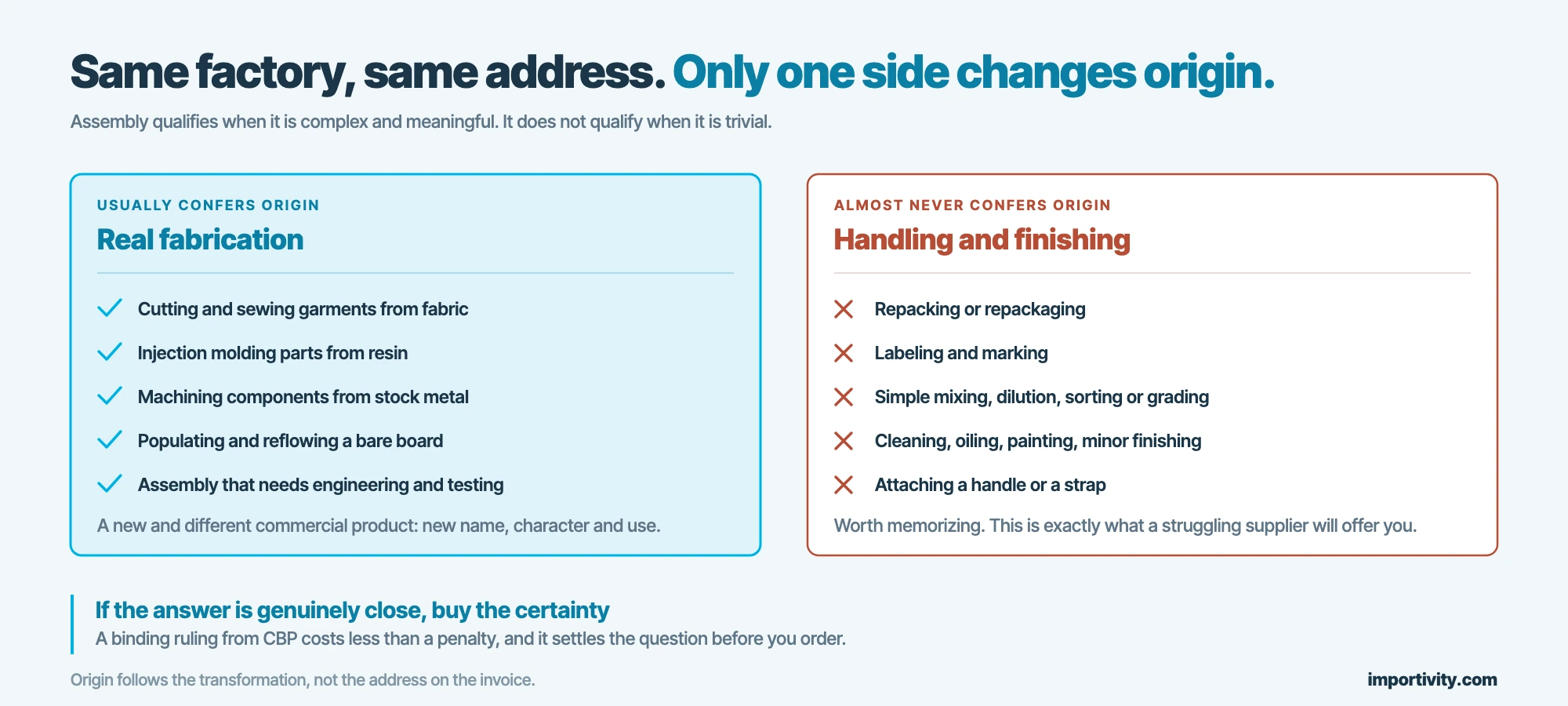
Operations that almost never confer origin on their own are worth memorizing, because they are exactly what a struggling supplier will offer you: repacking or repackaging, labeling and marking, simple mixing or dilution, sorting or grading, cleaning, oiling, painting, minor finishing, and attaching a handle or a strap to an otherwise finished good. Operations that usually do confer origin involve real fabrication: cutting and sewing garments from fabric, injection molding parts from resin, machining components from stock metal, populating and reflowing a bare board, or assembling a product from many components in a way that requires engineering and testing.
Where the line falls in your case depends on the product, and classification is part of the answer, so pair this with our HTS classification guide. If the answer is genuinely close, a binding ruling from CBP is cheaper than a penalty.
Why Vietnam draws more scrutiny in 2026
Vietnam absorbed a large share of the production that left China during the tariff years, which made it both the obvious alternative and an obvious place to look for origin abuse. Two things changed this year. USTR opened Section 301 investigations into 16 economies over structural excess manufacturing capacity, and Vietnam is on that list alongside China, Mexico, India, Korea, and Taiwan, covering sectors including electronics, batteries, and steel. Details are in our summary of the 16-economy investigations. Reporting through July has also pointed to continued tariff pressure prompting further supply chain restructuring inside Vietnam itself.
The practical read is not that Vietnam is a bad sourcing base. It is that Vietnam is no longer a tariff shelter by geography alone. Whatever advantage remains has to come from the work genuinely being done there, and that is a claim you now need evidence for rather than assurances.
The real risk is input dependence, not the factory
Most origin problems in Vietnam are not fraud. They are supply chains that moved one step and stopped. A Vietnamese factory that imports Chinese fabric, Chinese motors, Chinese cells, or Chinese populated boards is still a Vietnamese factory, but the value it adds may be too thin to change origin, and the sensitive input still carries whatever exposure it had before.
Ask three questions about any Vietnamese quote. Where does each major input come from, by value? What share of the finished cost is added in Vietnam? And what would happen to lead time and price if the Chinese input became unavailable or dutiable? A supplier who can answer all three has a supply chain. One who cannot is offering you a final assembly step and the risk that goes with it. The same input mapping also drives labor exposure, which is covered in forced labor import compliance.
The origin evidence file you should hold per product
Build this once per SKU, at qualification, and refresh it when the bill of materials changes. If CBP asks, you have a day or two, not a month.
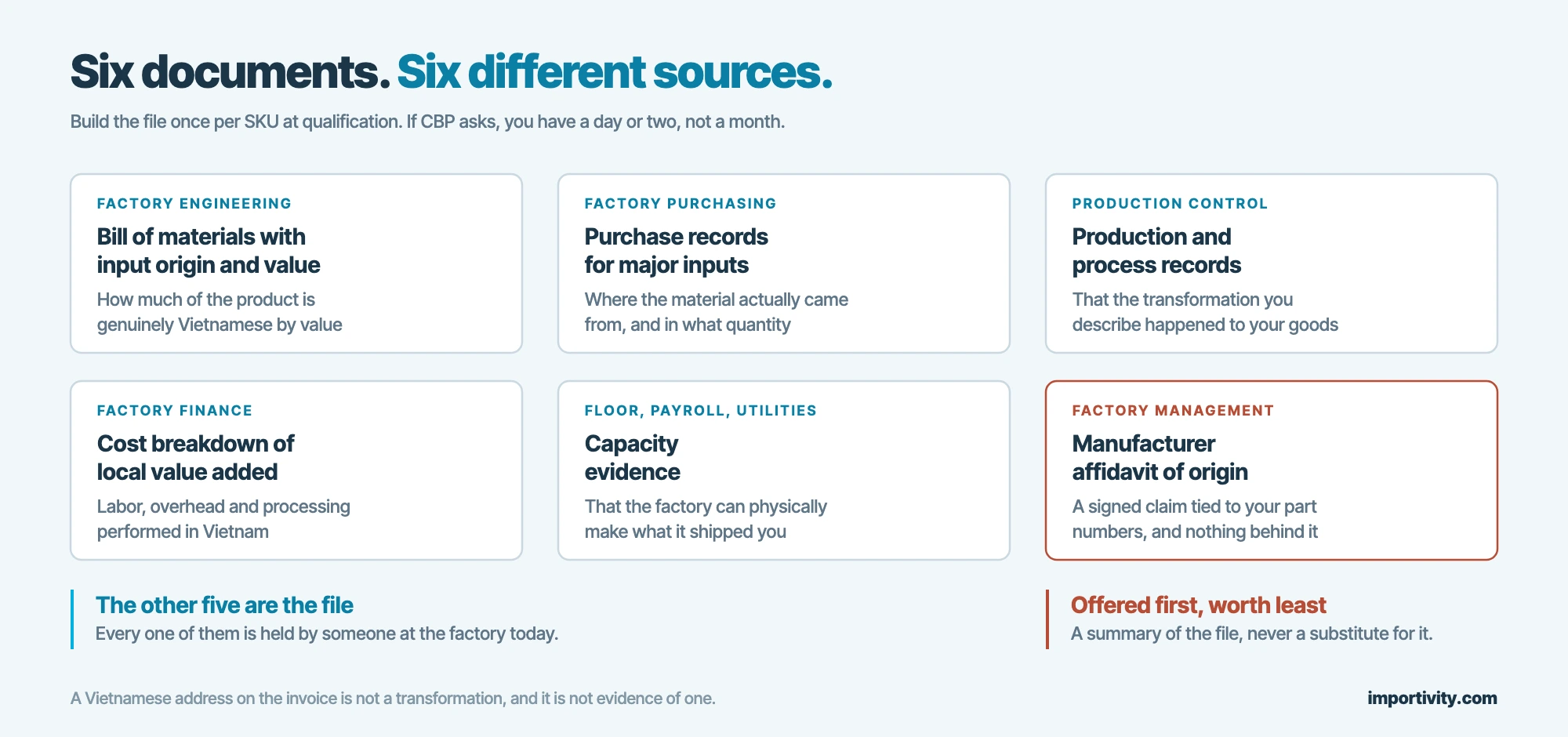
| Document | What it proves | Who provides it |
|---|---|---|
| Bill of materials with input origin and value | How much of the product is genuinely Vietnamese by value | Factory engineering or costing team |
| Purchase records for major inputs | Where the material actually came from and in what quantity | Factory purchasing, with supplier invoices |
| Production and process records | That the transformation described was performed on your goods | Factory production control, per work order |
| Cost breakdown of Vietnamese value added | Labor, overhead, and processing performed locally | Factory finance, ideally on their letterhead |
| Capacity evidence | That the factory can physically make what it shipped you | Machine list, floor area, headcount, utility bills |
| Manufacturer affidavit of origin | A signed origin claim tied to your specific part numbers | Factory management |
The affidavit is the weakest item on that list and the one suppliers offer first. Treat it as a summary of the file, never as a substitute for it.
How to test an origin claim before you order
- Do the capacity math. Compare your order volume against machine count, shifts, and headcount. If the numbers do not support the output, someone else is making part of your product.
- Go unannounced, or send someone who can. An announced visit shows you a prepared factory. Our factory audit checklist covers what to verify on the floor, including whether the machines match the process they described.
- Trace one shipment backwards. Pick a past order and follow it from finished carton to input purchase orders. Gaps show up immediately.
- Ask about subcontracting in writing. Undisclosed subcontracting is the most common way origin claims break, and a contractual disclosure duty gives you a remedy when it happens.
- Compare the quote against the input cost. A price that only works if the inputs are Chinese tells you what the inputs are.
- Check the export documents for consistency. Mismatched weights, packing configurations, or container counts between the factory's records and the shipping documents deserve an explanation.
If you would rather not run this in-country yourself, verifying origin and capacity is part of our supplier vetting work, and the country context sits on our Vietnam sourcing hub.
What transshipment actually costs
Understating origin is not a grey area. A false origin declaration is a false statement to CBP, and the consequences run well past the duty avoided: penalties that can reach the domestic value of the merchandise, exclusion or seizure of the goods, loss of any expedited clearance privileges, and a compliance record that slows every future entry. Where a pattern is found, exposure can extend to fraud liability rather than negligence.
The economics never work. You are risking multiples of the shipment value to save a percentage of it, and the party who signs the entry is you, not the supplier who suggested the arrangement.
When Vietnam is still the right answer
Vietnam remains one of the strongest manufacturing bases outside China for apparel, footwear, furniture, and a growing share of electronics assembly, with a deep labor pool and improving port infrastructure. The right way to decide is on landed cost and supply resilience with the origin question already answered, rather than on the headline duty rate. Run the numbers with our landed cost formula, compare the alternatives honestly using the China vs Vietnam comparison, and treat any supplier who cannot document Vietnamese value added as a supplier for a different product.
A move that survives an origin review is worth doing. A move that only survives while nobody checks is a liability that grows with every container.
We keep people in Guangzhou and Ho Chi Minh City rather than running this from a desk. Our case study on a plan B mold strategy using China for scale and Vietnam for tariff relief shows how the comparison plays out on a real programme, and Source With Jordan is where the work on the ground gets published.
Frequently Asked Questions
How is country of origin determined for goods made in Vietnam?
By substantial transformation. If the processing in Vietnam produces an article with a new name, character, and use compared with the inputs, origin is Vietnamese. Simple operations such as repacking, labeling, cleaning, or attaching a strap do not change origin no matter where they happen.
Does using Chinese components make my product Chinese?
Not necessarily. What matters is whether the Vietnamese processing transformed those components into a different product. Cutting and sewing from imported fabric usually qualifies; snapping together a nearly complete kit usually does not. Document input origins and Vietnamese value added so the answer is provable either way.
What documents prove Vietnamese origin to CBP?
A bill of materials with input origins and values, purchase records for major inputs, production records tied to your work orders, a cost breakdown of local value added, capacity evidence such as machine lists and payroll, and a manufacturer affidavit. The affidavit alone is not enough.
Is Vietnam exempt from Section 301 tariffs?
No. Vietnam is one of the 16 economies USTR is investigating under Section 301 over structural excess manufacturing capacity, in sectors including electronics, batteries, and steel. Vietnamese origin may still carry a different rate than Chinese origin, but it is not a tariff-free jurisdiction.
What happens if my supplier misdeclares origin?
The importer of record carries the liability. Penalties can reach the domestic value of the merchandise, the goods can be excluded or seized, and your future entries face closer scrutiny. Contractual protections help you recover from the supplier, but they do not move the legal exposure off you.
About the author
Jordan Lewis
Chief Operating Officer, Importivity
Runs Importivity's sourcing operations across China, Vietnam, Mexico and India, from supplier negotiation through landed delivery.
Press and media inquiries: press@importivity.com