
How to Find Furniture Manufacturers in Vietnam

Vietnam's furniture industry is concentrated in a small number of clusters that specialise, so the fastest way to find the right manufacturer is to search the right province rather than the whole country. Binh Duong, just north of Ho Chi Minh City, is the largest cluster and handles indoor wood furniture and panel processing. Binh Dinh in the centre, around Quy Nhon, is where outdoor furniture and sofa frames are built. Ho Chi Minh City itself is the trading, showroom and agent hub rather than a production centre. Two industry trade shows in March put several hundred vetted manufacturers in one building, which beats months of platform messaging.
This guide is for US furniture brands, retailers and importers evaluating Vietnam. It covers where the factories are, how to reach them, the tariff position as it stands in September 2026, and the four US compliance regimes that can hold a container at the port. If you are weighing Vietnam against other origins first, start with our guide to sourcing from Vietnam.
Why Vietnam and What the Numbers Say
The scale is real. Vietnam's wood and wood product exports reached roughly 17.2 billion dollars in 2025, up about 6 percent on the previous year and crossing 17 billion for the first time, according to figures from the Vietnam Timber and Forest Products Association and Vietnam Customs reported across the trade press. Wooden furniture accounted for around 10.25 billion of that, roughly 60 percent of the industry's export value.
The United States is the destination that matters. Shipments to the US came to about 9.46 billion dollars in 2025, somewhere near 55 percent of Vietnam's total wood and wood product export value, making it comfortably the industry's largest market. We were not able to verify these figures directly against Vietnam Customs or USITC data, since both are behind interactive query tools, so treat them as widely reported industry figures rather than audited statistics.
What that concentration means for you is practical rather than academic. Vietnamese furniture factories of any size already know US requirements, already build to US dimensions, and already handle US documentation. That is a genuine advantage over a country where you would be the customer teaching the factory what CARB and CPSC mean.
Where the Factories Actually Are
Three clusters do most of the work, and they are not interchangeable.
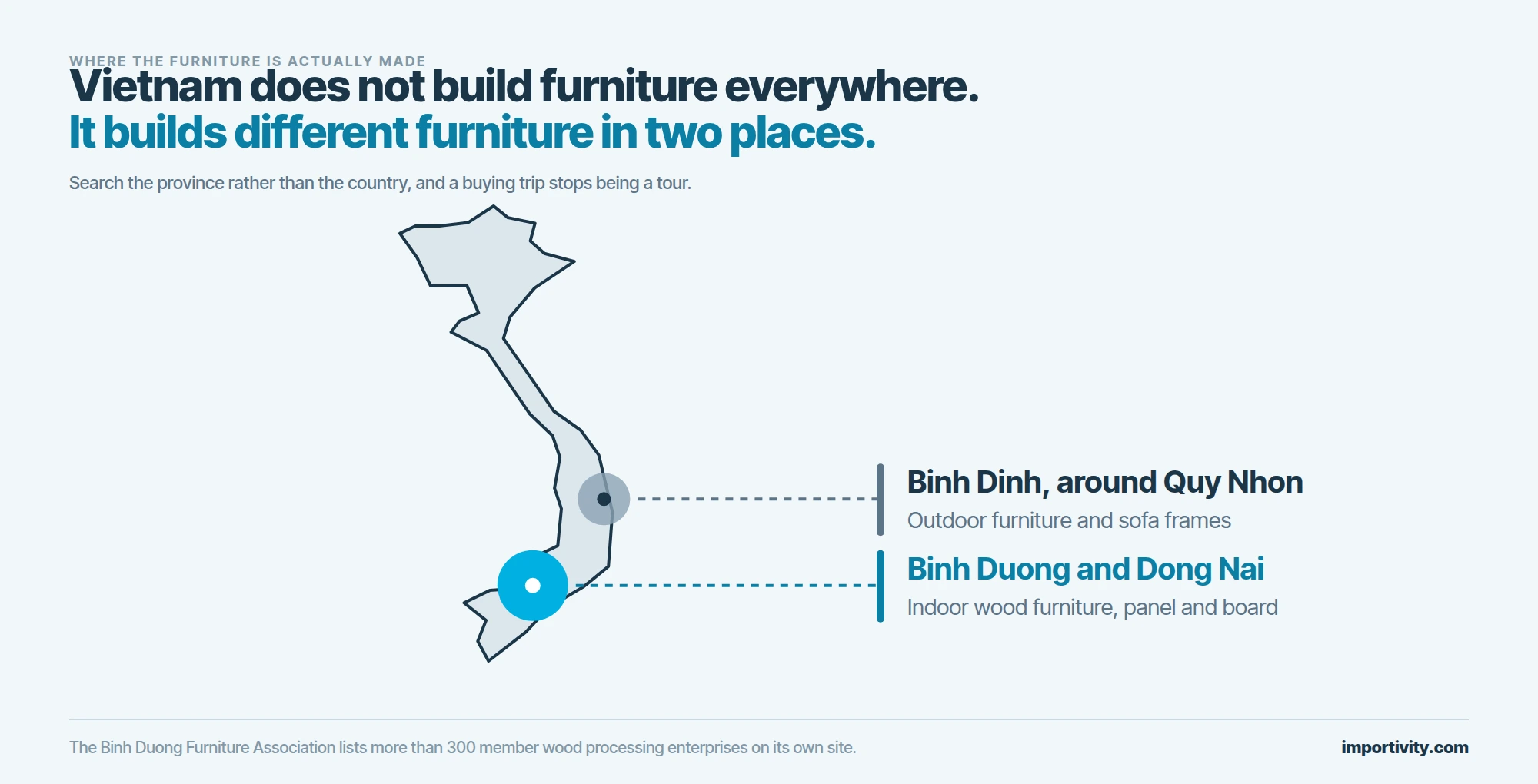
Binh Duong province is the centre of gravity for indoor wood furniture and for panel and board processing including MDF and veneer. The Binh Duong Furniture Association, founded in 2009, lists more than 300 member wood processing enterprises on its own site, which gives you a sense of density without relying on a sourcing blog's estimate. Neighbouring Dong Nai holds a similar profile with a lean toward higher end and boutique indoor production, and the two provinces effectively function as one industrial belt north and east of Ho Chi Minh City.
Binh Dinh province in central Vietnam, centred on Quy Nhon and the Phu Tai industrial zone, is the outdoor furniture cluster and the source of a great deal of sofa frame work. If you are buying garden, patio or teak furniture, this is the region to search, and a buying trip that only covers the south will miss it entirely. Ho Chi Minh City itself is where the trading companies, sourcing agents and showrooms are, which is useful for a first visit and misleading if you assume a city address means a factory.
We could not find a credible source describing a distinct furniture manufacturing cluster in the Hanoi or Bac Ninh area, and several sourcing guides assert one. Treat northern Vietnam as unproven for this category rather than as an option, unless a specific factory can show you its plant.
The Trade Shows That Shortcut the Search
Two shows run in Ho Chi Minh City within days of each other in March, and between them they solve most of the discovery problem.
HawaExpo ran 4 to 7 March 2026 at the Saigon Exhibition and Convention Centre, organised by VIFOREST and operated by HAWA, the Ho Chi Minh City handicraft and wood industry association. It reported over 700 exhibitors across more than 2,500 booths, with around 80 percent verified Vietnamese manufacturers, which is the highest manufacturer density of any furniture event in the country. VIFA EXPO, in its seventeenth edition, ran 8 to 11 March 2026 across the WTC EXPO and SKY EXPO venues with more than 650 exhibitors and roughly 2,500 to 2,800 booths, split about evenly between Vietnamese and international companies from 19 countries.
The overlap in dates is deliberate and useful. A single trip in the first half of March covers both, and the difference in exhibitor mix means you see domestic manufacturers at one and regional competition at the other. Book the trip around the show rather than the other way round, and take a written specification so every booth quotes the same thing. Our guide to writing a manufacturing RFQ covers what that document needs.
The Tariff Stack You Are Actually Buying Into
This is the part of the Vietnam furniture decision that changed most recently, and it is not a small adjustment.
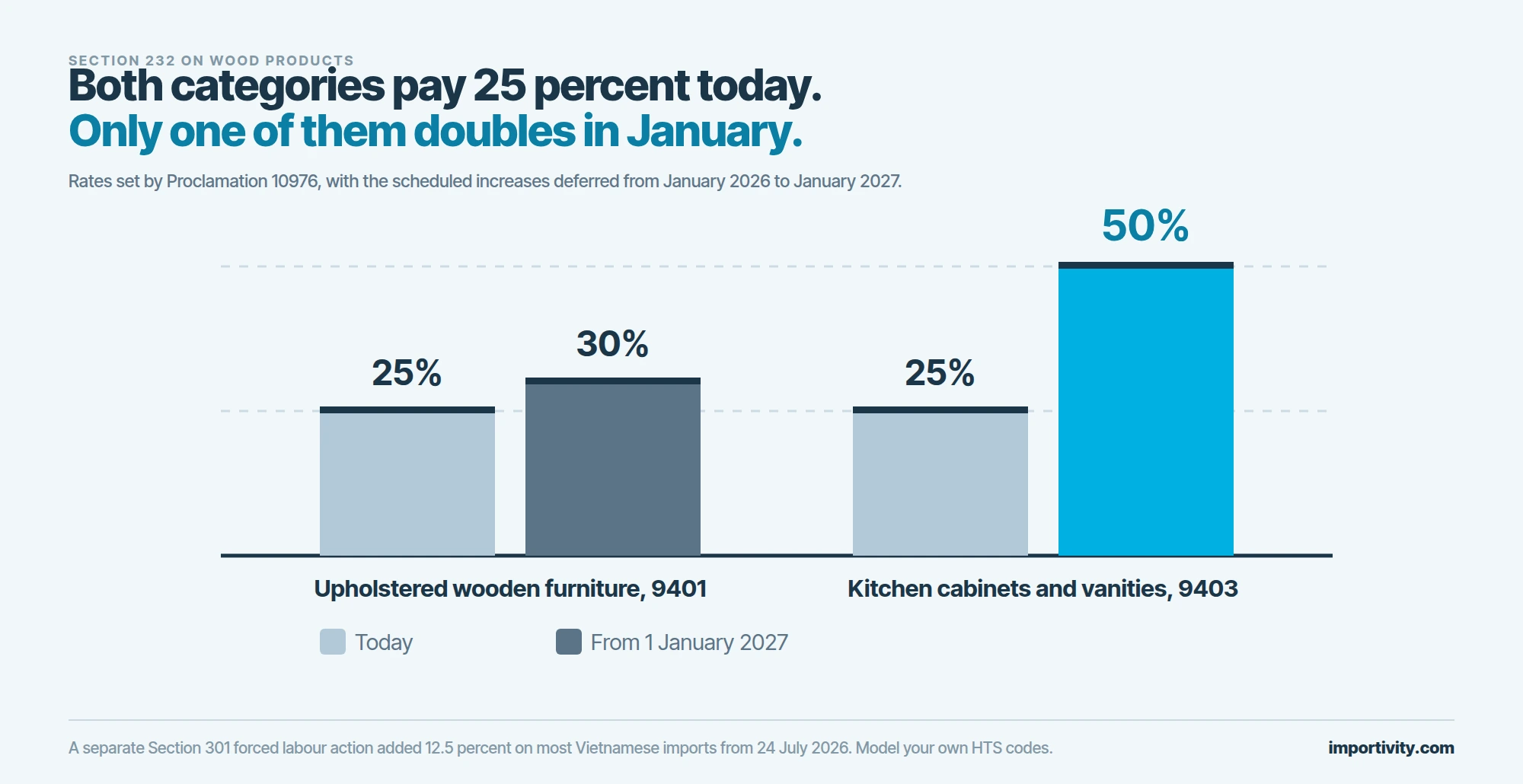
Proclamation 10976, signed on 29 September 2025 and effective 14 October 2025, imposed Section 232 tariffs on wood products: 10 percent on softwood timber and lumber under headings 4403 to 4407, and 25 percent on upholstered wooden furniture under heading 9401 and on kitchen cabinets and vanities under heading 9403. Scheduled increases taking upholstered furniture to 30 percent and cabinets and vanities to 50 percent were originally set for 1 January 2026 and were pushed back by a further proclamation to 1 January 2027. No Vietnam specific exemption appears in the sources we reviewed, though absence of a stated exemption is not the same as confirmation that none exists.
Separately, and this is a different action entirely, the US Trade Representative imposed an additional 12.5 percent tariff on most Vietnamese imports following a forced labor investigation, effective 12:01 a.m. Eastern on 24 July 2026 and published in the Federal Register on 28 July 2026. Do not confuse that with the older Section 301 Vietnam timber investigation opened in 2020, which was resolved by a bilateral agreement in October 2021 and produced no punitive tariffs.
The practical instruction is to model your specific HTS codes rather than reasoning from a headline rate, because how these measures interact depends on the classification. Our guides to HTS classification and calculating landed cost are the right order to do that in, and the 1 January 2027 step change means any tooling decision you make now should be tested against both rates.
The Compliance Rules That Stop a Container
Four US regimes apply to imported furniture and each has its own paperwork. Missing one is how a container sits at the port.
| Rule | What it requires | When it bites |
|---|---|---|
| Lacey Act declaration | Species, country of harvest, quantity and value declared for plant product imports. Phase VII, from 1 December 2024, extended this to essentially all remaining plant product codes including plywood, laminated wood and rattan and bamboo goods | At entry. From 1 January 2026 APHIS no longer accepts paper PPQ 505 or 505B forms, so filing must go through CBP's ACE or APHIS LAWGS |
| EPA TSCA Title VI, 40 CFR Part 770 | Formaldehyde emission limits for hardwood plywood, MDF and particleboard and any finished goods containing them, with third party certification, panel level labelling and compliance statements on invoices and bills of lading | At entry and on audit. CARB Phase 2 is harmonised with it, so a single standard now applies nationwide |
| CPSC 16 CFR Part 1261 | The STURDY Act tip over standard for clothing storage units, adopting ASTM F2057-23 | Applies to units manufactured after 1 September 2023. Dressers and chests are in scope |
| CPSC 16 CFR Part 1640 | Upholstered furniture flammability, adopting the California TB 117-2013 smoulder resistance test, plus a permanent label stating compliance with CPSC requirements | Manufacture and import from 25 June 2021, with labelling required from 25 June 2022 |
The one to check first is the Lacey filing change, because it is recent and it is procedural rather than substantive. A broker still filing on paper habits will be rejected, and the rejection arrives when the goods do. Confirm with your customs broker that they are filing electronically and that your supplier is giving them genuine species and harvest country data rather than a generic entry. Our guide to import product compliance covers what documentation has to travel with the goods.
The Origin Trap on Cabinets and Vanities
If you are buying kitchen cabinets or vanities, there is a specific trap that has already been decided against importers and it catches people who did nothing deliberately wrong.
Antidumping and countervailing duty orders on wooden cabinets and vanities from China were issued in April 2020. Commerce opened circumvention inquiries in June 2022 into cabinets finished in Vietnam and Malaysia using Chinese made components, and in a final scope determination on 17 July 2024 concluded that cabinets and vanities completed in Vietnam using Chinese made cabinet components and constituent wooden parts are covered by the China orders.
Read that plainly. A Vietnamese factory assembling Chinese doors and boxes is selling you goods that CBP can treat as subject to Chinese antidumping and countervailing duty rates, not Vietnam's ordinary treatment. The governing test is substantial transformation under 19 CFR 134.1(b), which asks whether the article emerged from Vietnam with a new name, character or use. Assembly, gluing and repackaging generally do not qualify, because the identity of the article was fixed in China.
So audit the bill of materials, not just the invoice. Ask where the boards, the doors and the hardware come from, ask to see the supplier's own purchase records for those inputs, and get the answer before the first order rather than in response to a CBP request. Our guide to Vietnam origin and transshipment risk covers the wider pattern, which is not confined to cabinets.
Lead Times, MOQs and How to Run the Search
Production lead times are commonly quoted by sourcing firms at 30 to 60 days for standard container furniture, stretching to two or three months during the April to September peak, with flat pack running faster at 25 to 45 days. Ocean transit to the US West Coast adds roughly three to four weeks. Minimum orders are usually framed as a 40 foot high cube container per style and color, with some factories accepting 50 to 80 units per SKU in a mixed container for a first order. None of those figures come from an industry association or government source, so treat them as planning assumptions to confirm in writing.
The search itself works best in this order.
- Pick the cluster before the factory. Indoor and panel work in Binh Duong and Dong Nai, outdoor and frames in Binh Dinh.
- Use the associations as a directory. BIFA for Binh Duong, HAWA and VIFOREST nationally. Association membership is a weak signal but a real one.
- Build the trip around the March shows. HawaExpo and VIFA EXPO in the same week is the highest density week of the year.
- Ask for the input origin on day one. Where the board, the doors and the hardware come from, in writing, for every quoted item.
- Require the compliance documents in the quotation. TSCA Title VI certification, species and harvest country for Lacey, and the applicable CPSC test reports.
- Model both tariff rates. The rate today and the rate from 1 January 2027, before you commit to tooling or a container programme.
Then vet the factory the way you would anywhere else. Our factory audit checklist applies without modification, our Vietnam sourcing page covers what we do on the ground, and what to know before sourcing from Vietnam, China and Mexico is the comparison to read before you commit to a country at all. We keep people in Ho Chi Minh City as well as Guangzhou, which is the only honest way to run a China against Vietnam comparison. Our case study on a plan B mold strategy using China for scale and Vietnam for tariff relief is the closest worked example, and Source With Jordan is where the work on the ground gets published.
Frequently Asked Questions
Where are the furniture factories in Vietnam?
Three clusters do most of the work. Binh Duong province north of Ho Chi Minh City is the largest, handling indoor wood furniture and panel and board processing, and its furniture association lists over 300 member enterprises. Neighbouring Dong Nai has a similar profile with a higher end lean. Binh Dinh province around Quy Nhon in central Vietnam is the outdoor furniture and sofa frame cluster. Ho Chi Minh City is a trading and showroom hub rather than a production centre.
What tariffs apply to Vietnamese furniture in 2026?
Two separate measures. Section 232 wood tariffs effective 14 October 2025 set 25 percent on upholstered wooden furniture and on kitchen cabinets and vanities, with scheduled increases to 30 and 50 percent respectively deferred to 1 January 2027. Separately, a Section 301 forced labor action added 12.5 percent on most Vietnamese imports from 24 July 2026. Model your specific HTS codes rather than a headline rate.
What US compliance rules apply to imported furniture?
Four. A Lacey Act declaration of species, harvest country, quantity and value, which since Phase VII in December 2024 covers essentially all remaining plant product codes and since January 2026 must be filed electronically. EPA TSCA Title VI formaldehyde limits with third party certification and panel labelling. The CPSC clothing storage unit tip over standard under 16 CFR Part 1261 for units made after 1 September 2023. And upholstered furniture flammability under 16 CFR Part 1640.
Can Vietnamese cabinets be subject to China antidumping duties?
Yes, and this has already been decided. In a final scope determination on 17 July 2024 Commerce concluded that wooden cabinets and vanities completed in Vietnam using Chinese made components and constituent wooden parts are covered by the antidumping and countervailing duty orders on China. Assembly in Vietnam does not usually amount to substantial transformation under 19 CFR 134.1(b), so audit the bill of materials before ordering.
When are the Vietnam furniture trade shows?
Both major shows run in Ho Chi Minh City in early March. HawaExpo ran 4 to 7 March 2026 at the Saigon Exhibition and Convention Centre with over 700 exhibitors and around 80 percent verified Vietnamese manufacturers. VIFA EXPO ran 8 to 11 March 2026 across the WTC EXPO and SKY EXPO venues with more than 650 exhibitors split roughly evenly between Vietnamese and international companies. One trip covers both.
About the author
Jordan Lewis
Chief Operating Officer, Importivity
Runs Importivity's sourcing operations across China, Vietnam, Mexico and India, from supplier negotiation through landed delivery.
Press and media inquiries: press@importivity.com