How to Find and Vet Toy Manufacturers in China (Clusters, Compliance and Costs)
Toy manufacturers in China sit in four clusters, and picking the right one is most of the sourcing job. Chenghai district in Shantou, Guangdong, makes over half of China's plastic toys and about a third of the world's. Dongguan and Shenzhen, on the other side of the Pearl River Delta, build the electronic, licensed and higher-spec toys. Yiwu in Zhejiang is the low-cost and wholesale channel. Yunhe county, also in Zhejiang, produces about 66 percent of China's wooden toys. A factory in the right cluster already has the molds, material suppliers and test labs your product needs. One in the wrong cluster subcontracts to one that does and charges you for the trip.
This guide is for US toy, game and children's product brands placing a first or second production order in China. It covers where the factories are, how to tell a molder from a trading company, the US compliance stack, what a proper quote contains, the tariff picture as of early September 2026, and the checks to run before a mold deposit. If you are still deciding whether to make in China at all, start with our manufacturer sourcing service page and come back here once the country is settled.
Where China's toy factories cluster
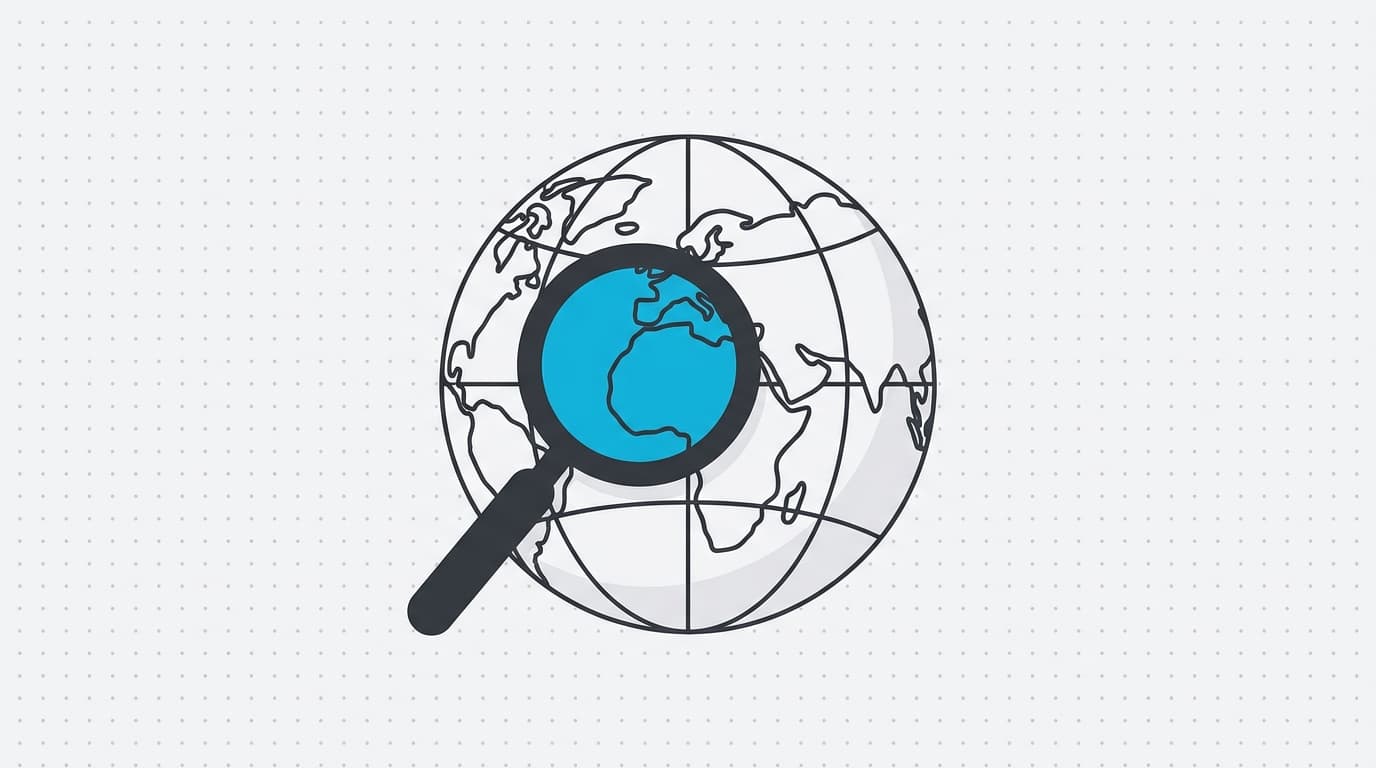
Two provinces, Guangdong and Zhejiang, hold nearly all of China's toy making, and inside them four towns do the real work. The map below shows where each product type is made.
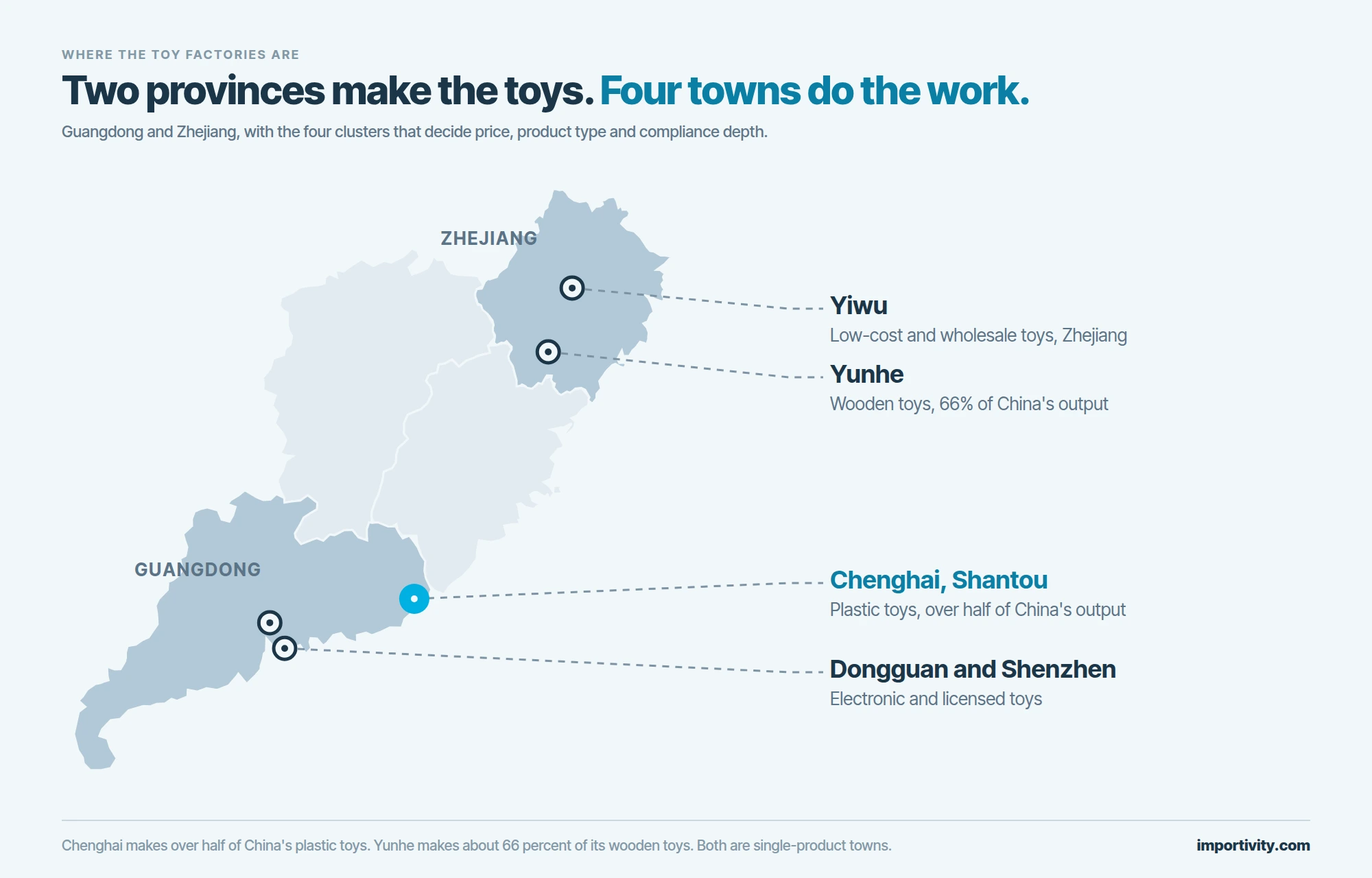
Chenghai is the one to know. It is a district of Shantou on the eastern Guangdong coast with more than 5,000 toy companies, and it accounts for over 50 percent of China's plastic toy output and roughly a third of global supply. Molded vehicles, dolls, building blocks and RC cars come from here, with the mold shops, resin traders and test labs within a short drive. Plastic prices are the lowest in the country, and so is the average factory size, which matters for compliance later.
Dongguan and Shenzhen are where the electronics live. If your toy has a circuit board, a battery or a licensed character, the factories that already pass the electrical tests and the brand owner's audits are here. They are larger, dearer per unit, and used to working from a tech pack rather than a photo. Yiwu is a wholesale market first: good for stock designs in small lots, weak for custom work. Yunhe is a single-product county with more than 1,100 wooden toy companies and about 30,000 workers making puzzles, blocks, trains and Montessori-style products.
| Cluster | Best for | Watch out for |
|---|---|---|
| Chenghai, Shantou | Injection-molded plastic toys, RC vehicles, dolls, building sets, lowest unit prices | Many small workshops; lab reports and social audits often belong to a bigger neighbor, verify the address on every certificate |
| Dongguan and Shenzhen | Electronic, battery-powered and licensed toys, tech-pack driven programs | Higher MOQs and unit prices; some plants prioritize brand-owner accounts and quote small buyers slowly |
| Yiwu, Zhejiang | Stock designs in small lots, promotional and novelty toys, mixed containers | You are usually buying from a trader; the CPC and test reports may not match the actual maker |
| Yunhe, Zhejiang | Wooden toys, puzzles, blocks, educational and Montessori products | Paint and coating compliance is the whole game; ask for lead-in-paint results per color, not per product |
Molder, design house or trading company
Before you compare prices, establish what kind of company is quoting you. Three types answer a toy inquiry. An OEM molder owns machines and makes your design from your drawings: cheapest per unit, least help on development. An ODM design house sells you a version of its own catalog toy with your logo and packaging: fast to market, and you own nothing. A trading company owns no machines and buys from either of the first two for you, adding a margin that is invisible on the quote.
The test is not the business license, which traders also hold. Ask for the address of the injection machines, the mold shop and the assembly line, then match it to the ISO or ICTI certificate and the most recent test report. If the addresses disagree, you are talking to a trader or a factory that borrowed paperwork. Our factory audit checklist lists the documents to pull and the walk to take, and the factory visit checklist is the one-page version for the trip.
None of the three is wrong. A Yiwu trader fits a 500-piece promotional order, an ODM house fits a first product with no engineering budget, and a molder fits a design you own with repeat volume. What is wrong is paying molder prices for trader accountability, which is the default when nobody asks.
The US compliance stack the factory must already know
A toy for children 12 and under cannot be sold in the US without third-party testing at a CPSC-accepted laboratory and a Children's Product Certificate issued by the importer. The mandatory standard is ASTM F963-23, in force for toys made from April 20, 2024, and the CPC must cite that version. The picture below shows what gets tested on a typical battery-powered toy car, part by part.
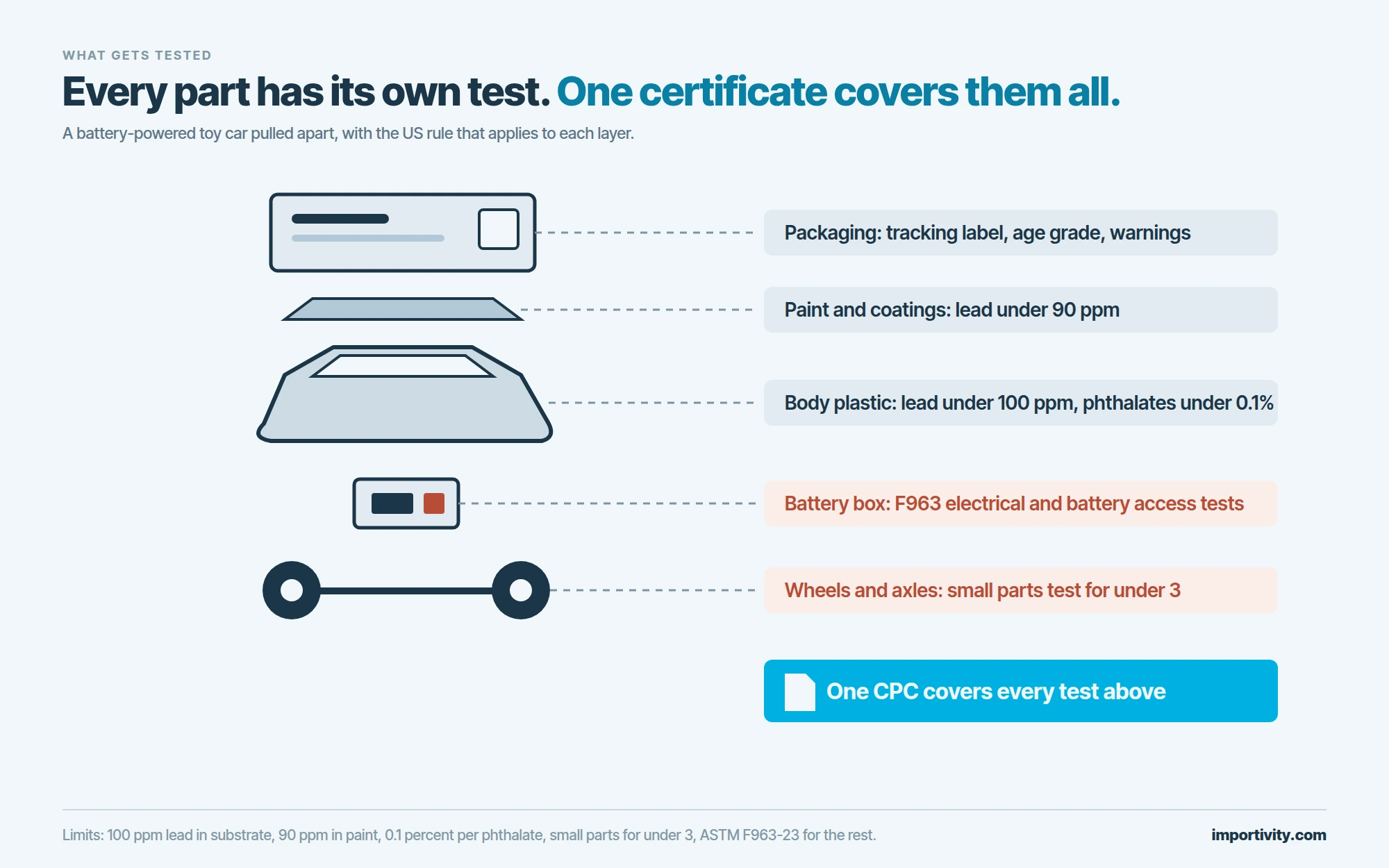
The limits are specific and a competent toy factory can recite them. Lead in any accessible substrate is capped at 100 parts per million under the CPSIA. Lead in paint and surface coatings is capped at 90 ppm under 16 CFR part 1303. Eight phthalates are each limited to 0.1 percent in toys and child care articles. Anything for children under three must pass the small parts test in 16 CFR part 1501. Battery-powered toys go through the electrical and battery accessibility sections of F963-23. Every unit and its packaging carry a permanent tracking label under 15 U.S.C. 2063(a)(5) naming the maker, date and batch.
Two habits separate a good factory from a risky one. The first is test reports that name the exact product and factory address, cover every color and material, and are dated within a year for the same tooling. A report for a similar item, or a neighbor's plant, protects nobody. The second is component-level testing before assembly, because a failed paint result on a packed order is a scrapped order. The broader import rules, including FCC for anything with a radio and the customs paperwork, are in import product compliance.
Social compliance and the ICTI audit
US toy retail runs on one social compliance scheme. The ICTI Ethical Toy Program, now the Ethical Supply Chain Program, has certified toy factories against the ICTI Code of Business Practices since 2004, and its audit runs to about 270 checkpoints on hours, wages, safety, dormitories, fire exits and worker age. Most large US retailers and every licensor ask for a current certificate before a line review, so a factory without one narrows your customer list before you have made a unit.
Treat the certificate as a door opener, not proof. It has tiers and expiry dates, and the factory's own registration number can be checked against the program's database. Then ask for the last audit summary and read the corrective actions. A clean certificate with a peak-season overtime finding is a normal Chenghai plant. A plant that cannot produce the summary is telling you something. This is the kind of check our supplier vetting work does before an introduction, because it is far cheaper to disqualify a factory on paper than after a mold is cut there.
What a real quote contains
A quote that says "$2.80 per piece, MOQ 3,000" is an opening position, not a quote. Ask for it broken into tooling, unit price by quantity, packaging, testing and freight terms, because each line negotiates differently.
- Tooling. An injection mold for a toy part typically runs $1,000 to $3,000 for a single-cavity prototype tool and $5,000 to $15,000 or more for production multi-cavity steel, and a toy with six molded parts needs six molds. Get the mold count, steel grade, guaranteed shot life and ownership in writing. You paid for it, so the PO should say you can collect it.
- MOQ. Typical minimums run from 500 to 5,000 pieces depending on how much is custom. A stock ODM item might go at 500; a fully tooled design usually starts around 1,000 to 3,000 because the factory wants the mold amortized inside the first run.
- Lead time. Stock items ship in roughly 30 to 45 days, custom designs in 45 to 60, and a new-tool project runs 60 to 90 days from approved drawing to loaded container. Sampling after mold approval takes about 15 to 25 days.
- Testing. Who pays the lab, which lab, and whether the report is in your company's name. The factory will often absorb the lab fee against a firm order.
- Packaging. Often the second largest cost on a toy. Quote it separately so a switch from window box to polybag shows up as a number.
Put the drawings, the color standards and the test requirements into an NNN agreement before you send them. A molder holding your tooling and artwork with no non-use clause is one slow season from selling your product to someone else.
What a toy from China costs to land in September 2026
Most toys under HTS heading 9503 carry a zero percent base duty, so the additional layers are the whole story. As of early September 2026, China-origin toys on Section 301 List 4A pay 7.5 percent, a smaller set on List 3 pays 25 percent, and the new Section 301 forced-labor action added a flat 12.5 percent on Chinese goods from July 24, 2026. The 10 percent Section 122 surcharge that ran from February expired the same day, and the IEEPA tariffs were struck down by the Supreme Court on February 20, 2026. A List 4A toy therefore carries about 20 percent in additional duty today, a List 3 toy about 37.5 percent, before fees and freight.
Check your exact subheading, because a ride-on, a puzzle and a plush animal do not all sit on the same list. On a toy that leaves the factory at $2.80, 20 percent is $0.56 a unit, about what a first round of price negotiation is worth. The duty is not a reason to abandon China, but it is a reason to model landed cost before you pick a cluster.
A vetting checklist before the mold deposit
The mold deposit is the point of no return: once steel is cut you either live with that factory or pay to move the tools. Run this list in order and stop at the first failure.
- Confirm the maker. Machine address, certificate address and test report address all match. If not, get the real factory's name or walk.
- Pull the last test report. Same tooling, same materials, every color, dated within a year, at a CPSC-accepted lab. Read the address on it.
- Check the ICTI registration. Current status, tier, and the corrective actions from the last audit.
- Get the mold terms. Count, cavities, steel, shot life and ownership, all on the PO.
- Approve a golden sample. Signed by both sides, with the color chips attached, before production starts.
- Book the inspection. Pre-shipment inspection with defect definitions and the AQL in the PO, plus a lab pull from the production lot.
- Model the landed cost. Tooling amortized, duty at the current stack, freight, testing and packaging.
The first step saves the most money. Most toy sourcing failures trace back to a buyer who negotiated hard on unit price with a company that did not own the machines. If you would rather have someone on the ground do this, Jordan runs Importivity's sourcing from Guangzhou, an hour from Dongguan and a morning's drive from Chenghai, and a fit check with Jordan starts with the question of which cluster your toy belongs in. The golden sample sign-off and the production inspections follow from there.
Frequently Asked Questions
Where are most toy manufacturers in China located?
Four clusters make nearly all of it. Chenghai district in Shantou, Guangdong, produces over half of China's plastic toys. Dongguan and Shenzhen in the Pearl River Delta build electronic, battery-powered and licensed toys. Yiwu in Zhejiang is the low-cost wholesale channel for stock designs. Yunhe county in Zhejiang makes about 66 percent of China's wooden toys. Matching your product type to the right cluster is the first sourcing decision.
What certification does a toy from China need to be sold in the US?
A toy for children 12 and under needs third-party testing at a CPSC-accepted laboratory and a Children's Product Certificate citing ASTM F963-23 plus the applicable CPSIA rules. The tests cover lead in substrate at 100 ppm, lead in paint at 90 ppm, eight phthalates at 0.1 percent, small parts for under-threes, the electrical sections for battery toys, and a permanent tracking label on the product and its packaging.
How much does tooling cost for a plastic toy in China?
A single-cavity prototype mold for one toy part typically runs $1,000 to $3,000, and production multi-cavity steel runs $5,000 to $15,000 or more per part. A toy with six molded components needs six molds, so total tooling on a simple vehicle can reach five figures. Get the mold count, steel grade, shot life and ownership written into the purchase order before you pay the deposit.
What is the minimum order quantity for toy factories in China?
Typical minimums run from 500 to 5,000 pieces. A stock design from an ODM house or a Yiwu trader may go at 500, while a fully tooled custom toy usually starts at 1,000 to 3,000 because the factory wants the mold cost amortized inside the first run. Lead times run about 30 to 45 days for stock items, 45 to 60 for custom designs, and 60 to 90 days for a new-tool project.
What tariff applies to toys imported from China in 2026?
Most toys under HTS 9503 have a zero percent base duty. As of early September 2026, China-origin toys on Section 301 List 4A pay 7.5 percent, List 3 items pay 25 percent, and the Section 301 forced-labor action added 12.5 percent from July 24, 2026. That puts a typical List 4A toy at about 20 percent additional duty and a List 3 toy at about 37.5 percent. Confirm your exact subheading with your broker.
About the author
Jordan Lewis
Chief Operating Officer, Importivity
Runs Importivity's sourcing operations across China, Vietnam, Mexico and India, from supplier negotiation through landed delivery.
Press and media inquiries: press@importivity.com