Shipping From China to the US (Costs, Transit Times and Fees)
Shipping from China to US ports costs about $8,000 to $10,200 for a 40 ft container on the spot market right now: Drewry's World Container Index put Shanghai to Los Angeles at $8,007 and Shanghai to New York at $10,166 on October 22, 2026, and air freight from China to North America was $6.88 per kg in Freightos's October 20 update. By sea, plan on about 15 to 20 days port to port to Los Angeles, 30 to 35 days from Ningbo to New York and 30 to 40 days door to door, against about 8 to 10 days for air freight and 3 days for an express courier.
This guide is for US brands buying from factories in China who need a freight budget and a delivery date they can plan around. It gives dated rates, transit times by coast, the US fees on top of freight and one container costed door to door. If you are still choosing between ocean and air, start with our guide to sea vs air freight.
The four ways to ship from China to the US
Freight from China moves in one of four ways, and each is priced on a different unit, which is why two quotes for the same order can be hard to compare.
- Full container load (FCL). You book a whole 20 ft or 40 ft container and pay one price per box, full or not. It is the cheapest way to move a large order.
- Less than container load (LCL). Your cartons share a container with other shippers' cargo and you pay by volume. It takes a few days longer, because cargo is consolidated at origin and separated at destination. Our FCL vs LCL guide shows where each one is cheaper.
- Air freight. Priced per kilogram, and light, bulky goods can be charged on dimensional weight instead of actual weight. Freightos's rule of thumb makes it the cheapest option for about 150 to 500 kg.
- Express courier. DHL, FedEx or UPS carries the parcel from the supplier's door to yours. Freightos's rule of thumb makes it the cheapest option up to about 150 kg.
The table gives the latest public number for each. LCL and courier rates have no public weekly index, so those come from your quotes.
| Mode | Latest public price, with date | Typical transit time |
|---|---|---|
| FCL, 40 ft, Shanghai to Los Angeles | $8,007 per container (Drewry, Oct 22, 2026) | 15 to 20 days port to port, 30 to 40 days door to door |
| FCL, 40 ft, Shanghai to New York | $10,166 per container (Drewry, Oct 22, 2026) | 30 to 35 days port to port from Ningbo |
| LCL | Quoted per cubic meter by your forwarder | A few days longer than FCL on the same route |
| Air freight | $6.88 per kg, China to North America (Freightos, Oct 20, 2026) | 8 to 10 days |
| Express courier | Quoted per parcel by the courier | About 3 days door to door |
What ocean freight costs right now
Two public indexes track spot container rates on this route every week. Drewry's World Container Index for Thursday, October 22, 2026 put a 40 ft container from Shanghai to Los Angeles at $8,007, up 2% on the week, and from Shanghai to New York at $10,166, up 1%. The Freightos Baltic Index, in the Freightos update dated October 20, 2026, had Asia to the US West Coast at $8,126 per 40 ft container and Asia to the US East Coast at $9,700.
On Drewry's numbers the East Coast costs $2,159 more per container than the West Coast, and on Freightos's numbers $1,574 more. Freightos described transpacific rates as stable but still very high. Its September 30 update had the West Coast at $8,400, the year's high at that point, with congestion at Far East ports tying up capacity. Drewry expected rates to hold the following week because US import demand was still strong.
An index is a spot market average, not your quote. Your forwarder's margin and any contract rate move the real price, so use the index to check that a quote is in range.
How long shipping takes, West Coast vs East Coast
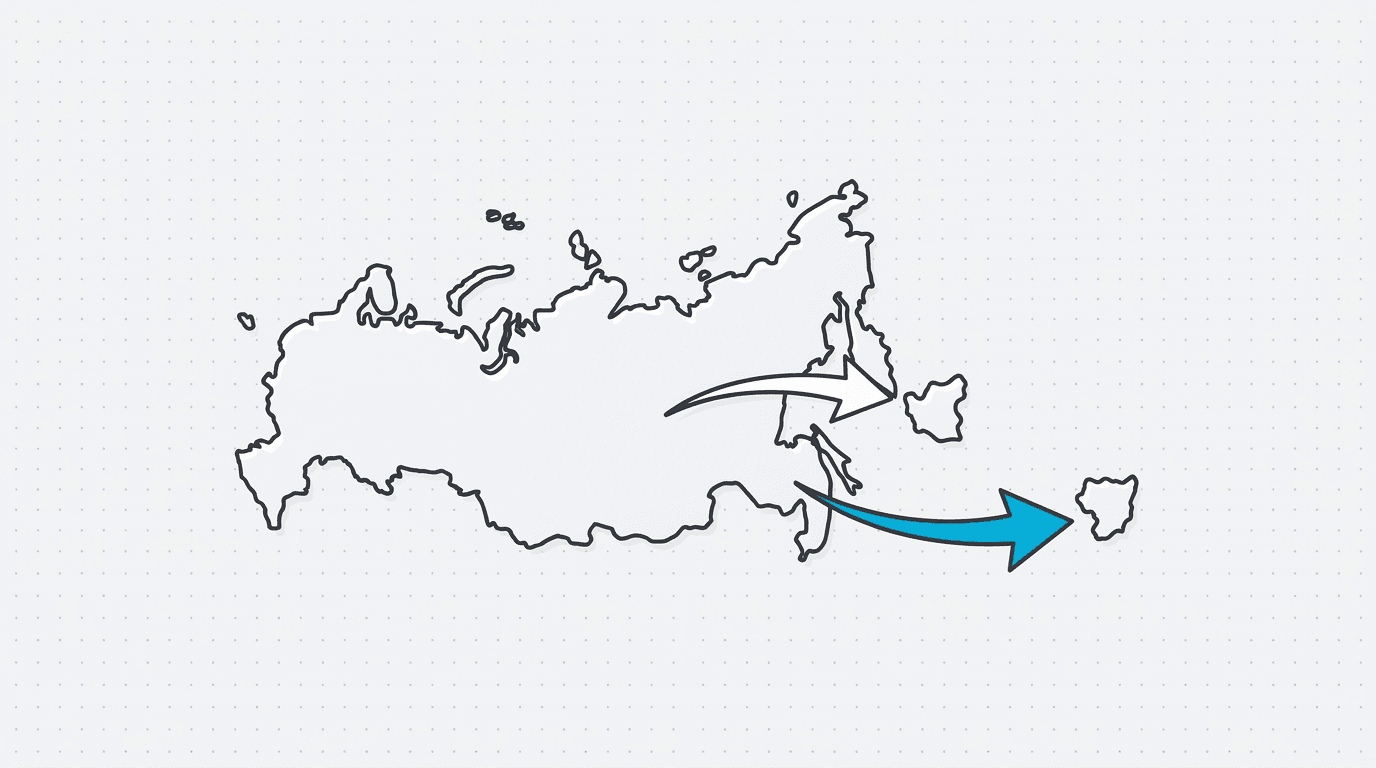
Most of the time difference between the coasts is the ocean leg. Ships to Los Angeles and Long Beach cross the Pacific directly. Ships to New York go through the Panama Canal, and some loops in ONE's 2026 network sail around the Cape of Good Hope instead. Going through Panama adds about two weeks. The map below shows both lanes with Drewry's rates.
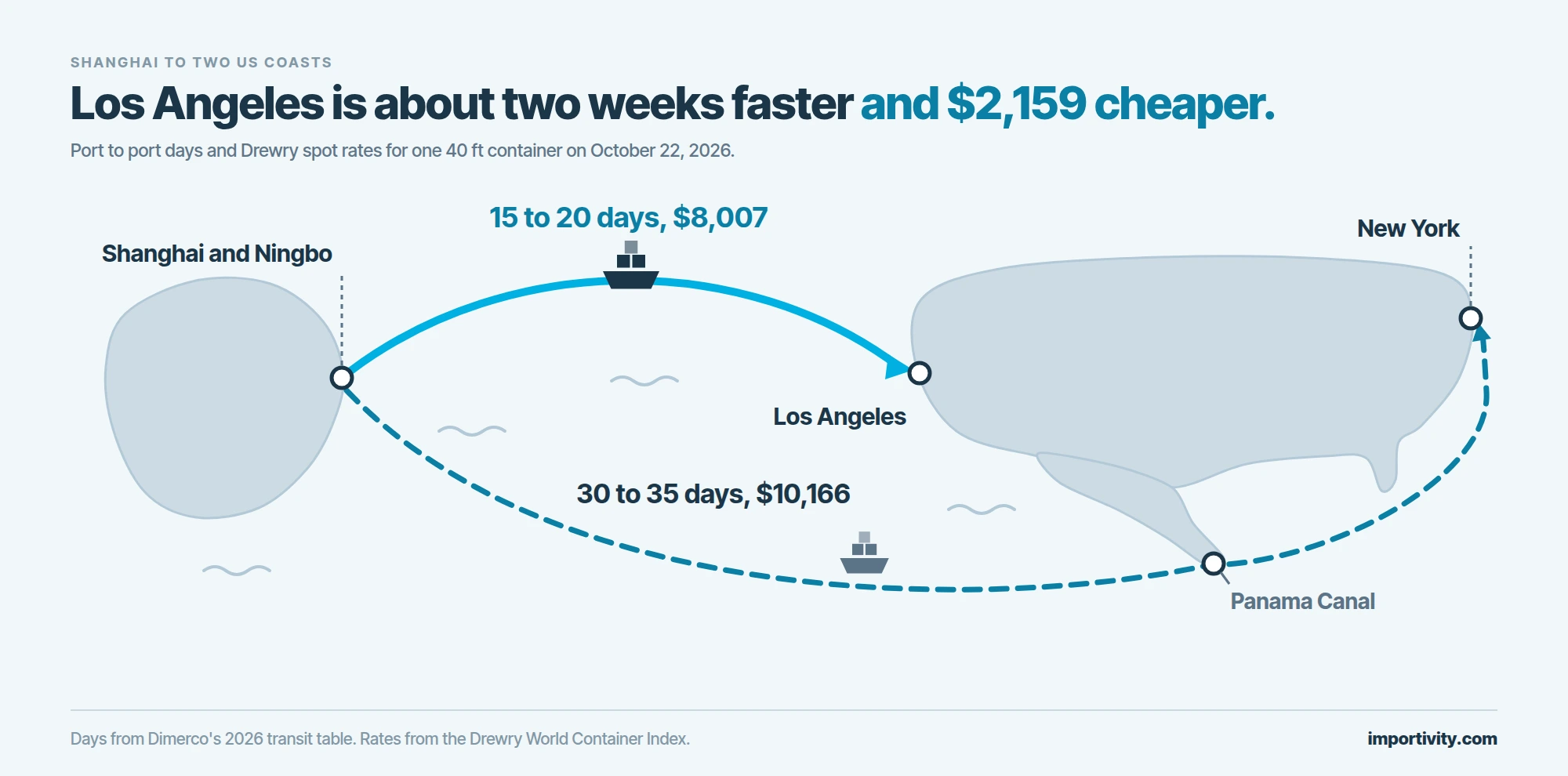
Carrier schedules give the range for the West Coast. Matson's CLX schedule shows 10 days from Shanghai to Long Beach, with cargo available the day after arrival, and Matson describes it as the fastest transit from China to Southern California. ONE's PS6 service, which calls in Korea on the way, showed 19 days from Shanghai and 17 days from Ningbo to Los Angeles in a customer advisory dated June 10, 2026. Dimerco's 2026 transit table gives around 15 to 20 days from Shanghai to Los Angeles.
For the East Coast, the same table gives 30 to 45 days from China via the Panama Canal or around South America, and often 30 to 35 days from Ningbo to New York. Canal conditions move this number: Freightos reported on September 30, 2026 that the Panama Canal Authority would restore the normal ten daily Neopanamax transits in mid October.
Port to port is not door to door, since trucking at both ends, the terminal cutoff and customs release all add days. Freightos's rule of thumb is 30 to 40 days door to door for ocean freight from China. If your warehouse is inland or in the East, price a West Coast landing with rail or truck next to the all-water route.
Air freight and express, and what they cost now
Air rates jumped in mid October while ocean rates held steady. The Freightos Air Index for China to North America rose 19% in one week to $6.88 per kg in the October 20, 2026 update, and Freightos put transpacific air rates 25% higher than a year earlier. It said the jump was possibly a rebound after China's Golden Week holiday or the start of peak season.
At that rate, 1,000 kg by air costs about $6,880 before fees, close to the $8,007 Drewry gave for a whole 40 ft container to Los Angeles. That is why air usually suits samples, launch stock and urgent restocks, while production orders go by sea. Bulky goods cost more by air than the per kg rate suggests, because they can be billed on dimensional weight.
Dimerco's table puts China to US air freight at 1 to 5 days airport to airport and 5 to 8 days door to door on its own network. Low-value parcels from China no longer enter the US duty free, as our guide to the end of the de minimis exemption explains, so a courier parcel pays duty like any other import.
US costs on top of the freight
The freight quote stops at the US port or airport. Government fees after that are set by rule, and the rest come from your customs broker, the port and the trucker. Broker prices below are from Clearit, a customs broker that publishes its price list online, last updated in September 2026.
- ISF filing. For ocean cargo, the Importer Security Filing must reach CBP at least 24 hours before the cargo is loaded on the ship in China, under 19 CFR 149.2. Clearit charges $50 for an on-time filing. Our ISF 10+2 guide covers the data it needs.
- Customs bond. A container of production goods is worth far more than the $2,500 informal entry limit, so it goes in as a formal entry, and under 19 CFR 142.4 CBP will not release it without a bond. Clearit lists a continuous bond at $500 a year. Our guide to how a customs bond works covers sizing.
- Merchandise processing fee (MPF). 0.3464% of the entered value, with a minimum of $34.58 and a maximum of $670.86 per formal entry for fiscal year 2027, which began October 1, 2026, according to CBP's fee notice in the Federal Register.
- Harbor maintenance fee (HMF). 0.125% of the value of cargo unloaded from a commercial vessel, under 19 CFR 24.24, so ocean cargo only.
- Customs broker. Clearit lists $149.95 for an ocean entry covering up to 3 HTS codes, plus a $25 handling fee. It adds 5% on duty and other charges it pays on your behalf, so ask any broker how to pay CBP directly. Our customs broker cost guide explains each line.
- Port fees at Los Angeles and Long Beach. The traffic mitigation fee is $81.26 per 40 ft container from August 1, 2026, according to PierPASS. The ports' Clean Truck Fund rate is $10 per TEU, so $20 for a 40 ft box, unless the truck that collects it is exempt, as zero-emission trucks are.
- Drayage. The truck from the terminal to your warehouse. Trucker bids collected by the forwarder Gateway from July 28 to October 14, 2026 had a median of $471 within 25 miles of the Los Angeles and Long Beach terminals and $650 to Ontario, California, about 49 miles away. Chassis rental, storage and waiting time are billed on top.
- Duty. Usually the largest US cost. It is a percentage of the customs value, which for most purchases is the factory price without international freight, and goods from China often carry several duties at once. Our tariff stacking guide shows how they add up.
A worked example, one 40 ft container door to door
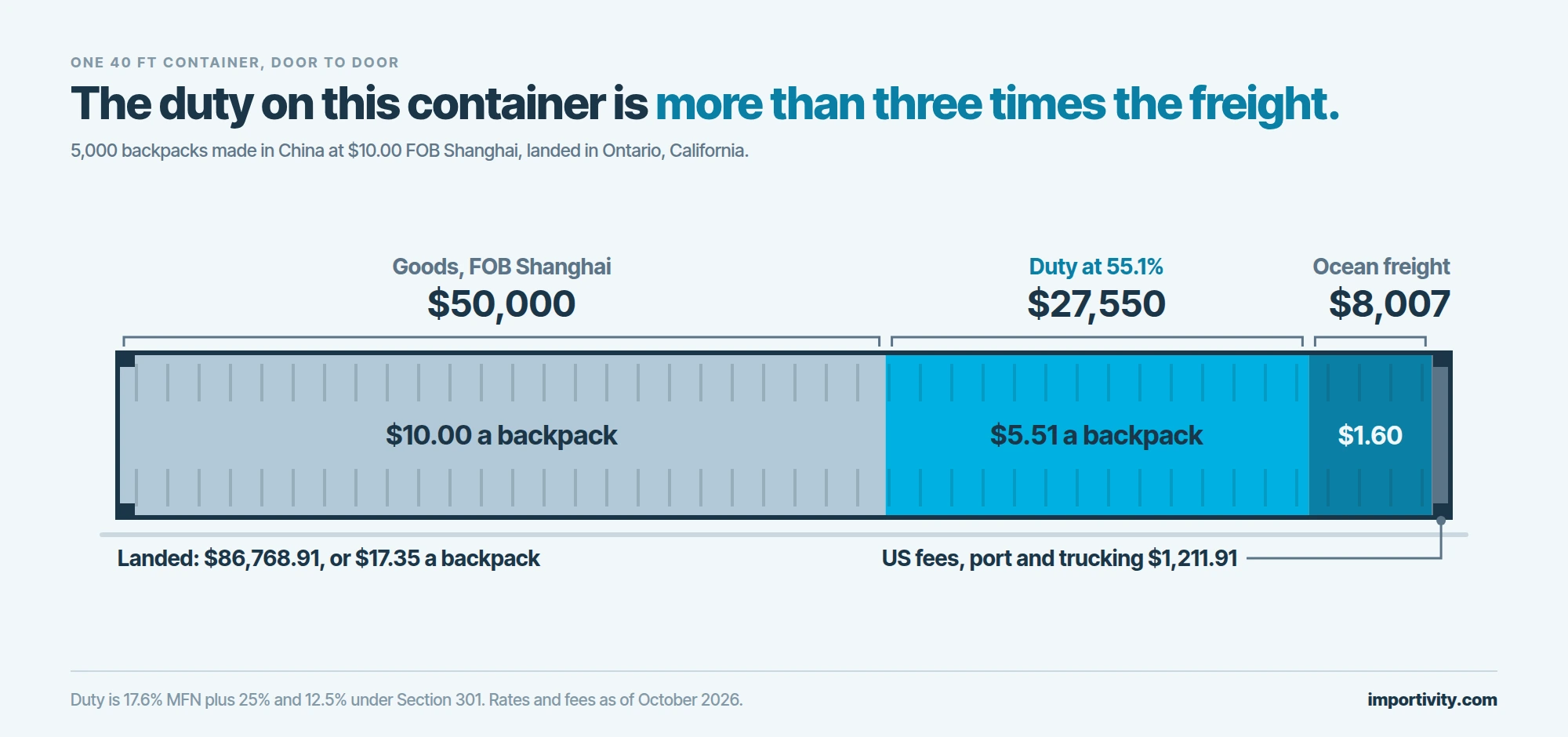
Take 5,000 backpacks of man-made fiber at $10.00 each FOB Shanghai, so $50,000 of customs value, shipped in one 40 ft container through Los Angeles to a warehouse in Ontario, California. FOB means the factory's price already covers getting the goods onto the ship in China. The drawing below shows where the money goes.
Each line uses the dated figures above:
- Ocean freight: $8,007, Drewry's October 22 reading for Shanghai to Los Angeles.
- Duty: $27,550. Backpacks of man-made fiber (HTS 4202.92.3120) made in China pay the 17.6% MFN rate, 25% under Section 301 List 3 and 12.5% under the 2026 Section 301 forced labor action, 55.1% in all.
- MPF: $173.20, which is 0.3464% of $50,000.
- HMF: $62.50, which is 0.125% of $50,000.
- Broker: $224.95 at Clearit's prices, which is $149.95 for the entry, $50 for the ISF and the $25 handling fee.
- Port fees: $101.26, the PierPASS fee of $81.26 plus $20 of Clean Truck Fund.
- Drayage to Ontario: $650, the median trucker bid.
That comes to $36,768.91 on top of the $50,000 of goods, a landed cost of $86,768.91 or $17.35 per backpack. Ocean freight is $1.60 of that per backpack. Duty is $5.51 per backpack, more than three times the freight. The other US charges come to $1,211.91 in total, about 24 cents a backpack.
Sent to a warehouse near New York instead, the ocean line alone rises to $10,166 at Drewry's rate. That is $2,159 more, or about 43 cents a backpack, before New York's own port and trucking charges.
The example leaves out costs that depend on your forwarder and your cargo: the forwarder's destination charges, chassis rental, cargo insurance, the bond, and any demurrage if the container sits too long. Add them from your quotes and use our guide on how to calculate landed cost to spread them across your SKUs.
From goods ready to goods in your warehouse, step by step
The steps below assume you book the freight, not the factory. Jordan Lewis, Importivity's COO, calls handing shipping to the factory the biggest mistake people make when shipping overseas: factories specialize in production, not logistics, and you end up with "zero communication with the people actually clearing your goods through customs." His fix is to ask the factory for an FOB price and use your own freight forwarder, or, if you are just getting started, to ask for DDP pricing so one party handles customs, duties and taxes.
This checklist runs from the factory's ready date to the empty container going back.
- Book space when the factory confirms a ready date. Send your forwarder the ready date plus the carton count, gross weight and volume, and book before packing ends.
- File the ISF. It must be in at least 24 hours before the container is loaded in China.
- Get the container to the terminal before the cutoff. On Matson's CLX schedule the Shanghai cutoff is Tuesday at 18:00 for a Thursday departure.
- Sail. About 10 to 20 days to Los Angeles or Long Beach, and 30 to 35 days from Ningbo to New York, on the schedules above.
- Clear customs. Your broker files the entry and the duty and fees are paid. Check it against the commercial invoice first.
- Pick up within free time. Book the truck before the ship arrives, because demurrage and detention start when the free days end. Our demurrage and detention guide covers how those days are counted.
- Deliver and return the empty. The trucker brings the container to your warehouse, you unload it, and the empty goes back before the detention clock runs out.
Freightos also expects rates to climb again ahead of Lunar New Year, so book early for anything that has to leave China in January.
Importivity helps US brands ship from China and handle the tariffs that come with it, from the freight booking to the duty on the entry. For a door to door plan for your next order, see our shipping and logistics service.
Frequently Asked Questions
How much does it cost to ship a container from China to the US?
On October 22, 2026, Drewry's World Container Index put a 40 ft container at $8,007 from Shanghai to Los Angeles and $10,166 from Shanghai to New York. Those are spot rates before US costs. In our worked example, the duty plus US fees and trucking to Ontario, California added another $28,761.91.
How long does shipping from China to the US take?
By ocean it takes about 15 to 20 days port to port from Shanghai to Los Angeles and often 30 to 35 days from Ningbo to New York, according to Dimerco's 2026 transit table. Freightos's rules of thumb are 30 to 40 days door to door by sea, 8 to 10 days for air freight and about 3 days by express courier.
How much is air freight from China to the US per kg?
The Freightos Air Index for China to North America was $6.88 per kg in the October 20, 2026 update, up 19% in one week. At that rate 1,000 kg costs about $6,880 before fees, close to the price of a whole 40 ft container by sea. Bulky goods can be billed on dimensional weight, which raises the real cost.
What US fees do I pay on top of the freight?
An ocean entry pays the ISF filing, a customs bond, the broker's fee, the 0.125% harbor maintenance fee and the 0.3464% merchandise processing fee, which runs from $34.58 to $670.86 per entry from October 1, 2026. Port fees, drayage and duty come on top. At Los Angeles and Long Beach a 40 ft box pays $81.26 to PierPASS and $20 to the Clean Truck Fund.
Is it cheaper to ship from China to the West Coast or the East Coast?
The West Coast was cheaper and faster by sea in October 2026. Drewry's October 22 reading had Shanghai to Los Angeles $2,159 below Shanghai to New York for a 40 ft container, and the Pacific crossing is about two weeks shorter. For a warehouse in the East, weigh that saving against rail or truck from a West Coast port.
About the author
Jordan Lewis
Chief Operating Officer, Importivity
Runs Importivity's sourcing operations across China, Vietnam, Mexico and India, from supplier negotiation through landed delivery.
Press and media inquiries: press@importivity.com