Demurrage and Detention Charges Explained and How to Avoid Them

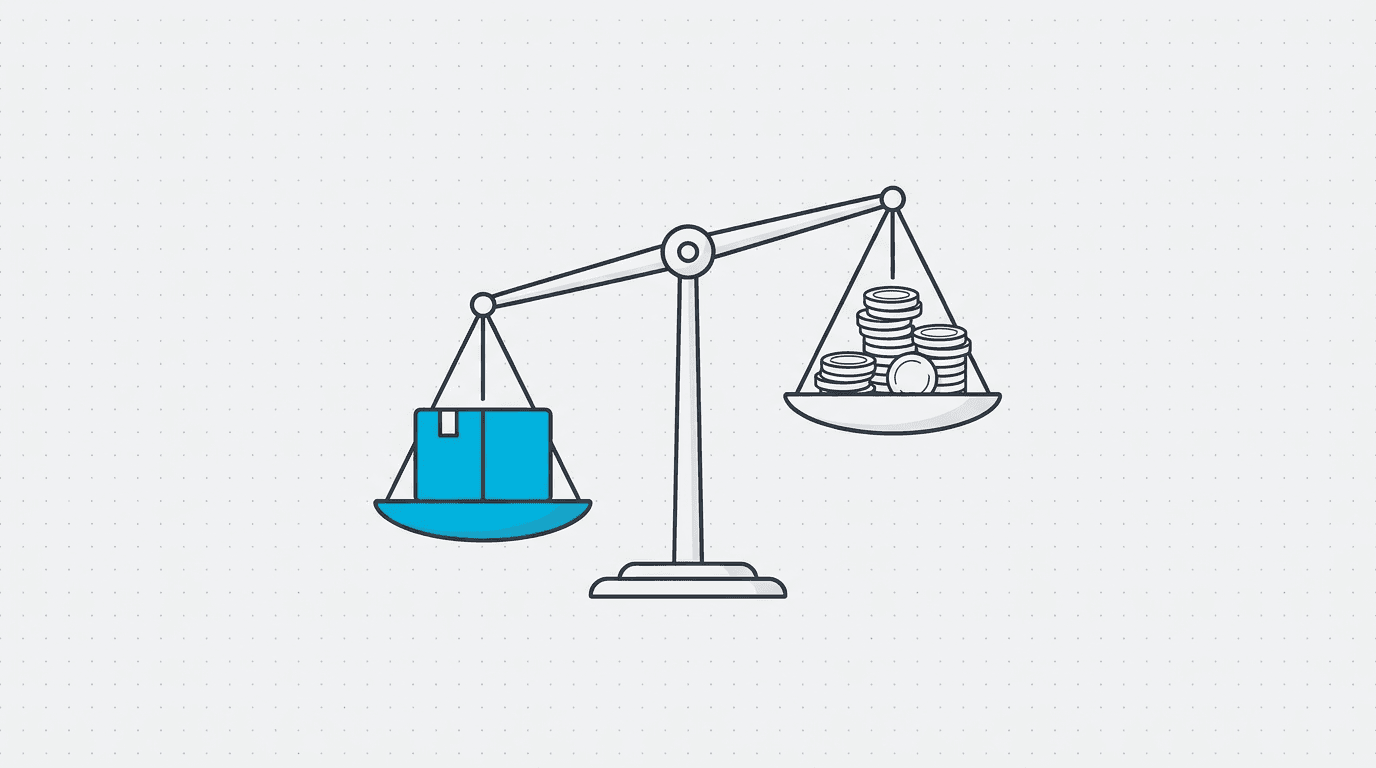
Demurrage is the daily charge for leaving a loaded import container inside the port terminal after its free time ends, and detention, often called per diem, is the daily charge for keeping the carrier's container outside the terminal past its free time until you return it empty. Under Maersk's US import tariff in effect since June 20, 2026, a dry container gets 4 free working days on each clock, then pays $300 a day in demurrage at most US terminals and $210 a day in detention, and both rates rise the longer it stays out.
This guide is for US brands and operations leads who import full containers and want to stop paying for days they did not need. It covers how free time is counted, what carriers and ports publish for 2026, the Federal Maritime Commission (FMC) billing rules and how to dispute or avoid a bill. Most importers first see these charges on a forwarder's invoice, so it helps to know what a freight forwarder actually does and which lines it passes through.
Demurrage vs detention: which clock is running
The two charges pay for different things. Demurrage pays for space in the marine terminal. Detention pays for the use of the carrier's container away from it. The moment that separates them is the out-gate, when your trucker pulls the full container out of the terminal.
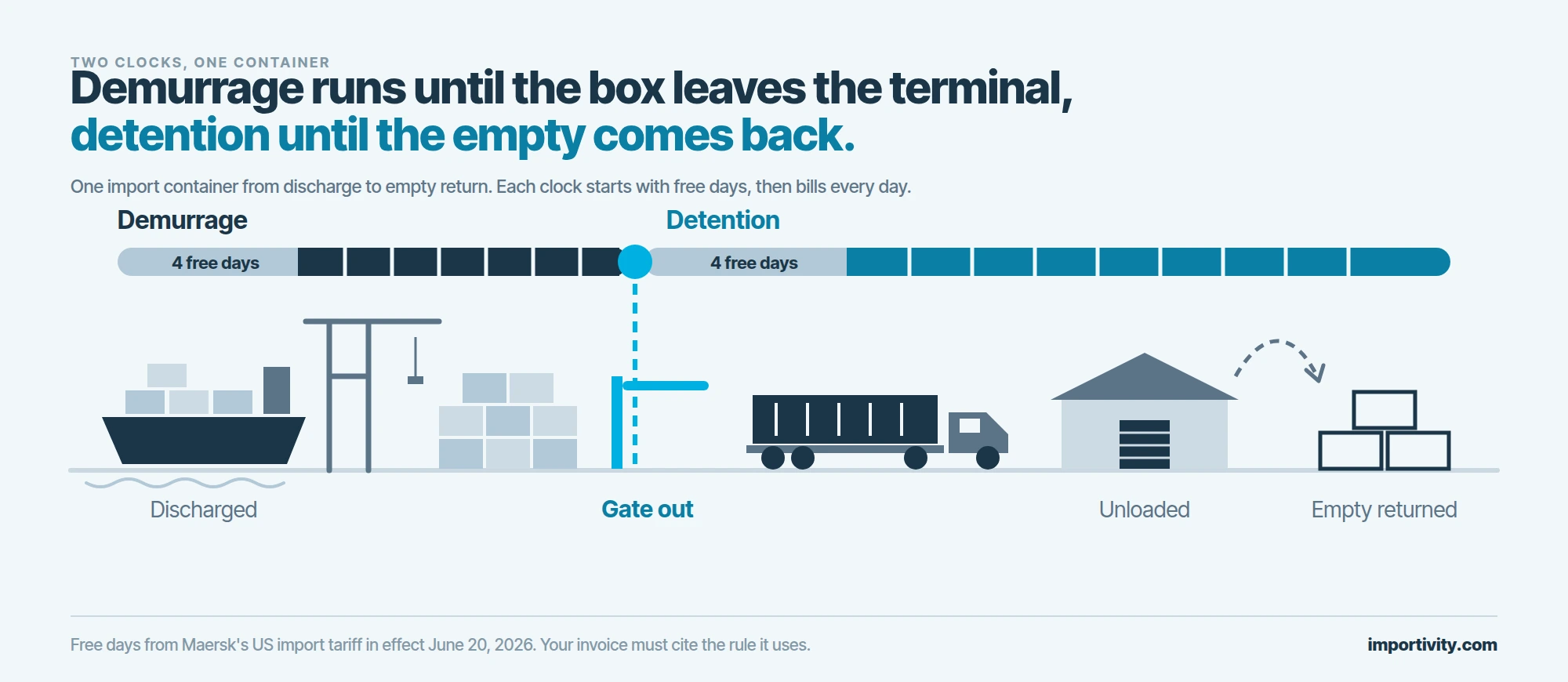
The demurrage clock starts when the container is discharged and available for pickup, and it stops at the out-gate. The detention clock starts at the out-gate and stops when the empty is returned to the terminal or depot the carrier names. A box that waits at the port and then waits again at your dock runs up both, one after the other.
| What differs | Demurrage | Detention (per diem) |
|---|---|---|
| What you pay for | Space in the marine terminal | Use of the carrier's container outside the terminal |
| Clock starts | Container is discharged and available for pickup | Container leaves the terminal by truck or rail |
| Clock stops | The full container gates out | The empty is returned to the terminal or depot named by the carrier |
| Maersk 2026 dry rate after free time | $300 a day for days 5 to 8 at most US terminals, $390 at New York and New Jersey terminals | $210 a day for days 5 to 8, rising to $290 from day 13 |
| Usual cause | Customs or ISF holds, no trucker booked, no terminal appointments | Slow unloading at the warehouse, no return appointment, no chassis |
Two other daily charges often land on the same invoice. Chassis providers bill for the chassis the container sits on, and some ports add their own fees on top of terminal demurrage. Treat each one as a separate clock with its own free time.
How free time is counted
Free time is the number of days before a clock starts charging. How those days are counted differs by carrier, so read the tariff rule your invoice cites.
- Working days in, calendar days out. Maersk counts free time in working days, meaning any day the gate is open for pickup, Monday to Saturday. A partial day of gate hours counts as a full working day. Once free time ends, Maersk bills every calendar day. Hapag-Lloyd's May 2026 US guide also charges on a calendar day basis once free time has expired.
- Missed appointments count against you. Under the Maersk rule, if a terminal closes because nobody booked appointments, that day still counts as a working day for any party that could have booked one and did not.
- Holidays and closures. Hapag-Lloyd excludes both scheduled bank holidays and short-notice shutout days, such as strikes or storms, from free time. After free time, it charges on bank holidays but not on shutout days.
- Customs holds. Hapag-Lloyd stops its own demurrage and detention clock when a container is put on a customs hold for no fault of the customer and restarts it on release. The terminal's storage charges during the hold are still billed to you.
The arrival notice usually goes out before the box is discharged, so treat any last free day on it as provisional. Check it in the terminal's own system once the vessel berths, and again after any delay.
What demurrage and detention cost in 2026
Rates are set in each carrier's tariff or your service contract, so there is no single US number. The published tariffs share a pattern: a few free days, then a daily rate that steps up in tiers.
- Maersk import demurrage, dry 20 ft and 40 ft, most US ocean terminals: per the Maersk US import tariff, 4 free working days, then $300 a day for days 5 to 8, $345 for days 9 to 13 and $395 from day 14.
- Maersk import demurrage at New York and New Jersey terminals: $390 a day for days 5 to 8, $500 for days 9 to 13, $640 for days 14 to 33 and $745 from day 34.
- Maersk import detention, dry: 4 free days, then $210 a day for days 5 to 8, $260 for days 9 to 12 and $290 from day 13.
- Port Houston, Barbours Cut terminal: 7 free days for loaded imports, then $71.55 a day for a 40 ft container under the port tariff effective September 1, 2026. A sustained import dwell fee of $48.53 a day is added from the eighth day after free time and must be paid before the box leaves the gate.
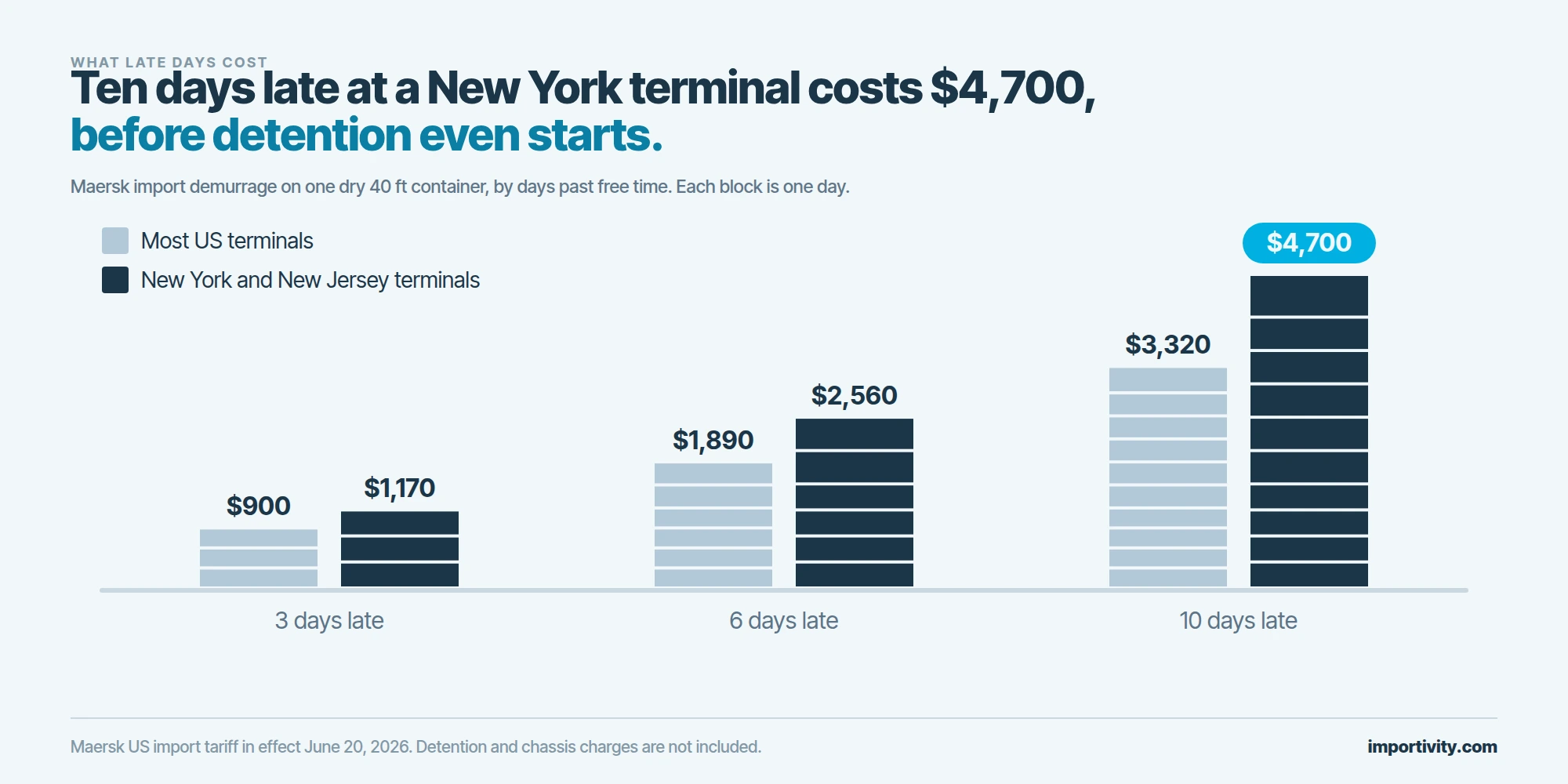
Add the tiers up and the totals grow fast. A dry 40 ft that leaves a standard Maersk US terminal 3 days after free time ends owes $900 in demurrage. Six days late, it owes $1,890. Ten days late, $3,320. At a New York or New Jersey terminal, the same delays cost $1,170, $2,560 and $4,700. Detention then starts at the gate. If your warehouse keeps the box 8 days before the empty goes back, the 4 days past free time add another $840.
A forwarder or NVOCC that bills you may use its own rates rather than the carrier's. Get the D&D terms in writing with every freight quote and put an allowance for them into your landed cost.
The FMC rules that decide whether you have to pay
The Ocean Shipping Reform Act of 2022, signed June 16, 2022, directed the FMC to set rules for these invoices. The result is 46 CFR part 541, which took effect May 28, 2024 and covers invoices from ocean carriers, marine terminal operators and NVOCCs.
- Required contents. Bill of lading and container numbers, why you are the party billed, the free time with its start and end dates, the container availability date, the dates charged, the tariff or contract rule and rate, a contact and web link for waiver requests, and a statement that the billing party did not cause the charges.
- Missing information. If any required item is missing, the rule says the billed party has no obligation to pay that charge.
- Deadline to bill. The invoice must be issued within 30 calendar days of the date the charge was last incurred. An NVOCC passing on a carrier's charge has 30 days from the invoice it received. Miss the deadline and you are not required to pay.
- Time to dispute. You get at least 30 calendar days from the invoice date to request mitigation, a refund or a waiver. The billing party must try to resolve it within 30 days of receiving it.
One part of the 2024 rule is gone. It limited which parties could be billed and barred billing truckers. The D.C. Circuit set that section aside on September 23, 2025 in World Shipping Council v. FMC, and the FMC removed it in December 2025. Everything above still applies.
Whether a charge is reasonable is a separate test, in 46 CFR 545.5, in force since 2020. It asks whether the charge works as an incentive to move cargo. Detention charged when an empty cannot be returned, for example because the terminal will not accept it, is likely to be found unreasonable. The FMC can also weigh government inspections and how you were told the cargo was available.
How to dispute a demurrage or detention invoice
Disputes are mostly won on paper, so build the file while the container is moving, not weeks later when the invoice arrives.
- Check the invoice against the required contents. A missing free time start date, availability date or tariff rule is a complete answer under 46 CFR 541.5.
- Check the dates. Confirm it was issued within 30 days of the last day charged, and that the availability date and free time match the arrival notice and the terminal's records.
- Collect the evidence. Keep screenshots of appointment screens with no open slots, emails refusing an empty return, gate closure notices, customs hold and release times and your trucker's dispatch log.
- Request mitigation in writing inside the window. Use the contact and process printed on the invoice, list the specific dates you dispute and attach the evidence. Ask for the answer in writing.
- Escalate to the FMC if the carrier refuses. A charge complaint under 46 U.S.C. 41310 goes by email to chargecomplaints@fmc.gov with the bill of lading numbers and invoices. Under the FMC's interim procedure there is no fee, the carrier must prove its demurrage or detention charge was reasonable, and there is no filing deadline for charges assessed on or after June 16, 2022.
A charge complaint covers charges assessed by a common carrier, so a terminal operator's own storage bill goes to complaints@fmc.gov or a formal complaint instead. Email is also not the only route. An FMC rule effective September 1, 2026 confirms you can file a charge complaint as a small claims case, with a $176 fee and claims up to $50,000, or as a formal complaint for $387, and the carrier still carries the burden of proof.
Under FOB or EXW terms the US side of the move is yours, so you deal with the carrier or your forwarder. Under DDP the seller carries the costs to the named delivery place, so a charge before delivery goes back to your supplier. Our page on FOB vs DDP shows where that line falls.
How to avoid demurrage and detention charges
Most avoidable charges come from a container that was ready before the paperwork, the truck or the warehouse. This checklist closes those gaps.
- File the ISF on time and the customs entry before arrival. A hold at discharge burns free time while nobody can move the box. Our guides to ISF 10+2 filing and choosing a customs broker cover the deadlines.
- Book the trucker before the vessel arrives. Send the drayage company the expected last free day and terminal as soon as you have the arrival notice.
- Track the real last free day. Read it from the terminal's system and recheck it after any vessel delay.
- Negotiate free time up front. Free time and rates can be set in a service contract or NVOCC arrangement, and the invoice must name the one used. Extra days can be worth more than a small freight discount if your warehouse unloads slowly.
- Ask about carrier haulage terms. Hapag-Lloyd's May 2026 US guide waives its line demurrage and terminal storage on carrier haulage imports when the delivery order is in 5 days before arrival, customs is cleared and freight paid 5 days before free time ends, and your site gives the trucker an appointment within 48 hours of the call.
- Plan the unload. Book dock labor for the delivery day. A container waiting at your door is on the detention clock.
- Return the empty on the first slot. Book the return appointment the day you unload, and screenshot any refusal.
- Allow for congestion. Peak season and port backlogs shrink the slack in each step. Our notes on managing shipping delays cover the causes.
If you would rather have one team line up the booking, clearance and trucking for each container, Importivity's shipping and logistics service helps US brands move freight from the factory to their door.
Frequently Asked Questions
Is detention the same as per diem?
In US container shipping it usually is. Carriers and the FMC use per diem for the daily charge on a carrier's container kept outside the terminal past its free time, which most tariffs call detention. Chassis providers also bill by the day, but that is a separate charge for the chassis, not for the container.
Who pays demurrage and detention, the shipper or the consignee?
The party the carrier or forwarder bills, which on an import is usually the consignee or whoever booked the freight. Under FOB or EXW terms the US buyer normally carries the destination charges, while under DDP the seller carries them up to the named delivery place. Every invoice must state why the billed party is liable for the charge.
Do I have to pay a demurrage invoice that is missing information?
Not under FMC rules. 46 CFR 541.5 says that if a demurrage or detention invoice from a carrier, terminal operator or NVOCC leaves out any required item, such as the free time dates, the container availability date or the tariff rule, the billed party has no obligation to pay that charge. Reply in writing and list the missing items.
How long do I have to dispute a demurrage or detention charge?
The billing party must give you at least 30 calendar days from the invoice date to request mitigation, a refund or a waiver, and it must try to resolve your request within 30 days of receiving it. If that fails, a charge complaint to the FMC has no filing deadline for carrier charges assessed on or after June 16, 2022.
Does a customs exam stop the demurrage clock?
It depends on the carrier's tariff. Hapag-Lloyd's US guide stops its own demurrage and detention clock during a customs hold that is not the customer's fault, but the terminal's storage charges for those days are still billed. Other carriers may keep counting, and the FMC can weigh government inspections when it reviews whether a disputed charge was reasonable.
About the author
Jordan Lewis
Chief Operating Officer, Importivity
Runs Importivity's sourcing operations across China, Vietnam, Mexico and India, from supplier negotiation through landed delivery.
Press and media inquiries: press@importivity.com