What Does a Freight Forwarder Actually Do, and Do You Need One?

A freight forwarder is a logistics company that arranges and coordinates the international shipping of your goods, but does not physically move the cargo itself. Think of it as the general contractor for your shipment: it books space on a vessel or aircraft, prepares the paperwork, arranges insurance and customs clearance, and coordinates last-mile delivery to your door, while carriers, ports, and truckers do the actual moving.
For a first-time importer, a forwarder turns a dozen moving parts into a single point of contact. That matters most when your freight crosses an ocean, changes hands several times, and has to clear US Customs before it can be released. If you are still weighing how your product should travel, our guide on sea vs air freight pairs well with this one.
This article explains what a freight forwarder does, how it differs from a customs broker and an NVOCC, what forwarders actually charge, and when hiring one beats booking freight direct. It is written for founders and operations teams importing physical products into the United States.
At a glance
Do you actually need a freight forwarder?
Find your shipment below:
What Is a Freight Forwarder?
A freight forwarder arranges and coordinates the movement of goods on your behalf without owning the ships, planes, or trucks that carry them. You hand over the shipment details and the destination, and the forwarder assembles the route, the carriers, the documentation, and the customs process into one managed shipment.
The key point is that a forwarder is an intermediary, not a carrier. It sells you the coordination and the paperwork, then buys the actual transport from ocean lines, airlines, and trucking companies, often at negotiated rates you could not access on your own. That is why forwarders are the default for ocean freight, where a single container can pass through a factory, a port, a vessel, a US port of entry, and a delivery truck before it reaches your warehouse.
What a Freight Forwarder Actually Does
The job goes well beyond booking a container. A capable forwarder manages the full chain of tasks below, which is exactly the work that trips up importers trying to do it alone.
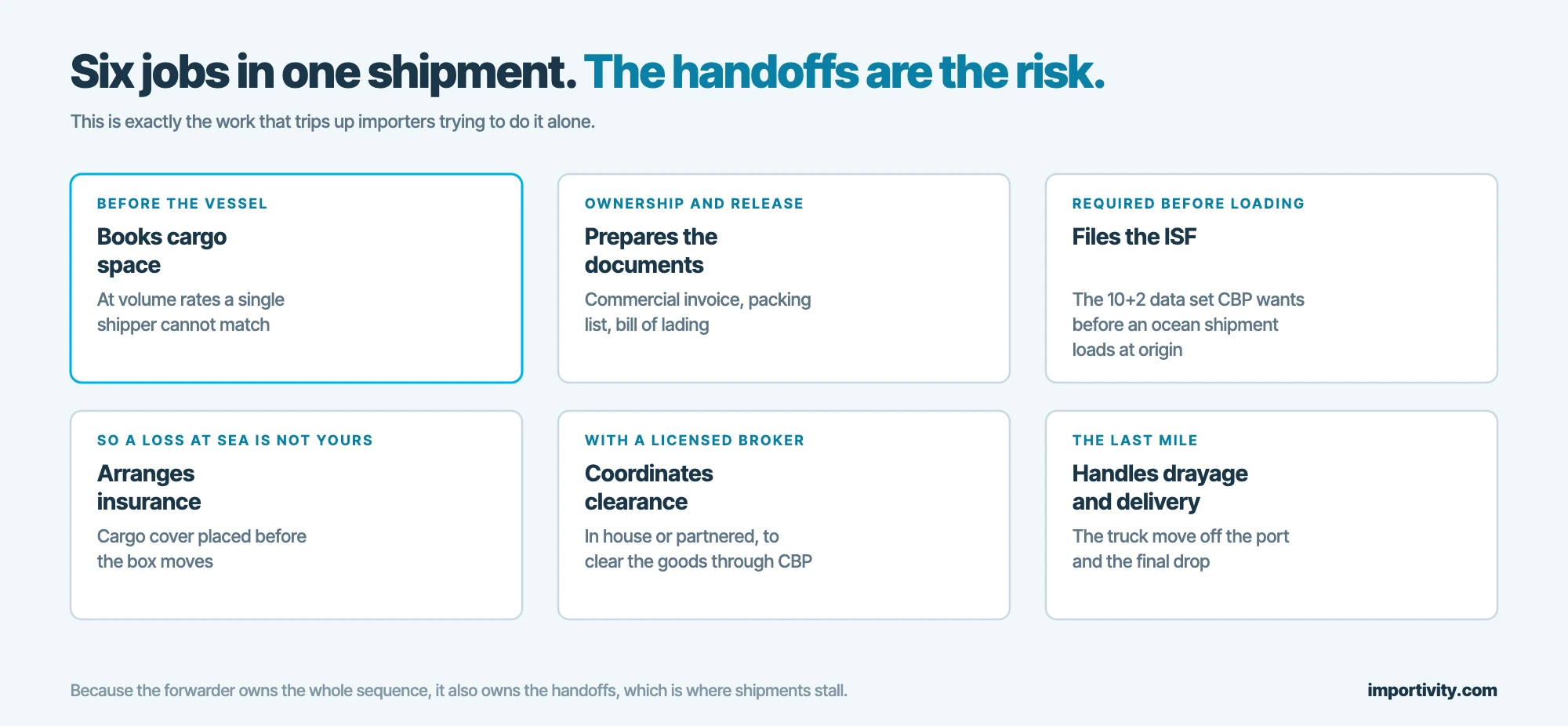
- Books cargo space. Reserves room on a vessel or aircraft and locks in a freight rate, using volume relationships you typically cannot match as a single shipper.
- Prepares the documents. Produces or checks the commercial invoice, packing list, and bill of lading, the paperwork that governs ownership and release of the goods.
- Files the ISF. Submits the Importer Security Filing, the "10+2" data set US Customs requires before an ocean shipment loads at the origin port.
- Arranges insurance. Places cargo insurance so a loss or damage at sea does not fall entirely on you.
- Coordinates customs clearance. Works with a licensed customs broker, in-house or partnered, to clear the goods through US Customs and Border Protection.
- Handles drayage and last-mile. Arranges the truck move from the port and the final delivery to your facility.
Because the forwarder owns the whole sequence, it also owns the handoffs, which is where shipments usually stall. When your terms of sale decide who pays for which leg, the forwarder helps you execute against them. Our breakdown of FOB vs DDP and the full Incoterms 2020 guide explain how those responsibilities are split.
Freight Forwarder vs Customs Broker vs NVOCC
These three roles get used interchangeably, and that confusion leads to double-paying or leaving a legal gap in your shipment. They are distinct. The difference comes down to who does what, who is licensed by CBP, and when you actually use each one.
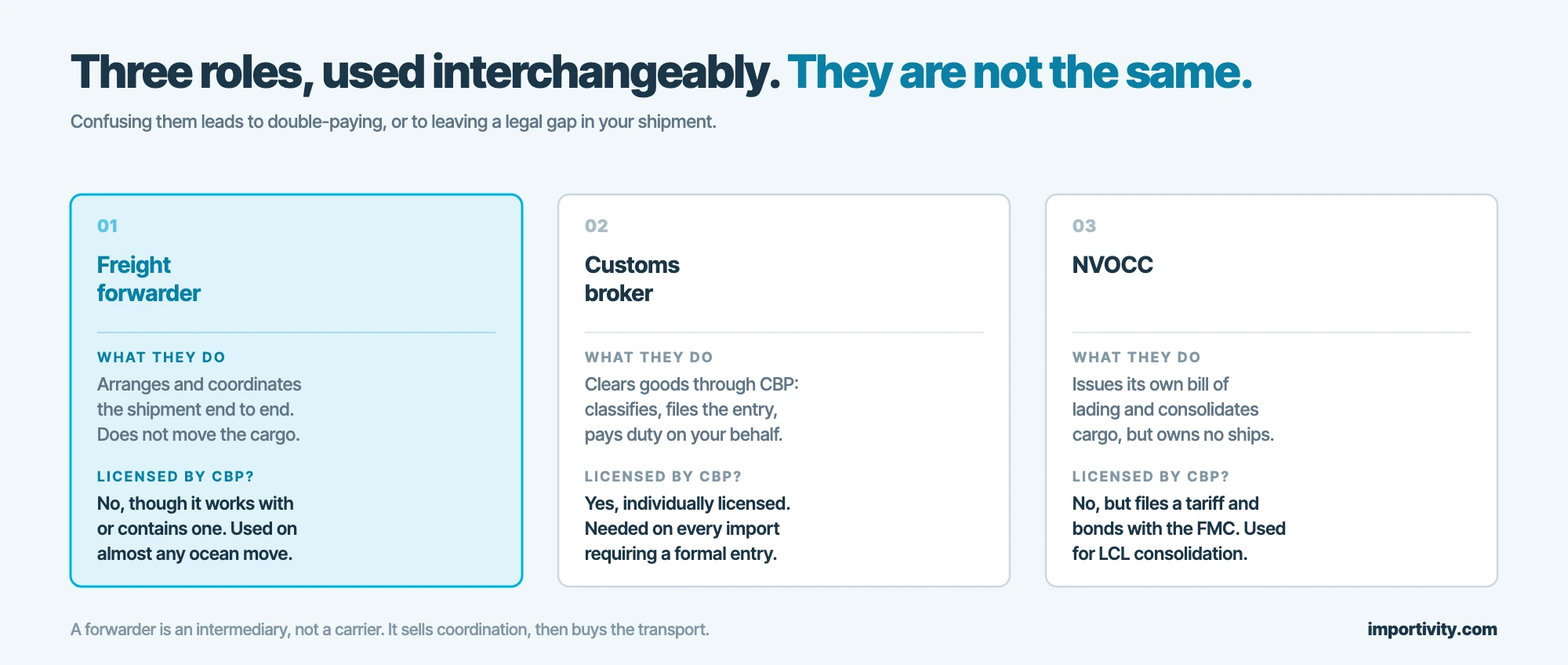
| Role | What they do | Licensed by CBP? | When you use them |
|---|---|---|---|
| Freight forwarder | Arranges and coordinates the shipment end to end: booking, documents, ISF, insurance, and delivery. Does not move the cargo itself. | No, though it works with or contains one | Almost any international shipment, especially ocean and multi-leg moves |
| Customs broker | Clears goods through US Customs: classifies the product, files the entry, and pays duties on your behalf. | Yes, individually licensed by CBP | Every US import that requires a formal customs entry |
| NVOCC | A non-vessel-operating common carrier. Issues its own bill of lading and consolidates cargo, but owns no ships. | No, but files a tariff and bonds with the FMC | LCL consolidation and shippers wanting a carrier relationship without a vessel line |
In practice the lines blur. Many freight forwarders keep a licensed customs broker in-house or partner with one, and plenty of forwarders also act as an NVOCC by issuing their own bills of lading. What you should confirm is simple: someone in the chain holds a valid CBP customs broker license, because only a licensed broker can legally clear your goods.
What Freight Forwarders Cost
Forwarder pricing has two layers. The first is a set of flat service fees for the paperwork and filings. The second is a margin the forwarder earns on the freight rate itself, the spread between what it pays the carrier and what it charges you. Typical flat fees look like this:
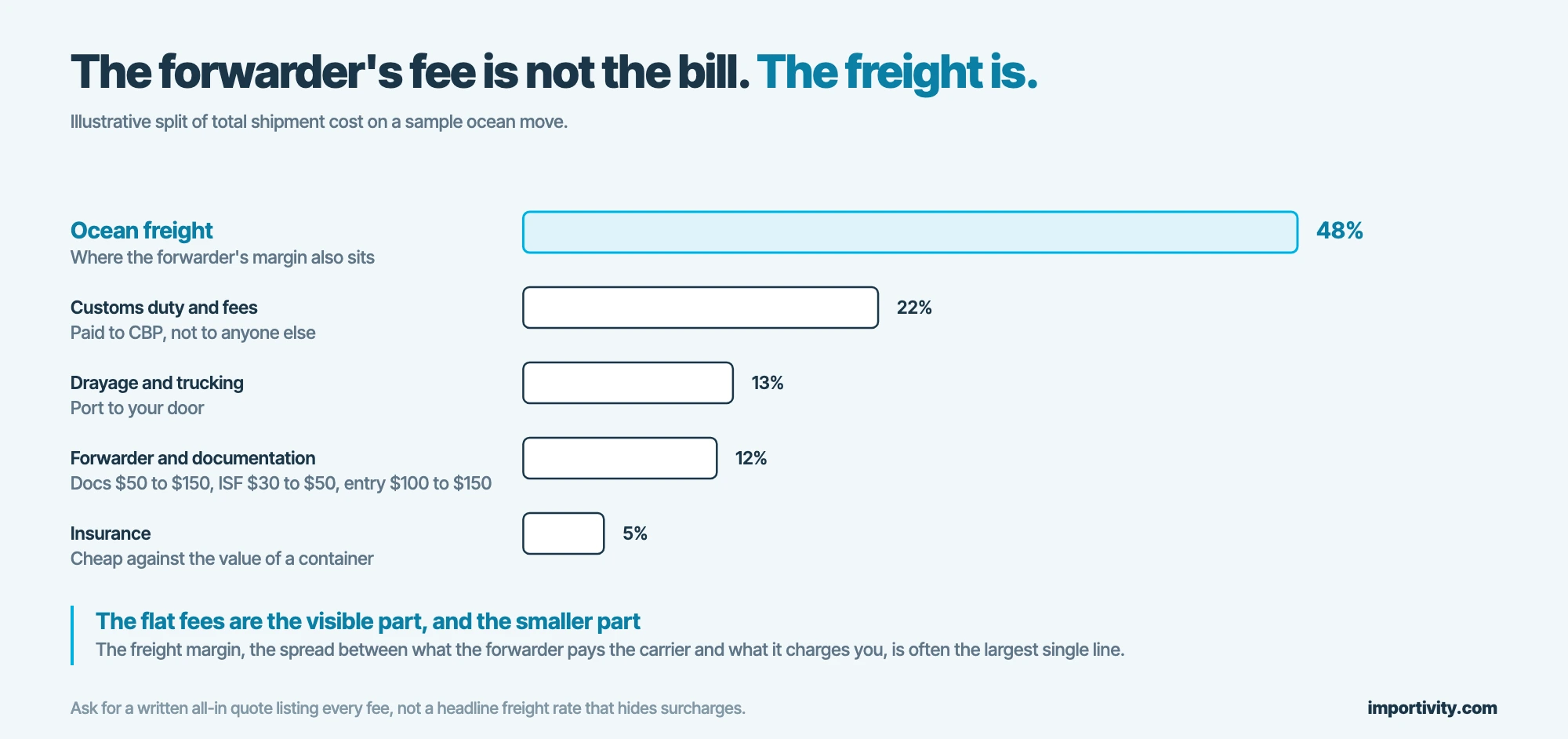
- Documentation fee: roughly $50 to $150 per shipment for preparing and processing the bill of lading and related paperwork.
- ISF filing: roughly $30 to $50 to file the Importer Security Filing for ocean cargo.
- Customs entry: roughly $100 to $150 for the broker to file the formal entry with CBP.
- Freight margin: a markup built into the ocean or air rate, which is often the largest single line in the invoice.
Those service fees are small next to the freight and duty on a real container. The chart below shows where the money goes on a sample ocean shipment. Ocean freight dominates, duty is the next largest slice, and the forwarder's own fees are a modest share of the total.
Illustrative split of total shipping spend for one imported ocean container. Your real numbers move with lane, commodity, and duty rate, so confirm them with a full landed cost calculation before you price your product.
When You Need One vs Booking Freight Direct
You do not always need a forwarder. A small, simple courier shipment, a few boxes moving door to door on a single air waybill, can often go direct through an express carrier that already handles the customs step for you. Paying a forwarder there adds cost without adding much value.
A forwarder earns its fee as soon as the shipment gets complicated. The shippers who benefit most are:
- First-time importers who have never filed an ISF, arranged a customs entry, or read a bill of lading, and want one party accountable for getting it right.
- Ocean LCL shippers who need their cargo consolidated with other freight into a shared container, which requires a consolidator to manage.
- Ocean FCL shippers moving a full container who want negotiated rates, reliable space, and coordinated drayage on the US side.
- Multi-leg shipments that change carriers or modes, where every handoff is a chance for the goods to sit and rack up storage fees.
If you are deciding whether your volume calls for a shared or full container in the first place, our comparison of FCL vs LCL shipping is the right next read. As a rule, the more legs, handoffs, and customs steps your shipment has, the more a forwarder is worth its fee.
How to Choose a Freight Forwarder
Forwarders vary widely in lane coverage, service level, and honesty about all-in cost. Before you hand over a shipment, work through this checklist:
- Confirm they routinely handle your trade lane and your mode, not just a lane they will learn on your cargo.
- Verify a licensed customs broker is in-house or under a named partner, so clearance is covered.
- Ask for a written all-in quote that lists every fee, not a headline freight rate that hides surcharges.
- Check that they carry cargo insurance options and adequate liability coverage.
- Ask how they communicate: real tracking and milestone updates, or silence until something breaks.
- Request references from importers who ship a product and volume similar to yours.
- Confirm they file your ISF on time, since late filings draw CBP penalties that land on you.
- Compare at least two or three forwarders on the same shipment so you can judge the quote and the responsiveness.
If you would rather have sourcing and logistics run as one accountable service instead of stitching vendors together yourself, that is exactly what our shipping and logistics team does for importers.
If you would rather somebody held these decisions open on every shipment instead of after a problem, that is the work we publish at Source With Jordan.
Frequently Asked Questions
What is a freight forwarder in simple terms?
A freight forwarder is a company that arranges and coordinates the international shipping of your goods on your behalf, without owning the ships, planes, or trucks that carry them. It books cargo space, prepares the shipping documents, files customs paperwork, arranges insurance, and coordinates delivery, acting as a single point of contact for the whole shipment.
Do I need both a freight forwarder and a customs broker?
You need the functions of both, but often not two separate companies. Only a customs broker licensed by US Customs and Border Protection can legally clear your goods through customs. Many freight forwarders keep a licensed broker in-house or partner with one, so a single forwarder can cover both roles. Confirm that a licensed broker is part of the chain before you ship.
How much does a freight forwarder charge?
Forwarders charge flat service fees plus a margin on the freight rate. Typical flat fees are about 50 to 150 dollars for documentation, 30 to 50 dollars for the ISF filing, and 100 to 150 dollars for the customs entry. On top of that, the forwarder adds a markup to the ocean or air freight rate, which is usually the largest cost on the invoice after the freight and duty themselves.
What is the difference between a freight forwarder and an NVOCC?
An NVOCC, or non-vessel-operating common carrier, issues its own bill of lading and consolidates cargo but owns no ships. A freight forwarder arranges and coordinates the shipment as an intermediary and does not have to issue its own bill of lading. Many companies act as both, but the defining trait of an NVOCC is that it takes on carrier responsibilities through its own bill of lading.
Can I ship internationally without a freight forwarder?
Yes, for simple shipments. A small courier shipment moving door to door on a single air waybill can often go direct through an express carrier that handles customs for you. A forwarder becomes worth the fee once the shipment involves ocean freight, LCL consolidation, multiple legs, or your first import, when the paperwork and handoffs are easy to get wrong.
About the author
Jordan Lewis
Chief Operating Officer, Importivity
Runs Importivity's sourcing operations across China, Vietnam, Mexico and India, from supplier negotiation through landed delivery.
Press and media inquiries: press@importivity.com