What a Customs Broker Does, What One Costs and When You Need One

A customs broker is a private agent licensed by U.S. Customs and Border Protection to file your import entry, classify the goods, calculate the duties and fees, post your bond, file the Importer Security Filing, transmit agency data such as FDA prior notice, and pay CBP on your behalf. You are not legally required to hire one. A self-filer is allowed, but you need ACE-certified filing software, your own filer code, an ACH account with CBP, a bond, and a person on your payroll who owns the reasonable-care duty the law puts on the importer. Most importers pay $95 to $175 per formal entry plus add-ons, and the line that matters most in 2026 is the disbursement fee of 2 to 3 percent on any duty the broker advances for you.
This guide is for US importers deciding whether they need a broker, what a fair invoice looks like, and how to pick one. It covers what a broker does, when self-filing makes sense, a realistic 2026 fee picture, the life of an entry from ISF to protest, the questions to ask before you sign a power of attorney, and where a broker stops and a sourcing partner such as our import and export agency takes over.
What a customs broker actually does
CBP licenses brokers, and there are roughly 16,170 active licensed brokers in the country. Since the modernized broker regulations took effect in December 2022, a broker who sees a client breaking customs law must advise on the correction and keep a record of that advice. The relationship is closer to an accountant than to a courier.
- Entry filing. The entry and entry summary go to CBP through ACE under the broker's filer code and your importer number.
- Classification and valuation. Every line gets a ten-digit HTS number, a declared value and a country of origin, built from the invoice you supply. Our guide to HTS codes and customs classification explains why this step decides your duty rate.
- Duty and fee calculation. Ordinary duty, any Section 301 or Section 232 layer that applies, the merchandise processing fee, and the harbor maintenance fee on ocean cargo.
- Bond and ISF. A single entry or continuous bond through a surety, and for ocean freight the Importer Security Filing before the container is loaded.
- Partner government agencies. FDA prior notice, USDA declarations, EPA and DOT certifications, CPSC and Lacey Act data, sent with the entry.
- Payment and post-entry work. Paying CBP by ACH, post summary corrections, and protests after liquidation.
Do you legally need one
No. Nothing in the Tariff Act requires an importer to use a broker, and CBP's own guidance says so. The law requires that someone at your company files a complete and accurate entry, pays on time, and can show CBP the classification and value were reached with reasonable care. Self-filing means holding your own filer code, licensing ACE-certified ABI software, opening an ACH payer account, carrying your own bond, and keeping every entry record for five years. That is a job, not a plug-in.
Self-filing pays off for a company that imports the same few products hundreds of times a year and can justify a full-time compliance person. For an importer bringing in ten to two hundred containers a year, the broker's per-entry fee is far cheaper than the salary, the software and the penalties from an entry filed wrong. A middle path works well: keep a broker for filing, but hand them a written classification rationale for each product. And since the de minimis threshold was suspended for every country at the end of August 2025, a $60 parcel needs an entry like a container does; our post on what importers pay now that de minimis is gone covers that side.
What a customs broker costs in 2026
Brokers price per entry, and the entry fee is the number everyone quotes and the smallest line on a big invoice. The ranges below come from published 2026 broker fee schedules; two brokers in the same port will quote differently, so compare schedules line by line rather than by the headline entry fee.
- Formal entry fee. $125 to $175 for an ocean entry, $95 to $150 for air, $60 to $95 for an informal entry under $2,500; high-volume importers negotiate down to $75 to $110.
- ISF filing. $50 to $85 per ocean shipment, sometimes bundled with the entry.
- Additional tariff lines. The base fee usually includes three to five HTS lines; each extra line costs $3 to $10, so a forty-SKU container can double the entry fee quietly.
- Agency filings. $15 to $50 per partner government agency per entry.
- Bond. A single entry bond runs $45 to $120, more for FDA cargo. A continuous bond at the $50,000 minimum runs $250 to $500 a year from most sureties. Sizing rules are in our guide to how a customs bond works.
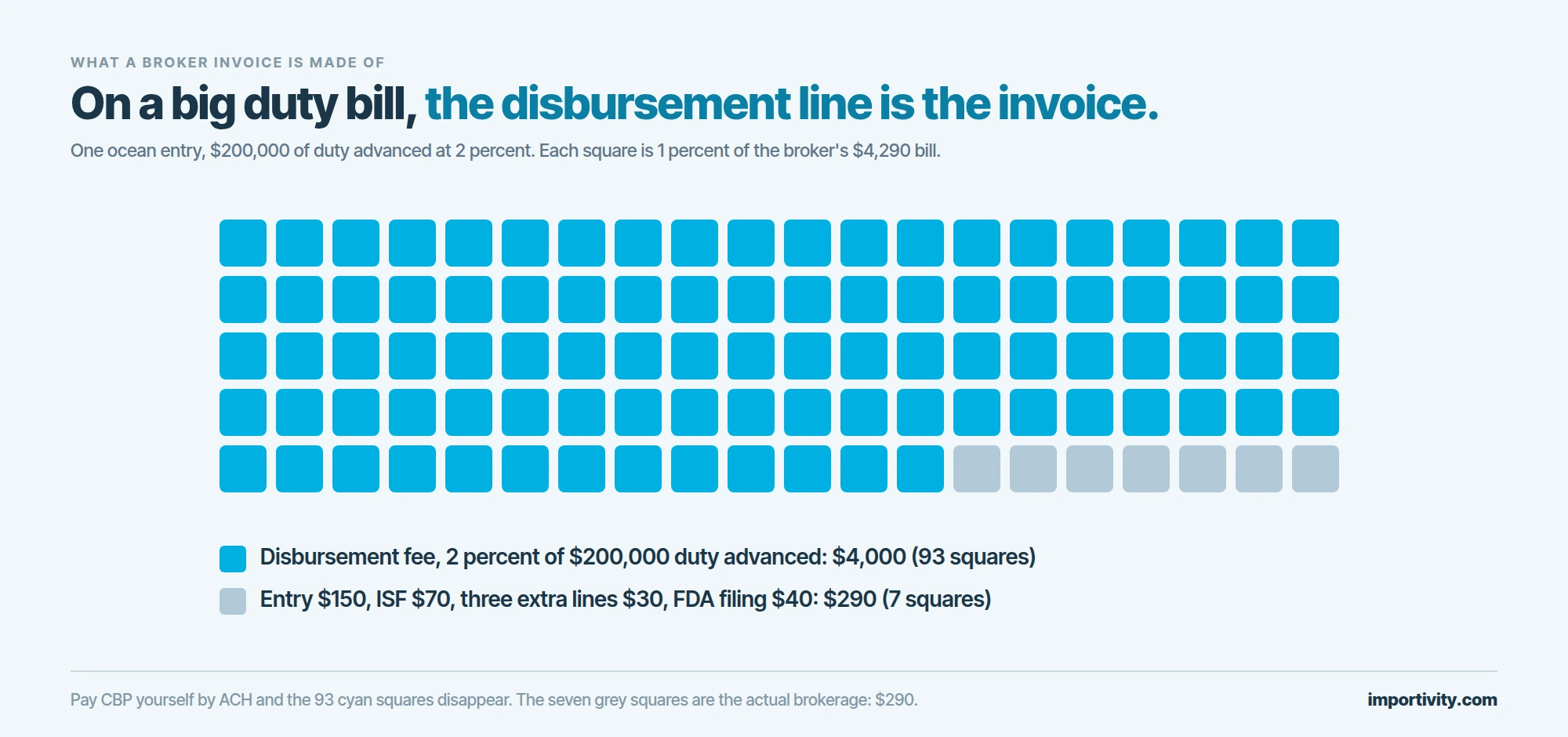
- Disbursement fee. 2 to 3 percent of any duty, tax or fee the broker pays CBP before you reimburse them. It is a financing charge, and it scales with your duty bill, not with the work involved.
Take one ocean entry with $200,000 of duty owed, six HTS lines and one FDA line. The brokerage itself is about $290: a $150 entry fee, $70 for ISF, $30 for three extra lines and $40 for the FDA filing. The disbursement fee at 2 percent is $4,000, which brings the invoice to $4,290. Ninety-three cents of every dollar on that invoice pays for advancing money, and it goes away if you pay CBP through your own ACH account, which is free to set up.
Two costs on the same invoice are not broker fees at all. The merchandise processing fee is a CBP charge of 0.3464 percent of entered value, with a fiscal year 2026 minimum of $33.58 and maximum of $651.50 per formal entry, and the harbor maintenance fee is 0.125 percent of value on ocean cargo. A broker passes both through at cost.
Three ways to get an entry filed
Most importers meet their broker through their freight forwarder and never realize they had a choice. The routes differ in cost, in who controls classification, and in whose interest the filer serves.
| Route | What it costs and who controls it | When it fits |
|---|---|---|
| Self-file | Software license, a filer code, your own bond and ACH, and a salaried compliance owner. Full control, full liability. | High volume on repeating products and an in-house compliance person. |
| Forwarder's in-house broker | Per-entry fees bundled into the freight quote, often at the higher end. Classification is done fast, by whoever is on shift. | Simple products, one lane, low duty exposure, and a preference for one invoice over the lowest total cost. |
| Independent licensed broker | Per-entry fees on a written schedule, no freight margin, and a broker whose only revenue is the brokerage and its accuracy. | Multiple suppliers or lanes, agency-regulated goods, tariff-sensitive products, or any importer whose duty bill is bigger than its freight bill. |
| Broker plus a sourcing partner | The broker files; the sourcing partner supplies correct invoices, origin evidence and specs for the broker to classify against. | Importers building a new product or moving production between countries. |
The forwarder route is fine for a first container. As duty exposure grows the problem shows: a forwarder is paid on freight, so the classification review that might cut your duty by 8 points is nobody's job.
The life of one entry and where the broker earns the fee
A customs entry is a series of deadlines that start before the ship leaves the origin port and end more than a year after arrival, and the broker's job is to hit each one. Knowing the sequence tells you when a mistake stops being cheap to fix.
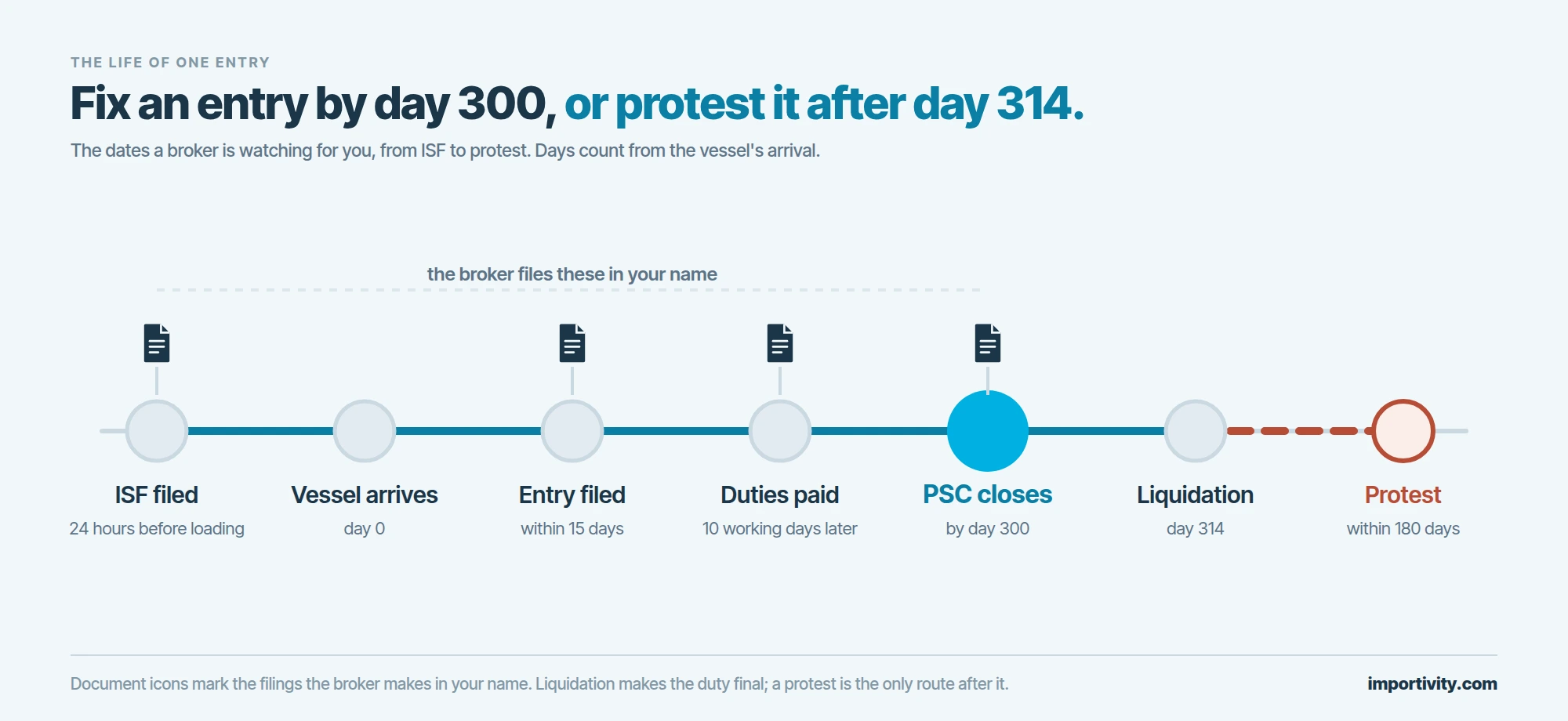
The ISF must be transmitted at least 24 hours before the container is loaded at the foreign port; a late or missing filing exposes you to a $5,000 penalty. Once the vessel arrives, the entry has to be filed within 15 calendar days, and the entry summary with the duties and fees is due 10 working days later. CBP normally liquidates the entry 314 days after entry, the point at which the duty amount becomes final.
Between filing and liquidation you have the cheapest correction tool in customs law, the post summary correction. A PSC can fix classification, value, origin or a missed exclusion, with a refund if the duty falls, and it can be filed up to 300 days after entry and no later than 15 days before the scheduled liquidation date. After liquidation the only route is a protest, filed within 180 days of the liquidation date, which takes longer and needs a written legal argument. A broker who runs a monthly report of unliquidated entries against your classification changes is doing the job. One who files and forgets leaves refunds that expire on day 300.
How to choose a customs broker
Start with the license. CBP publishes a Permitted Customs Brokers list on its website, searchable by port, and every broker on it holds an active license and a national permit. If the company is not on it, your entries would be filed under someone else's license. Then ask for the fee schedule in writing, and ask these questions.
- Which of my products have you classified before? A broker who works furniture all day will classify a wireless sensor by guesswork. Ask for their two largest clients in your product category.
- How do you handle stacked tariffs? In 2026 a single line can carry the ordinary duty, a Section 301 layer, a Section 232 layer on steel, aluminum or copper content, and whichever executive tariff is in force that quarter, under anti-stacking rules that keep changing. Ask the broker to walk through the stack on one of your products. Our guide to Section 232 tariffs shows what a correct answer contains.
- What is your disbursement policy? The right answer is that they will help you set up ACH with CBP so the fee never applies.
- What happens when my invoice description is vague? A good broker stops and asks you. A bad one picks a code and files.
- What does the power of attorney cover? The broker must hold a valid customs POA before filing in your name. Read it: a limited POA can be scoped to specific ports or transactions, and a partnership's POA expires after two years.
Three red flags end the conversation: pricing quoted as a percentage of shipment value, because the work does not scale with value; no written fee schedule, because every add-on will appear after the fact; and a broker who never asks a question about your product, because that broker is not exercising the supervision their license requires.
Where the broker stops and a sourcing partner starts
A broker works from the documents that reach them: the commercial invoice, the packing list and the bill of lading. All of those are created before the goods ship, by the factory and by whoever manages the factory relationship. When the invoice describes the product badly, states the wrong origin, values a sample at zero, or splits a set across two lines that should be one, the broker inherits the error and so do you. That gap is where most duty overpayments and CBP requests for information begin.
Jordan's team at Importivity sits on the sourcing side of that line: getting the factory's invoice to describe the product the way the HTS reads it, collecting origin evidence at the factory rather than after a CBP notice, and building a landed-cost model the broker can classify against. When the paperwork arrives correct, brokerage is a fee, not a risk. Start with a fit check with Jordan and bring your last three entries; the classification review alone usually pays for the call.
Frequently Asked Questions
Do I need a customs broker to import into the USA?
No. There is no legal requirement to hire a broker, and CBP allows importers to file their own entries. Self-filing means your company holds a filer code, uses ACE-certified filing software, pays duties through its own ACH account, carries its own bond and keeps entry records for five years. Most importers below a few hundred entries a year find a broker's per-entry fee cheaper than staffing that work.
How much does a customs broker charge per entry?
Published 2026 fee schedules put a formal ocean entry at $125 to $175 and an air entry at $95 to $150, with informal entries at $60 to $95. Add $50 to $85 for an ISF filing, $3 to $10 for each HTS line beyond the three to five included, and $15 to $50 per partner government agency. The largest add-on is usually the disbursement fee of 2 to 3 percent on any duty the broker advances.
What is a customs broker disbursement fee and can I avoid it?
A disbursement fee is a charge of roughly 2 to 3 percent that a broker adds when it pays CBP duties and fees on your behalf and bills you afterward. It is a financing charge, so it grows with your duty bill rather than with the work involved. You avoid it entirely by setting up an ACH account with CBP so duties are debited from your own bank account, which costs nothing.
How do I verify that a customs broker is licensed?
Check CBP's Permitted Customs Brokers list on cbp.gov, which is searchable by port and shows every broker holding an active license and a national permit. If the company is not on the list, its entries are being filed under someone else's license. Ask the broker for its filer code and confirm it matches the entity named in the power of attorney you are signing.
What is the difference between a freight forwarder and a customs broker?
A freight forwarder arranges the movement of the goods: booking, consolidation, trucking and ocean or air carriage. A customs broker is licensed by CBP to file the entry, classify the goods, calculate duties and pay CBP on your behalf. Many forwarders have an in-house brokerage, but the license, the liability and the fee schedule are separate, and you can use an independent broker with any forwarder.
About the author
Jordan Lewis
Chief Operating Officer, Importivity
Runs Importivity's sourcing operations across China, Vietnam, Mexico and India, from supplier negotiation through landed delivery.
Press and media inquiries: press@importivity.com