Which Is Cheaper, FCL or LCL Shipping?
FCL is usually cheaper once your shipment passes roughly 13 to 15 cubic meters, while LCL is the cheaper choice for smaller loads below that point. FCL, or full container load, means you book a whole ocean container and pay a flat rate whether you fill it or not. LCL, or less than container load, means your cargo shares a container with other shippers and you pay per cubic meter. The right pick comes down to your volume, your timeline, and how fragile your goods are.
This guide defines both options, lays out the key differences in a side by side table, and shows the exact cost curve where LCL stops being the bargain. It is written for importers comparing quotes and trying to avoid overpaying on ocean freight. If you are still weighing ocean against airfreight in the first place, start with our breakdown of sea vs air freight, then come back to choose your container strategy. For the wider service, see how we handle shipping and logistics end to end.
Quick answer
Which ocean freight option should you book?
Find your shipment volume below:
What FCL and LCL Mean
FCL, full container load, means you reserve an entire shipping container for your cargo alone. You pay a flat rate for that container regardless of how full it is. A standard 20ft container holds roughly 28 to 33 CBM of usable space, and a 40ft container holds roughly 58 to 67 CBM. Because the price is fixed per box, your cost per CBM drops the more you load in.
LCL, less than container load, means your shipment is too small to justify a full box, so it travels alongside other companies' cargo inside one shared container. You pay per cubic meter, or per 1,000 kg if your freight is dense, whichever is greater. That per CBM model is what makes LCL attractive for small orders and expensive for large ones. LCL also requires consolidation at origin and deconsolidation at destination, where a warehouse combines and later separates the loads, and that extra handling shows up in both time and risk.
Key Differences Between FCL and LCL
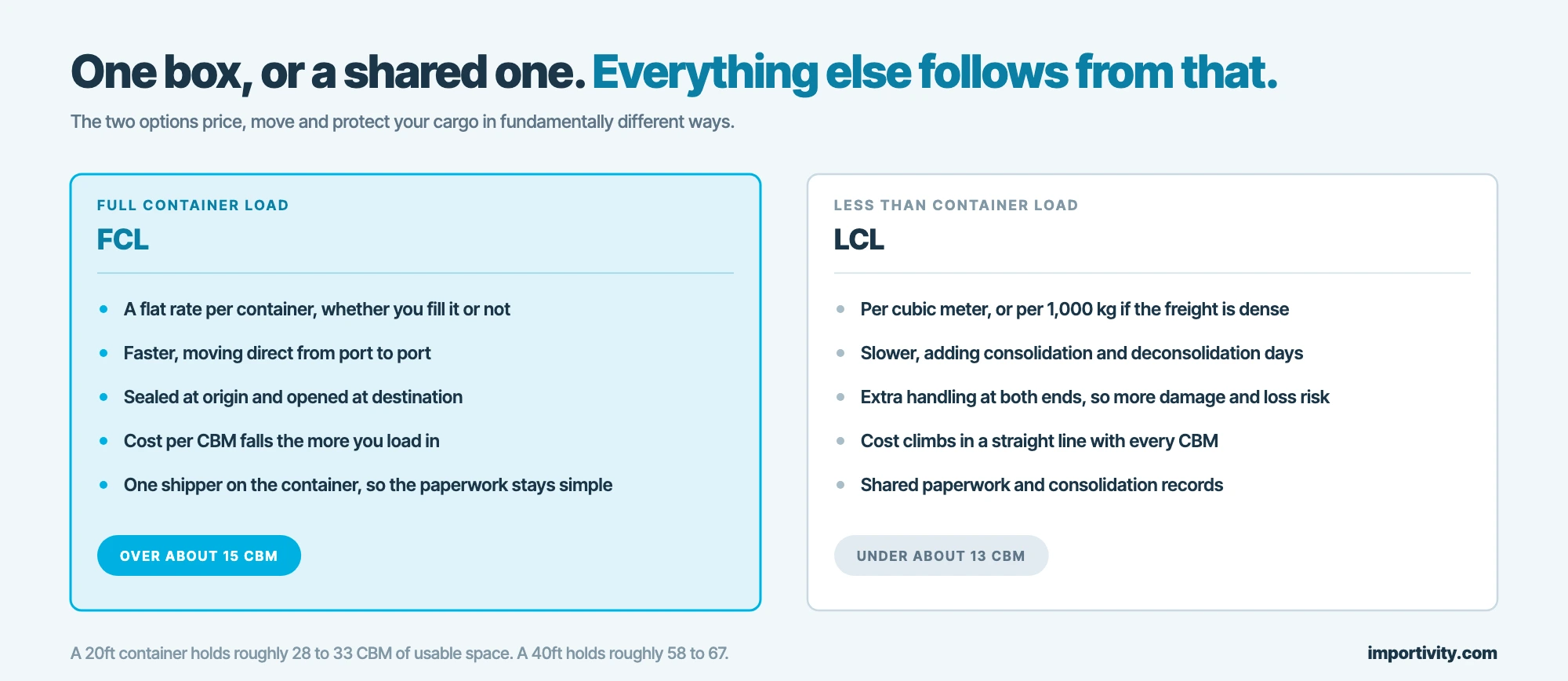
The two options price, move, and protect your cargo in fundamentally different ways. The table below sums up what actually changes when you switch between them.
| Factor | FCL | LCL |
|---|---|---|
| How you pay | Flat rate per container, full or not | Per cubic meter (CBM), or per weight if dense |
| Speed | Faster, direct from port to port | Slower, adds consolidation and deconsolidation days |
| Handling and risk | Sealed at origin, opened at destination, lower damage risk | Extra handling at both ends, higher damage and loss risk |
| Best volume | Over about 15 CBM | Under about 13 CBM |
| Documentation | Straightforward, one shipper on the container | More complex, shared paperwork and consolidation records |
Cost Comparison and the Break-Even Point
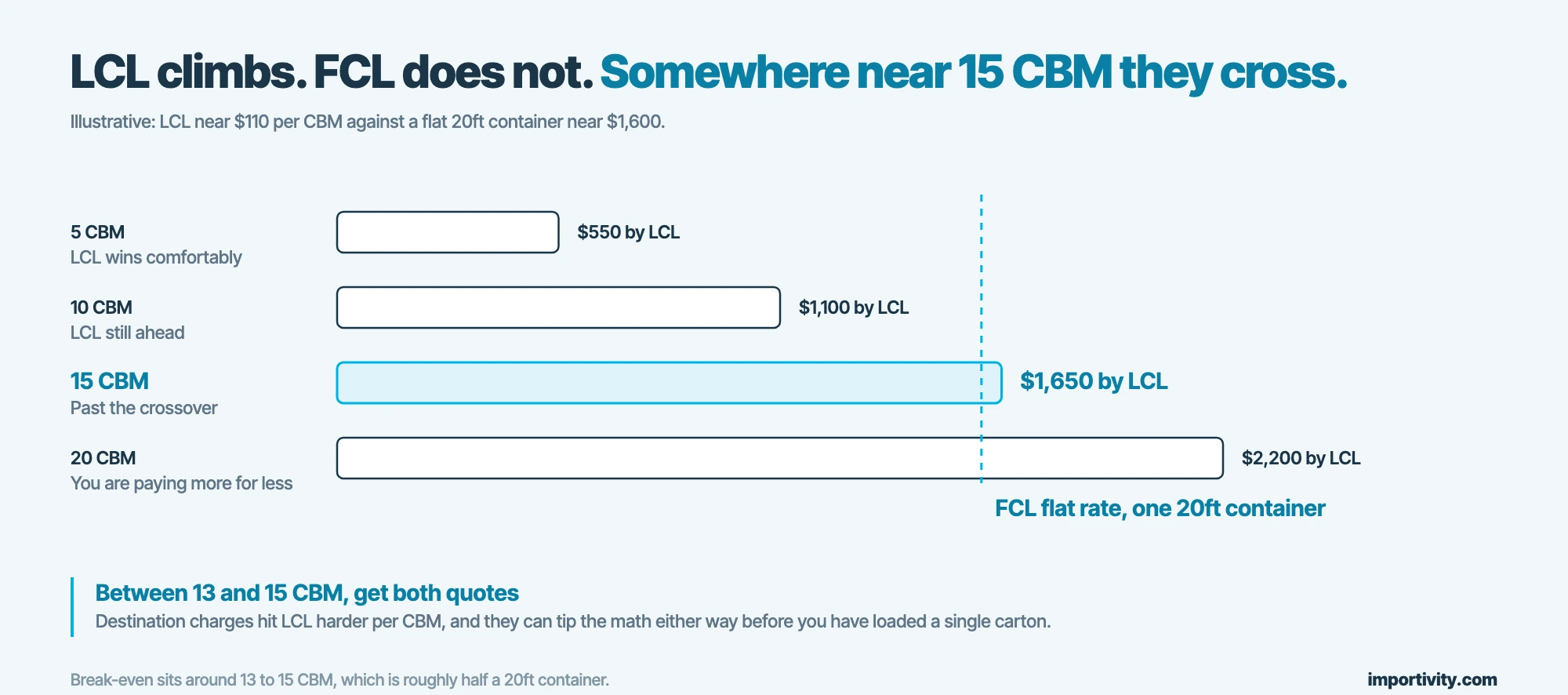
Here is the heart of the decision. LCL cost climbs in a straight line because you pay for every cubic meter, while FCL stays roughly flat because one 20ft container costs the same whether it holds 10 CBM or 28. Plot both and the lines cross. Below the crossover LCL is cheaper, above it FCL wins. The bars below use illustrative rates, an LCL price near $110 per CBM and a flat 20ft container near $1,600, to show where the two meet.
FCL total (flat, one 20ft container)
$550
$1,600
$1,100
$1,600
$1,650
$1,600
$2,200
$1,600
Break-even is around 13 to 15 CBM, roughly half a 20ft container. Below it, LCL costs less. At about 15 CBM the LCL total ($1,650) passes the flat FCL rate ($1,600), and every cubic meter after that makes the full container the clear winner on price.
Numbers are illustrative and for shape only. Real rates swing with lane, season, fuel, and destination charges, so confirm your own quote and fold it into a full landed cost calculation before you commit.
Transit Time and Damage Risk
Price is only half the story. LCL almost always takes longer than FCL on the same lane. Your goods have to wait at an origin warehouse to be consolidated with other shipments, then get separated again at destination during deconsolidation. Those two steps commonly add several days to a week on each end, and they happen before and after the ocean leg you actually paid for. FCL moves as a sealed unit from the origin port straight to the destination port, so there is far less waiting in a warehouse queue.
Damage risk follows the same logic. Every extra time your cargo is handled, restacked, or moved next to a stranger's freight is another chance for crushing, moisture, or mislabeling. FCL cartons are loaded once, sealed, and opened only at the final destination, which is why fragile or high value goods usually travel better in a full container. If your timeline is tight or your product is delicate, the small premium for FCL often pays for itself in fewer claims and fewer delays.
When to Choose FCL vs LCL
Run your shipment through this checklist. If most of the boxes point the same way, your answer is usually obvious.
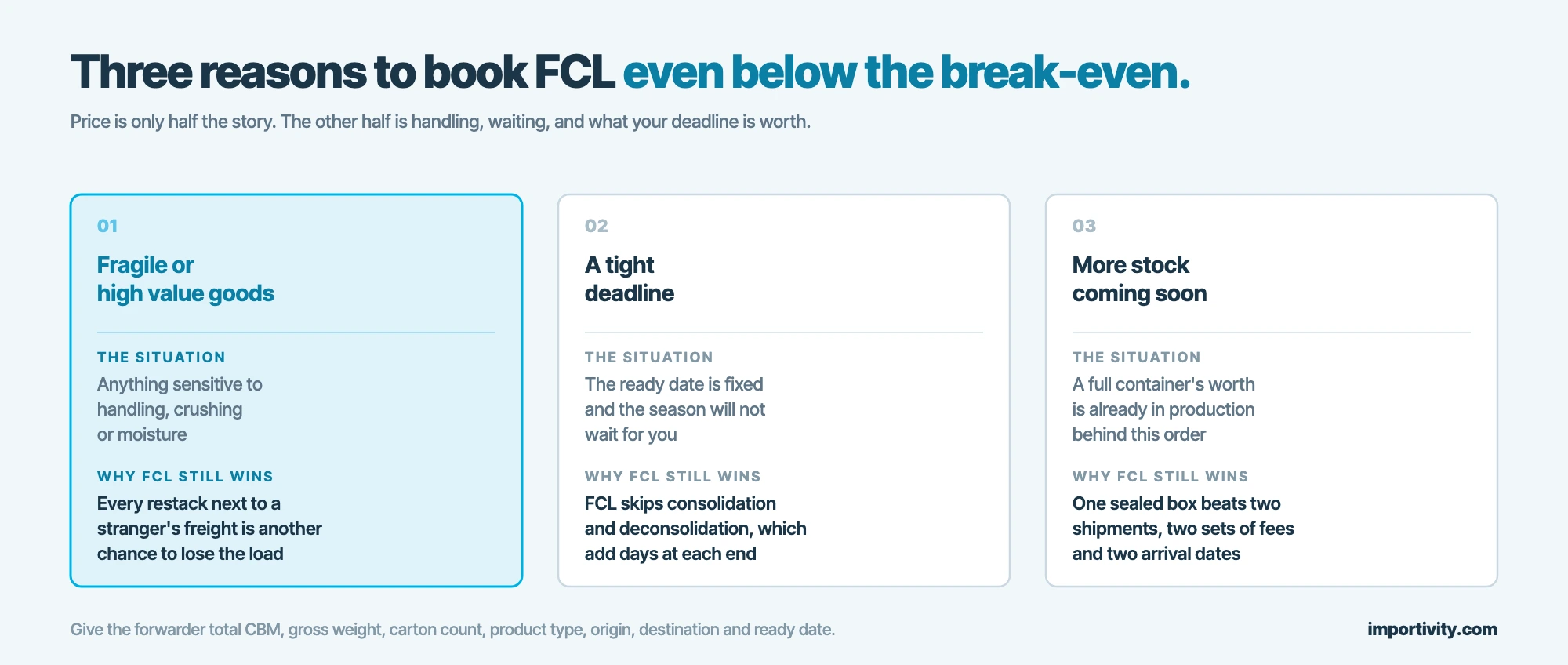
- Choose LCL when your volume is under roughly 10 to 13 CBM and cost matters more than speed.
- Choose FCL when your volume is over about 15 CBM, since the flat container rate beats per CBM pricing.
- Choose FCL when your goods are fragile, high value, or sensitive to handling and moisture.
- Choose FCL when your deadline is tight, because it skips consolidation and deconsolidation delays.
- Choose LCL when you are testing a new product and want a small first order without paying for a whole box.
- Consider FCL even below break-even if you have a full container's worth of stock coming soon and want to avoid two shipments.
- Compare both quotes whenever you land between 13 and 15 CBM, since destination charges can tip the math either way.
Your supplier's chosen shipping terms shape who pays for which leg, so read our guide to Incoterms 2020 before you agree a price. The Incoterm decides where your responsibility for freight and risk begins and ends.
How to Book Ocean Freight
Once you know whether you need FCL or LCL, booking follows a clear path. Most importers work through a freight forwarder rather than dealing with the carrier directly, because a forwarder consolidates LCL loads, negotiates FCL rates, and handles the paperwork. If you are new to the role a forwarder plays, read what is a freight forwarder before you request quotes.
Give the forwarder your total CBM, gross weight, number of cartons, product type, origin, destination, and target ready date. Ask for both an FCL and an LCL quote when your volume sits near the break-even, and make sure each quote lists destination charges, not just the ocean rate, because those fees hit LCL harder per CBM. Confirm the Incoterm, agree who clears customs, and book early during peak season when container space tightens. If you would rather hand the whole process to a partner, our shipping and logistics team books, tracks, and clears both FCL and LCL shipments so you can focus on selling.
If you would rather somebody held these decisions open on every shipment instead of after a problem, that is the work we publish at Source With Jordan.
Frequently Asked Questions
Is FCL or LCL cheaper?
It depends on your volume. LCL is cheaper for small shipments because you only pay for the cubic meters you use. FCL is cheaper for larger shipments because you pay one flat rate for the whole container no matter how full it is. The switch usually happens around 13 to 15 CBM, which is roughly half a 20ft container.
What is the break-even point between FCL and LCL?
The break-even is commonly around 13 to 15 CBM, about half a full 20ft container. Below that range LCL almost always costs less. Above about 15 CBM a full container is usually cheaper and safer, so the rule of thumb is to use LCL under roughly 10 to 13 CBM and FCL over about 15 CBM.
How many CBM fit in a 20ft container?
A standard 20ft container holds roughly 28 to 33 CBM of usable space in practice, and a 40ft container holds roughly 58 to 67 CBM. Real capacity is lower than the theoretical maximum because of pallet footprints, carton shapes, and stacking limits, so plan your loading around the usable figure rather than the raw internal volume.
Is LCL slower than FCL?
Yes. LCL adds consolidation at origin and deconsolidation at destination, where your cargo waits to be combined with and later separated from other shippers' loads. Those steps commonly add several days to a week on each end. FCL moves as a sealed container directly from port to port, so it is normally faster on the same lane.
Can I use FCL if I cannot fill a whole container?
Yes. You can book FCL even when your cargo does not fill the container, because you pay a flat rate for the box regardless of how full it is. This can still make sense if your volume is close to the break-even, if your goods are fragile and you want less handling, or if you have a tight deadline that cannot absorb LCL consolidation delays.
About the author
Jordan Lewis
Chief Operating Officer, Importivity
Runs Importivity's sourcing operations across China, Vietnam, Mexico and India, from supplier negotiation through landed delivery.
Press and media inquiries: press@importivity.com