China Inland Freight Costs and How They Affect Supplier Selection
On July 29, 2026, COSCO Shipping Ports switched on what it calls China's first dedicated sea-rail line running directly into an automated container terminal. The move is a useful reminder that a lot of your cost is decided before the container ever touches a ship. Landed cost conversations tend to jump straight to ocean freight and tariffs, but the leg from a supplier's dock to the export port, China inland freight, quietly moves your numbers and rarely shows up as a line item on an FOB quote.
According to the terminal operator, the new line at CSP Xiamen Ocean Gate Terminal lets containers move between ships and trains without passing through an intermediate storage yard, and COSCO expects it to cut per-container logistics costs by more than 15% while shortening transit by two to three days. That is a headline about a single terminal, but the underlying lesson is universal: where a factory sits relative to trucking, rail, and a deep-water port changes your true cost before goods leave the country.
This guide explains how China inland freight costs work, what drives them, and how to use them as a real tie-breaker when two suppliers quote nearly the same unit price. If you are still choosing where to build, start with how to find overseas manufacturers and then bring this framework to the shortlist.
What the COSCO Xiamen Announcement Actually Changed
Strip away the marketing and the news is about eliminating a bottleneck. The 1,586-meter railway entered service at CSP Xiamen Ocean Gate Terminal on July 29, and unlike conventional port railways positioned parallel to the waterfront or outside the terminal, the new line runs perpendicular to the shoreline and reaches within 70 meters of the quay. Containers can be transferred directly between the terminal operating area and waiting trains, removing the truck or yard moves normally required between the two transport modes.
COSCO said the integration of the railway and terminal operating systems had reduced the transfer process to nine minutes, and the line has designed annual capacity of 250,000 TEU plus 250,000 tonnes of breakbulk and general cargo. The link connects Xiamen's 21 ocean routes to inland rail networks reaching Jiangxi, Hubei, and Sichuan provinces, which matters because those interior provinces are exactly where inland freight normally eats the biggest chunk of cost.
The demand is already there. In the first half of 2026, Xiamen's sea-rail intermodal volume rose 35.76% year-on-year. For an importer, the takeaway is not that Xiamen is now the cheapest port. It is that a supplier whose goods can ride sea-rail intermodal through a terminal like this may carry a structurally lower inland cost than a competitor trucking the same distance, even with an identical factory-gate price.
Why Inland Freight Is the Hidden Layer of Landed Cost
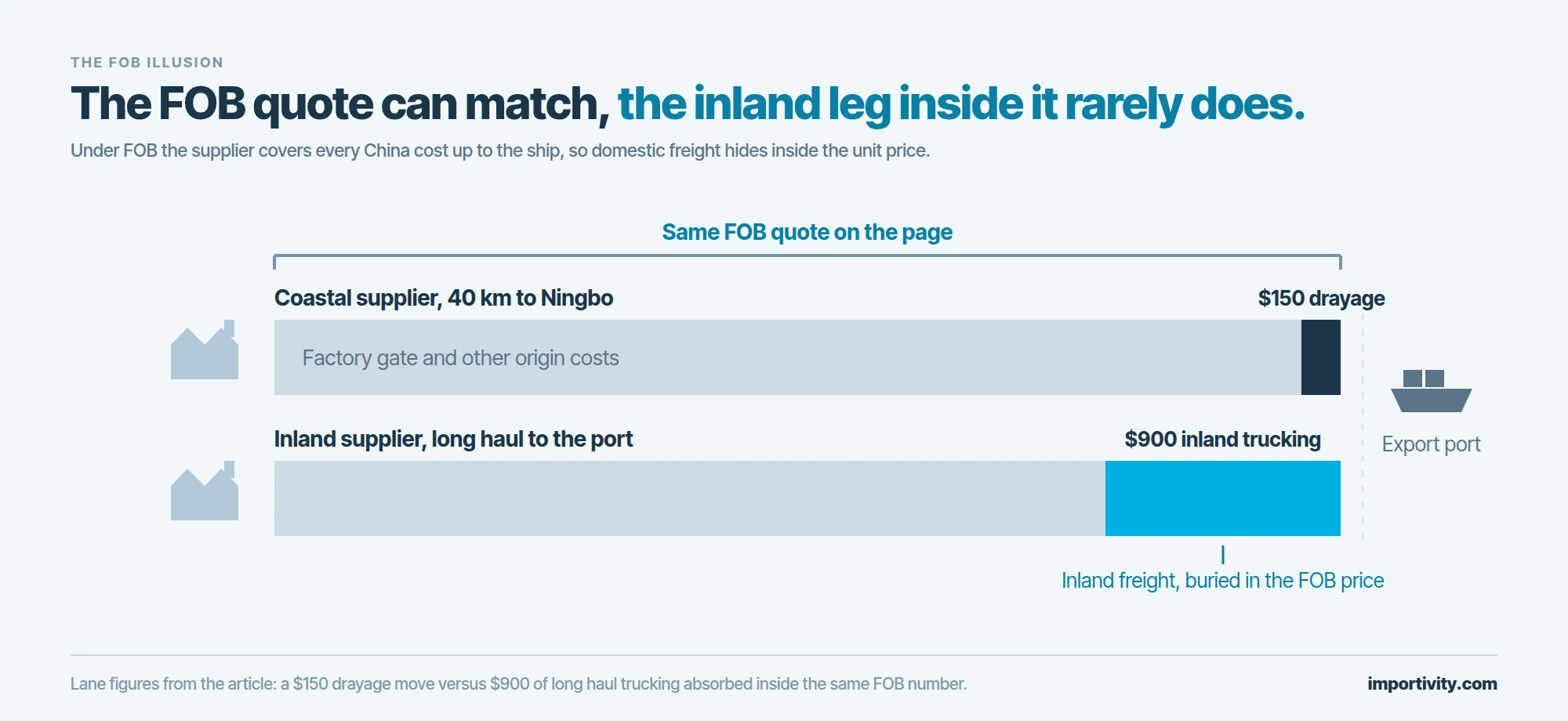
Most China purchases quote FOB, which means the supplier covers everything up to the ship's rail at the named port. That is convenient, but it buries inland freight inside the unit price where you cannot see it or negotiate it separately. Origin costs encompass all fees incurred in China, from the moment your goods leave the factory to when they are loaded onto a vessel, and under FOB terms these are the responsibility of the seller.
Buried does not mean free. A factory 1,200 km from the port pays for that distance somehow, and it shows up as either a higher unit price or thinner margin that eventually erodes quality. If you want to see exactly where FOB hands off responsibility versus EXW or CIF, our Incoterms 2020 guide lays out who pays for the inland leg under each term.
The FOB illusion
Two suppliers can quote the same FOB price while running completely different domestic logistics. One sits 40 km from Ningbo; the other is deep inland and rail-hauls to the coast. The coastal factory's FOB may include a $150 drayage move; the inland factory's FOB may absorb $900 of long-haul trucking. Same number on the page, very different cost structure and very different exposure when fuel or tolls rise.
What Drives China Inland Freight Costs
Inland cost is not one figure. It is a stack of variables, and each one shifts with the lane, the season, and the mode you choose.
- Distance and mode. Trucking dominates short-haul domestic transport due to speed and accessibility, with reported 2025 rates around RMB 1.5 to 2.5 per km per ton, while rail is priced for volume over distance.
- Fuel and tolls. Rising fuel costs affect trucking more than rail, and highway tolls were reported to rise 10 to 15% in 2025, both of which land on the inland leg.
- Volume. Rail suits bulk goods over long distances while trucking offers door-to-door flexibility, so a full container behaves differently from a partial load.
- Port congestion and yard moves. Every intermediate handling step, exactly what the Xiamen line removes, adds cost and time.
- Season. Peak periods before Chinese New Year and Golden Week push truck rates up and capacity down.
A useful academic note: studies of China's road container transportation found the average cost per ton-kilometer under normal conditions is almost equal to or even higher than the average freight rate, meaning trucking margins are thin and rate spikes get passed to you fast when fuel moves.
Trucking vs Rail vs Sea-Rail Intermodal
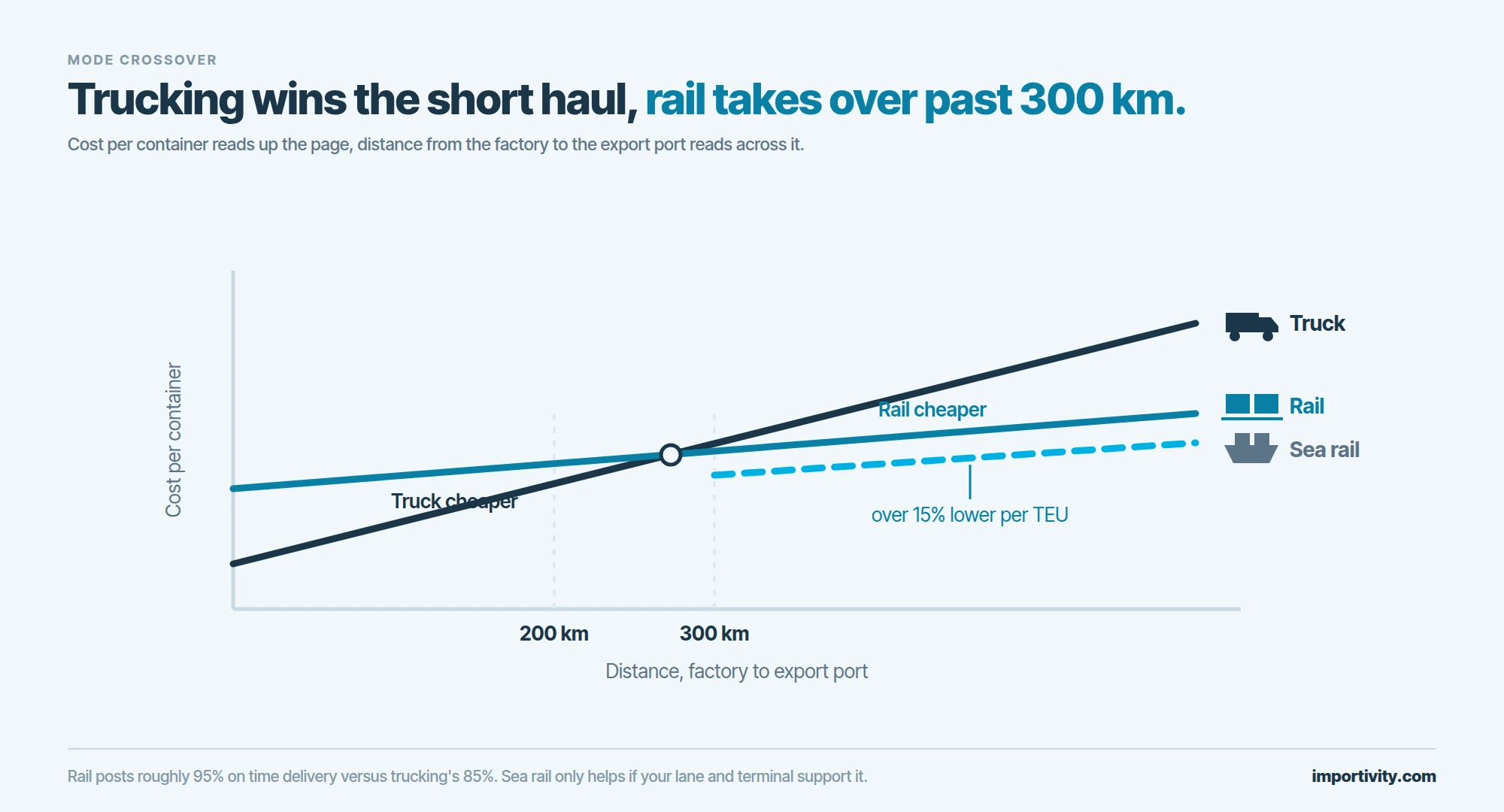
The mode your supplier uses for the inland leg is where the COSCO story becomes practical. Here is how the three common options compare for moving a container from an inland factory to an export port.
| Mode | Best distance | Cost profile | Reliability / notes |
|---|---|---|---|
| Truck (drayage / FTL) | Under ~200 km | Cheapest short-haul; door-to-door | Flexible but exposed to tolls, fuel, and traffic |
| Rail (long-haul) | From ~300 km up | Cheaper per unit at volume over distance | Higher on-time rate; needs first/last-mile trucking |
| Sea-rail intermodal | Interior to coast | Removes yard/truck transfers; can cut per-box cost | Only helps if your lane and terminal support it |
The distance crossover is real. Trucking beats rail for hauls under about 200 km, but around 300 km rail becomes cheaper for high-volume factory-to-port moves, and rail posts roughly 95% on-time delivery versus trucking's 85% amid traffic. The Xiamen link is the third row taken to its logical end: COSCO said the new operation can reduce logistics costs per TEU by more than 15% and it connects with more than 20 inland rail corridors, which is precisely the profile that helps an interior supplier close the gap with a coastal one.
How to Compare Two Suppliers With the Same Unit Price
This is the decision the COSCO news should sharpen. When two shortlisted suppliers quote nearly identical unit prices, inland logistics is often the real difference in landed cost. Work it out explicitly rather than trusting the FOB number.
Step 1: Unbundle the origin cost
Ask each supplier, or your freight forwarder, to break out the inland leg: distance to the port, mode, drayage or trucking fee, and origin terminal handling. If a supplier resists, that opacity is itself a signal. Bake this question into your supplier onboarding process so you capture it before the first PO.
Step 2: Model total landed cost, not FOB
Add inland freight, origin handling, ocean freight, duty, and destination charges for each supplier. A helpful benchmark: inland transport commonly runs $300 to $1,200 for trucking or rail depending on distance and load. Drop those numbers into a proper model using our landed cost formula, and the supplier with the lower unit price sometimes finishes second.
Step 3: Price the lead-time and risk difference
An interior factory that saves 2 to 3 days through sea-rail intermodal, exactly the gain COSCO cites at Xiamen, may cut your inventory carrying cost and demurrage exposure. A remote factory that trucks 1,000 km carries more variability from tolls, weather, and holiday capacity crunches. Fold that into the comparison the same way you would a FCL vs LCL decision.
Step 4: Confirm the port pairing
A factory is only as good as its access to the right export port. Match the supplier's location to a port with the ocean routes and intermodal connections your cargo needs, then verify the actual routing your forwarder will use.
Where This Fits in Your Sourcing Decision
Inland freight should be a scored criterion in supplier selection, not an afterthought discovered on the first invoice. It ranks alongside quality systems, compliance, and financial stability. When you build a shortlist and run a structured RFQ, add a line requiring each supplier to state their distance to the export port and their inland mode.
This matters even more for heavy or bulky goods where inland cost per unit is high, such as building materials, metal parts, or furniture. Our look at roofing material sourcing shows how quickly domestic logistics can swing the math on dense, low-value-per-cubic-meter products. And if you are weighing China against alternatives entirely, factor inland infrastructure into the India vs China comparison, because China's dense rail and port network is part of its cost advantage.
The practical rule: a slightly higher unit price from a coastal, port-adjacent supplier often beats a cheaper interior factory once inland freight and lead-time risk are counted. The COSCO Xiamen line is one example of the interior gap narrowing, but you still have to verify that your specific cargo actually rides that infrastructure.
If you would rather somebody held these decisions open on every shipment instead of after a problem, that is the work we publish at Source With Jordan.
Frequently Asked Questions
What are China inland freight costs?
China inland freight costs are the domestic transport charges to move cargo from the factory to the export port inside China, including drayage or long-haul trucking, rail moves, tolls, fuel surcharges, origin terminal handling, and warehousing. Under FOB terms these are usually bundled into the supplier's price, so a low unit price can hide a high inland cost, or the reverse.
How much does trucking a container from factory to port in China cost?
It depends on distance and lane. Reported 2025-2026 truck rates run roughly RMB 1.5 to 2.5 per ton-km, and a short drayage of a 20ft box on a lane like Shanghai to Ningbo has been quoted around RMB 5,000 to 8,000. For long inland hauls the figure climbs quickly, which is why a coastal factory and an interior factory with the same unit price rarely land at the same total cost.
When is rail cheaper than trucking inside China?
Trucking generally wins on short hauls under roughly 200 km because of door-to-door flexibility, while rail tends to become cheaper for high-volume, long-haul moves from around 300 km up. Rail also posts higher on-time reliability. Price both for your specific lane and volume rather than assuming.
Does the COSCO Xiamen automated port-rail link lower my costs?
If your cargo actually moves by sea-rail intermodal through that terminal, potentially yes. COSCO says the direct ship-to-rail transfer can cut per-container logistics costs by more than 15% and shorten transit by two to three days by removing intermediate yard and truck moves. But the benefit only reaches you if your supplier and forwarder route through it, so treat it as one data point in supplier selection.
How do I compare two suppliers with the same unit price but different locations?
Build a full landed-cost model for each. Add inland freight, origin handling, and any consolidation fees to the unit price, then apply ocean freight, duties, and destination costs. A coastal supplier near a major port often beats an interior supplier on total landed cost even at a slightly higher unit price, because inland trucking and lead-time risk erode the interior factory's advantage.
About the author
Jordan Lewis
Chief Operating Officer, Importivity
Runs Importivity's sourcing operations across China, Vietnam, Mexico and India, from supplier negotiation through landed delivery.
Press and media inquiries: press@importivity.com