Where Is YETI Made (Countries, Factories and the Move Out of China)
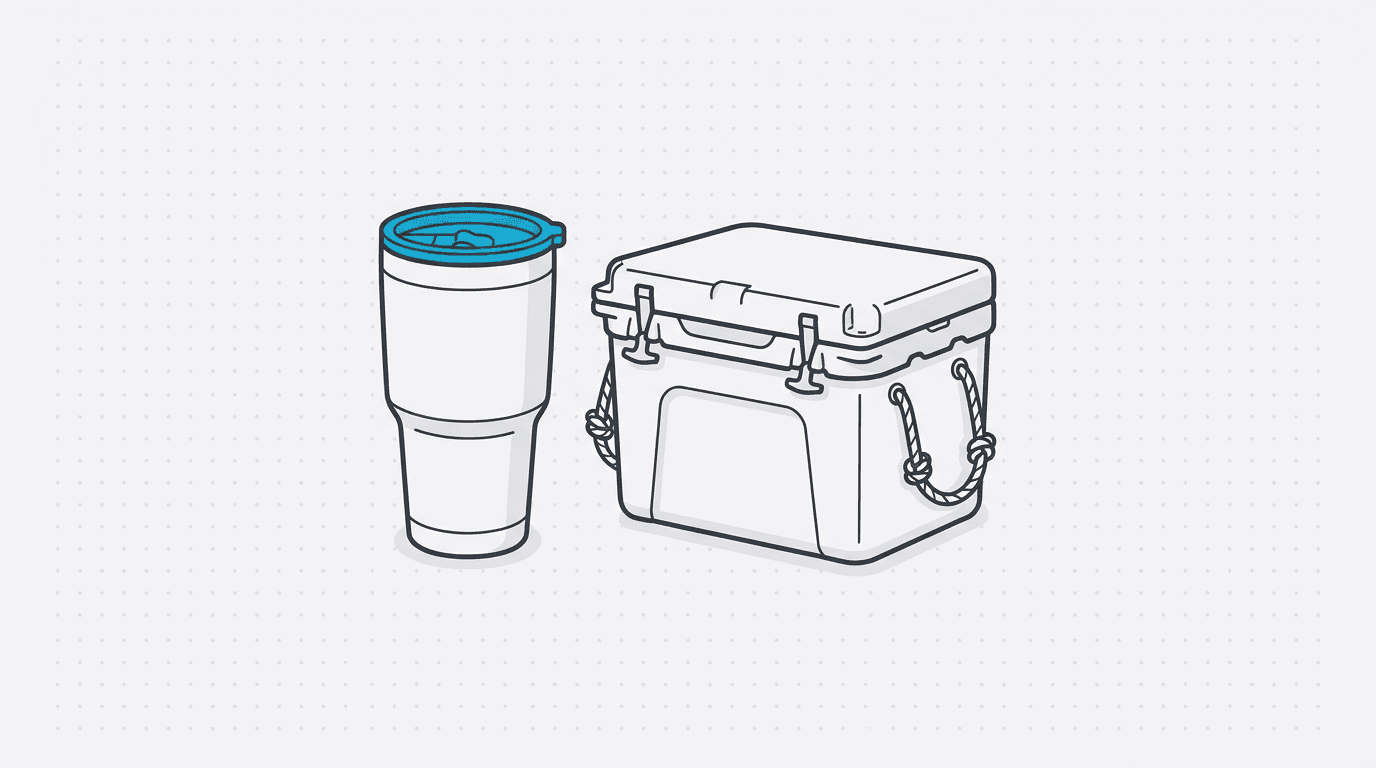
YETI is made by contract manufacturers, not in factories YETI owns. Its 10-K for fiscal 2025 names seven countries that make many of its core products: China, Thailand, Malaysia, Vietnam, the Philippines, Mexico and Poland. In 2025, after US tariffs on Chinese goods rose, YETI set out to have most of its drinkware manufacturing capacity outside China by the end of the year.
This guide is for founders who want to make insulated drinkware or coolers and want to see how YETI gets its products made, and which parts of that a small brand can copy. The figures come from YETI's 10-K for fiscal 2025, the year that ended January 3, 2026, its earlier 10-Ks, its quarterly reports and its earnings calls through August 13, 2026. For a larger network run on the same model, see our guide to where Nike makes its shoes and clothes. Importivity is not affiliated with YETI.
Where YETI products are made in fiscal 2025
YETI is based in Austin, Texas. Outside companies make its products. In its fiscal 2025 10-K, the company names the countries where many of its core products are made: China, Thailand, Malaysia, Vietnam, the Philippines, Mexico and Poland. It buys from these manufacturers with purchase orders rather than long-term commitments.
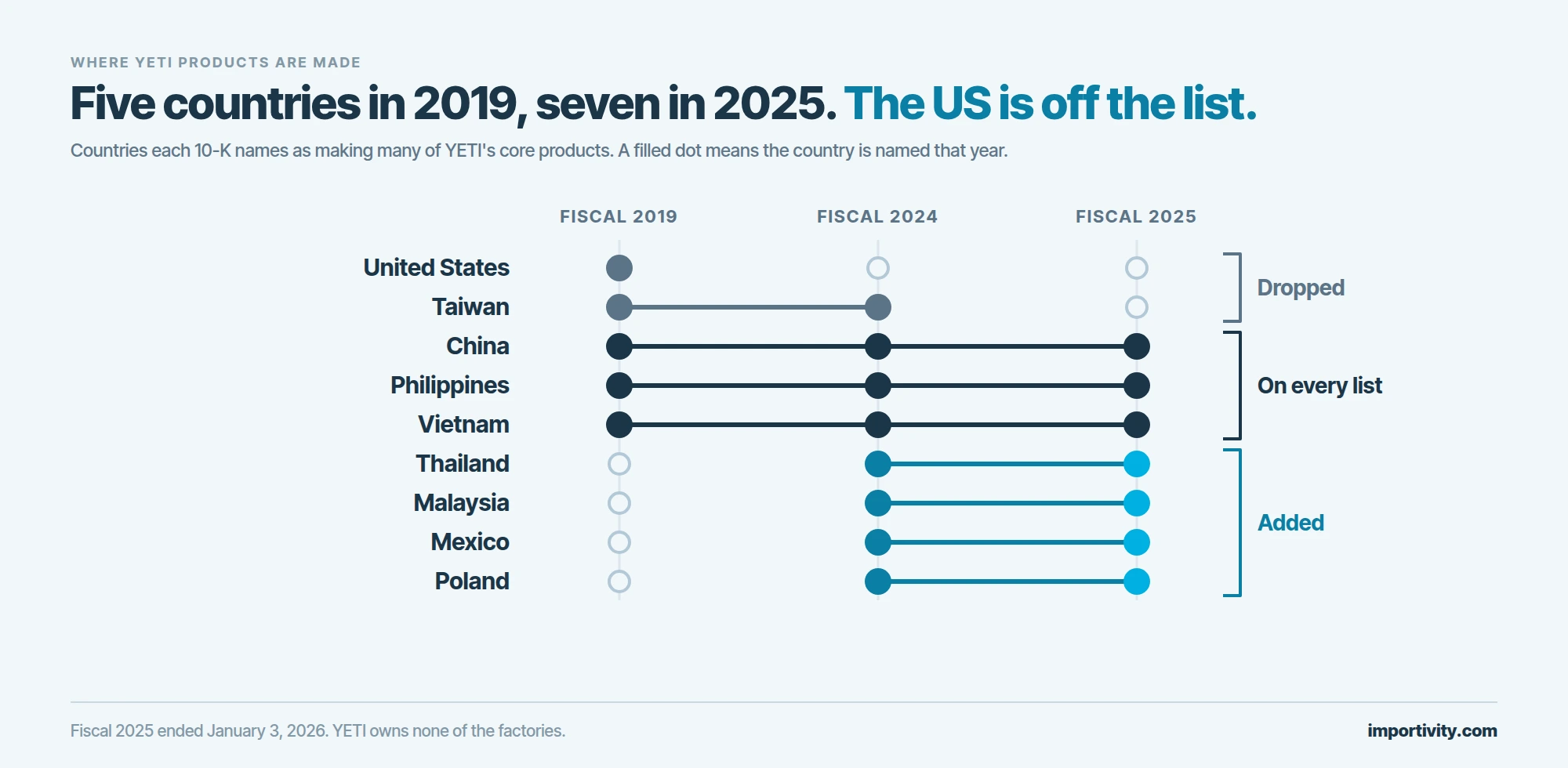
The list has changed over the years. YETI's 10-K for fiscal 2019 named five countries: the United States, China, the Philippines, Vietnam and Taiwan. By the fiscal 2021 filing the United States was no longer on it. Mexico and Thailand were added by fiscal 2023, and the fiscal 2024 filing named eight countries, including Taiwan, Poland and Malaysia. Taiwan does not appear in the fiscal 2025 filing.
The products are made abroad and sold mostly in the US. About 79% of YETI's fiscal 2025 net sales were in the United States and 21% in other countries. So US duties apply to most of what YETI sells.
Who makes YETI products
YETI designs the products, and contract manufacturers make the coolers, drinkware and bags. A small number of those manufacturers make most of the volume.
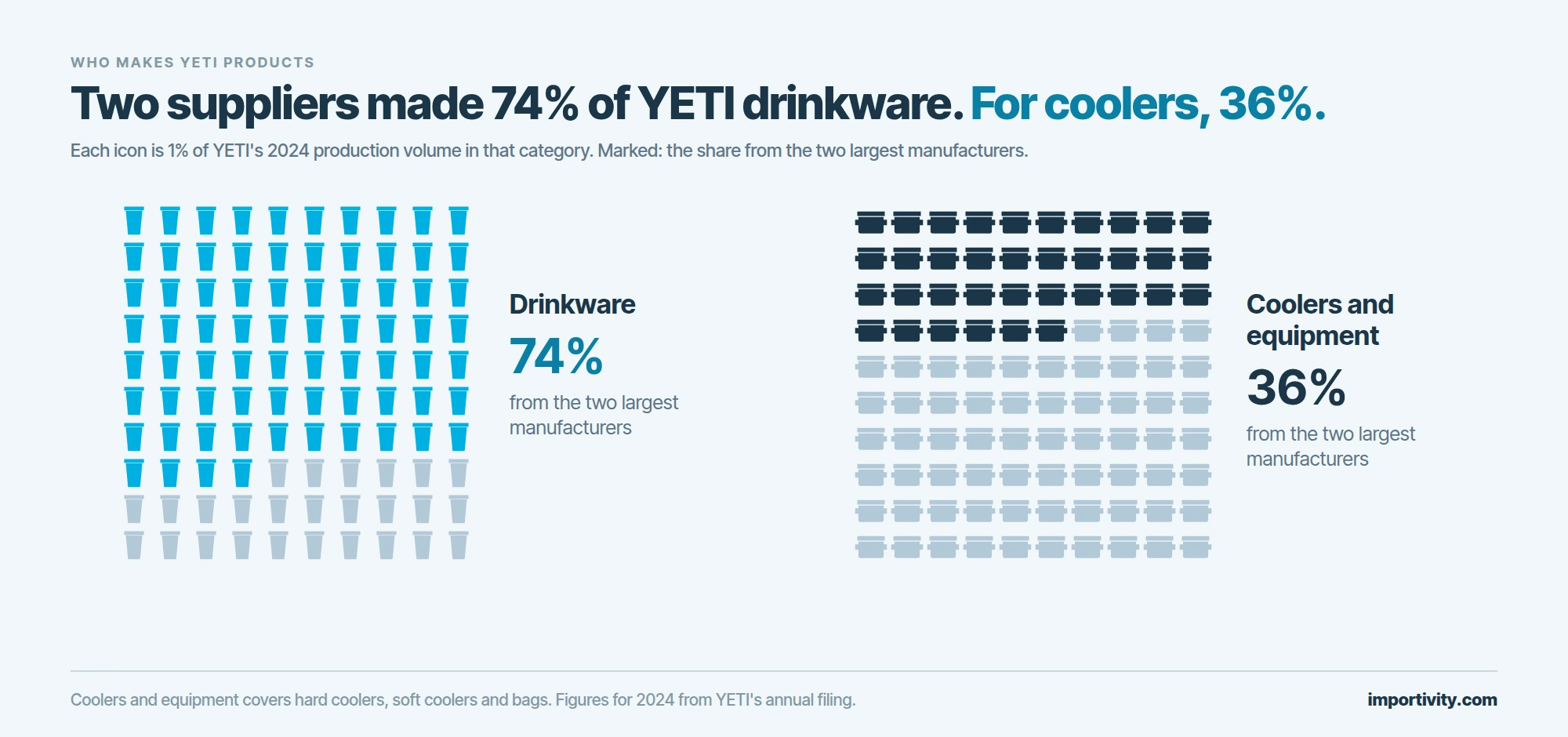
YETI's 10-K for fiscal 2024 put the concentration in numbers. That year its two largest drinkware manufacturers made about 74% of its drinkware by production volume, and its two largest coolers and equipment manufacturers made about 36% of that category. Drinkware is the more concentrated category: one manufacturer that stops shipping can hold up a large share of a whole product line.
The products help explain the gap. Every vacuum-insulated tumbler goes through the same process chain: forming the stainless steel walls, welding them, pulling the vacuum, then coating and printing the outside. Coolers and equipment cover more kinds of product, such as rotomolded hard coolers, sewn soft coolers and bags, and each kind is made in a different type of factory, so the volume spreads across more suppliers.
If you look up who supplies a large brand, use the result to learn which countries and regions already make the product at volume. A plant that already supplies a large brand may have no room for a new customer or a small order, a point our Nike guide covers in more detail.
How YETI moved its drinkware out of China
Before 2025, much of YETI's drinkware was made in China. When US tariffs on Chinese goods rose that year, YETI sped up its plan to make drinkware elsewhere. In its 10-Q for the quarter ended March 29, 2025, it said it expected most of its drinkware manufacturing capacity to be outside China by the end of 2025.
The move had a cost. In its 10-Q for the quarter ended September 27, 2025, YETI said the faster shift had caused short-term supply chain disruptions that affected its ability to source certain products. A new drinkware plant has to qualify its welds, vacuum and coatings before it can ship at volume, and that takes time.
The duty bill moved too:
- February 19, 2026. On its fourth-quarter call, YETI said it expected about $80 million of tariff costs in its 2026 cost of goods sold, most of it from IEEPA tariffs, and its guidance assumed no relief.
- February 20, 2026. The Supreme Court struck down the IEEPA tariffs the next day. Our guide to IEEPA tariff refunds explains who can claim.
- August 13, 2026. In its second-quarter 2026 results, YETI said IEEPA tariff refunds, for amounts it had expensed in 2025 and 2026, added $42.6 million to gross profit. It recorded them as a reduction of cost of goods sold.
What US duty applies in each country on YETI's list
Leaving China removes the China Section 301 duties, but not every duty. Since July 24, 2026, products of 60 economies pay a Section 301 forced-labor duty on top of the normal (MFN) rate unless an exemption applies. The table shows the extra duty for six of the seven countries on YETI's fiscal 2025 list, as of November 2026.
| Country | Extra US duty on top of the normal rate | What to watch |
|---|---|---|
| China | Any China Section 301 duty that covers the HTS code, plus the 12.5% forced-labor duty | USTR extended the 178 remaining China product exclusions through January 9, 2027. |
| Vietnam | 12.5% forced-labor duty | USTR also has a Section 301 investigation open on Vietnam's intellectual property practices, with findings due by February 28, 2027. |
| Thailand | 12.5% forced-labor duty | Same duty as Vietnam, so compare the two on factory price, quality and freight. |
| Malaysia | 10% forced-labor duty | USTR said it will set a tariff-rate quota for Malaysia when feasible. |
| Mexico | 10%, or none for goods entered duty free under USMCA | The product has to meet the USMCA rules of origin to skip the duty. |
| Poland (EU) | Enough to bring the normal rate plus the duty to 10%, and none if the normal rate is 10% or more | The same cap applies to Taiwan, which left YETI's list in fiscal 2025. |
Each rate is charged on the same customs value as the normal rate, and the amounts are added together. Goods that pay a Section 232 duty are exempt from the forced-labor duty. Importers have challenged the forced-labor duty at the Court of International Trade, which heard argument on September 30, 2026. As of early November 2026, the court had not ruled, and CBP was still collecting the duty. For the Philippines, the seventh country on YETI's list, confirm the rate for your HTS code with your customs broker before you order. Our guide to tariff stacking shows how the layers add up on one entry.
Are any YETI coolers made in the USA
Not according to YETI's latest filing. The fiscal 2025 10-K does not list the United States among the countries that make its core products. The fiscal 2019 10-K did, and the United States had dropped off the list by fiscal 2021.
That does not rule out an American-made cooler on a store shelf, because the 10-K lists only the countries that make many of its core products. The label on the unit is the record that counts:
- Imported products. Under 19 U.S.C. 1304, most imported goods must show their country of origin in English in a conspicuous place, legibly and permanently. Look on the base of a cup or bottle, on the cooler body or on the box.
- Made in USA claims. Under the FTC's Made in USA Labeling Rule, an unqualified "Made in USA" label requires that all or virtually all of the product be made in the US. A cooler assembled in the US from imported parts can carry a qualified claim, such as "Made in USA of U.S. and imported parts," but not a plain "Made in USA" label. Our guide to where Carhartt is made walks through the same rule for clothing.
It is normal for two YETI products to show different countries, since the brand buys from manufacturers in seven countries. The country alone does not tell you whether an item is genuine. It does decide which US duties the importer paid.
What a small drinkware or cooler brand can take from YETI
You cannot buy from YETI's manufacturers on YETI's terms, and you do not need to. The parts that work at small scale are the choice of countries, the order of the work and the backup plan.
- Pick the factory type first. Vacuum drinkware, rotomolded hard coolers and sewn soft coolers come from three different kinds of plant. Quote each product with plants that already make it.
- Start where the cups are made. In China, most insulated cups come from one city. Our guide to manufacturers in China covers Yongkang in Zhejiang, which Global Times reported in 2024 makes and exports over 70% of China's thermal cups. For a second source, Vietnam and Thailand both appear on YETI's list, and our guide to manufacturers in Vietnam shows where the plants are.
- Start with a stock body. A logo printed or laser-engraved on a factory's existing tumbler needs no new tooling, so the minimum is lower. A custom shape needs its own tooling and a larger first order. Our guide to what MOQ means explains how factories set minimums.
- Test before you ship. Ask for vacuum retention and leak test results on samples from the production line, not only on the approved sample, and confirm the materials that touch drinks meet FDA food contact rules.
- Price the duty for each country. Use the table above with your own HTS code. Moving a tumbler from China to Vietnam or Thailand removes the China Section 301 duty but keeps the 12.5% forced-labor duty. The origin has to be real: the product must be made in the new country, and packing it there is not enough.
- Plan a second factory early. YETI's two largest drinkware manufacturers made about 74% of its drinkware in fiscal 2024, and when it moved drinkware out of China in 2025, its own filing reported supply disruptions. A new brand usually starts with one factory. Qualify a second one for your best seller before a tariff change forces the move. Our China plus one guide shows how to run two sources without doubling the work.
If you want drinkware or coolers made in one of these countries, send us your product and order size. Our manufacturer sourcing team finds and vets factories that make your product type.
Frequently Asked Questions
Is YETI made in China?
Partly. China is still one of the seven countries that YETI's fiscal 2025 10-K names for its core products, along with Thailand, Malaysia, Vietnam, the Philippines, Mexico and Poland. After US tariffs on Chinese goods rose in 2025, YETI said it expected most of its drinkware manufacturing capacity to be outside China by the end of that year. The label on each product shows where that unit was made.
Where are YETI cups made?
YETI cups come from contract manufacturers. The company's fiscal 2025 10-K names China, Thailand, Malaysia, Vietnam, the Philippines, Mexico and Poland as the countries that make many of its core products, and in 2025 YETI said it expected most of its drinkware capacity to be outside China by year end. To see where your cup was made, check its base or the box, since US law requires imported goods to show their country of origin.
Are YETI coolers made in the USA?
Not according to YETI's latest annual filing. Its fiscal 2025 10-K does not list the United States among the countries that make its core products, although its fiscal 2019 10-K did. To check a specific cooler, read its label. Under FTC rules, an unqualified Made in USA claim requires that all or virtually all of the product be made in the US, so a cooler with significant imported parts cannot carry a plain Made in USA label.
Who makes YETI products?
Contract manufacturers make them. YETI does not own factories, and it buys with purchase orders rather than long-term commitments. Production is concentrated: in fiscal 2024, its two largest drinkware manufacturers made about 74% of its drinkware by production volume, and its two largest coolers and equipment manufacturers made about 36% of that category, according to its 10-K for that year.
Is YETI an American company?
Yes. YETI Holdings is based in Austin, Texas, and its shares trade on the New York Stock Exchange under the ticker YETI. About 79% of its fiscal 2025 net sales were in the United States. Its products are made by contract manufacturers in other countries, and its fiscal 2025 10-K names seven: China, Thailand, Malaysia, Vietnam, the Philippines, Mexico and Poland.
About the author
Jordan Lewis
Chief Operating Officer, Importivity
Runs Importivity's sourcing operations across China, Vietnam, Mexico and India, from supplier negotiation through landed delivery.
Press and media inquiries: press@importivity.com