Yiwu Market Guide for US Buyers (Districts, Minimums and How to Buy)
Yiwu market, officially the Yiwu International Trade City, is a permanent wholesale market in Yiwu, Zhejiang province, where about 80,000 booths sell small consumer goods such as toys, jewelry, bags, hardware, stationery and socks, mostly as stock designs in small mixed lots. A US buyer orders booth by booth, a local agent collects everything in one warehouse, and the goods leave China as one export shipment, usually from Ningbo-Zhoushan, the port that serves most of Zhejiang.
This guide is for US brands deciding whether to fly to Yiwu or buy from it remotely. It covers the districts, the sellers, minimums, export, US duty, the New Year closure and the risks. If you are still working out which Chinese city makes your product, start with our guide to manufacturers in China.
What the Yiwu Wholesale Market Is
The market is run by Zhejiang China Commodities City Group, a company listed on the Shanghai Stock Exchange. Its official online platform, Chinagoods, describes it as the world's largest wholesale market, with 80,000 booths, and says the platform serves 2 million micro, small and medium-sized companies. The International Trade City is split into five numbered districts, and a sixth building, the Global Digital Trade Center, opened in October 2025.
Each booth is a small showroom for one company's catalog. Some belong to factories that make the goods. Others belong to traders who buy from several workshops and resell. The booth sign does not tell you which, and it matters once you want a change to the product or someone to answer for a defect. Ask for the business license and the factory address, and read our guide to buying from a manufacturer, wholesaler or trading company before you reorder.
The market's strength is range: dozens of versions of one item in a single corridor, and one container filled from many sellers. Its weakness is custom work. The shelves hold stock designs made for many buyers, and a change beyond a logo, a color or the packaging has to be made by the factory.
Yiwu Market Districts and What Each One Sells
Booths are grouped by trade, and each district gives whole floors to one product family. The market's own yiwugo.com directory lists the trades district by district and floor by floor, so look up your product there before you plan the day.
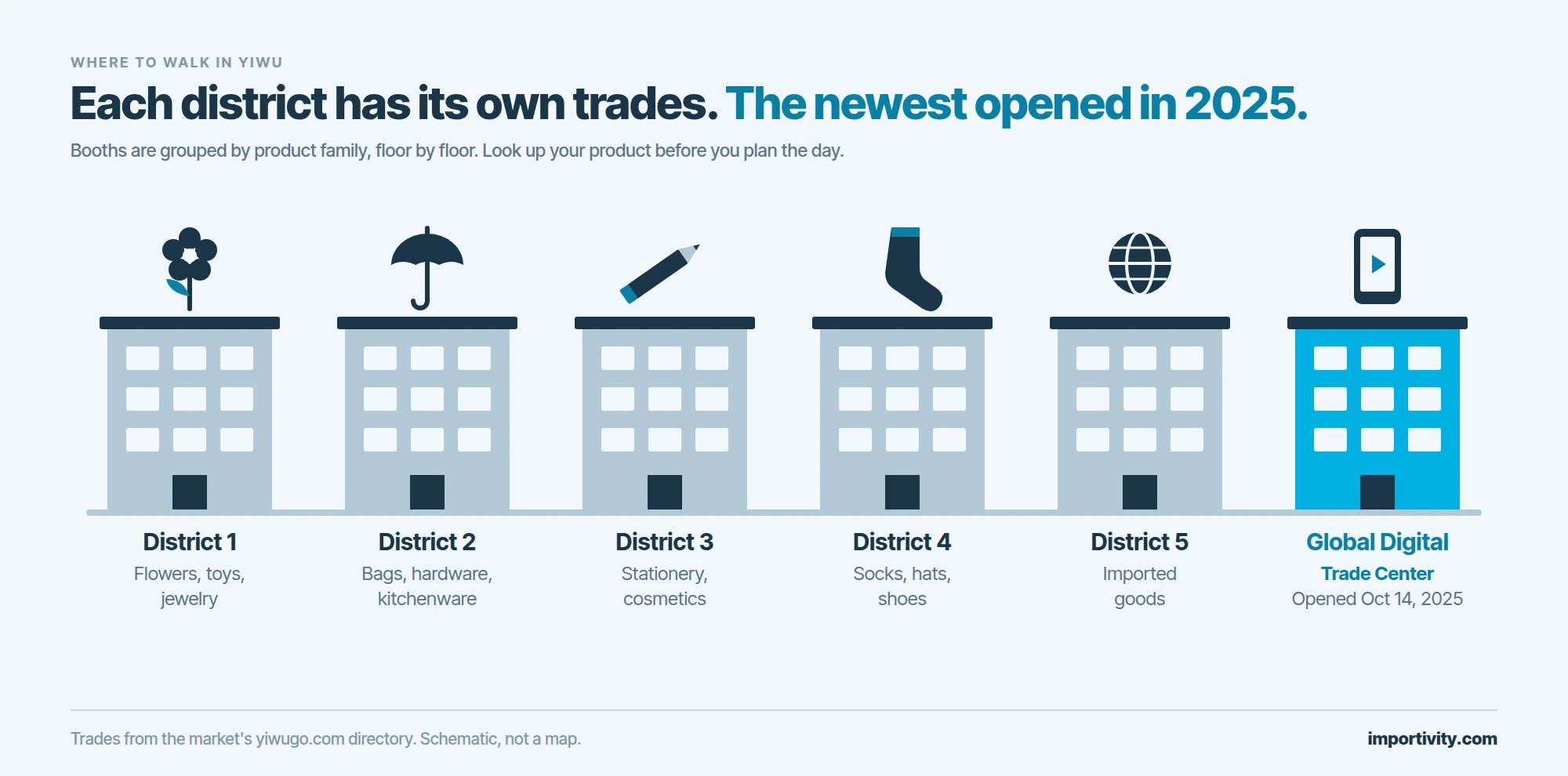
| District | What it sells | US rule to check before you order |
|---|---|---|
| District 1 | Artificial flowers, flower accessories, toys (plush, inflatable, electric), jewelry | Toys need third-party testing and a Children's Product Certificate. Children's jewelry falls under the CPSIA lead limits. |
| District 2 | Bags, umbrellas, luggage, hardware tools and fittings, locks, electrical products, kitchenware, small appliances, watches | Electronic products fall under FCC rules. Kitchenware that touches food falls under FDA food contact rules. |
| District 3 | Stationery and school supplies on the lower floors, plus sports goods, cosmetics, eyewear, zippers and buttons | Cosmetics need FDA facility registration and product listing. School supplies made for children 12 and under are children's products. |
| District 4 | Socks, gloves, hats, shoes, lingerie and daily necessities | Textile goods need fiber content and country of origin labels, and most need care labels, under FTC rules. |
| District 5 | An imported goods hall with products from more than 100 countries and regions | The origin is the country that made the item, so China's Section 301 duties do not apply, but the US duties on that country's goods do. |
| Global Digital Trade Center | The newest building, opened October 14, 2025, built around online and digital trade | Ask each seller where the goods are made and test them as you would goods from any other district. |
Zhejiang's provincial government news site reported that the Global Digital Trade Center opened on October 14, 2025, after building work began in 2022, and that it covers 1.25 million square meters. Xinhua and People's Daily describe it as Yiwu's sixth-generation market. Ask your agent which trades have moved in before you plan a day there. The US rules in the table are starting points; our guide to import product compliance covers which agency regulates what.
Minimums, Prices and What a Booth Quote Leaves Out
Each booth sets its own minimum. Ask for four things at every booth: the minimum per design, whether colors can be mixed to reach it, the number of pieces in one carton, and the price at two quantities. Combining small orders from many booths is how one buyer fills a container with many items in small quantities.
The booth price is a price in yuan for goods handed over in Yiwu. It leaves out the agent's fee, delivery to the warehouse, export paperwork, ocean freight and US duty. A 1688 listing works the same way, and our guide on how to buy from 1688 lists the costs to add back.
US duty can be the largest of those. As of November 2026, a product of China pays its normal duty rate, plus Section 301 duty of 25% on Lists 1 to 3 or 7.5% on List 4A, plus the 12.5% Section 301 forced-labor duty that started on July 24, 2026. Take 1,000 backpacks of man-made fiber (HTS 4202.92.3120) bought at a District 2 booth for an assumed $4.00 each, a customs value of $4,000:
- Normal duty. 17.6% is $704.
- Section 301, List 3. 25% is $1,000.
- Forced-labor duty. 12.5% is $500.
- Fees. The merchandise processing fee is 0.3464%, which is $13.86, so the $34.58 minimum applies. The harbor maintenance fee on ocean cargo is 0.125%, or $5.00.
Duty and fees come to $2,243.58, or about $2.24 a backpack, which is more than half the booth price. Our guide to tariff stacking explains each layer. Compare a booth with a factory quote only at landed cost.
How Buying Works for a Foreign Buyer
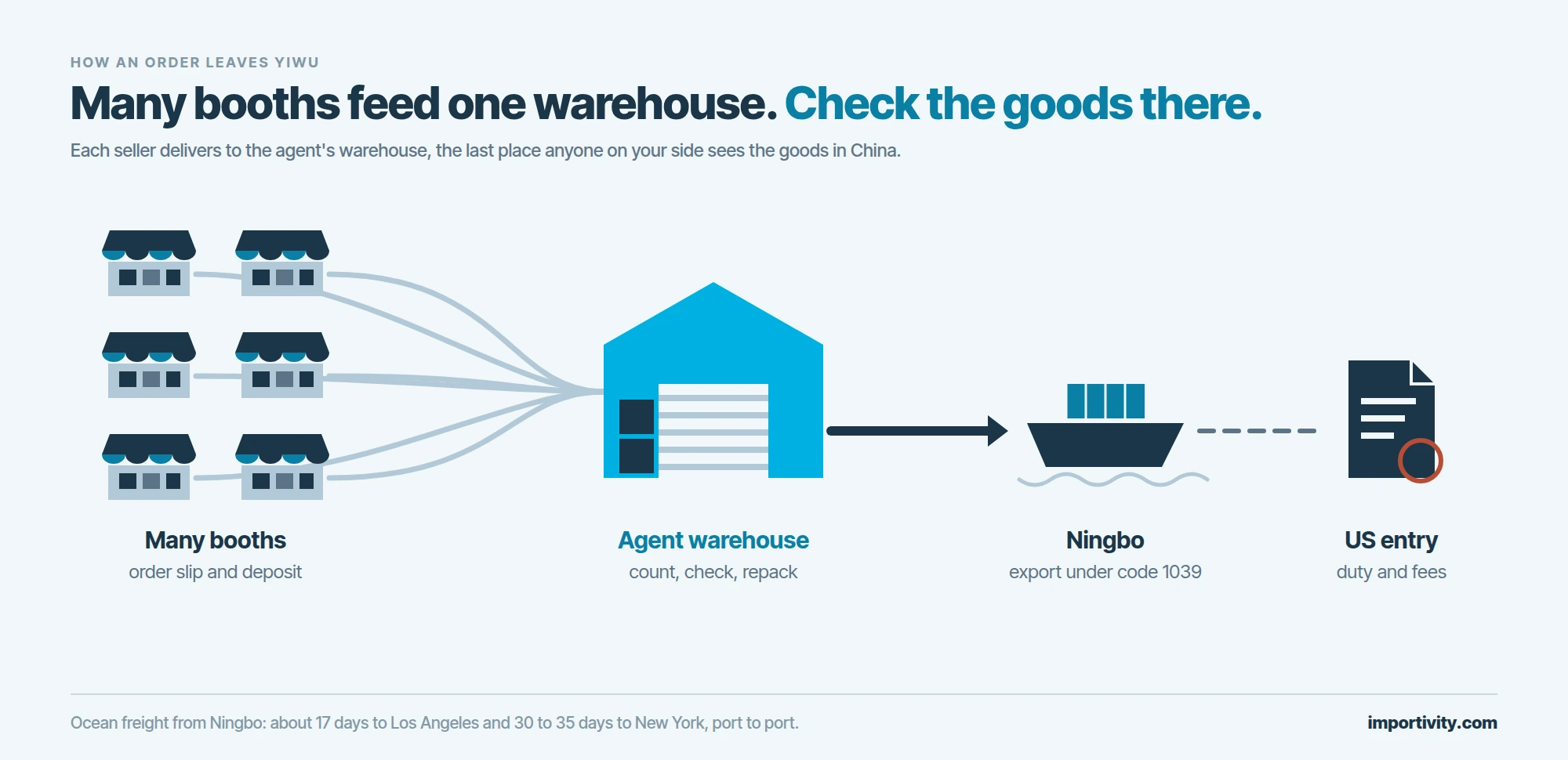
A foreign order follows one path. You place small orders at many booths, each seller delivers to one warehouse in Yiwu, the goods are checked and packed together, and one export shipment leaves for the US.
- Hire an agent before you fly. The agent books booth visits, translates, writes up orders, chases delivery and runs the warehouse. Get the fee, the inspection scope and a no-rebate clause in writing. Our guide to what a China sourcing agent costs covers the fee models.
- Write up each order at the booth. Record the item number, a photo, the price, the quantity, the delivery date and the deposit paid. Pay deposits to the company named on the business license, not to a personal account.
- Check the goods at the warehouse. The agent counts the cartons, opens a sample from each order and sends photos with measurements. Nobody on your side sees the goods in China after this, so agree what counts as a defect in advance.
- Export under market procurement trade. Goods bought in the market can leave China under market procurement trade, customs supervision code 1039, a simplified export procedure for small commodities. China Daily reported in November 2025 that it was the main driver of Yiwu's trade growth in the first nine months of that year, when trade hit a record, and that 39 markets in 22 provinces and regions had copied it. The agent or its forwarder files the declaration.
- Ship and clear US customs. On published schedules, ocean freight from Ningbo takes about 17 days to Los Angeles and 30 to 35 days to New York, port to port. A mixed order under about 13 to 15 cubic meters is usually cheaper as LCL, shared container space. With de minimis suspended, every shipment needs a US customs entry, and one valued over $2,500 needs a formal entry and a customs bond.
You are normally the importer of record, so US customs holds you to the declared value. Read the commercial invoice before it is filed.
When the Market Is Closed and How to Plan the Trip
The market is open all year except for a break around Chinese New Year. China's state news site china.org.cn reported in March 2026 that the market typically reopens on the 12th day of the first lunar month. Chinese New Year 2027 falls on February 6, so on that pattern the market would reopen on about February 17, 2027. Confirm the dates with your agent once the operator posts its 2027 holiday notice.
The factories behind the booths keep the same calendar. As our Chinese New Year shutdown guide explains, most stop one to two weeks before New Year's Eve and do not reach full output again until March. For stock in the first half of 2027, plan to load by about January 22, 2027.
- Visa. US passport holders can use China's 240-hour visa-free transit if they arrive through a designated port with a confirmed onward ticket to a third country or region. Otherwise apply for a business visa.
- Getting there. Fly into Shanghai or Hangzhou and continue to Yiwu by train. Your agent can book the transfer.
- Days. Plan one day for each district you need, a day at the warehouse, and a visit to the factory behind any booth you plan to reorder from.
- Remote first. Chinagoods lists booths and products online, so you can shortlist sellers before you fly or buy through an agent without flying.
Yiwu, the Canton Fair or Buying Online
Pick the route by what you are buying and how much of it you need.
- Yiwu. Open all year apart from the New Year break. It suits stock and lightly branded goods, many items in small quantities, and one container filled from many sellers. It is a poor choice for a product you designed.
- The Canton Fair. Held each spring and autumn in Guangzhou. The 140th session ran from October 15 to November 4, 2026, in three phases split by product, and the overseas buyer badge was free. Many exhibitors set minimums for full production runs, so it suits buyers ordering at volume or looking for factories for custom work. Our Canton Fair guide covers the phases.
- Online. Chinagoods puts many Yiwu booths online, 1688 needs an agent, and Alibaba.com suppliers handle export themselves. Online works for samples and for reorders of items you know, but you cannot handle the goods.
For a US brand with its own design, Yiwu works best as research: what already exists, what it costs at the booth, and which factories make the closest version. A factory then quotes the custom product from your written specification.
Risks and a Checklist for Your Visit
Most problems with Yiwu goods come from one fact: they were made for the general market, not to your specification or to US rules.
- Quality that changes between orders. When the booth is a trader, a reorder can come from a different workshop. Keep a signed sample of every item and inspect against it.
- Copies of branded products. Do not buy anything that carries another company's brand, character or design unless the seller shows a license. US Customs and Border Protection can seize goods that infringe a US trademark, and the loss falls on the importer.
- US compliance. Unless a booth shows a US test report for that exact item, assume a toy or an electronic product has not been tested to US rules. Since July 8, 2026, importers of products that need a CPSC certificate must also file the certificate data electronically with the entry.
Checklist for the trip:
- Before you fly. A product list with target prices, the US rules for each item, an agent with written terms, and a shortlist from Chinagoods.
- At each booth. Minimum per design, carton quantity, price at two quantities, delivery date, business license and factory address.
- For each order. A photo, the item number, a signed sample and a written order slip.
- At the warehouse. Count, open, measure and photograph before anything is repacked, and check the US labels and origin mark.
- Before the balance. Landed cost with duty and fees, and the value on the commercial invoice.
Our product sourcing team helps US brands find and vet factories and check quality, then ship the goods and handle the tariffs. To have a product quoted by a factory instead of a booth, send us your product details.
Frequently Asked Questions
What is the Yiwu wholesale market?
The Yiwu wholesale market, officially the Yiwu International Trade City, is a permanent market in Yiwu, Zhejiang province, run by Zhejiang China Commodities City Group. Its official platform, Chinagoods, lists 80,000 booths. They sell small consumer goods such as toys, jewelry, bags, hardware, stationery and socks, mostly stock designs that buyers order in small mixed lots.
What does each district of Yiwu market sell?
District 1 sells artificial flowers, toys and jewelry. District 2 sells bags, umbrellas, luggage, hardware, electrical products and kitchenware. District 3 sells stationery, sports goods, cosmetics and eyewear. District 4 sells socks, gloves, hats, shoes and lingerie. District 5 has an imported goods hall. The Global Digital Trade Center, the newest building, opened on October 14, 2025.
What is the minimum order at Yiwu market?
Each booth sets its own minimum, and there is no market-wide rule. Ask every booth for its minimum per design, whether colors can be mixed to reach it, the number of pieces in a carton and the price at two quantities. Buyers fill one container by combining small orders from many booths in an agent's warehouse.
Is Yiwu market open during Chinese New Year?
No. The market closes for the Spring Festival holiday, and china.org.cn reported in 2026 that it typically reopens on the 12th day of the first lunar month. Chinese New Year 2027 falls on February 6, so on that pattern it would reopen on about February 17, 2027. The factories behind the booths do not reach full output again until March.
How do I buy from Yiwu market from the US?
Work through a local agent. You order at the booths in person or find sellers on the official Chinagoods platform, each seller delivers to the agent's warehouse in Yiwu, and the agent checks, repacks and exports the goods. You then clear US customs as importer of record and pay duty, including Section 301 duties on Chinese goods.
About the author
Jordan Lewis
Chief Operating Officer, Importivity
Runs Importivity's sourcing operations across China, Vietnam, Mexico and India, from supplier negotiation through landed delivery.
Press and media inquiries: press@importivity.com