Alibaba vs AliExpress (Minimums, Prices, Protection and US Duties)
Alibaba.com and AliExpress belong to the same company, Alibaba Group, but they sell to different buyers. Alibaba.com is a wholesale marketplace where businesses buy in bulk from factories and trading companies, negotiate the price and can order a custom or private label product, while AliExpress is a retail marketplace where anyone buys a single item at a fixed price and gets it delivered. Use AliExpress to test a few units of a product that already exists, and use Alibaba.com when you need hundreds of units, your own logo or a product made to your specification.
This guide is for US brands and founders deciding where to place a first order from China. It compares the two sites on minimums, price, customization, buyer protection, payment, shipping and the US duties that every parcel now pays, then says which one fits a test of 5 units and which one fits 500 custom units. If you have already chosen Alibaba.com, our guide on how to buy from Alibaba walks through a first order step by step.
How Alibaba and AliExpress are related
Alibaba Group runs several marketplaces, and each one is built for a different buyer. Its fiscal 2026 annual report describes Alibaba.com as an international online wholesale marketplace and 1688.com as a domestic wholesale marketplace in China. Alibaba's fiscal 2022 annual report described AliExpress as an international retail marketplace where consumers buy directly from manufacturers and distributors in China and elsewhere.
The difference shows up in how an order works on each site.
- Alibaba.com lists suppliers. You send an inquiry, get a quote, agree on a specification and place an order, which the supplier often makes after you pay a deposit. Some suppliers are factories and some are trading companies that buy from factories. Our guide to manufacturers, wholesalers and trading companies shows how to tell them apart.
- AliExpress lists finished products in stock. You add an item to the cart, pay the price shown and the seller ships a parcel. There is nothing to negotiate, and nothing is made for you.
Neither site makes anything itself. Both are marketplaces of independent sellers, and both leave the checking to you. Our guide to whether Alibaba is safe explains what the supplier badges do and do not prove.
Alibaba vs AliExpress side by side
These are the eight points that decide most first orders. The claim windows and fees come from Alibaba's and AliExpress's own pages as of November 2026.
| Point | Alibaba.com | AliExpress |
|---|---|---|
| Who buys | Businesses buying wholesale | Consumers and small sellers buying retail |
| Minimum order | Set by each listing. Custom logo minimums on the listings we checked ran from 2 to 1,000 pieces | Usually one piece |
| Unit price | Price tiers that fall as quantity rises, and open to negotiation | Fixed retail price per item |
| Custom and private label | Your logo, packaging, colors or a product made to your drawings | None. You get the product as listed |
| Buyer protection | Trade Assurance: apply within 30 days of confirmed receipt (60 for Enterprise buyers), judged against your order terms | Buyer Protection: refund if the item never arrives, or claim within 15 days of receiving it if it does not match the listing |
| Payment | Card or PayPal at 2.99%, up to $12,000 per transaction, or a wire for your own bank's fee | Pay the checkout total, like any online store |
| Shipping | You agree on terms with the supplier: it books express, air or ocean freight, or your forwarder collects at the factory | The seller ships a parcel to your door |
| US customs | Over $2,500 needs a formal entry and a customs bond, and you are usually the importer of record | Every parcel needs an entry and pays duty, either inside the checkout price or billed on delivery |
Minimum order, unit price and private label
On AliExpress the minimum is usually one piece and the price is fixed. On Alibaba.com each listing sets its own minimum order quantity and shows price tiers that drop as the quantity rises. Treat that listed price as the start of a quote. The supplier will price your exact specification, quantity and packing.
Alibaba.com also separates stock goods from custom work. Alibaba's help center says in-stock products with a Start order button can be bought without contacting the supplier, while customized products need an inquiry first. Custom work carries its own minimum. On listings we checked in November 2026, a skin care set sold as stock from 12 sets but needed 100 pieces for a custom logo, and a toothpaste listing needed 1,000 pieces for a custom logo, package or printed graphic.
That is the real line between the two sites. AliExpress sells a product someone else designed, unbranded or under the seller's brand. Alibaba.com is where you ask a supplier to put your logo on its product, change a color or material, or make a product to your drawings. A product made to your design has a higher minimum than the stock minimum on the listing, because the factory has to buy material and set up a line for you.
Trade Assurance vs AliExpress Buyer Protection
Both sites let you claim a refund after delivery, and both deadlines are short. AliExpress Buyer Protection refunds an order that never arrives, and one that does not match its description or photos, arrives damaged or arrives short, if you claim within 15 days of receiving it. Alibaba.com Trade Assurance lets you apply for a refund no later than 30 days after confirmed receipt, or 60 days for Enterprise and Enterprise Pro buyers.
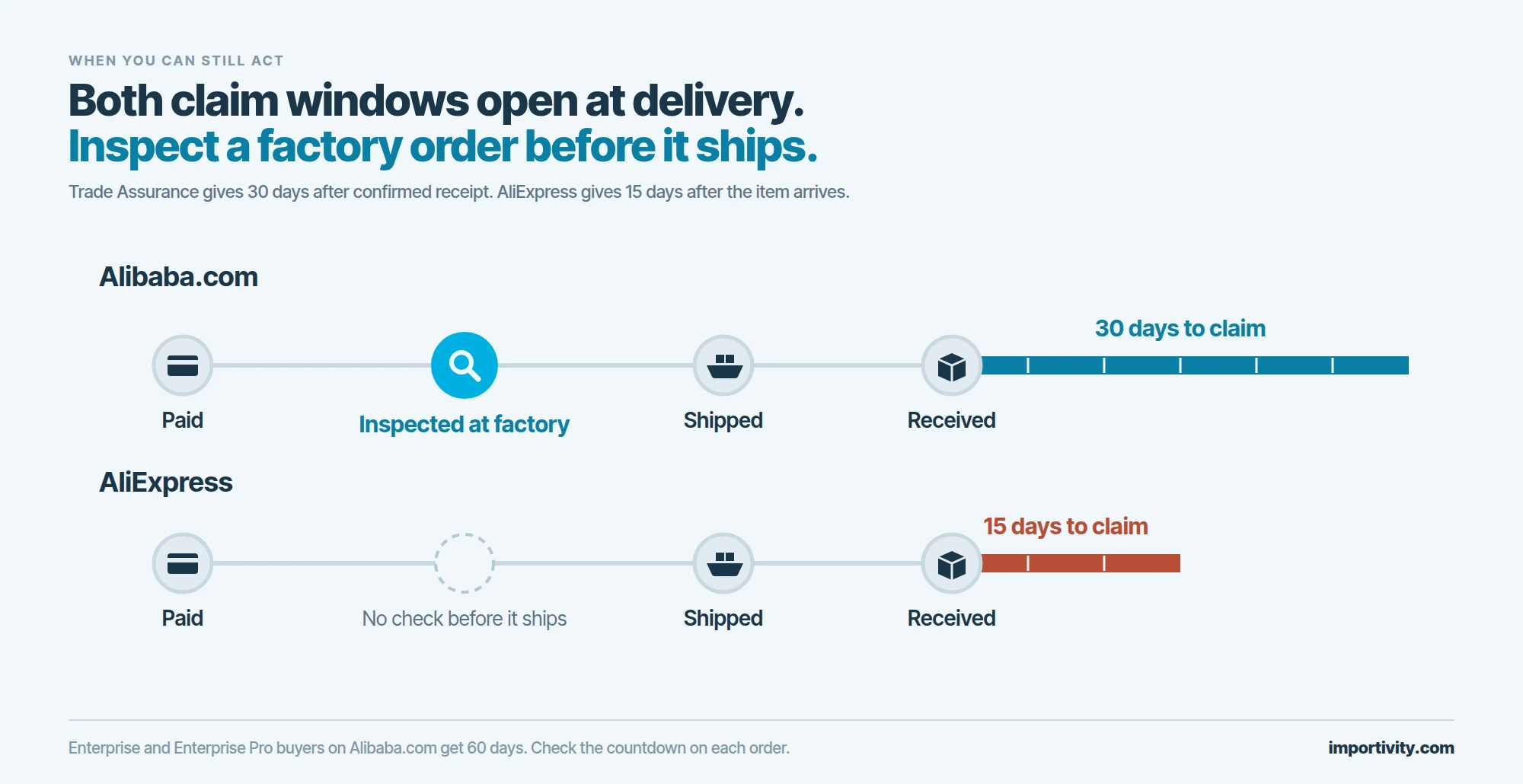
The bigger difference is what each claim is judged against. On AliExpress it is the listing: the photos and the description. On Alibaba.com it is the order you wrote. Trade Assurance covers late shipment or no shipment, quality below what the order states, and missing documents, so an order that only says "good quality" gives the dispute team nothing to measure. Our guide to Alibaba Trade Assurance covers the rules, deadlines and evidence.
A factory order also allows a check that a retail parcel does not. You can book a pre-shipment inspection while the goods are still at the factory and your balance is unpaid, before the 30-day claim period starts. On AliExpress, the first person to check the goods is you, when the parcel arrives.
For small Alibaba.com orders there is also Easy Return. It lets buyers in 46 countries, the United States among them, send defective or wrong goods back to a local warehouse at no cost within 30 days of delivery, on eligible products and orders under $3,000. AliExpress has a Free Return option on marked items, for 15 days after delivery. Neither site protects money you pay outside the platform, and our guide to Alibaba scams lists the reasons sellers give for asking you to pay that way.
Payment and shipping
Alibaba.com charges nothing extra for Trade Assurance, but each payment method has a processing fee. Alibaba's payment fee table lists 2.99% for cards, Apple Pay, Google Pay and PayPal, up to $12,000 per transaction. A wire transfer into the order costs only your own bank's fee, which makes it the cheaper choice once an order runs into thousands of dollars.
A wholesale order needs more shipping decisions. On AliExpress the seller picks the carrier, and the price usually includes delivery. On Alibaba.com you agree on a trade term with the supplier, and that term decides who books the freight and who pays which costs.
- EXW or FOB. The supplier hands the goods over at its factory or loads them at a Chinese port, and your forwarder handles the rest. You control the freight and the customs entry.
- DDP. The supplier quotes a delivered price that includes freight, US duty and the customs entry. It is simpler, but check that the duty in the quote matches the real rate for your product.
- Alibaba.com Logistics. Freight booked through the platform. Its on-time delivery guarantee pays 5% compensation, up to $100, on eligible orders that arrive late.
Small orders usually fly by express courier. Larger orders go by air freight or ocean.
US duties on AliExpress and Alibaba orders
Small orders used to skip duty. A parcel worth $800 or less entered the United States duty free under the de minimis rule, which is why AliExpress orders arrived with no bill. That ended for goods from China and Hong Kong on May 2, 2025 and for every country on August 29, 2025, and CBP wrote the suspension into its regulations in June 2026. Every shipment now pays the full duty for its product and origin, whether it is one AliExpress parcel or a pallet from an Alibaba.com supplier. Our guide to the end of de minimis covers the entry rules in detail.
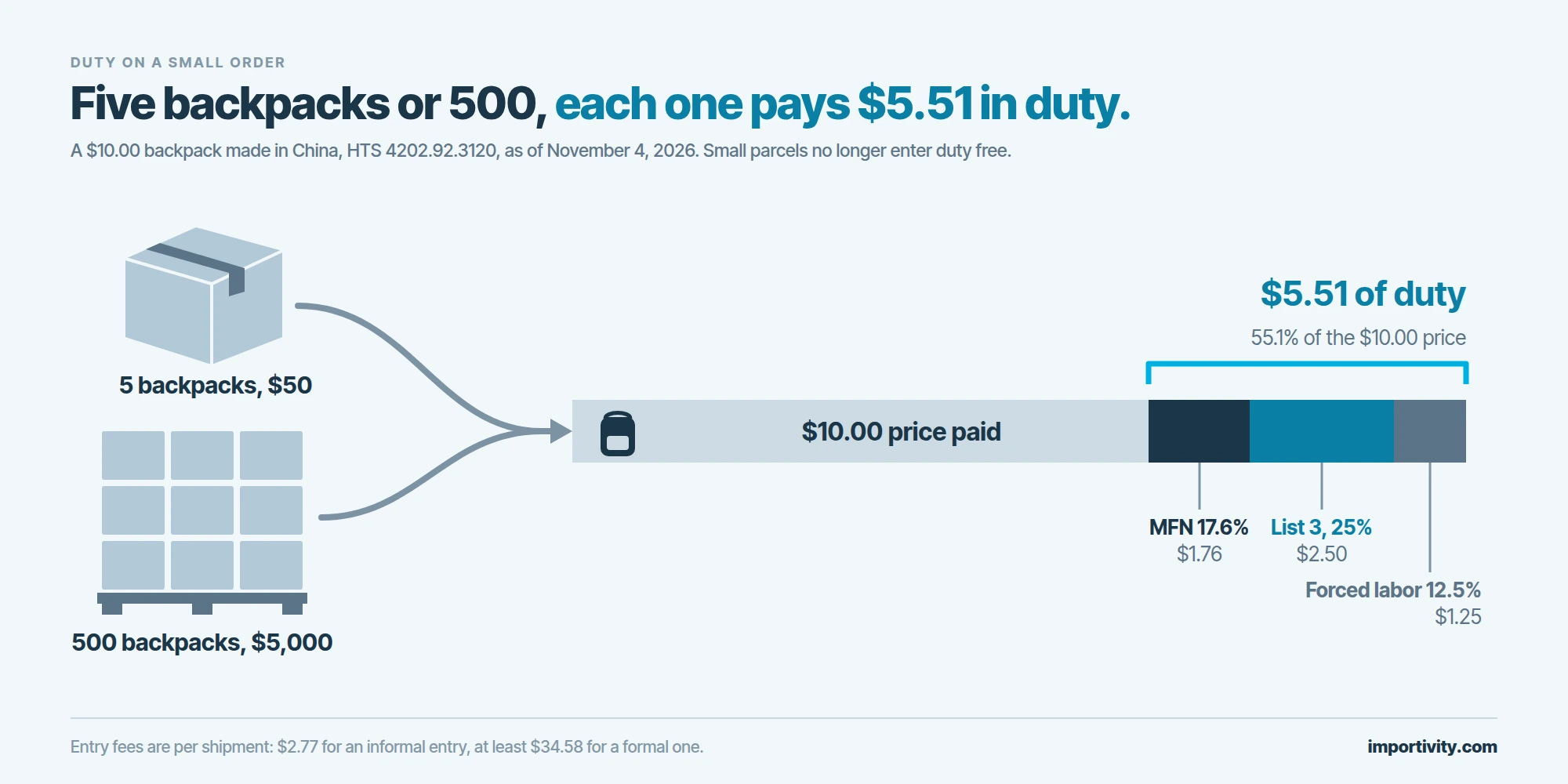
Take a backpack of man-made fiber made in China, HTS 4202.92.3120, bought for $10.00. As of November 4, 2026, the MFN rate of 17.6% adds $1.76. Section 301 List 3 adds 25%, or $2.50. The Section 301 forced-labor duty that started on July 24, 2026 adds 12.5%, or $1.25. That is $5.51 of duty per backpack, 55.1% of the price, and the rate is the same on 5 backpacks or 500.
Two things do change with the size of the order.
- The value duty is charged on. US customs value is the price you paid, without international freight. A backpack bought at a retail price on AliExpress pays more duty in dollars than the same backpack bought at a factory price.
- The cost of the entry. A shipment of $2,500 or less by express can clear on an informal entry, with a merchandise processing fee of $2.77 from October 1, 2026, plus the carrier's charge for filing it. Above $2,500 you need a formal entry, a customs bond and usually a customs broker, and the fee is 0.3464% of the value, at least $34.58 and at most $670.86. On 5 backpacks worth $50, the $2.77 fee is about $0.55 a unit. On 500 backpacks worth $5,000, the $34.58 minimum is about $0.07 a unit.
On an AliExpress order, check at checkout whether the price includes US duties. If it does not, expect the carrier to bill you before it delivers. On an Alibaba.com order, the importer of record owes the duty, which is you unless the supplier sells DDP.
Which one to use, and where 1688 and Taobao fit
Order size and how much the product has to change decide it.
- Use AliExpress for a test of about 5 units. Buy two or three versions of an existing product to handle, photograph and compare. Accept that you pay a retail price, get no specification and get no US test reports.
- Use Alibaba.com for 500 custom units. You get price tiers, your logo and packaging, a written specification, an inspection before shipment and a Trade Assurance claim measured against your order.
- Use both in sequence. Buy the best AliExpress version, then send it to three to five Alibaba.com suppliers as a reference sample with your quote request, so every supplier prices the same thing.
1688 is Alibaba Group's wholesale marketplace for buyers inside China. It is in Chinese, prices are in yuan, most sellers deliver only inside China, and many listings take very small orders. A US buyer orders through a buying agent, which takes delivery in China and exports the goods. Alibaba.com Trade Assurance does not cover those orders. Our guide on how to buy from 1688 covers the costs that the low listing price leaves out.
Taobao is the group's consumer marketplace in China, closer to AliExpress than to Alibaba.com. It added an English interface in Singapore and Malaysia in September 2024, but for a US buyer it works much like 1688: retail quantities, sellers who serve Chinese shoppers, and usually an agent or forwarder in between. If none of these sites fits your product, our guide to Alibaba alternatives covers the other channels.
When the product has to be custom and the order is worth checking properly, our supplier vetting team confirms the supplier is a real factory and inspects the goods before you pay the balance. To get it priced, send us your product and order details.
Frequently Asked Questions
Is AliExpress owned by Alibaba?
Yes. AliExpress and Alibaba.com both belong to Alibaba Group, which also runs 1688.com and Taobao. They are separate marketplaces with separate buyers. Alibaba.com sells wholesale to businesses, with minimum orders, price tiers and custom products. AliExpress sells retail to anyone, one item at a fixed price, delivered to the door.
Is Alibaba cheaper than AliExpress?
Per unit, usually yes, because Alibaba.com prices fall as quantity rises and suppliers quote factory prices. In total, not always. A first Alibaba order may carry a minimum of hundreds of pieces, a card fee of 2.99%, freight, a customs entry and US duty. For a test of a few units, AliExpress can cost less overall. Compare landed cost per unit, not the listing price.
Can you buy just one item on Alibaba?
Sometimes. Some Alibaba.com listings sell in-stock goods through a Start order button with small minimums, and many suppliers sell paid samples. A custom version, with your logo, packaging or design, needs an inquiry and has its own minimum, which ran from 2 to 1,000 pieces on the listings we checked. If you only want one or two units of an existing product to try, AliExpress is usually the simpler route.
Do you pay customs duty on AliExpress orders to the US?
Yes. The $800 de minimis exemption that let small parcels enter duty free was suspended for goods from China on May 2, 2025 and for all countries on August 29, 2025. Every AliExpress parcel now pays the duty for its product and origin, including Section 301 duties on many Chinese goods. Check whether the checkout total includes duties. If it does not, the carrier collects them.
Should I use Alibaba or AliExpress to start a brand?
Use both, at different stages. AliExpress is good for buying a few existing products to compare and test with customers. A brand needs its own logo, packaging and a fixed specification, and only Alibaba.com suppliers, or factories found another way, will make that. Send the best AliExpress sample to several Alibaba.com suppliers as a reference when you ask for quotes.
About the author
Jordan Lewis
Chief Operating Officer, Importivity
Runs Importivity's sourcing operations across China, Vietnam, Mexico and India, from supplier negotiation through landed delivery.
Press and media inquiries: press@importivity.com