How to Plan for the Chinese New Year Factory Shutdown in 2027
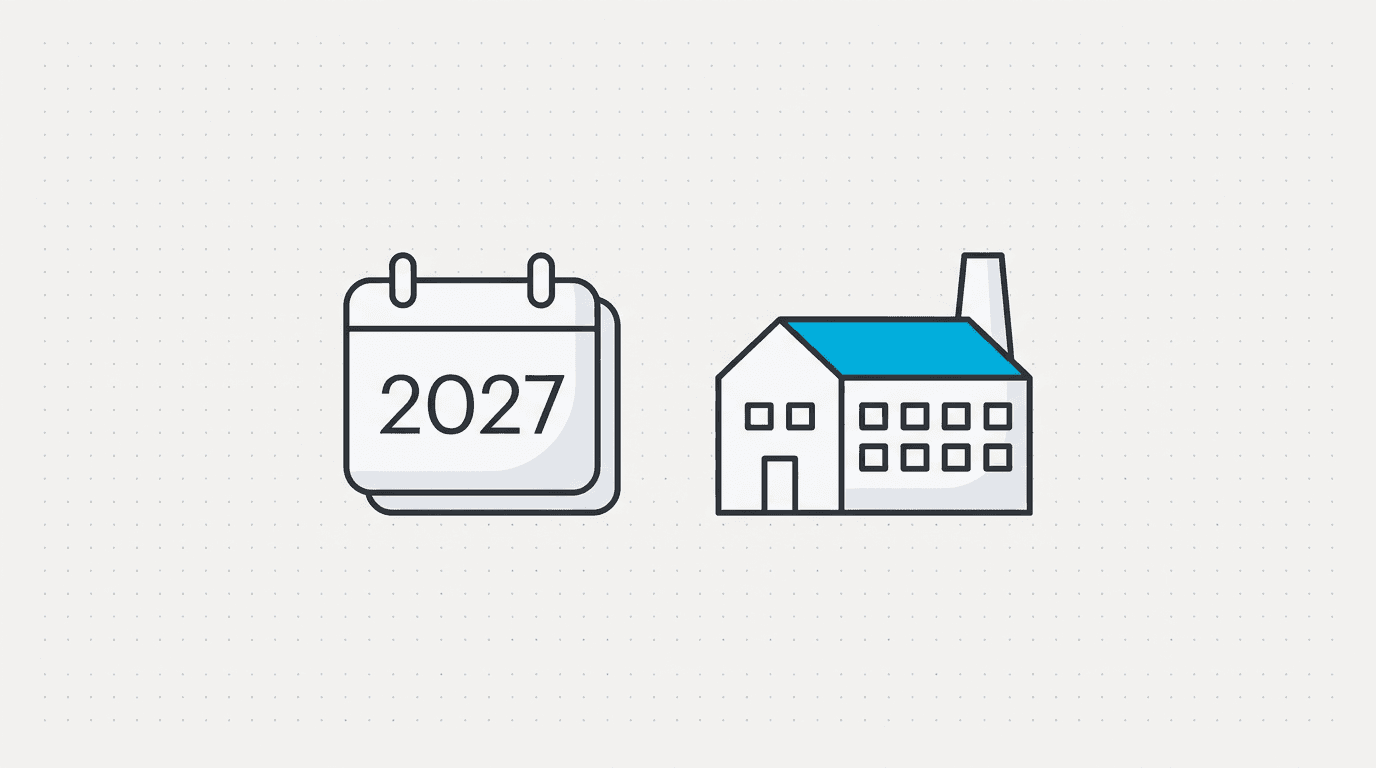
Chinese New Year 2027 falls on Saturday, February 6, and although China's official holiday runs eight or nine days, most factories stop production one to two weeks before New Year's Eve on February 5 and do not reach full output again until March. Plan on losing about six weeks of normal production, and set your purchase order deadlines by counting back from a last loading date around January 22, 2027.
This guide is for US brands that make products in China and need stock on shelves in the first half of 2027. It covers the dates, how long lines really stop, why staffing drops after the holiday, order cutoffs, freight space, quality risk and a week by week plan. If late shipments are already a pattern with your supplier, read why suppliers keep missing deadlines first, because the holiday makes every existing gap wider.
When Chinese New Year 2027 falls and what the official holiday covers
The first day of the lunar new year is Saturday, February 6, 2027, as listed in the Hong Kong government's 2027 holiday schedule. New Year's Eve is Friday, February 5. The Lantern Festival, the fifteenth day, falls on Saturday, February 20, and it is the traditional end of the season.
On the mainland, the statutory Spring Festival holiday has been four days since January 1, 2025: New Year's Eve plus the first three days of the new year. The State Council then swaps weekend days to build a longer break. For 2026 the official schedule gave nine days off, February 15 to 23, with Saturday February 14 and Saturday February 28 worked to make up for it. That notice came out on November 4, 2025. The 2027 notice had not been published as of late October 2026, so treat any exact 2027 office dates as provisional until it appears.
Vietnam does not offer a way around the same weeks. Its Ministry of Home Affairs set the Tet break for civil servants at seven days, Thursday February 4 to Wednesday February 10, 2027, in a notice dated October 9, 2026. Private employers choose their own plan and must tell workers at least 30 days ahead. If you run a China plus one strategy, both lines will go quiet at the same time.
How long factories really stop
The official holiday is the shortest part of the shutdown. Inspection firms that work on factory floors in China describe a longer cycle: production slows and stops one to two weeks before New Year's Eve, offices stay open a little longer than the lines, and most suppliers are not running again until two or three weeks after the Eve.
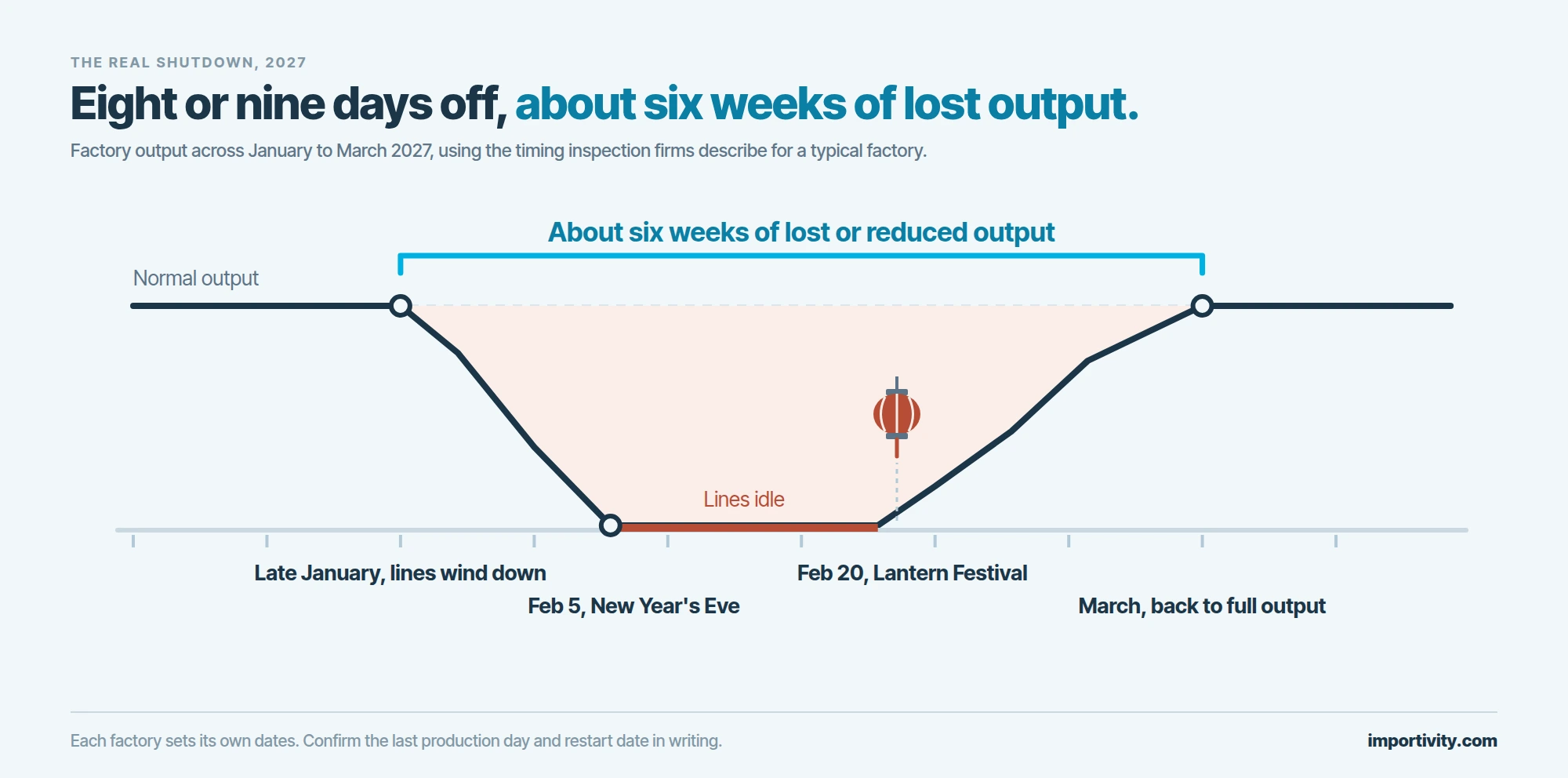
Then the restart is slow. Insight Quality Services, an inspection company, says most factories fully close for two to four weeks and that it can take up to a month after the holiday for production to return to full capacity. Put the 2027 dates on that pattern and lines start winding down between about January 22 and January 29, sit idle until around the Lantern Festival on February 20, and ramp back up into March. That is about six weeks of lost or reduced output.
The travel data shows why. China's 2026 Spring Festival travel season ran 40 days, from February 2 to March 13, and Xinhua reported that the busiest travel day of the season was expected on February 22, the sixth day of the new year. Workers are still on the road well after the office reopens.
Worker turnover after the holiday
Chinese factories rely on workers who live far from home. China's National Bureau of Statistics counted 301.15 million migrant workers in 2025, of whom 180.06 million worked outside their home area and 67.65 million crossed a provincial border. Of all migrant workers, 28.2% work in manufacturing. The holiday is when many of them travel home, and some do not come back to the same job.
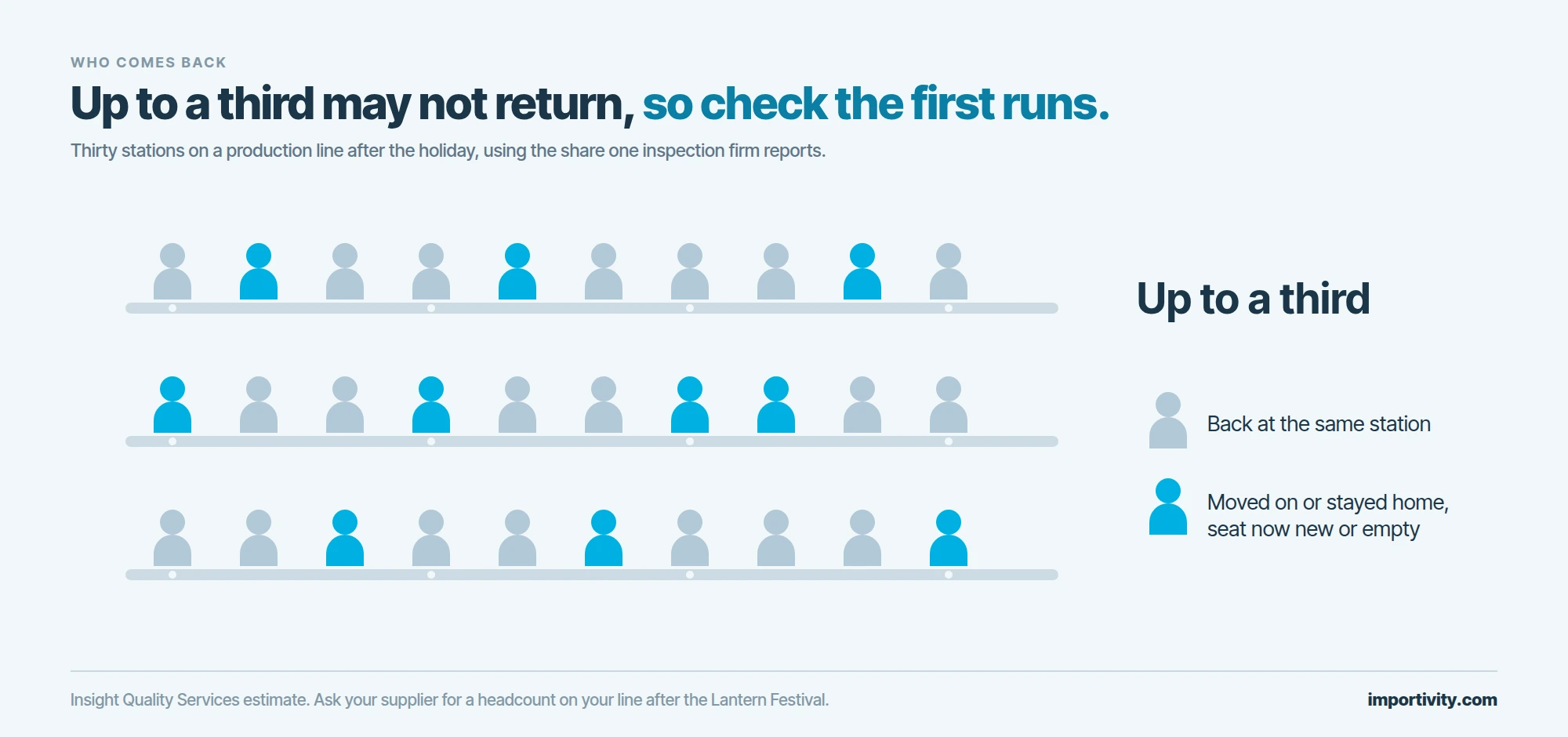
Insight Quality Services puts it at up to a third of workers who may move to another factory or stay in their hometowns. Every one of those seats is either empty or filled by someone new to your product. That changes three things. The line runs slower, so the restart takes longer than the calendar suggests. Experienced operators on critical steps may be gone. And the factory has an incentive to catch up on its backlog with whoever is available.
Ask your supplier for a headcount on your line in the week after the Lantern Festival, and ask which stations lost experienced people. A factory that answers with specifics is managing the restart. One that answers "everything is normal" in late February is guessing.
Order cutoff dates for a February 2027 holiday
Work backward from the last loading date, not forward from today. For a holiday on February 6, plan to load by about January 22, 2027, which leaves a margin if the line stops early. Then subtract the steps in front of it.
- Production lead time. Use the time your factory quotes from deposit to finished goods. If it quotes 45 days, the deposit has to land by about December 8, 2026 to load on January 22.
- Materials and packaging. Printed cartons, labels and special materials come from other suppliers who are on the same calendar. Order them with the main purchase order.
- Samples. A new product or a changed one needs pre-production sample approval before mass production starts, which can add weeks.
- Inspection and booking. Leave time for a pre-shipment inspection and for any rework it finds, which is hard to schedule in the last week before the break.
Goods needed in March or April have the opposite problem. A purchase order placed in late January will not start production until the line is staffed again. Insight Quality Services advises starting those conversations with suppliers around September or October. If you are already past that, order now and accept a later ship date in writing rather than a promise that the factory cannot keep. Our guide to the manufacturing purchase order covers how to put ship dates and late penalties into the contract.
Before you place the order, confirm these points with the factory in writing:
- Last production day for your line, not for the office.
- Last loading day and the forwarder's cutoff for the sailing you booked.
- Reopening and restart dates for the office and for your line, which are often different.
- Who stays reachable during the break, by name.
- Raw material on hand for the first run after the holiday, so the restart does not wait on a supplier that is also restarting.
Freight rates and space around the holiday
The pressure before the holiday is on trucks and loading slots inside China, because every exporter wants to load in the same few weeks. Book the factory pickup and the ocean space when you place the purchase order, not when the goods are packed.
After the holiday the problem is fewer sailings. Drewry counted 136 cancelled sailings across the transpacific, Asia to Europe and Mediterranean, and transatlantic trades in February 2026, up 122% from January, with most of them on the transpacific. It expected the number to fall to about 53 in March. Spot rates did not jump. Drewry reported transpacific eastbound rates still weakening in mid-February 2026. The cost of the holiday showed up as longer waits between sailings and less reliable transit times, not as a rate spike. Drewry publishes a weekly cancelled sailings tracker worth checking in January.
For a small, urgent order that misses the last sailing, air freight is the fallback. Our comparison of sea vs air freight shows when it pays, and our piece on how ocean freight affects sourcing covers timing purchase orders around the freight cycle.
Quality risk on the last runs before and the first runs after
Quality slips on both sides of the break. Before it, factories rush to finish orders so they can close on time. V-Trust, an inspection firm, reported that defect rates in its inspections rise sharply in December and January, and more so on new products. QIMA reported that 23% of products failed inspection in factories in the first quarter of 2018, a 7% increase, and tied it to the labor shortages factories face around Chinese New Year.
After the break, the risk moves to the restart. New hires are learning the job while the factory is under pressure to clear its backlog. Three checks cover most of it:
- Inspect the last pre-holiday lot before it ships. A pre-shipment inspection booked for mid-January catches rushed work while you still hold the balance payment.
- Re-send the spec pack and golden sample reference in the first week back, so new workers build to the approved standard.
- Check the first post-holiday run early. A first article inspection or an inspection during production on the first lot finds setup problems before a full order is built on them.
Our guide to quality control with factories in China covers the full process. Importivity's quality control team runs these inspections for US brands.
A week by week plan for Chinese New Year 2027
The table below puts the steps on the 2027 calendar. The dates assume a factory that follows the common pattern, so replace them with the dates your supplier confirms in writing.
| Week | What is happening | What you do |
|---|---|---|
| Late October to mid November 2026 | Factories plan their last production slots before the break | Confirm closing and restart dates in writing and lock forecasts through April |
| Mid November to early December | The State Council published the last two holiday notices in November | Place purchase orders and pay deposits for anything that must ship before the break |
| December 7 to December 31 | Materials arrive and mass production runs | Approve samples and book ocean space for January sailings |
| January 4 to January 15, 2027 | Orders finish under time pressure | Book the pre-shipment inspection and confirm loading dates |
| January 18 to January 29 | Lines wind down and workers start leaving | Load the last containers and get any new ship date in writing |
| February 1 to February 14 | New Year's Eve on February 5 and New Year on February 6, factories closed | No production. Plan the restart and the first inspections |
| February 15 to February 26 | Lantern Festival on February 20, workers return over this period | Ask for a headcount on your line and re-send specs and sample references |
| March 1 to March 19 | Lines ramp back toward full output | Inspect the first post-holiday run and confirm revised ship dates |
If you want a partner to hold these dates with your factories and check the goods on both sides of the break, you can send us your product and timeline and we will tell you what is still possible before February.
Frequently Asked Questions
When is Chinese New Year 2027?
Chinese New Year 2027 is Saturday, February 6, and New Year's Eve is Friday, February 5. The Lantern Festival, which closes the season, is Saturday, February 20. China's State Council sets the exact official days off each year, and its 2027 notice had not been published as of late October 2026.
How long do Chinese factories close for Chinese New Year?
The official holiday is eight or nine days, but most factories stop production one to two weeks before New Year's Eve and are not running again until two or three weeks after it. Reaching full output can take up to a month after the holiday, so plan on about six weeks of lost or reduced production.
When should I place orders before Chinese New Year 2027?
Count back from a last loading date around January 22, 2027. Subtract your factory's quoted production lead time, then add time for materials, samples and inspection. With a 45 day lead time, the deposit needs to land by about December 8, 2026. Orders for March or April delivery are best agreed with the supplier in September or October.
Do factories in Vietnam close for Tet at the same time?
Yes. Tet 2027 falls in the same week as Chinese New Year. Vietnam's Ministry of Home Affairs set a seven day break for civil servants from February 4 to February 10, 2027, and private employers choose their own schedule with at least 30 days' notice to workers. A Vietnam supplier will not cover the Chinese holiday gap.
Is it risky to ship goods made right after Chinese New Year?
The risk is higher than usual. Factories restart with new hires in place of workers who did not return, while they are under pressure to clear a backlog. Re-send your spec pack and golden sample reference in the first week back, and inspect the first production run early instead of waiting for the final pre-shipment inspection.
About the author
Jordan Lewis
Chief Operating Officer, Importivity
Runs Importivity's sourcing operations across China, Vietnam, Mexico and India, from supplier negotiation through landed delivery.
Press and media inquiries: press@importivity.com