Shipping Marks and Carton Labels and What to Send Your Factory

Shipping marks are the identifying text printed on every export carton: a main mark with your consignee code, PO number, destination, carton number such as 15/240 and country of origin, and a side mark with the item, the quantity, the weights and the carton size, all matching the packing list and commercial invoice. Write them into a carton spec before production, along with handling symbols, the case barcode and box strength, because a factory left to decide will print what it prints for every other buyer.
This guide is for US brands shipping from factories in China, Vietnam, India or Mexico to their own warehouse, a 3PL or a retailer's distribution center. It covers what goes on each face of the carton, when the carton itself must show the country of origin, which handling symbols are worth printing, carton barcodes, box strength and drop tests, and the spec to send your factory. For the retail box that sits inside the carton, see our guide to custom packaging manufacturers.
Main marks and side marks
Every export carton carries two blocks of text. The main mark, in large type on two opposite faces, says whose carton it is and where it is going, so it shows whichever way the carton is stacked. The side mark, on the other two faces, says what is inside so nobody has to open the box to find out. The drawing below shows both on one carton.
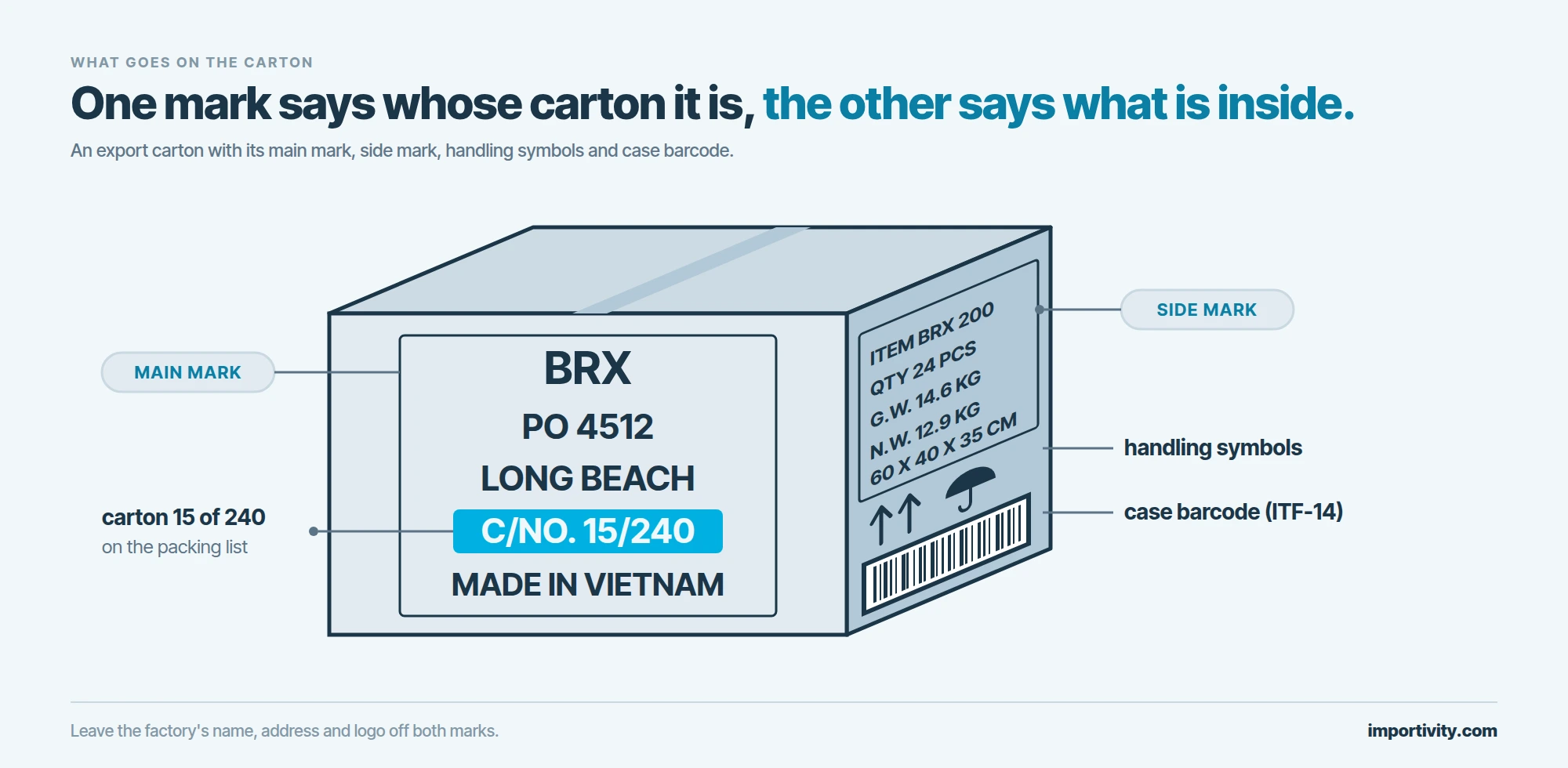
A main mark has five lines, in this order:
- Consignee code. A short code or your initials, BRX in the example, rather than your full brand name. On goods that are easy to resell, a neutral code makes the carton a less obvious target in transit.
- PO number. PO 4512 ties the carton to one order, which is how a warehouse sorts a mixed delivery.
- Destination. The port or warehouse city, LONG BEACH in the example.
- Carton number. This carton over the total, C/NO. 15/240. It lets anyone count a shipment, find a missing carton and match a carton to its line on the packing list.
- Country of origin. MADE IN VIETNAM, in English. The next section covers when the law requires it on the carton.
The side mark carries what a warehouse needs without opening the box: item number, quantity per carton, gross weight, net weight and outer dimensions, for example ITEM BRX 200, QTY 24 PCS, G.W. 14.6 KG, N.W. 12.9 KG and 60 X 40 X 35 CM. Leave the factory's name, address and logo off both marks. They tell your 3PL, your retailer and anyone else downstream who makes your product.
Each mark has a different reader, which is why each has its own place on the carton.
| Mark | Where it goes on the carton | Who reads it |
|---|---|---|
| Main mark | Two opposite faces, in the largest type | Forwarder, container freight station, receiving dock |
| Side mark | The other two faces | Warehouse receiving and pickers |
| Country of origin | On the main mark, and next to any US address | CBP officers and the ultimate purchaser |
| Handling symbols | Upper part of the faces, only where they apply | Freight handlers and forklift drivers |
| Case barcode (ITF-14) | Printed into the carton artwork, low on a side face | Warehouse and retailer scanners |
| Logistic label (SSCC) | Applied label, one per carton and two per pallet | 3PL and retailer receiving systems |
Country of origin on the carton
The marking law is written around the ultimate purchaser, the last person in the United States who receives the article in the form in which it was imported. The article itself must carry its origin in English, legibly and permanently, and our guide to country of origin rules covers those rules and the 10 percent marking duty. The carton comes into it in four cases under 19 CFR Part 134:
- The carton shows a US address. Under 19 CFR 134.22(c), a container bearing the name and address of a US importer or distributor must show the origin of the contents in close proximity to that address, with wording such as "Contents made in China." Brand-printed cartons usually carry your address, so this case comes up most.
- The article is excepted from marking. When the article itself is excused, the outermost container in which it ordinarily reaches the ultimate purchaser must be marked instead, under 134.22(a).
- The carton reaches the buyer unopened. In CBP's marking guidance, a marked container can stand in for marked contents when it reaches the ultimate purchaser unopened. A master carton sold whole to a business customer is then the marking.
- Someone repacks the goods. If your 3PL or a customer will repack the goods into retail packs after release, 19 CFR 134.26 requires you to certify to CBP that the origin mark will not be hidden, or to tell the buyer in writing that the repacked goods must be marked. Missing it can bring liquidated damages and the additional marking duty.
The simple policy is to print MADE IN [COUNTRY] on the main mark of every carton and to put "Contents made in [country]" next to any US address. It costs nothing at the printing stage and covers the first three cases. It does not fix an unmarked article. If the units inside need their own mark, the carton cannot stand in for it unless an exception applies.
Handling symbols worth printing
Handling pictograms come from ISO 780:2015, the international standard of graphical symbols for distribution packages. It applies to packages of any goods, it leaves out dangerous goods, and it says the symbols should be used only when necessary. That last point is the useful one. Print the symbols that change how someone should handle that carton and skip the rest:
- This way up, two upward arrows, for anything with liquid, a pump or a part that must stay upright.
- Fragile, a wine glass, for glass, ceramics and finished surfaces that dent.
- Keep dry, an umbrella, for paper goods, wood, electronics and retail boxes that must arrive clean.
- Stacking limit for cartons that cannot carry the weight of a full stack above them.
- Center of gravity for heavy, uneven items such as a machine with its motor at one end.
Lithium batteries, aerosols and other regulated cargo follow dangerous goods regulations, with their own marks and labels, so tell your freight forwarder before booking.
Barcodes on the carton
Two different barcodes can go on a master carton, and they do different jobs. The case barcode identifies what is inside. The logistic label identifies the carton itself.
- Case barcode (ITF-14). It encodes a 14-digit GTIN for the case, prints straight onto corrugated board inside a thick bearer bar, and is not used at a retail checkout. The case GTIN is built from the unit's GTIN with an indicator digit from 1 to 8 in front. A carton of mixed items cannot use this structure to describe its contents.
- Logistic label (SSCC). The Serial Shipping Container Code is a unique serial number for one shipping unit, printed as a GS1-128 barcode at least 31.75 mm (1.25 in) tall. It is the only mandatory element of a GS1 logistic label, and a 4 x 6 inch label is enough when the SSCC is all you need.
The GS1 Logistic Label Guideline targets the bottom of the barcode 32 mm (1.25 in) above the natural base of a carton and at least 19 mm (0.75 in) from any vertical edge. On pallets it puts the barcode 400 to 800 mm (16 to 32 in) above the base, with the same label on two sides. The factory can print the ITF-14 into the carton artwork because it is the same on every carton of that item. SSCC labels change carton to carton, so they are usually printed at packing from data you or your 3PL supply. Retailer routing guides and Amazon's inbound rules add their own label requirements, so get them before the factory prints anything.
Drop tests and carton strength
The quickest proof that a packed carton will survive the trip is a drop test. ISTA 1A, the basic integrity test from the International Safe Transit Association for packaged products of 150 lb (68 kg) or less, drops each packed carton ten times: one corner, three edges and six faces, from a height set by the packed weight.
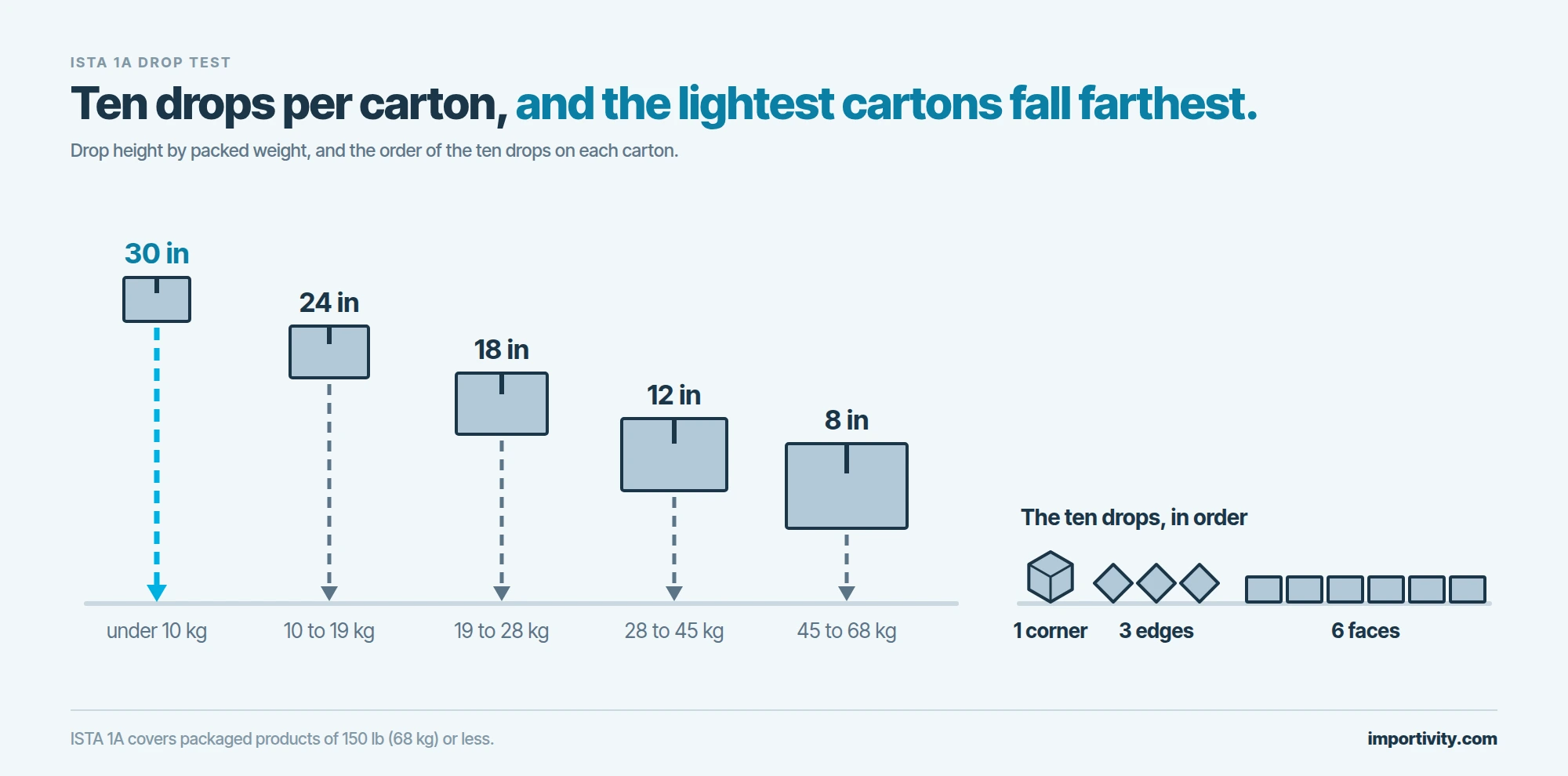
Published summaries of the ISTA 1A table give 30 inches for cartons under 10 kg, 24 inches from 10 to 19 kg, 18 inches from 19 to 28 kg, 12 inches from 28 to 45 kg and 8 inches from 45 to 68 kg. Run it on packed production cartons before mass packing, then again on cartons pulled at the pre-shipment inspection. LCL cargo is handled more often than a sealed full container, which our FCL vs LCL guide explains, so a marginal carton is more likely to fail there.
Factories in China quote export cartons by ply, usually 3-ply single wall or 5-ply double wall, plus a paper grade. US carriers think in burst strength, a measure of puncture resistance, and edge crush test (ECT), a measure of stacking strength. The UPS packaging guidelines map packed weight to board:
- Up to 30 lb: single wall, 200 burst, 32 ECT.
- 31 to 50 lb: single wall, 250 burst, 44 ECT.
- 51 to 65 lb: single wall, 275 burst, 55 ECT.
- 81 to 100 lb: double wall, 350 burst, 61 ECT.
UPS calls these guidelines rather than specifications and recommends testing packed products to ISTA 3A, the ISTA test for parcel shipments. It also says never to exceed the maximum gross weight on the Box Maker's Certificate, the stamp on the bottom flap. Ask the factory's carton supplier to print one, and put the rating you want in the spec instead of a ply count alone.
The marks have to match the paperwork
Carton marks are part of the customs record. Under 19 CFR 141.86, the commercial invoice must describe the merchandise "together with the marks and numbers of the packages in which the merchandise is packed," and it must state in adequate detail what is in each package. The bill of lading carries the same marks in its marks and numbers field. A carton printed 15/240 should appear on the packing list as carton 15, with the same item, quantity and weight, so anyone holding the papers can find it.
LCL makes this stricter. Your cartons are unloaded at a container freight station next to other shippers' cargo and sorted by their marks, so a carton with a missing or wrong main mark can be delivered with someone else's freight or held until it is identified. Build the carton list first and have the factory produce the commercial invoice and packing list from it, so the three documents match.
The carton marking spec to send your factory
Send this as one page with the order and ask for carton photos in the inspection report. A manufacturing purchase order that references the spec makes a wrong carton a defect you can reject.
- Main mark text, exact lines and order, on two opposite faces, with a minimum letter height.
- Side mark text and the fields filled per carton, which are the item number, the quantity per carton, both weights and the outer dimensions.
- Carton numbering as this carton over the total, running across the whole PO rather than restarting per item.
- Origin mark, MADE IN [COUNTRY], plus "Contents made in [country]" beside any US address.
- Handling symbols, only the ones that apply, with their position.
- Case barcode, the GTIN-14 for each carton type, and who applies the SSCC labels.
- Board, wall type, burst or ECT rating, maximum gross weight for the Box Maker's Certificate, and carton size.
- Drop test, ISTA 1A or your customer's test, on packed cartons before mass packing.
- What not to print: the factory's name, address, logo or phone number, and any price.
- Proof approval, a photo of one printed carton for sign-off before the full carton order.
Importivity helps brands set packaging and carton specs through its packaging service and checks the cartons during quality control inspections. To start, send us your product and order details.
Frequently Asked Questions
What are shipping marks on a carton?
Shipping marks are the text printed on an export carton so it can be identified without opening it. The main mark shows the consignee code, PO number, destination, carton number and country of origin, and the side mark shows the item, quantity, weights and dimensions. Both must match the packing list and commercial invoice.
Do master cartons need to say Made in China?
The law mainly requires the article inside to be marked. A carton must show the origin when it carries a US company's name and address, when the article inside is excepted from marking, or when the carton reaches the ultimate purchaser unopened. Next to a US address the wording should read like Contents made in China.
What is the difference between a main mark and a side mark?
The main mark says whose carton it is and where it is going, for the forwarder, the container freight station and your receiving dock. The side mark describes what is inside, item, quantity, weight and size, for the warehouse that stores and picks it. Main marks usually go on two opposite faces and side marks on the other two.
Should my brand name be printed on shipping cartons?
It does not need to be. A short consignee code identifies the carton just as well and makes branded goods that are easy to resell less visible in transit. Keep the factory's name and address off the carton too, because they show everyone downstream who makes your product.
How strong should an export carton be?
Match the board to the packed weight and the way the carton will travel. The UPS guideline puts cartons up to 30 lb in single wall board rated 200 burst and 32 ECT and moves to double wall from 81 lb. Check the maximum gross weight on the Box Maker's Certificate and confirm with a drop test such as ISTA 1A before mass packing.
About the author
Jordan Lewis
Chief Operating Officer, Importivity
Runs Importivity's sourcing operations across China, Vietnam, Mexico and India, from supplier negotiation through landed delivery.
Press and media inquiries: press@importivity.com