How to Source a Custom Packaging Manufacturer Without Overpaying
Choosing a custom packaging manufacturer on unit price is how brands end up paying twice. The box costs what it costs, somewhere between a few cents and a few dollars depending on format and volume, but its outside dimensions set your shipping cost on every parcel for the life of the SKU, and in 2026 the packaging itself has to be registered and reported under extended producer responsibility laws in a growing list of states. Get the dimensions and the compliance right and the unit price becomes a rounding error. Get them wrong and no per box saving recovers it.
This guide is for US brands and ecommerce sellers sourcing custom retail or shipping packaging, domestically or overseas. It covers the dimensional weight arithmetic, print method economics and where the MOQ thresholds sit, the state EPR deadlines now live, the material and food contact rules, and how the freight maths changes the import decision. If packaging is part of a wider product launch, our guide to how packaging choices affect sourcing costs covers the upstream half.
The Cost Driver Nobody Puts on the Quote
Parcel carriers bill on the greater of actual weight and dimensional weight, and dimensional weight is calculated by multiplying length by width by height and dividing by a divisor. A smaller divisor means a higher billable weight for the same box. Per shipping industry reporting, UPS and FedEx moved to a divisor of 139 for daily and standard rates in August 2025, with UPS retail rates on 166, and USPS is cutting its own divisor from 166 to 139 with effect from 12 July 2026 across Priority Mail Express, Priority Mail, Ground Advantage and Parcel Select. We were not able to confirm these figures directly on the carriers' own sites, which block automated access, so verify against your carrier agreement before repricing anything.
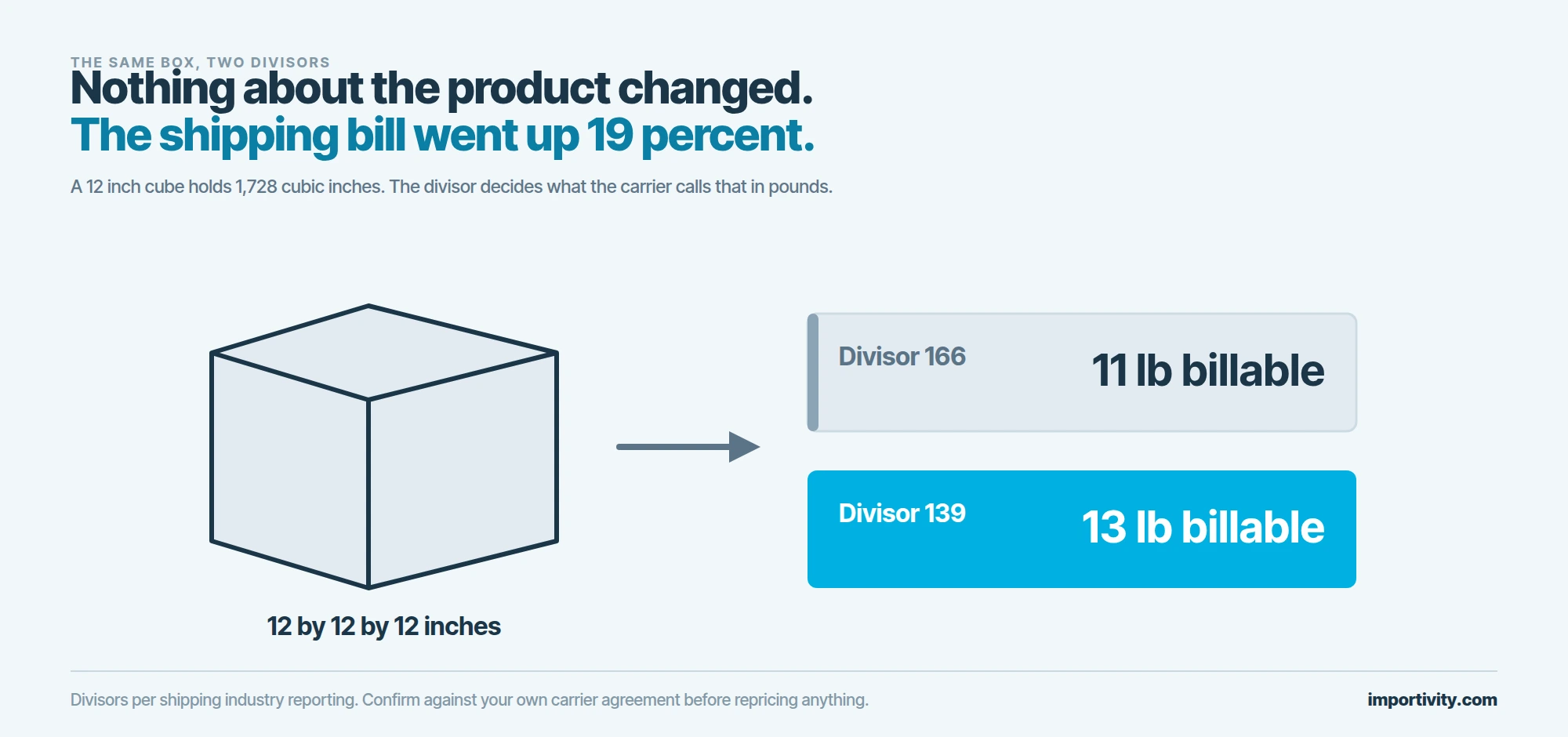
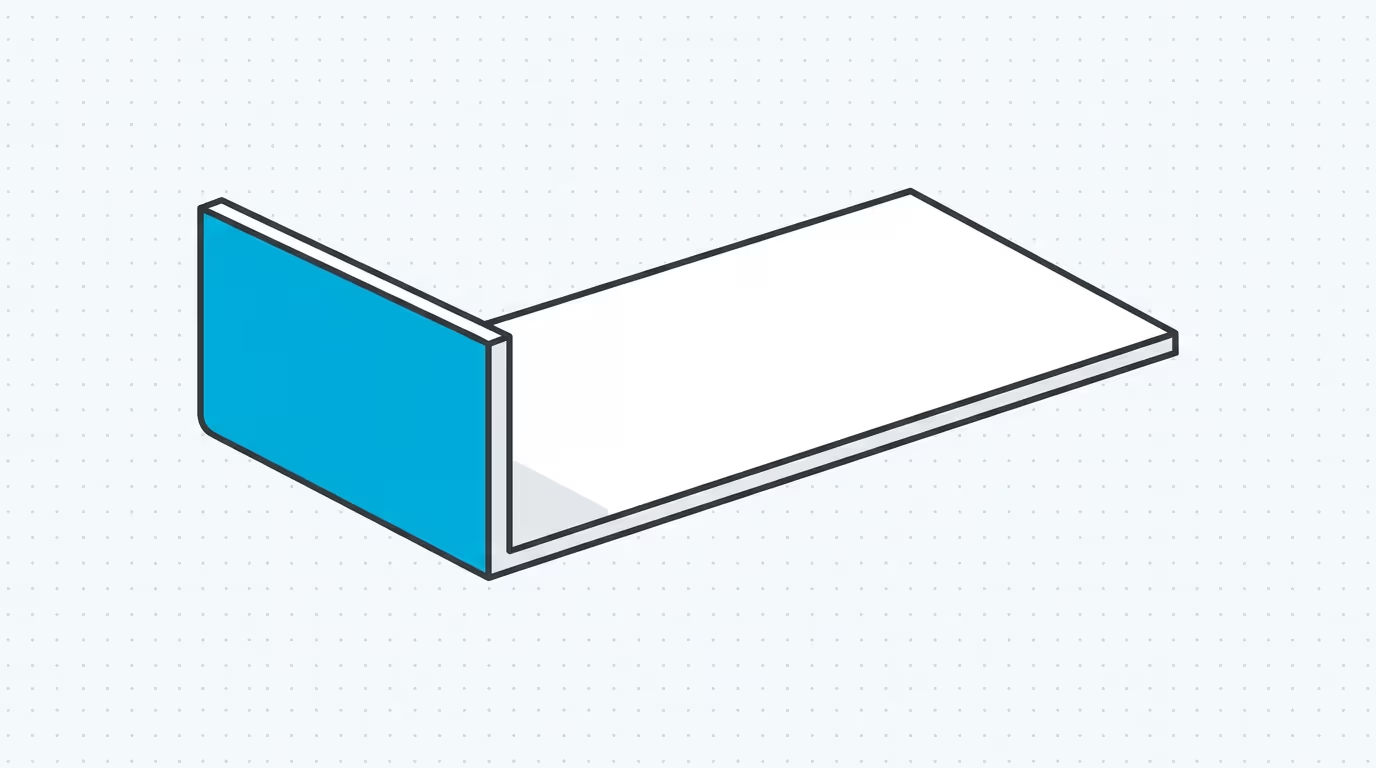
The arithmetic is unforgiving. A 12 by 12 by 12 inch box contains 1,728 cubic inches. Divided by 166 that is a billable weight of 11 pounds. Divided by 139 it is 13 pounds. Nothing about the product changed, and the shipping cost rose roughly 19 percent. One useful nuance on the USPS side is that dimensional pricing only triggers above one cubic foot, meaning 1,728 cubic inches, so a box that stays just under that threshold is billed on actual weight regardless of shape.
That single fact should drive the brief you give a packaging manufacturer. Ask for the smallest box that protects the product, not the nearest stock size up. Ask what the dimensions do to billable weight at your carrier's divisor before approving a dieline. And treat any packaging redesign that reduces a dimension by an inch as a shipping project rather than a design one, because that is where the money is.
What It Costs and Where the MOQs Sit
Numbers in this category come almost entirely from packaging suppliers' own published guides, not independent research, so treat them as the ranges the market quotes and get written quotations. Custom printed folding cartons are commonly quoted from around a dollar to three dollars a unit at one to three thousand units, with MOQs typically in that same one to three thousand band and some suppliers going to 300. Corrugated shipping boxes run roughly 40 cents to three dollars depending on size, flute grade and print. Rigid boxes start around 500 units and three dollars a unit, rising well above that with premium finishing. Flexible pouches have the highest MOQs, often 8,000 units or more, at 10 cents to a dollar each.
The bigger lever is which printing process you land in, because the plate or cylinder cost is what sets the economic order quantity.
| Print method | Where it wins | Image carrier cost and life |
|---|---|---|
| Digital | Short runs, typically breaking even somewhere around 500 to 1,000 units | No plates at all, so no setup to amortise and no volume commitment |
| Offset litho | Usually cheapest under roughly 10,000 units, with strong graphics quality | Low plate cost, but MOQs commonly 3,000 to 5,000 and up to 10,000 on complex multi color work |
| Flexography | Becomes cheaper as runs scale into the hundreds of thousands | Plates quoted around 300 to 500 dollars per color, lasting 50 to 100 million impressions |
| Rotogravure | The longest runs only, where cylinder cost disappears into volume | Steel cylinders quoted at 1,500 to 1,800 dollars, sleeve etch versions nearer 350 to 450 per color, lasting 100 million impressions and beyond |
Read that table as a warning against color count. Every additional spot color multiplies the plate or cylinder bill, so a five color design on flexo carries a materially different setup cost from a three color one. Reducing colors is usually easier than renegotiating a unit price, and it is the first thing to test when a quote comes back high. Our guide to writing a manufacturing RFQ covers how to get several suppliers quoting the same specification so the comparison means something.
The Compliance Layer That Now Applies to the Packaging Itself
Extended producer responsibility has moved from a European idea to a live US obligation, and it applies to the brand that puts the packaging on the market rather than to the company that made it.
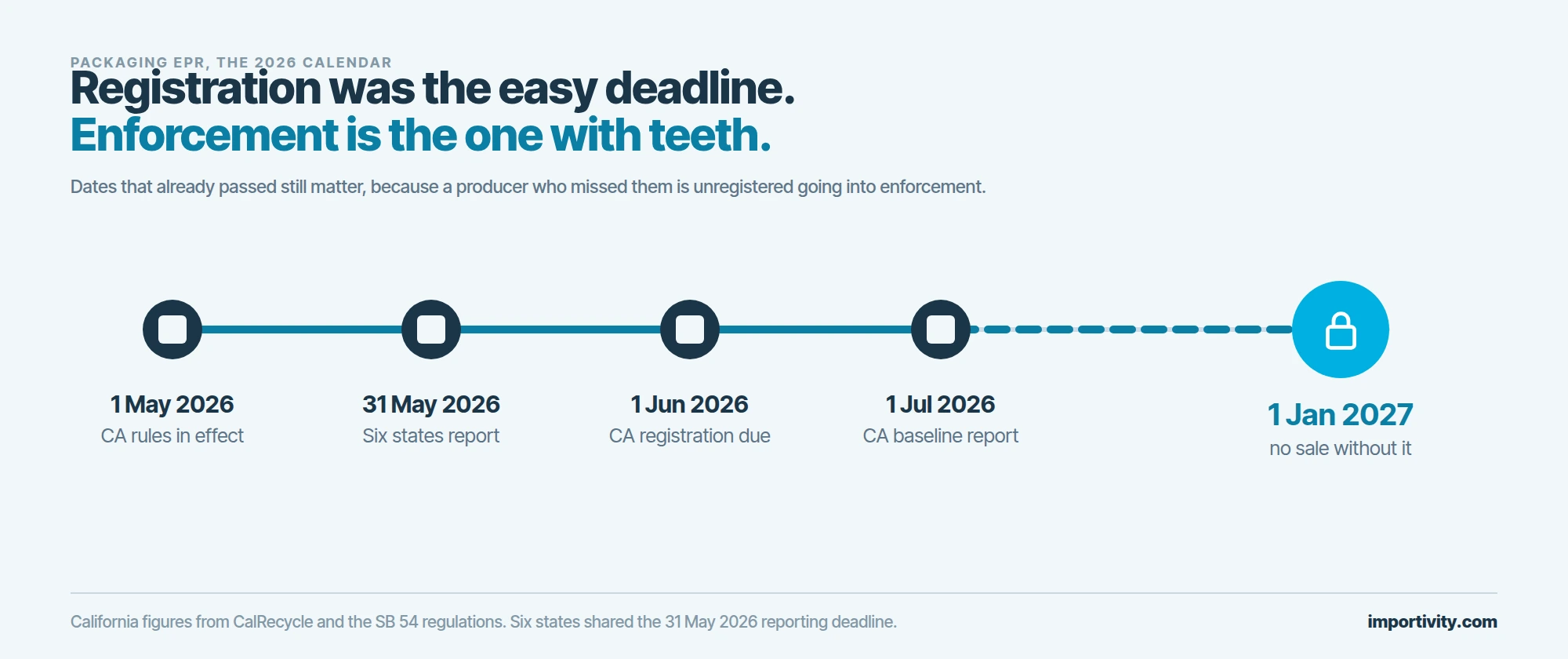
California is the largest programme. Its SB 54 regulations took effect on 1 May 2026, with a producer registration deadline of 1 June 2026 through one of three routes: joining the Circular Action Alliance as a producer responsibility organisation member and submitting supply data, registering directly with CalRecycle as an independent producer, or claiming the small producer exemption for businesses under one million dollars in California gross sales in the prior year. A baseline producer report using 2023 data was due on 1 July 2026, and full enforcement, meaning no sale of covered materials in California without registration or PRO participation, begins on 1 January 2027. CalRecycle estimates more than 5,700 producers are in scope.
California is not alone. Six states shared a reporting deadline of 31 May 2026, according to the printing industry association's summary: Oregon and Colorado required detailed annual supply reports at component level using 2025 data, California required baseline, annual supply and source reduction reports, and Minnesota, Maryland and Washington required simplified supply reports of aggregated material weight. Maine also has a producer registration obligation falling in 2026, and we could not confirm the exact date, so check with Maine DEP directly rather than relying on a compliance vendor's summary.
The practical consequence for supplier selection is that you now need material weight and composition data per SKU, broken out by component. A packaging manufacturer that cannot give you the grammage, the material class and the recycled content of every component in a bill of materials is making your reporting obligation harder every quarter. Ask for that data as a deliverable of the quote, not as a favour afterwards.
Food Contact, Heavy Metals and Green Claims
Three more rules bite before the first pallet ships, and one of them is a genuine trap when you change supplier.
If the packaging touches food, any new food contact substance in it, meaning a coating, adhesive, ink component or resin additive, must go through FDA's food contact notification process before use, and adhesives and coatings are regulated as indirect food additives under 21 CFR Part 175. The trap is that a notification is effective for the specific manufacturer named in it. It does not travel with the design. Moving the same food packaging to an equivalent factory overseas can require a fresh notification, which is a lead time nobody budgets for.
On materials, the model Toxics in Packaging legislation, maintained by the Toxics in Packaging Clearinghouse, caps the combined concentration of lead, cadmium, mercury and hexavalent chromium at 100 parts per million by weight in packaging and packaging components, with no tolerance for intentional use. Nineteen states have adopted laws based on that model, New Hampshire being the outlier at 200 parts per million. Compliance runs on certificates of compliance issued by the supplier, so make the certificate a condition of the purchase order. Separately, California's Proposition 65 is an exposure law rather than a content law, covering more than 800 listed chemicals, and it reaches manufacturers, packagers, importers, distributors and retailers, including companies outside California selling into it.
On claims, the FTC's Green Guides revision covering recyclability and recycled content has been under review since late 2022 and, as of early 2026, had still not been issued. State truth in labelling rules are filling the gap in the meantime. The safe position is to make specific, substantiated claims about a named material rather than general ones about the package, and to hold the supplier documentation that supports each claim.
The Freight Arithmetic on Importing Packaging
Packaging is bulky and cheap, which inverts the usual import calculation. A container fills up on volume long before it reaches its weight limit, so the question is not what a box costs in China but what a cubic metre of empty boxes costs to bring across an ocean.
Commonly cited freight figures put a 20 foot container at around 33 cubic metres of theoretical capacity and a 40 foot at around 67, with a 40 foot high cube nearer 76, and practical loading at roughly 80 to 90 percent of those numbers once pallets and access are accounted for. Flat packed corrugated ships reasonably well against that constraint. Rigid boxes, molded pulp and anything pre assembled ships terribly, because you are paying ocean freight for air.
Domestic supply also looks better than it did on price alone. North American containerboard producers announced closures during 2025 amounting to nearly 10 percent of production capacity, completing in the first quarter of 2026, with Q1 2026 production down 8 percent year on year and prices up roughly 100 dollars a ton across two rounds of increases in the first half of 2026, according to Packaging Dive. That is a supply led increase rather than a demand led one, which means it is unlikely to unwind quickly, and it narrows the gap between an imported box and a domestic one once freight is in the model. Run it properly with the landed cost calculator rather than comparing unit prices, and see our guide to FCL and LCL shipping if your volumes do not fill a box.
How to Run the Sourcing Process
Work in this order and the quotes you get back will be comparable.
- Fix the product dimensions before the packaging brief. Then design the smallest protective box, and check what it does to billable weight at your carrier's divisor.
- Quote the same dieline to every supplier. Same board grade, same color count, same finish, same quantity breaks at three volumes.
- Ask for tooling cost separately from unit price. A low unit price with a buried plate charge is not a low quote.
- Require material data per component. Weight, material class and recycled content, in a format you can file for EPR reporting.
- Require a certificate of compliance on heavy metals. Make it a purchase order condition rather than a request.
- Ask about food contact notification coverage by name. If the packaging touches food, confirm the notification names the factory that will actually run your job.
- Get a produced sample, not a digital proof. Color on screen is not color on board, and structural performance is only testable on the real substrate.
Then vet the supplier the way you would any other manufacturer, because a packaging plant is a factory with the same failure modes as any other. Our factory audit checklist applies, our packaging service covers the sourcing itself, and import product compliance covers what has to travel with the goods. We film the packaging plants we qualify the same way we film any other factory, and those walkthroughs go out through Source With Jordan.
Frequently Asked Questions
How does box size affect my shipping cost?
Carriers bill on the greater of actual and dimensional weight, and dimensional weight is length times width times height divided by a divisor. A smaller divisor raises the billable weight for the same box. Per shipping industry reporting, UPS and FedEx moved to a divisor of 139 for daily rates in August 2025, and USPS cuts from 166 to 139 on 12 July 2026. On a 12 inch cube that shifts billable weight from 11 pounds to 13.
What is the MOQ for custom packaging?
It depends heavily on format and print method. Suppliers commonly quote one to three thousand units for custom printed folding cartons, around 500 for rigid boxes, and 8,000 or more for flexible pouches. Digital printing breaks even somewhere around 500 to 1,000 units with no plates to amortise, while offset commonly needs 3,000 to 5,000. These are quoted market ranges rather than audited data, so get written quotations.
Do I have to register my packaging under EPR laws?
If you sell into a state with a packaging EPR programme, probably yes. California's SB 54 required producer registration by 1 June 2026 and begins full enforcement on 1 January 2027, with CalRecycle estimating more than 5,700 producers in scope. Oregon, Colorado, Minnesota, Maryland and Washington shared a 31 May 2026 reporting deadline, and Maine has its own 2026 registration obligation. Small producers below defined sales thresholds may be exempt.
Can I move food packaging to a different factory without refiling with FDA?
Often not, and this catches brands out. An FDA food contact substance notification is effective only for the specific manufacturer named in it, so it does not transfer to another factory producing an equivalent design. Changing supplier for food contact packaging can require a fresh notification, which adds lead time nobody budgets for. Confirm the notification names the factory that will actually run your job.
Is it cheaper to import packaging or buy domestically?
Less clearly than it used to be. Packaging is bulky and cheap, so a container fills on volume rather than weight and you are effectively paying ocean freight for air, especially on rigid or pre assembled formats. Meanwhile North American containerboard capacity closures in 2025 pushed prices up about 100 dollars a ton in the first half of 2026. Compare landed cost per unit rather than factory unit price.
About the author
Jordan Lewis
Chief Operating Officer, Importivity
Runs Importivity's sourcing operations across China, Vietnam, Mexico and India, from supplier negotiation through landed delivery.
Press and media inquiries: press@importivity.com