How to Source Sheet Metal Parts Without Overpaying
Sheet metal fabrication turns flat metal sheet into finished parts by cutting, forming, and joining it, and it is one of the most cost effective ways to make brackets, enclosures, frames, chassis, and housings at almost any volume. If your product has a metal body or a structural component that is not solid or round, there is a good chance it starts life as a flat sheet. It is a core capability inside how we run product sourcing for hardware clients.
This guide explains what sheet metal fabrication includes, the core processes behind it, the materials and gauges you will choose from, what actually drives the price of a part, and how to design and source parts without paying for avoidable cost. It is written for founders, engineers, and product teams deciding how to make a metal part and where to have it built.
Material picker
Which sheet metal should you spec?
Match your priority to the right material:
What Is Sheet Metal Fabrication?
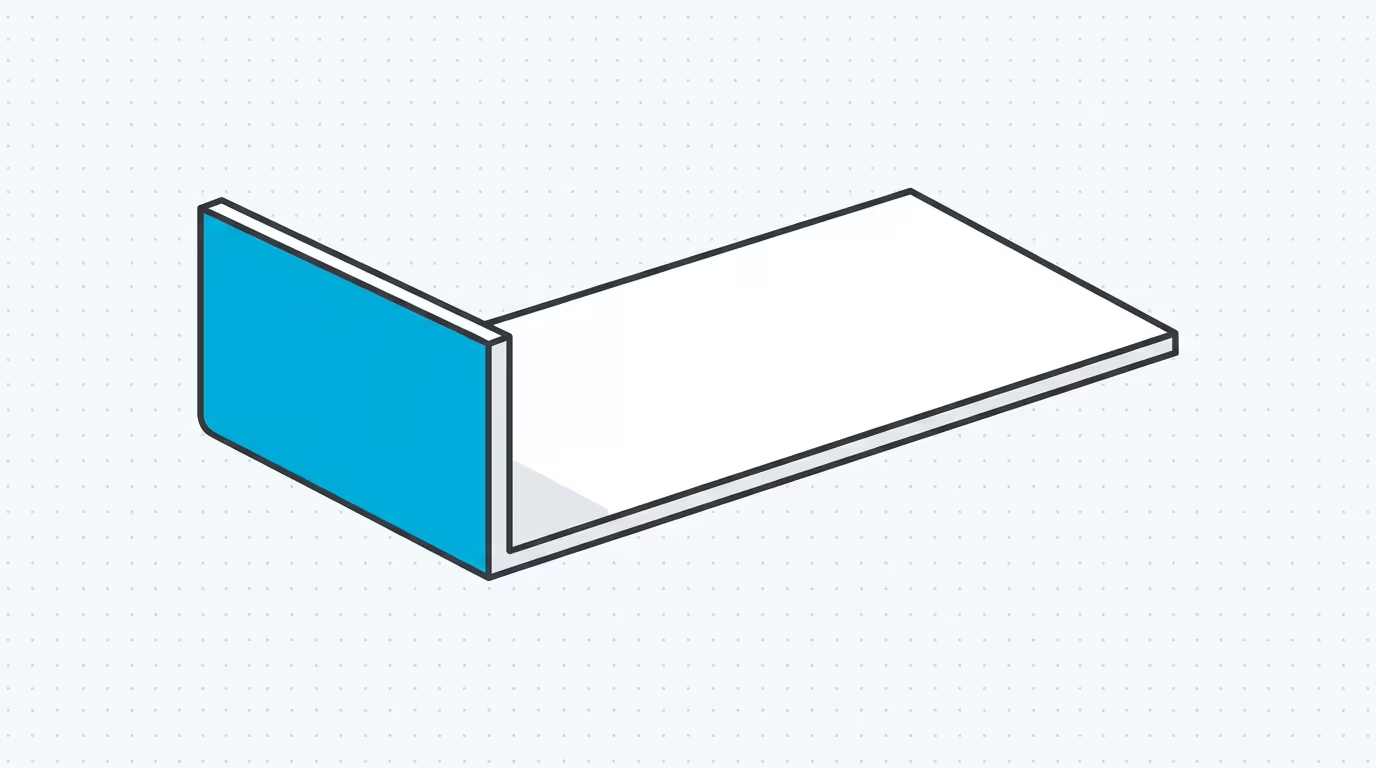
Sheet metal fabrication is the process of converting flat rolled metal into a three dimensional part through cutting, forming, and joining. Sheet stock usually runs from about 0.006 inch up to roughly 0.25 inch thick. Anything thicker is generally called plate and is handled differently. The defining trait of a sheet metal part is constant wall thickness: the material starts as one flat sheet, so the finished part keeps the same thickness everywhere it is bent or cut.
That single constraint is what makes the process so affordable. Instead of cutting away solid stock like CNC machined metal parts, or filling a mold like die casting, you take material you have already paid for and simply reshape it. Waste is low, tooling is often minimal, and the same equipment can make one prototype or ten thousand production units.
The Core Sheet Metal Processes
Almost every fabricated part is built from four families of operations. A simple bracket may use only two of them, while a welded enclosure with a finish uses all four.
- Cutting. Flat blanks are cut from the sheet by laser, plasma, or waterjet. Laser is the workhorse for thin to medium steel and stainless and gives clean, tight edges. Plasma cuts thicker conductive metal faster but with a rougher edge. Waterjet cuts almost any material cold, which matters for aluminum and heat sensitive alloys because it adds no heat affected zone.
- Forming. Flat blanks become three dimensional through press-brake bending, where a punch presses the sheet into a die to create each bend, and through stamping or punching, which pushes shaped tools through the metal to make holes, louvers, or repeated features in one stroke.
- Joining. Parts are assembled by welding, most often MIG for speed and strength, TIG for precise or thin work and clean cosmetic seams, and spot welding for fast tack joints on overlapping sheet. Riveting and pressed-in hardware such as self clinching nuts and standoffs add fasteners without any welding at all.
- Finishing. The last step protects and dresses the part. Powder coating adds a durable colored layer, anodizing hardens and colors aluminum, plating deposits zinc or nickel for corrosion protection, and passivation cleans stainless steel so its natural corrosion resistance performs as intended.
Common Materials and Gauges
Three metals cover the large majority of fabricated parts: mild or cold-rolled steel, stainless steel, and aluminum. The right choice is a trade between cost, weight, and how the part will survive its environment. The table below compares them at a glance.
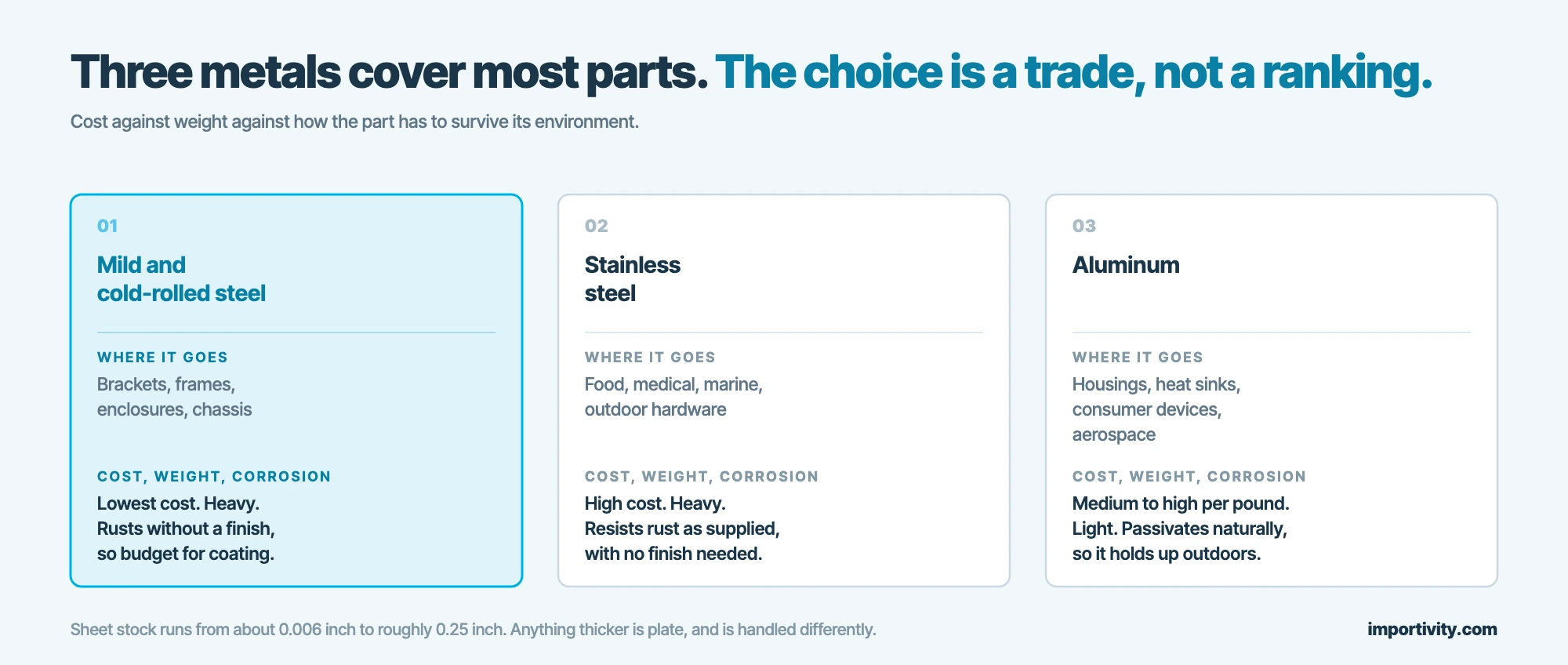
| Material | Typical use | Corrosion resistance | Relative cost | Weight |
|---|---|---|---|---|
| Mild / cold-rolled steel | Brackets, frames, enclosures, chassis | Low, rusts without a finish | Lowest | Heavy |
| Stainless steel | Food, medical, marine, outdoor hardware | High, resists rust as supplied | High | Heavy |
| Aluminum | Housings, heat sinks, consumer devices, aerospace | Good, naturally passivates | Medium to high per pound | Light |
Mild and cold-rolled steel is the cheapest option and strong, but it will rust if you leave it bare, so it almost always needs powder coating or plating. Stainless resists corrosion straight out of the mill at a higher material cost. Aluminum is roughly one third the weight of steel and resists corrosion on its own, though it costs more per pound and can be trickier to weld.
Thickness is specified by gauge, and the counterintuitive rule is that a higher gauge number means thinner metal. For steel, 20 gauge is about 0.036 inch, 16 gauge is about 0.060 inch, and 12 gauge is about 0.105 inch. Aluminum and stainless use their own gauge tables, so always confirm the actual thickness in inches or millimeters rather than trusting the gauge number alone. Most electronics enclosures and light brackets live in the 18 to 14 gauge range.
What Drives the Cost of a Sheet Metal Part
The price you pay is rarely dominated by the raw metal. Material matters, but the labor and machine time spent bending, welding, and finishing usually add up to more than the sheet itself. The chart below shows a typical split for a mid complexity fabricated part such as a welded enclosure.
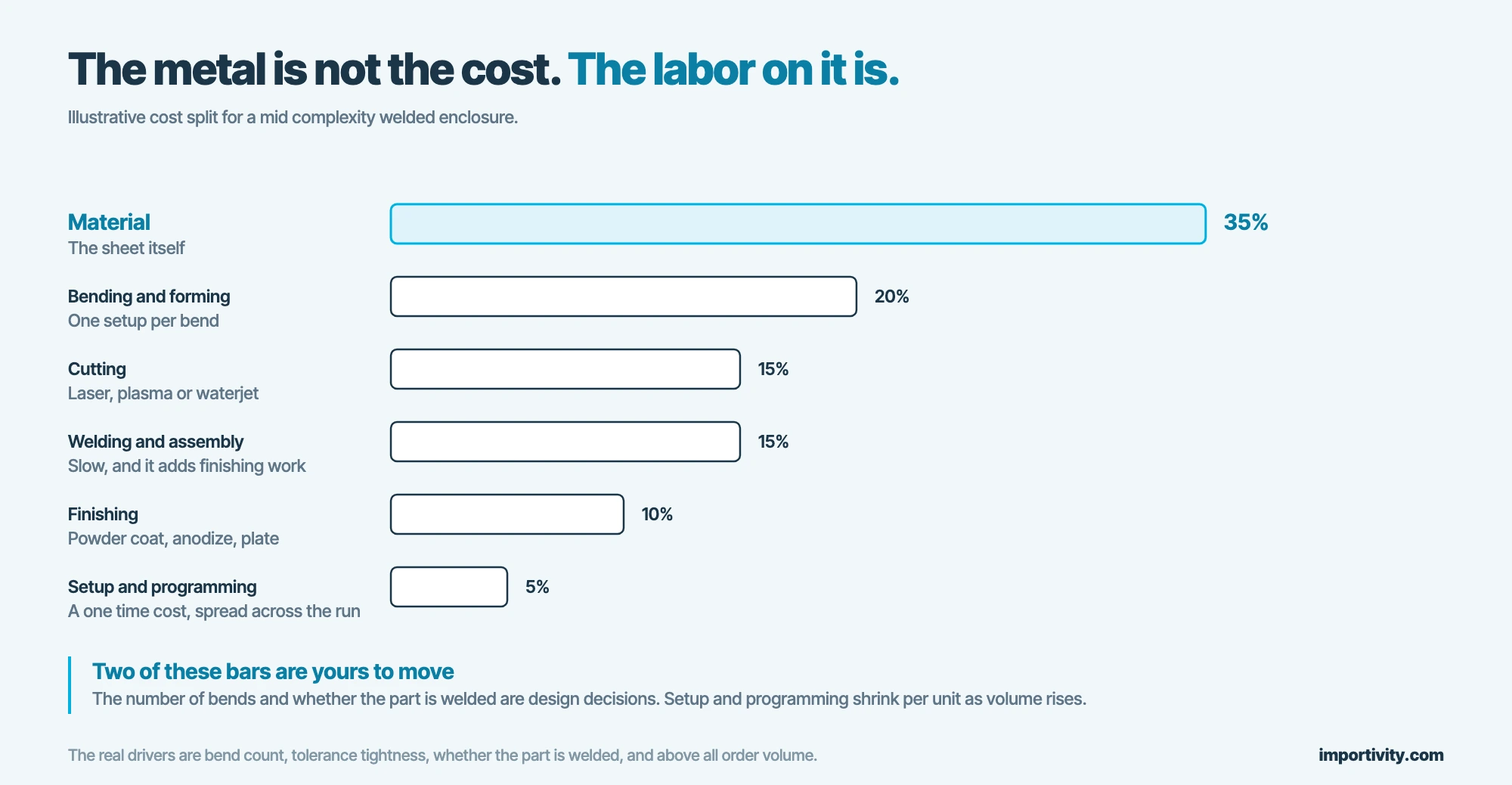
Illustrative cost split for a mid complexity welded part. The real drivers behind these bars are the number of bends, how tight your tolerances are, whether the part is welded, and above all your order volume, since setup and programming are one time costs spread across every unit.
Two levers move the total the most. The first is volume: setup and programming are fixed costs, so a run of 1,000 parts spreads them thin while a run of 10 makes them dominate the unit price. The second is complexity: every added bend, tight tolerance, weld seam, and finishing step adds labor. To turn a factory quote into a real number, run a full landed cost calculation that includes freight and duty, not just the part price.
Design Tips That Cut Cost
Most of a part's cost is locked in at the design stage. A few decisions on the drawing can shave real money off every unit without weakening the part. Work through this checklist before you release drawings for quote.
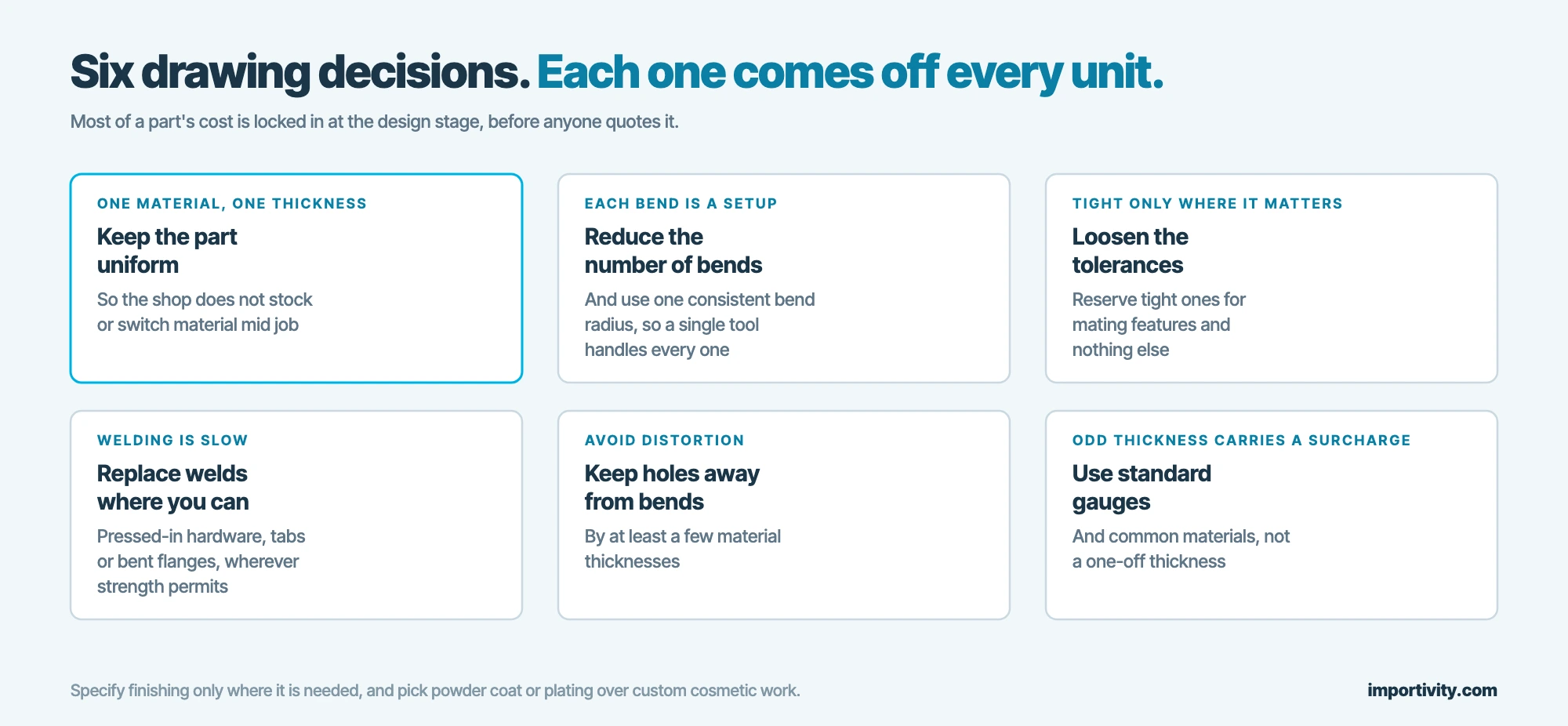
- Keep the whole part in one uniform thickness so the shop does not stock or switch material mid job.
- Reduce the number of bends, since each bend is a separate setup and a chance for error.
- Use a single consistent bend radius across the part so one tool handles every bend.
- Loosen tolerances anywhere the function allows, and reserve tight tolerances only for mating features.
- Replace welds with pressed-in hardware, tabs, or bent flanges wherever strength permits, because welding is slow and adds finishing work.
- Keep holes and bends away from each other by at least a few material thicknesses to avoid distortion.
- Choose standard sheet gauges and common materials rather than an odd thickness that carries a surcharge.
- Specify finishing only where it is needed, and pick powder coat or plating instead of custom cosmetic work when appearance is not critical.
- Design for nesting so parts pack efficiently on the sheet and cut scrap.
How to Source Sheet Metal Fabrication
Once the design is stable, where you build it comes down to volume, speed, labor cost, and how sensitive your intellectual property is. Overseas fabrication in China or Mexico rewards higher volume and lower labor rates, while domestic US shops win on speed and control. Each has a clear sweet spot.
- China. Best for higher volume orders where the labor and tooling savings outweigh longer transit times. You get deep capacity and low unit pricing, but you carry weeks of lead time and need real supplier vetting.
- Mexico. A strong middle option for North American brands, combining lower labor cost than the US with shorter freight and easier time zone overlap. It suits steady mid volume production that still needs reasonably fast replenishment.
- United States. Best for fast turnaround, lower volume runs, prototypes, and work where tight IP control or on site collaboration matters. Unit prices are higher, but you save days or weeks and keep the supply chain close.
Wherever you build, vet the shop the same way. Confirm it runs the processes your part needs in house, ask for material certifications on the metal, request a first article inspection before full production, and run a factory audit for any meaningful order. If your product also uses extruded or machined components, coordinate those alongside the fabrication so tolerances match, and see our guides to aluminum extrusion sourcing and CNC machined parts.
For a worked example running from a drawing to a first article, see our 420seven prototyping case study, and Source With Jordan for the sourcing behind it.
Frequently Asked Questions
What is sheet metal fabrication?
Sheet metal fabrication is the process of turning flat metal sheet into a finished part by cutting, forming, and joining it. The sheet is cut into blanks, bent or stamped into shape, and then welded or fastened together, often with a protective finish added at the end. Because it reshapes flat stock rather than cutting away solid material, it is a low waste and cost effective way to make brackets, enclosures, and frames.
What are the main sheet metal cutting methods?
The three most common are laser, plasma, and waterjet. Laser cutting is the workhorse for thin to medium steel and stainless and gives clean, precise edges. Plasma cuts thicker conductive metal faster but leaves a rougher edge. Waterjet cuts almost any material cold, which avoids a heat affected zone and suits aluminum and heat sensitive alloys.
Does a higher gauge number mean thicker metal?
No. Gauge measures thickness, and a higher gauge number means thinner metal. For steel, 20 gauge is about 0.036 inch while 12 gauge is about 0.105 inch, so the smaller number is thicker. Aluminum and stainless use different gauge tables, so always confirm the actual thickness in inches or millimeters.
Which metal should I choose for a fabricated part?
Mild or cold-rolled steel is cheapest and strong but rusts unless it is finished, so it needs powder coating or plating. Stainless steel resists corrosion straight from the mill at a higher cost and suits food, medical, marine, and outdoor use. Aluminum is light and naturally corrosion resistant but costs more per pound, making it a good fit for housings, heat sinks, and portable devices.
Should I source sheet metal parts overseas or in the US?
It depends on volume, speed, and IP sensitivity. Overseas fabrication in China or Mexico suits higher volume orders where lower labor cost outweighs longer lead times. Domestic US shops suit fast turnaround, lower volume runs, prototypes, and work where tight intellectual property control matters. Many brands prototype in the US and move volume production offshore once the design is locked.
About the author
Jordan Lewis
Chief Operating Officer, Importivity
Runs Importivity's sourcing operations across China, Vietnam, Mexico and India, from supplier negotiation through landed delivery.
Press and media inquiries: press@importivity.com