How to Source CNC-Machined Metal Parts Overseas: A Buyer’s Guide

CNC machining sourcing from overseas suppliers can cut your per-part cost by 40–70% compared to domestic shops, but only if you go in with accurate drawings, realistic tolerance expectations, and a supplier who can actually hold them. In short, CNC is the right process for low-to-mid volume metal parts with tight tolerances or complex geometry. Get the file package right, verify the supplier's equipment, and the cost savings are real. Otherwise, you'll spend the savings on rework, rejected shipments, and reorders.
This guide covers the whole sourcing path, from understanding what CNC actually involves, to the cost drivers you can control, to what your quality inspection should look like before parts leave the factory. It's aimed at U.S. brand owners and product teams sourcing metal components abroad for the first time or trying to fix a process that's gone sideways.
One honest caveat upfront: CNC is not always the right answer. For example, if you're running 50,000 identical units a year with no tight tolerances, casting or die-casting will almost certainly be cheaper. The process selection decision comes first, everything else follows from it.
What CNC Machining Actually Is
CNC (Computer Numerical Control) machining is a subtractive process, you start with a solid block of material and a machine cuts away everything that isn't your part. That's the key distinction from casting or injection molding, which are additive or forming processes. Because you're cutting to final shape rather than flowing material into a mold, you can achieve dimensional tolerances that casting simply can't match: ±0.005 inches as a standard working tolerance, ±0.001 inches or tighter with the right setup.
Milling vs. turning
The two primary CNC processes you'll encounter are milling and turning. Milling uses rotating cutting tools on a stationary (or indexed) workpiece to produce prismatic shapes, brackets, housings, plates, pockets, and complex 3D contours. Turning (also called CNC lathe work) rotates the workpiece against a stationary cutting tool; it's the right process for cylindrical parts, shafts, bushings, threaded connectors, and anything with a round cross-section. Many parts require both: a shaft with a milled keyway, for instance, goes on a lathe first, then a mill.
3-axis, 4-axis, and 5-axis
- 3-axis: The tool moves in X, Y, and Z. Works for the majority of prismatic parts. Standard equipment at most Chinese and Taiwanese shops. Lowest cost.
- 4-axis: Adds rotation around one axis (usually A). Useful for parts that need features on multiple sides without manual re-fixturing, reduces setup time and improves repeatability.
- 5-axis: Full simultaneous movement in five axes. Required for complex aerospace or medical geometry, undercuts, and compound-angle features. Equipment is expensive; fewer overseas shops have it; per-part cost is meaningfully higher.
For most imported hardware, enclosures, brackets, adapters, structural components, 3-axis is sufficient. However, if your design requires 5-axis, verify the supplier actually has simultaneous 5-axis (not just 3+2 indexed), and ask for a recent sample or inspection report from a comparable part.
When CNC Beats Casting and Molding
Process selection is a cost and quality tradeoff, not a preference. Here's the honest breakdown:
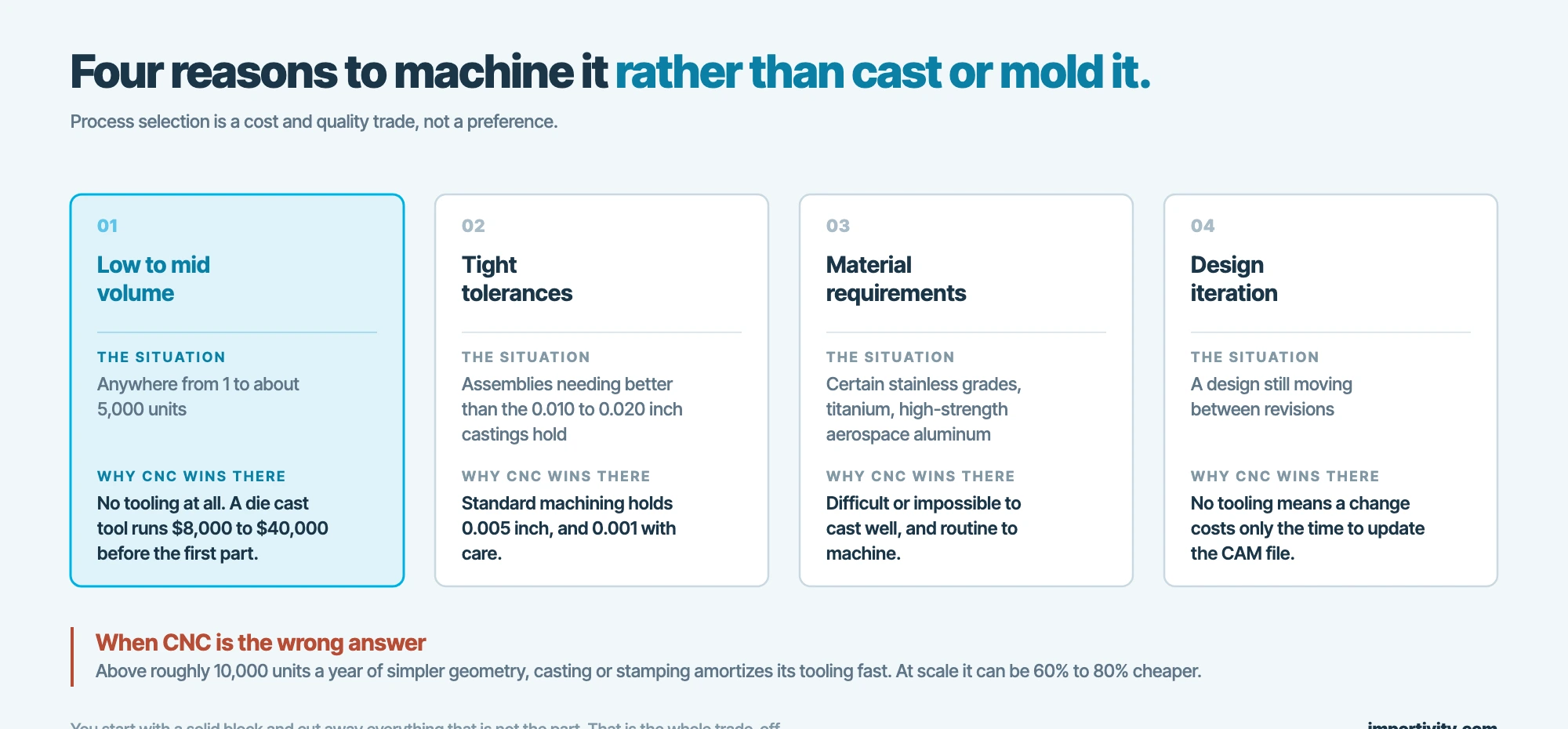
- Low-to-mid volume (1 – ~5,000 units): CNC has no tooling cost. Die casting requires a steel tool that runs $8,000–$40,000 before you make a single part. At low volumes, CNC wins on total landed cost even though per-part cost is higher.
- Tight tolerances: Cast parts typically hold ±0.010–0.020 inches on critical dimensions without secondary machining. If your assembly requires ±0.003 inches or tighter, you're either CNC machining or you're adding a secondary machining step to a casting, at which point you may as well start with CNC.
- Material requirements: Some alloys (certain grades of stainless steel, titanium, high-strength aerospace aluminum) are difficult or impossible to die-cast. CNC handles them cleanly.
- Design iteration: No tooling means design changes cost nothing except the programmer's time to update the CAM file. This makes CNC the default choice for prototypes and pre-production validation runs.
When CNC is NOT the right choice: High-volume production (10,000+ units/year) of simpler geometry, where casting or stamping amortizes the tooling cost quickly. In addition, parts where structural porosity is acceptable and dimensional precision is loose, investment casting or sand casting may be 60–80% cheaper at scale.
Cost Drivers, and What You Can Control
Overseas CNC quotes for the same part can vary 3x between suppliers. Understanding what drives the price lets you make intelligent design and sourcing decisions, not just chase the lowest number.
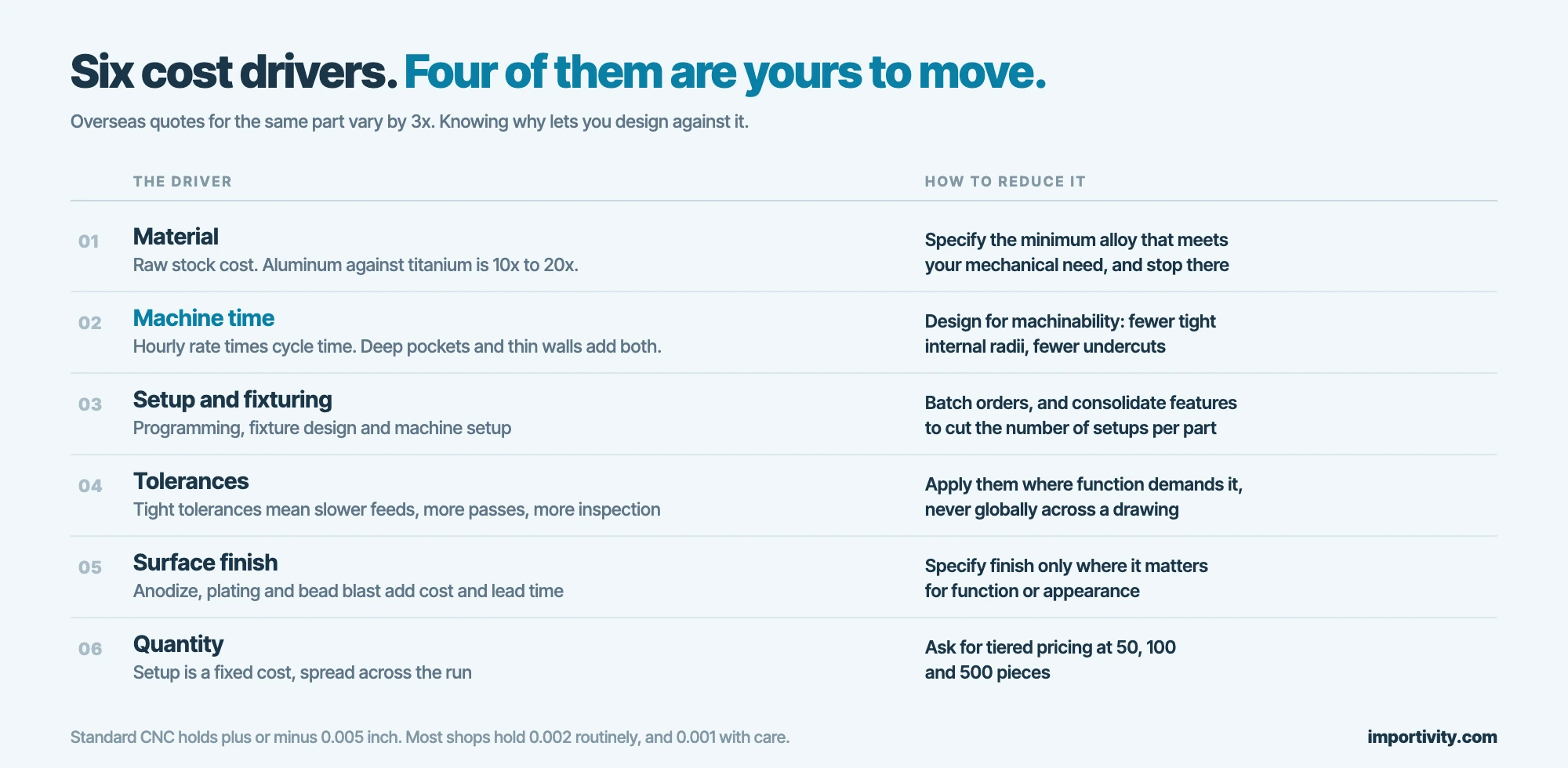
| Cost Driver | What It Is | How to Reduce It |
|---|---|---|
| Material | Raw stock cost; varies greatly by alloy (aluminum vs. titanium is 10–20x) | Specify the minimum alloy that meets your mechanical needs, don't over-engineer |
| Machine time | Hourly rate × cycle time; complex geometry, deep pockets, and thin walls add time | Design for machinability, minimize tight internal radii, unnecessary deep pockets, and undercuts |
| Setup and fixturing | Programming, fixturing design, and machine setup; amortized over the run quantity | Batch orders; consolidate features to reduce the number of setups per part |
| Tolerances | Tight tolerances require slower feeds, more passes, and inspection steps | Apply tight tolerances only where function demands it, not globally on a drawing |
| Surface finish | Post-machining treatments (anodize, plating, bead blast) add cost and lead time | Specify finish only on surfaces where it matters for function or appearance |
| Quantity | Setup is fixed cost; higher quantities spread it across more parts | Order in larger batches if inventory carrying cost allows; ask for tiered pricing at 50 / 100 / 500 pcs |
The single biggest lever buyers miss: tolerances. A drawing that calls out ±0.001 inches across all dimensions, when only two critical bores actually need it, can double the quote versus a drawing with selective tolerancing. As a result, you should audit your drawings before you send them out.
Common Materials and What They Cost You
For metal CNC manufacturing overseas, the dominant alloys you'll encounter are:
Aluminum 6061-T6
The workhorse. Easy to machine, it offers an excellent strength-to-weight ratio and takes anodizing well. Most Chinese shops know it cold. Expect raw material costs around $2–4/lb. It works well for enclosures, structural brackets, heat sinks, and consumer hardware. If your part is aluminum and doesn't have extreme stress needs, 6061-T6 is usually the right call.
Mild steel (1018, 1045)
Inexpensive, strong, and easy to weld. Use it for structural components, fixtures, and any part where weight isn't a concern. Surface rusts without a finish, so factor in zinc plating, black oxide, or powder coat. Shops in China machine carbon steel constantly; quality is generally consistent.
Stainless steel (303, 304, 316)
Corrosion resistant and harder to machine than aluminum or mild steel. 303 is free-machining and the easiest to quote competitively. 316 is necessary for marine or harsh chemical environments but costs 20–30% more to machine due to work-hardening. Verify your supplier has experience with stainless, it's not forgiving of poor tooling or speeds.
Brass (C360)
Excellent machinability, faster cycle times than steel, which partially offsets the higher material cost. Common for fittings, electrical connectors, valve bodies, and decorative hardware. It also takes plating (nickel, chrome) well.
Titanium (Grade 2, Grade 5/Ti-6Al-4V)
Strong, lightweight, biocompatible, and corrosion-resistant. It is also expensive to machine, slow feeds, specialized tooling, high scrap rate if the shop isn't set up for it. Don't source titanium parts from a generalist shop with a low quote. Instead, expect overseas pricing at 4–8x equivalent aluminum parts.
Tolerances, GD&T, and Why Your Drawing Is the Specification
The drawing you send is the contract. If your drawing is vague, you'll receive parts that meet the drawing, not the part you imagined. For overseas metals sourcing, this matters more than it does domestically, because you can't walk the floor to clarify ambiguities.
Tolerance basics
Standard CNC machining holds ±0.005 inches (0.127 mm) as a general working tolerance. Most competent shops can hold ±0.002 inches routinely, and ±0.001 inches with care. Below that, you're in precision grinding territory, a different process, with different suppliers and higher cost. Specify your tolerances on the drawing, not in an email. Otherwise, most overseas suppliers will apply their own general tolerance block, which may or may not match your functional needs.
GD&T
Geometric Dimensioning and Tolerancing (GD&T) per ASME Y14.5 is the standard for communicating form, orientation, and positional needs, things like flatness of a mounting surface, perpendicularity of a bore, or true position of a bolt circle. If your parts have assembly-critical features, GD&T is worth the upfront investment in the drawing. It removes ambiguity and gives your QC inspector a clear pass/fail criterion.
Practical note: Not every overseas shop has engineers fluent in ASME Y14.5. Send a 2D drawing (PDF) plus a STEP file. The STEP file lets the shop's CAM programmer work from the 3D geometry; the 2D drawing conveys tolerances, surface finish callouts, material, and notes. Never rely on the STEP file alone, it carries no tolerance information.
Surface Finishes
As-machined aluminum has visible tool marks and no corrosion protection. For most applications, you'll need a surface finish, either for appearance, function, or both.
- Bead blast (as-machined + blast): Removes tool marks, produces a uniform matte texture. It offers no corrosion protection on its own. Common pre-treatment before anodizing. Adds $0.50–$2 per part for small components.
- Anodize Type II (clear or color): Electrochemical conversion coating for aluminum. Improves corrosion resistance, adds a thin hard layer (0.0002–0.001 inches), accepts dye colors. Type II is standard; Type III (hard coat) is thicker and more wear-resistant, used for moving surfaces or high-wear applications. Hard coat can affect critical dimensions, account for the build-up in your tolerances.
- Electroless nickel plating: Uniform coating thickness (even in bores and recesses), good corrosion resistance, mild hardness increase. Works on steel, aluminum, and brass. Used for functional surfaces requiring close tolerances, since plating thickness is controllable.
- Zinc plating / chromate conversion: Low-cost corrosion protection for steel. Bright zinc is the most common. Not appropriate for high-stress or high-temperature applications.
- Passivation: For stainless steel, removes free iron from the surface via acid bath, improving corrosion resistance. It's not a coating; it doesn't change dimensions or appearance. Required for most medical and food-contact applications.
From Prototype to Production: The Sourcing Path
The single most expensive mistake in overseas CNC sourcing is skipping the rapid prototyping stage and ordering production quantities before you've validated the part. The path looks like this:
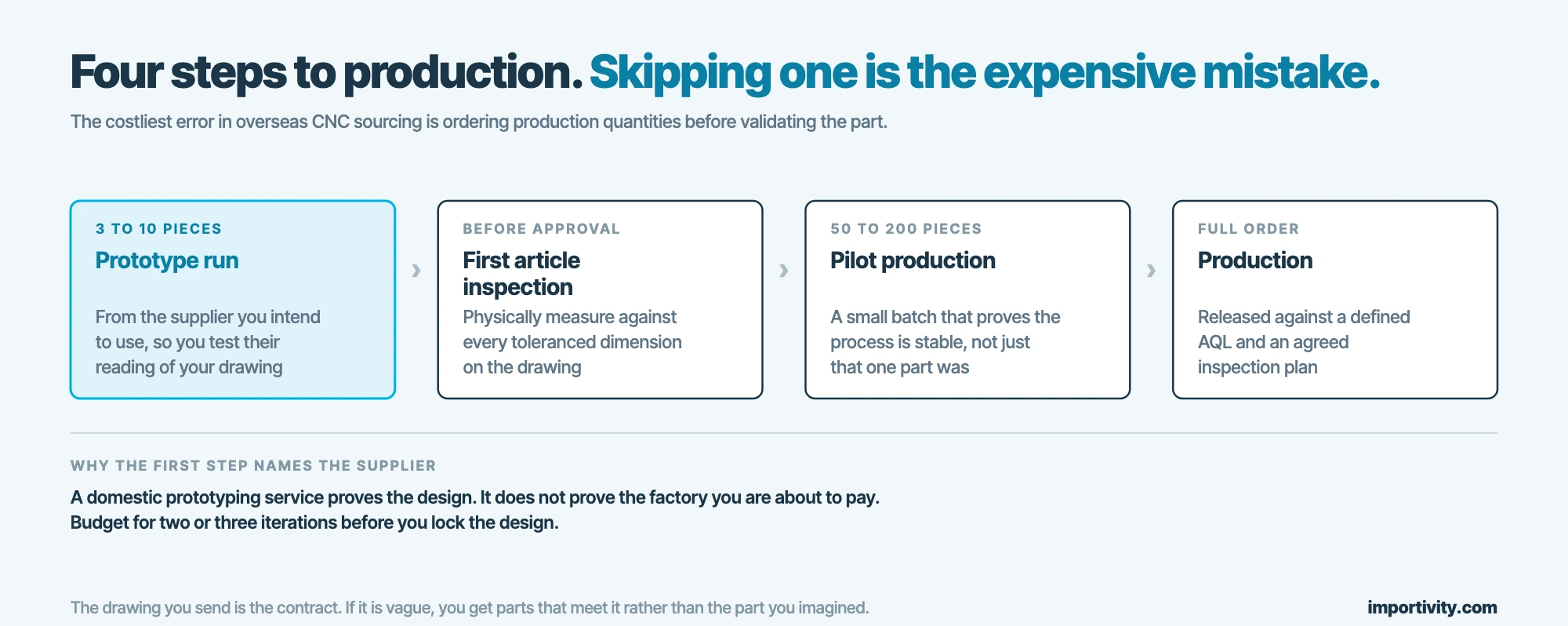
- Prototype run (3–10 pieces): First article from your intended overseas supplier, not a domestic prototyping service. You're testing their capability and their interpretation of your drawing, not just the design. Budget for two or three iterations before locking the design.
- First article inspection (FAI): Before approving a production run, physically measure the prototype against every toleranced dimension on your drawing. Use calipers for loose tolerances; a CMM (Coordinate Measuring Machine) report for critical features. A CMM report from the supplier is useful; an independent CMM report from a third-party lab is better.
- Pilot production (50–200 pieces): Run a small batch before committing to the full order. This step validates that the process is stable, that the supplier can hold tolerances consistently across a run, not just on the carefully produced prototype.
- Production: Once pilot parts pass inspection, release the full order with a defined acceptance quality level (AQL) and an agreed inspection plan, either inline at the factory or pre-shipment by a third party.
Overseas CNC suppliers will often quote a prototype and a production run on the same inquiry, and the prototype may look fine because they made it by hand or with extra care. The risk isn't the prototype; it's whether the production process is repeatable at volume. Always run a pilot batch before scaling.
CMM and first article inspection
A Coordinate Measuring Machine (CMM) is a precision measuring device that probes a part's surface and records X/Y/Z coordinates to verify geometry against a CAD model or drawing. For production-critical parts, request a CMM report (also called a First Article Inspection Report or FAIR) on the first approved samples. It should map every critical dimension with actual measured values, tolerances, and pass/fail status. Reputable CNC suppliers in China and Taiwan have CMMs in-house; if a supplier can't provide a CMM report, that's a signal about their quality infrastructure.
For manufacturer sourcing in general, the ability to produce a proper FAIR is a useful filter. It shows a supplier who understands paperwork needs, which matters when something goes wrong later.
For a worked example running from a drawing to a first article, see our 420seven prototyping case study, and Source With Jordan for the sourcing behind it.
Frequently Asked Questions
What file formats do I need to provide to a CNC supplier?
At minimum: a STEP file (.stp or .step) for the 3D geometry, and a PDF 2D drawing with tolerances, material callout, surface finish specs, and any general notes. The STEP file is used for CAM programming; the 2D drawing is the legal specification the supplier is held to. Never send only a STEP file, it carries no tolerance information. If you have special needs (thread specs, GD&T callouts, specific hardware inserts), all of this lives on the 2D drawing. DXF files are acceptable for 2D parts like laser-cut profiles, but STEP plus PDF is the standard for 3D machined parts.
What's a realistic lead time for overseas CNC parts?
For a standard prototype run (5–20 pieces, no exotic material, no complex post-processing): 7–15 business days production plus 3–5 days shipping by air. For a pilot or production batch (100–500 pieces): 15–25 business days production. Surface finishes like anodizing or plating add 3–7 days. Sea freight from China is 25–35 days in transit; air freight is 3–5 days. Factor in customs clearance (typically 1–3 business days for cleared importers). First-time orders often run longer than subsequent orders because the supplier is programming the part from scratch, re-orders are faster.
How do I evaluate whether an overseas CNC supplier can hold my tolerances?
Ask three things: What CNC equipment do they run (brand, age, and axis count)? Do they have CMM measurement capability in-house? Can they provide a first article inspection report with actual measured values? Beyond equipment, ask for a sample or recent FAIR from a part with similar tolerances to yours. A supplier who can't show you this evidence either doesn't have the capability or doesn't have the documentation culture, both are problems. Tight tolerances (±0.001 inches) also require temperature-controlled machining environments; ask if their CMM room and finishing area are climate controlled.
When does it make more sense to cast a part than to CNC it?
When your volumes are high enough to amortize tooling, typically 5,000+ units per year for die casting, lower for investment casting, and your geometry doesn't require tight tolerances on most surfaces, casting delivers much lower per-part cost. A die cast aluminum housing might cost $0.80/piece at 20,000 units; the same part CNC machined might be $8–12/piece. The crossover point depends on part complexity, material, and order volume. The practical test: get a CNC quote and a casting quote for the same part, calculate total cost including tooling over your expected annual volume, and let the math decide. Don't assume CNC is cheaper just because it has no upfront tooling cost.
What should I do if production parts fail inspection?
Before any production run, your purchase order should define acceptance criteria, inspection method, and the remediation process for rejected parts, specifically whether the supplier reworks or replaces at their cost, and who pays return freight. If parts fail inspection after arrival, document every defect with photos and measurement data, submit a formal non-conformance report (NCR) to the supplier, and hold the shipment. Most reputable suppliers will re-run or rework failed parts; the negotiation is over who bears the cost and timeline. This is why first article inspection before shipment is so valuable, it catches problems while parts are still at the factory, before the freight cost and delay of returning goods internationally.
About the author
Jordan Lewis
Chief Operating Officer, Importivity
Runs Importivity's sourcing operations across China, Vietnam, Mexico and India, from supplier negotiation through landed delivery.
Press and media inquiries: press@importivity.com