Private Label Skincare Manufacturers (MOQs, FDA Rules and Lab Tests)
Private label skincare manufacturers are contract labs that sell you one of their tested stock formulas under your brand, or develop a formula for you, then fill and pack it under your label. Labs commonly quote 1,000 to 5,000 units per item for a stock formula and 5,000 to 10,000 for a custom one, and the three main places to look are the United States, South Korea and Guangdong province in southern China. Whichever lab you pick, FDA holds the company named on the label responsible for the product.
This guide is for US founders launching a serum, moisturizer, cleanser or sunscreen with a contract lab: formulas, locations, the FDA rules as of November 2026, tests and timing. Makeup has its own guide, on choosing a private label cosmetics manufacturer, which goes deeper on contracts and liability.
Stock formula or custom formulation
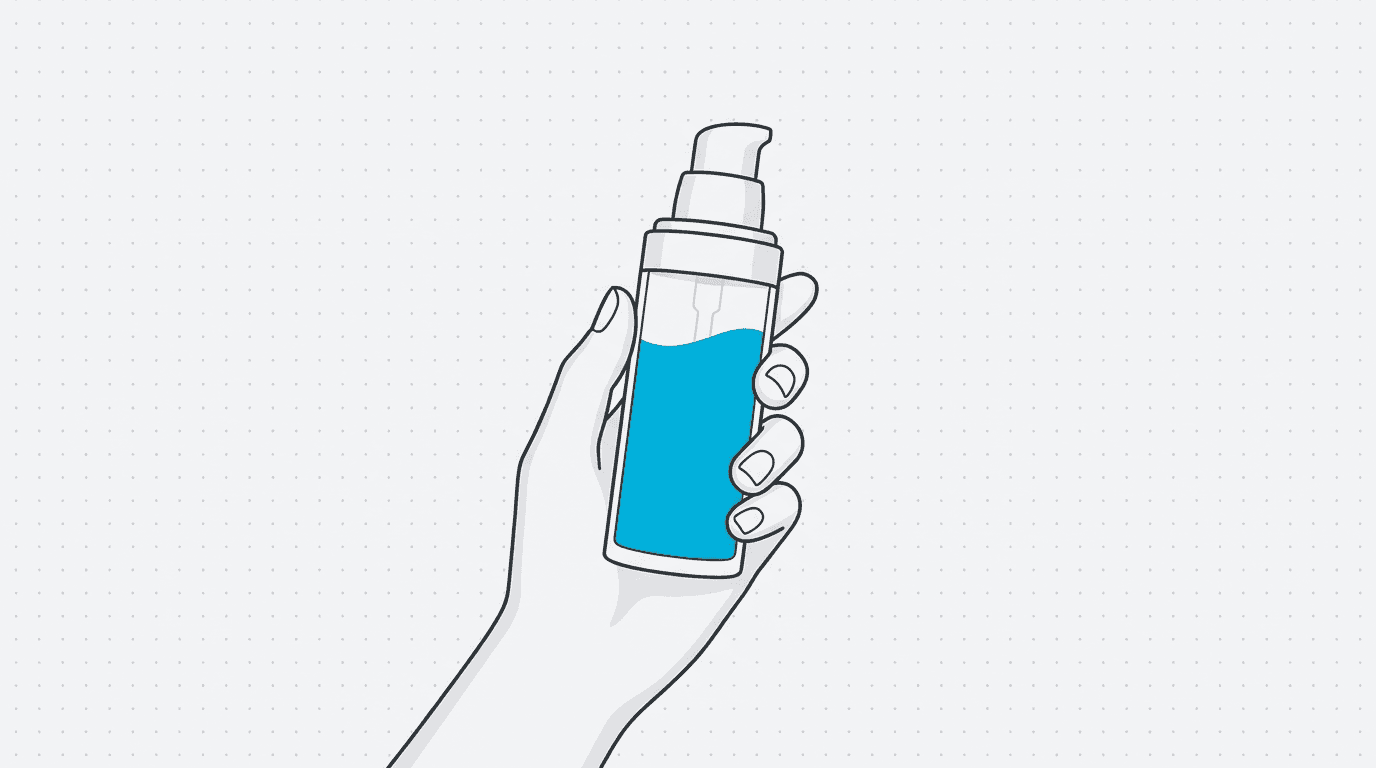
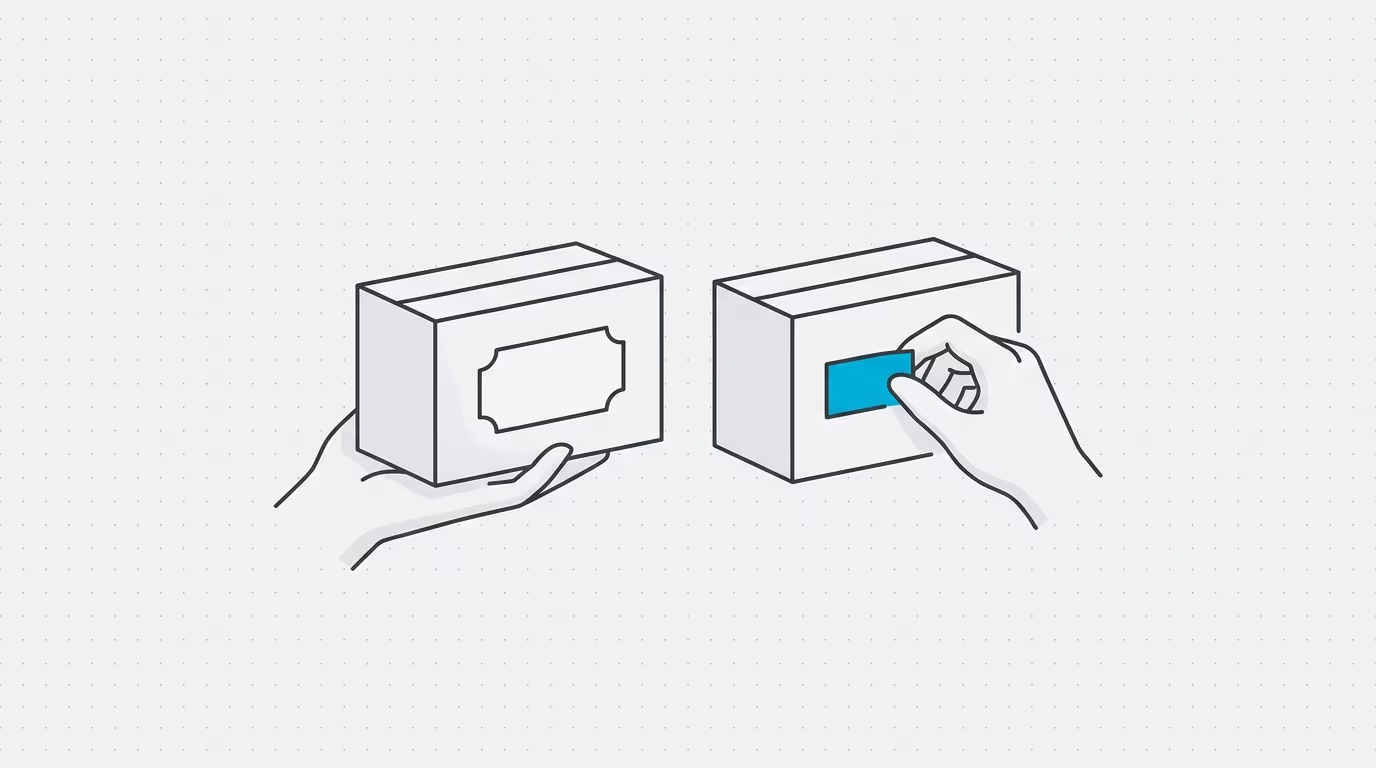
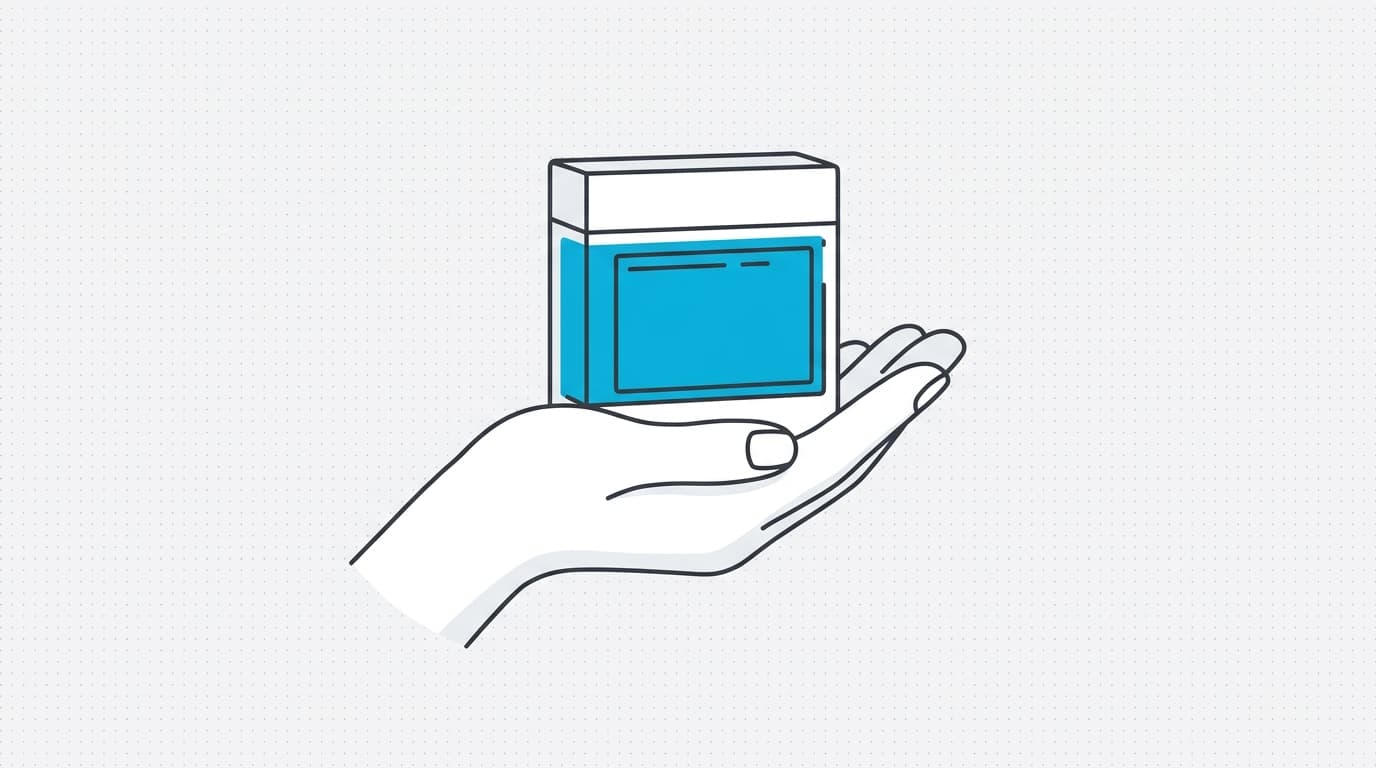
A stock formula is a base the lab already makes and has tested, such as a gel cleanser or a hyaluronic acid serum, filled into your packaging. A custom formula is one the lab's chemists develop to your brief. The two differ in who owns the formula as much as in price, the same split we cover in private label vs white label. The minimums below are ranges that labs publish, collected in our cosmetics manufacturer guide.
- Stock formula. Minimums often run 1,000 to 5,000 units per item, and some labs offer programs from 100 to 250 units for brands testing a concept. The lab keeps the formula and can sell it to other brands. Ask for the stability data it already holds, and check that it was run in packaging like yours.
- Modified stock. A stock base with a new scent, color or active. Any change can affect stability and the preservative, so expect new tests.
- Custom formula. Minimums usually start at 5,000 to 10,000 units, because the lab spreads bench work and testing across the run. You own the formula only if the contract assigns it to you and requires the lab to hand over the full ingredient list with percentages.
In skincare the minimum comes from the mixing tank more than the filling line. Many labs quote a minimum batch in kilograms, because a tank will not mix a small volume evenly. Divide that batch by your fill weight to find your real minimum. A 200 kilogram batch fills 4,000 jars of 50 grams, or 6,666 bottles of 30 grams before losses in the tank and lines. To order less, pick a stock base the lab already mixes in bulk or a lab with smaller tanks. Our guide to what MOQ means shows how the minimum moves unit price, and OEM vs ODM manufacturing covers who owns what.
Ask every lab to split its quote into the same lines: bulk formula per kilogram, filling labor, each packaging component, labels and cartons, and one-time charges for development and testing. A single price per unit hides which of those you can change.
Where skincare manufacturers are
Most US skincare brands choose among three places.
- United States. A US lab is already inside FDA jurisdiction, pays no import duty and is a short trip away when you need to approve a batch. Unit prices tend to run higher. It is often the simplest route for sunscreen and acne products, where the plant must also meet FDA drug rules.
- South Korea. Korea's cosmetics exports reached a record $10.2 billion in 2024, up 20.6% from 2023, according to its Ministry of Food and Drug Safety. Much of that output comes from contract developers that create and produce formulas for many brands, including publicly traded companies such as Kolmar Korea. Korean labs are known for new textures and actives, and their minimums assume you plan to scale. Since July 24, 2026, a Section 301 duty has raised the total US duty on goods of Korea, the normal rate included, to 12.5%.
- Guangdong, China. China's skincare labs are concentrated in Guangdong province, around Guangzhou, with packaging suppliers nearby. Minimums are often the lowest of the three. Products of China pay the 12.5% Section 301 forced-labor duty that started on July 24, 2026, plus any China Section 301 list duty on the product's tariff line.
A lab outside the US must register its facility with FDA just as a US lab does, so ask for the registration number in the first week. Our tariff stacking guide shows how the duty layers combine on one entry, so you can compare landed cost by country rather than factory price.
FDA rules for skincare under MoCRA in November 2026
The Modernization of Cosmetics Regulation Act (MoCRA), signed into law in December 2022, covers skincare that makes no drug claim. Most duties fall on the responsible person, the company named on the label. Check FDA's MoCRA page before you file, because the open items can change.
- Facility registration. Enforced since July 1, 2024. The company that makes or processes the product registers each facility in FDA's Cosmetics Direct portal, as FDA's registration and listing guide explains, and renews every two years. A new facility registers within 60 days of starting work.
- Product listing. Enforced since July 1, 2024. The responsible person lists each product, with its ingredients and the facility that makes it, within 120 days of first sale.
- Safety substantiation. In force since December 29, 2023. You must hold records showing the product is safe when used as directed. FDA does not publish a list of required tests.
- Serious adverse event reports. In force since December 29, 2023. You report each serious event to FDA within 15 business days and keep records for six years, or three years for a small business.
- Label contact. Since December 29, 2024, each label must carry a US address, phone number or electronic contact where consumers can report adverse events.
- Good manufacturing practice rule. MoCRA required FDA to propose a rule by December 29, 2024 and finalize one by December 29, 2025. FDA missed both dates, and its regulatory agenda moved the rule to its long-term list with no proposal date. No federal cosmetic GMP rule applies yet, so ask a lab for ISO 22716 and check FDA's page for news.
- Fragrance allergen labeling. MoCRA requires FDA to name, by regulation, the fragrance allergens that labels must list. FDA missed the law's deadline for the proposed rule. Check FDA's page for whether a list has been proposed before you design a label, and do not rely on an allergen count you read online.
A business with average US cosmetic sales under $1 million a year over the previous three years is exempt from registration, listing and the future manufacturing rule, but not from safety substantiation, labeling or adverse event reporting. The exemption never covers products that touch the eye's mucous membrane, injected products or products for internal use.
When a skincare product becomes an OTC drug
The claim on the label decides whether a product is a cosmetic or a drug. Under federal food and drug law, a cosmetic cleanses or beautifies, while a drug treats or prevents disease or affects the structure or function of the body. A cream that hydrates dry skin is a cosmetic. The same cream labeled SPF 30, or labeled to treat acne, is also an over-the-counter (OTC) drug and must meet both sets of rules, as FDA explains in Is It a Cosmetic, a Drug, or Both?
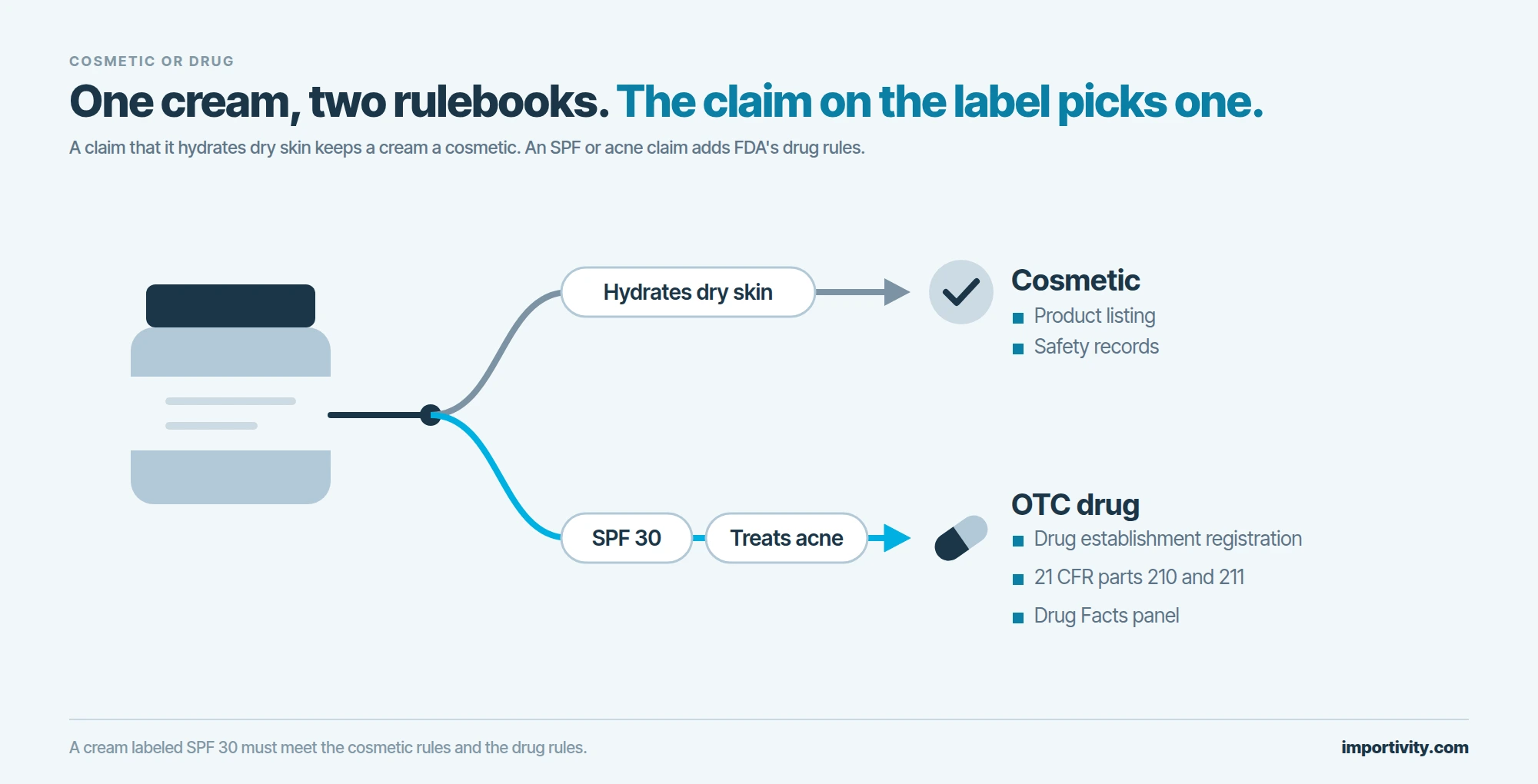
A drug claim changes which plant can make your product. The site must be registered with FDA as a drug establishment, list the product as a drug and follow the drug manufacturing rules in 21 CFR parts 210 and 211. The product may use only the active ingredients and strengths that FDA's OTC monograph allows for that use, and it must carry a Drug Facts panel. Many cosmetic labs are not set up for drug work, so ask before you send a brief.
- Sunscreen. Under FDA's 2011 sunscreen rule, SPF and broad spectrum protection must be tested by FDA's methods. Only a broad spectrum product with SPF 15 or higher may say it reduces the risk of skin cancer, and a water resistance claim must state 40 or 80 minutes.
- Acne. An acne product must use an active ingredient from the acne monograph, such as benzoyl peroxide or salicylic acid, within the strength range it sets. Your lab should name the monograph section it formulates to.
- Cell claims. FDA says claims that a product will regenerate cells are generally drug claims, so a serum with no drug ingredient can still become an unapproved drug. Keep claims to how the skin looks and feels.
The tests to ask your lab for
Ask for the reports, not a promise that testing was done. A stock formula's old reports only count if the formula and the packaging match yours.
| Test | What it tells you | Method and time |
|---|---|---|
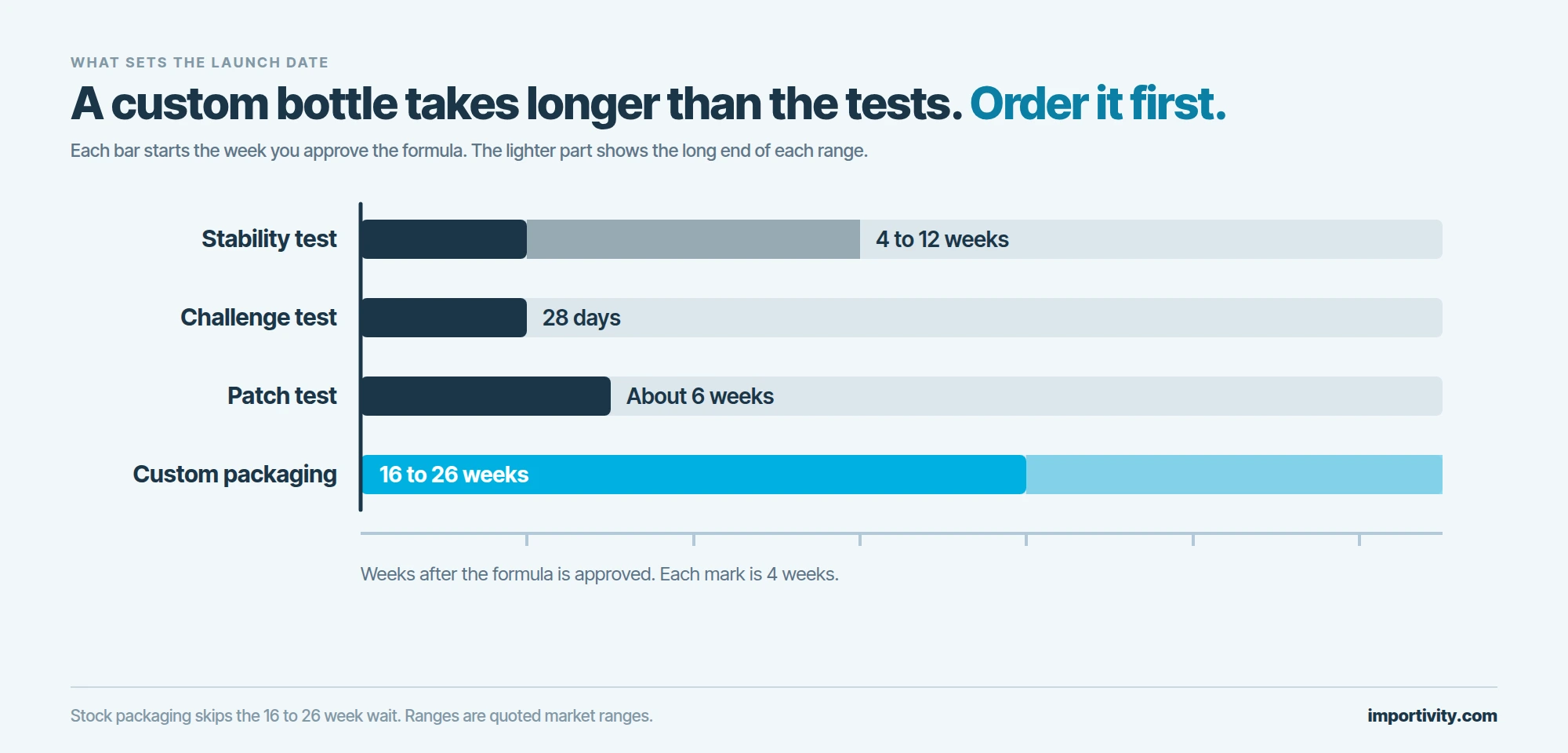
| Accelerated stability | Whether color, scent, pH, thickness and actives hold over the planned shelf life | Commonly 40 to 45 degrees C at 75% relative humidity for 4 to 12 weeks, plus samples kept at room temperature |
| Packaging compatibility | Whether the formula and the pack react: weight loss, collapsed walls, clogged pumps, discolored liners | Run in your final packaging alongside the stability test |
| Preservative efficacy (challenge test) | Whether the preservative kills bacteria, yeast and mold that get in during use | ISO 11930, with counts at 7, 14 and 28 days |
| Microbial limits | Whether a finished batch is clean enough to release | ISO 17516: no more than 1,000 colony forming units per gram, or 100 for eye area, mucous membrane and under-three products |
| Patch test | Whether the formula irritates skin or causes allergy on repeat use | Human repeat insult patch test on a volunteer panel, about 6 weeks |
| SPF and broad spectrum (sunscreen only) | Whether the SPF number and the broad spectrum claim are true | FDA test methods from the 2011 sunscreen rule, with water resistance tested at 40 or 80 minutes |
The patch test takes about six weeks because of how it runs: nine patches over three weeks, a rest of about two weeks, then a challenge patch read over the next one to three days. Vitamin C serums darken as they oxidize in air and light, so labs often fill them into airless pumps or amber glass. Test in the bottle you will sell, not the lab's sample jar.
Stock packaging also keeps you off the tooling bill. By the supplier ranges in our cosmetics manufacturer guide, a private mold needs 12,000 to 50,000 units to make sense, and tooling for standard parts costs about $5,000 to $20,000. Our guide to choosing a custom packaging manufacturer covers the rest. If you sell in California, also check every ingredient against the list in our Prop 65 guide for importers.
Timeline from brief to finished goods
A stock formula in stock packaging moves fastest. A custom formula in a custom bottle takes longest, and the bottle is often slower than the formula. The tests and the tooling each run for a set time once they start, so they set the launch date.
- Bench samples. The lab makes samples to your brief, and each revision round adds time. Ask for the turnaround per round in writing.
- Tests. Stability, the challenge test and the patch test run on the approved formula in the final pack, for the times in the table above.
- Custom packaging. The same guide puts mold making alone at 25 to 45 days, and the path from tooling kickoff to the first packaging delivery at 16 to 26 weeks.
- Production and listing. The lab mixes, fills and tests each batch for microbes before it ships. You list the product with FDA within 120 days of first sale.
Start the three tests in the week you approve the formula, and order packaging the same week. If they run side by side, the custom bottle sets the date: 26 weeks at the long end. If they run one after another, the long ends add up to 48 weeks.
Questions to ask before you sign
Get the answers in writing before the first purchase order.
- Formula ownership. Who owns the formula, and will the contract require the lab to release the full formula with percentages if you move?
- Minimum batch. What is the minimum batch in kilograms, and the minimum per item at your fill size?
- Existing reports. Is there stability and challenge test data for this formula in this exact packaging?
- FDA status. What is the facility's registration number in Cosmetics Direct? For SPF or acne products, is the site registered as a drug establishment, and what was the result of its last FDA inspection?
- Quality system. Does the lab hold a current ISO 22716 certificate? Check the issuing body and the expiry date.
- Batch release. Will each batch ship with a certificate of analysis that includes microbial results, and will the lab keep retained samples?
- Filings. Who prepares the listing data and the safety file, and who submits them?
Our supplier vetting service can check a lab before you commit, and the import product compliance guide lists what must travel with the goods. When your brief is ready, send it to us as a quote request.
Frequently Asked Questions
What is private label skincare?
Private label skincare is a product made by a contract lab and sold under your brand. The lab fills one of its tested stock formulas into your packaging or develops a custom formula to your brief. A custom formula belongs to you only if the contract assigns it. Under MoCRA, the company named on the label is responsible for the product, not the lab.
What is the minimum order for private label skincare?
Labs commonly quote 1,000 to 5,000 units per item for a stock formula and 5,000 to 10,000 for a custom formula, and some run programs from 100 to 250 units. The real limit is often the minimum batch in kilograms. Divide it by your fill weight: a 200 kilogram batch fills 4,000 jars of 50 grams.
Do you need FDA approval to sell private label skincare?
No. Cosmetics do not need FDA approval before sale, apart from color additives. Under MoCRA, the facility must be registered, the brand must list each product within 120 days of first sale, keep safety records and report serious adverse events within 15 business days. A product with an SPF or acne claim must follow an FDA OTC monograph.
Where are most skincare manufacturers located?
US brands usually choose among three places. US labs sit inside FDA jurisdiction and pay no import duty. South Korea, whose cosmetics exports hit a record $10.2 billion in 2024, is known for new textures and actives. Guangdong province in China, around Guangzhou, often has the lowest minimums. Korean and Chinese goods pay Section 301 duties, so compare landed cost.
Is sunscreen a cosmetic or a drug?
In the US, sunscreen is an over-the-counter drug, and a moisturizer with SPF is both a cosmetic and a drug. The plant must be registered with FDA as a drug establishment and follow 21 CFR parts 210 and 211. The label needs a Drug Facts panel, and SPF and 40 or 80 minute water resistance claims must be tested by FDA's methods.
About the author
Jordan Lewis
Chief Operating Officer, Importivity
Runs Importivity's sourcing operations across China, Vietnam, Mexico and India, from supplier negotiation through landed delivery.
Press and media inquiries: press@importivity.com