Hoodie Manufacturers for US Brands (Countries, Costs and MOQs)
Hoodie manufacturers that work with US brands are concentrated in China, Bangladesh, Vietnam, Pakistan and India, and Turkey, Mexico and US shops serve faster or smaller runs. The price of a hoodie depends mostly on its fabric (weight in GSM, fleece or French terry, fiber and dye), its decoration and its country of make, because the US duty on a cotton hoodie starts at a 16.5% base rate and, as of mid November 2026, reaches 36.5% from China.
This guide is for US brands getting a first hoodie made, from a logo on a blank to a full custom design. It shows where hoodies are made and what drives their cost. It then prices out 500 heavyweight hoodies and lists the sampling steps and quote details a factory needs. If you have not chosen a production model yet, our guide to finding a private label clothing manufacturer compares them.
What sets a hoodie's quality and cost
Fabric is the largest line on a hoodie quote. Our private label guide builds the cost of a mid-weight zip hoodie made in Vietnam, 500 pieces in 320 GSM French terry, and puts the fabric at $4.50 of a $10.80 factory price. Sewing comes to $3.20, factory overhead and profit to $1.80, trims to $0.90 and packing to $0.40.
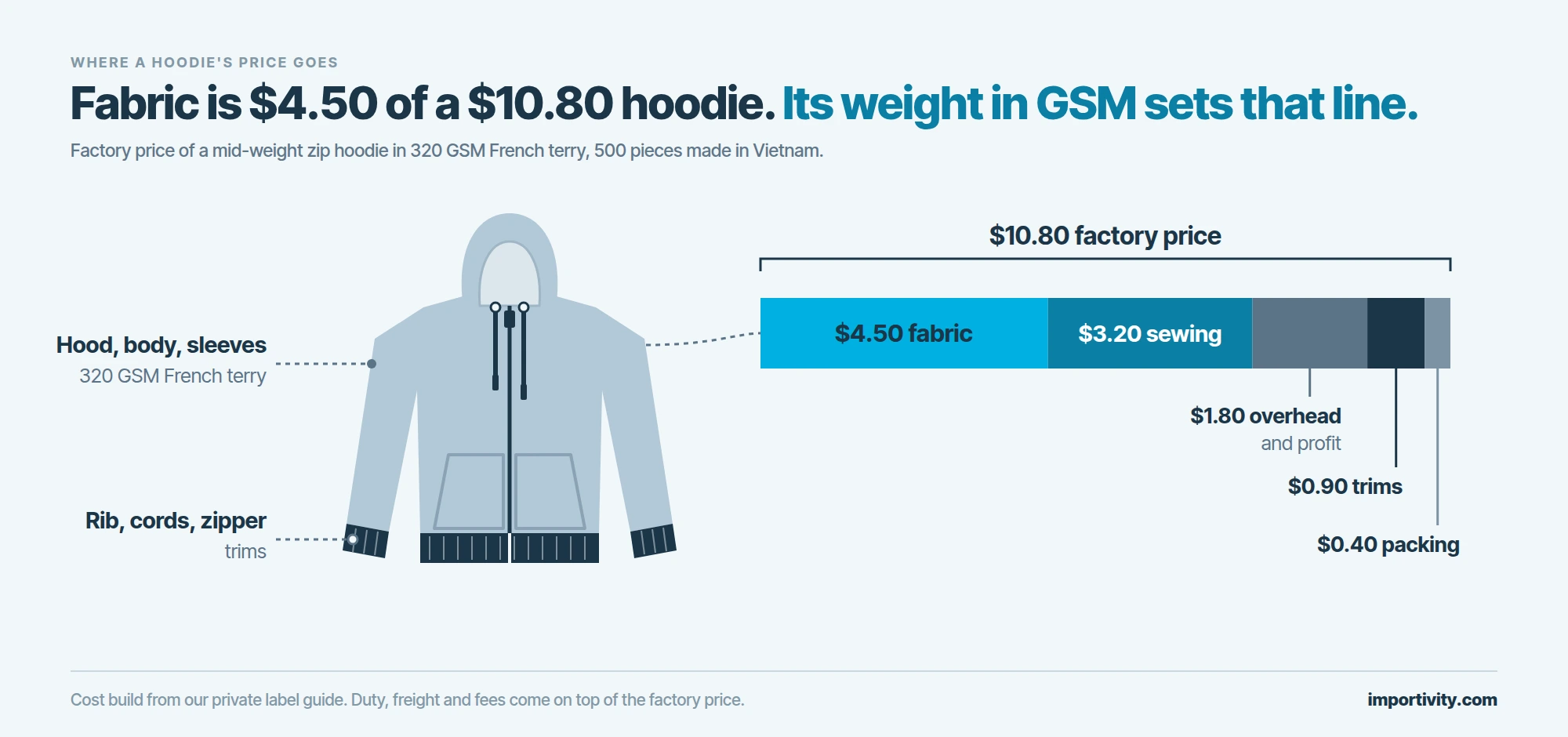
Each choice below moves one of those lines. Write every one into the spec, because a factory fills a blank field with its own choice.
- Fabric weight. GSM is grams per square meter. At the same price per kilo, the fabric line rises with the weight. No standard defines "heavyweight", so put the GSM number in the spec. Some US blank makers give ounces per square yard instead: multiply by 33.9 to get GSM, so 10 ounces is about 339 GSM. To check a swatch, weigh a 10 by 10 centimeter square and multiply the grams by 100.
- Fleece or French terry. Both are knits with loops on the back. French terry leaves the loops as knitted, so it suits a lighter hoodie. Fleece has the loops brushed into a soft nap that holds more warmth, an extra step at the mill.
- Fiber. Cotton shrinks more than a cotton and polyester blend, and polyester can pill. The fiber that weighs the most also sets the tariff line: a mostly cotton hoodie falls under 6110.20.20 at a 16.5% base rate, and a mostly polyester one under 6110.30, which has its own rate. A 50/50 blend also goes under 6110.30: in a tie, the notes to Section XI of the Harmonized Tariff Schedule pick the fiber whose heading comes last in numerical order.
- Dye. Mills dye fabric in lots, so each color carries its own fabric minimum. Garment dyeing colors sewn, undyed hoodies instead, which allows smaller color runs but adds shrinkage and shade differences between pieces.
- Trims. Rib cuffs and waistband, a single or lined hood, the drawcord and its tips, eyelets, a zipper and labels. Each is a priced row on the bill of materials.
- Decoration. Screen printing is priced by colors and print locations, because each color needs its own screen. Embroidery is priced by stitch count.
Where hoodie manufacturers are, by country
Duty figures below are for a cotton hoodie under 6110.20.20, as of mid November 2026.
- China. The widest choice of fabric and trims. China Textile City in Keqiao, Shaoxing, is a large fabric market. Duty is 36.5%: the 16.5% base rate, 7.5% under Section 301 List 4A, which covers apparel, and the 12.5% forced-labor duty, as our guide to import tax from China sets out.
- Bangladesh. Our private label guide calls it strongest on high-volume, simple garments such as basics and fleece. Duty is 26.5%, the base rate plus a 10% forced-labor rate.
- Vietnam. Strongest on performance fabrics and technical details. Our guide to Vietnam clothing suppliers describes small-batch factories built for hoodies, tees and joggers, and says imported fabric can add 3 to 6 weeks. Duty is 29%. USTR's open Section 301 investigation into Vietnam's intellectual property practices now has a decision deadline of February 28, 2027.
- Pakistan and India. Both grow cotton and spin, knit, dye and sew it in the country, which suits 100% cotton fleece. India's knitwear clusters are Tirupur in Tamil Nadu and Ludhiana in Punjab, with lead times of 90 to 110 days in our private label guide. Duty from either is 26.5%.
- Portugal. The better factories start at 200 to 500 pieces, at the highest prices in our private label guide. A cotton hoodie pays only the 16.5% base rate, because USTR's forced-labor notice sets the extra duty on EU goods to zero when the base rate is 10% or more.
- Mexico. Hoodies enter duty free when they meet the USMCA yarn-forward rule: the yarn is spun, and every later step done, in the US, Mexico or Canada. Those that do not qualify pay 26.5%.
| Origin | Typical minimum per style | Price level for a hoodie | Lead time |
|---|---|---|---|
| China | 100 to 300 pieces, the floor at most private label factories in Asia | $14 to $18 FOB, heavyweight | 45 to 75 days for private label, 90 to 150 for new cut and sew with sampling, then about 30 to 40 days by ocean |
| Bangladesh | 100 to 300 pieces, and some factories also set a minimum per size | $8 to $12 FOB, heavyweight | 90 to 120 days |
| Vietnam | 50 to 300 at small-batch factories, 300 to 1,000 at mid-tier factories | $10.80 FOB, mid-weight 320 GSM, 500 pieces | 14 to 16 weeks to a US warehouse, ocean included |
| Turkey | About 50 pieces at some smaller factories, at a higher price | 20 to 35% above Asian FOB prices | 45 to 60 days from order to FOB |
| Mexico | No published range, so ask each plant | Often above a Chinese quote, with 0% duty if USMCA rules are met | 2 to 3 days by truck from Monterrey to Dallas |
| United States | 25 to 500 pieces, per Maker's Row's 2026 guide | Set by US wages: sewing operators earn a median $16.56 an hour | Days by ground freight, with no customs entry |
The China, Bangladesh, Turkey and Vietnam rows come from our private label and Vietnam guides. The US row, the Mexico minimum and truck time and the China ocean time come from our guide to clothing manufacturers in the USA, and the Mexico price from our post on where Carhartt is made. The China and Bangladesh prices are for heavyweight hoodies and the Vietnam price is one mid-weight build, so get quotes on the same tech pack before you compare countries.
What one heavyweight custom hoodie costs
Here is a worked example for 500 heavyweight zip hoodies made in Vietnam and shipped by ocean. It starts from the private label guide's $10.80 build and changes the fabric from 320 GSM to 400 GSM. Every other input is that guide's figure or a stated assumption, not a factory's quote.
- Fabric. At the same yardage and price per kilo, 400 GSM costs 400 divided by 320, or 1.25 times as much: $4.50 times 1.25 is $5.63, or $1.13 more.
- Factory price. The other lines stay at $6.30, so the hoodie is $11.93 FOB, or $5,962.50 for 500. A factory may also raise its margin on a heavier fabric.
- Duty. 29% from Vietnam is $1,729.13, or $3.46 a hoodie.
- Customs fees. The merchandise processing fee of 0.3464% comes to $20.65, under the $34.58 minimum for a formal entry, so you pay $34.58. The harbor maintenance fee of 0.125% on ocean cargo is $7.45.
- Freight and clearance. The private label guide's $1.60 a hoodie for ocean freight in a shared container and $0.70 for brokerage, ISF and port fees: $800 and $350.
- Development and inspection. A $500 tech pack, the low end of the range in our tech pack guide. Two sample rounds at an assumed $300 each, plus an assumed $100 of courier per round. One inspection day at an assumed $300, inside the $200 to $400 a day in our Vietnam guide. That is $1,600 in all.
Landed, the 500 hoodies cost $8,883.66, or $17.77 each before development and inspection. The first run adds $1,300 for the tech pack, samples and courier and $300 for the inspection, for $10,483.66, or $20.97 a hoodie. A reorder pays for the inspection again but not the development: $9,183.66, or $18.37 a hoodie.
The same $11.93 hoodie would pay $4.35 of duty from China, 89 cents more, and $3.16 from Bangladesh, India or Pakistan, 30 cents less. Factory prices differ more. At the midpoints of the private label guide's ranges, a $16.00 hoodie from China with 36.5% duty costs $21.84 before freight, against $12.65 for a $10.00 hoodie from Bangladesh with 26.5%.
The fabric also sets the minimum. Say a mill dyes a custom color in lots of 500 meters, the low end of the range in our guide to what MOQ means. At the private label guide's 1.8 yards, or about 1.65 meters, a hoodie, one lot covers about 303 hoodies. A smaller run in that color means paying for fabric you do not use, or picking a color the mill already stocks.
Blank hoodies against private label and custom cut and sew
There are three ways to get a hoodie with your name on it. The lower the minimum, the less of the garment you decide.
- Blanks plus decoration. You buy finished blank hoodies and have them printed or embroidered. Our private label guide puts white label orders as low as 12 to 50 units per SKU. You get the blank maker's fabric, fit and country of origin, and printing does not change that origin. Our USA guide notes that in 2022 the FTC ordered a Utah apparel seller to pay about $211,000 for printing "Made in USA" on imported blanks.
- Private label. A factory makes its own base hoodie in your fabric color, with your labels and small changes such as the pocket or the rib. Expect 100 to 300 pieces a style at most factories in Asia.
- Custom cut and sew. The factory makes your pattern from your tech pack, in fabric you specify. Our private label guide puts cut-and-sew minimums at 300 to 1,000 pieces a style, and our tech pack guide puts a tech pack from a US freelance designer at $500 to $2,000.
A relabeled blank still needs the fiber content, the country of origin, your business name or RN number and care instructions, as the FTC guide Threading Your Way Through the Labeling Requirements shows. A design that sells on blanks gives you sales numbers before you pay for a factory minimum. Our guide to how to start a clothing brand works through the cash each route needs.
Sampling steps for a custom hoodie
Budget for two revision rounds. Our pre-production sample guide puts a cycle with two revision rounds at 8 to 12 weeks, from the first prototype request to an approved pre-production sample.
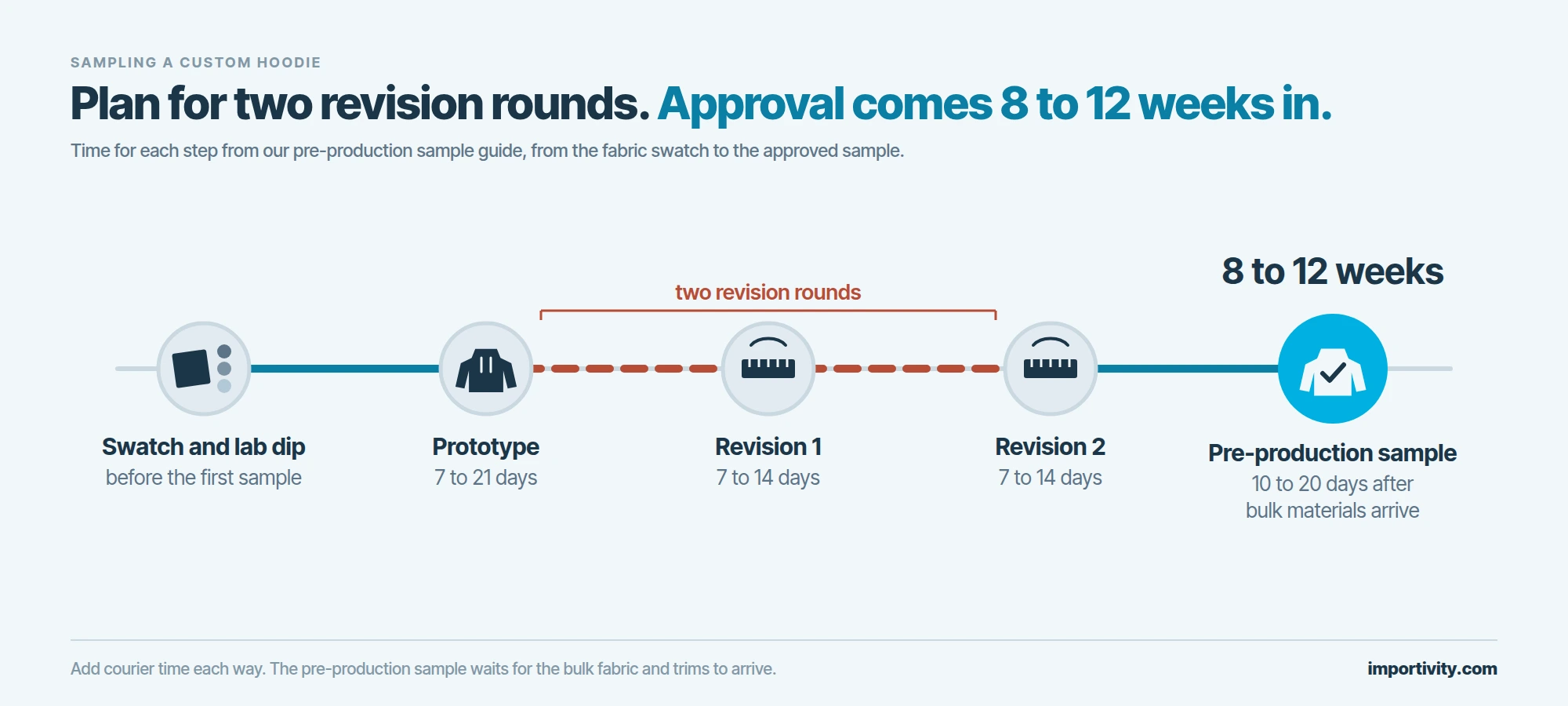
- Fabric and color. Before the first sample, ask for a swatch of the bulk fabric and a lab dip for each color, matched to a Pantone TCX number. Weigh the swatch to confirm the GSM.
- Prototype. 7 to 21 days from a confirmed brief. Check the fit, the hood, the rib stretch and the pocket position. The same guide puts sample fees for most soft goods at $50 to $300.
- Wash test. Wash and dry the prototype, then measure the chest and body length again. Cotton knits shrink, so agree whether the chart is for before or after washing.
- Revision rounds. Budget 7 to 14 days per round, plus courier time. Reply by point of measure, with the measured value and the change you want.
- Pre-production sample. Made in the bulk fabric, trims and labels, 10 to 20 days after those materials reach the factory. Once approved, it is the standard for the order. Keep one for each color.
- Top-of-production sample. The first pieces off the line, checked against the approved sample before the full run is sewn.
What to put in a hoodie quote request
Factories quote what you write down. Send the same request to at least three hoodie manufacturers so the prices compare, and include these points:
- Style and fabric. Pullover or zip, sketches, the size range, fiber by percentage, fleece or French terry, GSM and whether it must be pre-shrunk.
- Color and trims. Pantone TCX numbers, whether stock colors are acceptable, and the rib, hood lining, drawcord, eyelets, zipper and labels.
- Decoration. Method, artwork, size and placement measured from the high point shoulder, and the number of colors or the stitch count.
- Quantities. Prices at your test size, at the factory's minimum and at twice the minimum, split by color and size.
- Children's sizes. No drawstrings in the hood or at the neck: since 2011 the CPSC has treated them on children's upper outerwear as a substantial product hazard. Its overview of textile and apparel requirements lists the other rules, including the Children's Product Certificate.
- Terms. FOB port, ship date, sample fees and whether they are credited against the bulk order, and an inspection before you pay the balance.
Our quality control service inspects bulk orders against the approved sample, so a failed GSM, shrinkage or color check is caught at the factory. To get quotes from hoodie manufacturers that fit your quantities, send us your tech pack and order details. We help US brands find and vet factories and run quality control. We also handle shipping and tariffs.
Frequently Asked Questions
Where are hoodies manufactured?
Hoodies for US brands are made mainly in China, Bangladesh, Vietnam, Pakistan and India. Turkey and Portugal take smaller runs at higher prices. Mexico ships duty free when a hoodie meets the USMCA yarn-forward rule, and US cut-and-sew shops take 25 to 500 pieces a style.
How much does it cost to manufacture a hoodie?
Our private label guide puts a heavyweight hoodie at $8 to $12 FOB from Bangladesh and $14 to $18 from China, and builds a mid-weight one from Vietnam at $10.80. Duty, freight and fees come on top. In our worked example, 500 heavyweight hoodies from Vietnam land at $17.77 each, or $20.97 on a first run.
What is the minimum order for custom hoodies?
It depends on the route. Blank hoodies with your logo can start at 12 to 50 units. Private label hoodies usually start at 100 to 300 pieces a style in Asia, or 50 to 300 at small-batch factories in Vietnam. Custom cut and sew runs 300 to 1,000 pieces overseas, or 25 to 500 at US shops.
What GSM is a heavyweight hoodie?
No standard defines heavyweight, so compare GSM numbers, not labels. Our private label guide treats 320 GSM French terry as mid-weight, and our worked example uses 400 GSM for a heavier hoodie, which costs 1.25 times as much in fabric at the same price per kilo. To check a swatch, weigh a 10 by 10 centimeter square and multiply the grams by 100.
What is the import duty on hoodies from China?
As of mid November 2026, a mostly cotton hoodie under HTS 6110.20.20 pays 36.5% from China: the 16.5% base rate, 7.5% under Section 301 List 4A and the 12.5% forced-labor duty. It pays 29% from Vietnam and 26.5% from Bangladesh, India or Pakistan. A mostly polyester hoodie falls under 6110.30, which has its own rate.
About the author
Jordan Lewis
Chief Operating Officer, Importivity
Runs Importivity's sourcing operations across China, Vietnam, Mexico and India, from supplier negotiation through delivery to the client's door.
Press and media inquiries: press@importivity.com