Where Are Birkenstocks Made (Six German Plants and One in Portugal)
Birkenstocks are made in the European Union, mostly in Germany, in factories that Birkenstock runs itself. The company makes every footbed in Germany and says it assembles over 90% of its products there, and its only plant outside Germany, in Arouca, Portugal, makes components.
This guide is for shoppers who want to check a pair they own and for founders who want a sandal or shoe made. The facts come from Birkenstock's Form 20-F for fiscal 2025, the year that ended September 30, 2025, its fiscal 2024 20-F, its supply chain reports for Canada, its press releases and its results through the quarter that ended June 30, 2026. We read passages of these documents as shown in search results, not the full documents, so we report only what those passages say. For a brand that outsources its production, see our guide to where adidas shoes are made. Importivity is not affiliated with Birkenstock.
Where Birkenstocks are made as of November 2026
Birkenstock Holding plc files an annual report, Form 20-F, with the US Securities and Exchange Commission. Its 20-F for fiscal 2025, filed on December 18, 2025, states the policy: all footbed production and engineering take place in Germany, and all manufacturing takes place in the EU. In fiscal 2025 the company made 100% of its footbeds in its German factories. It runs six production plants in Germany and one in Portugal.
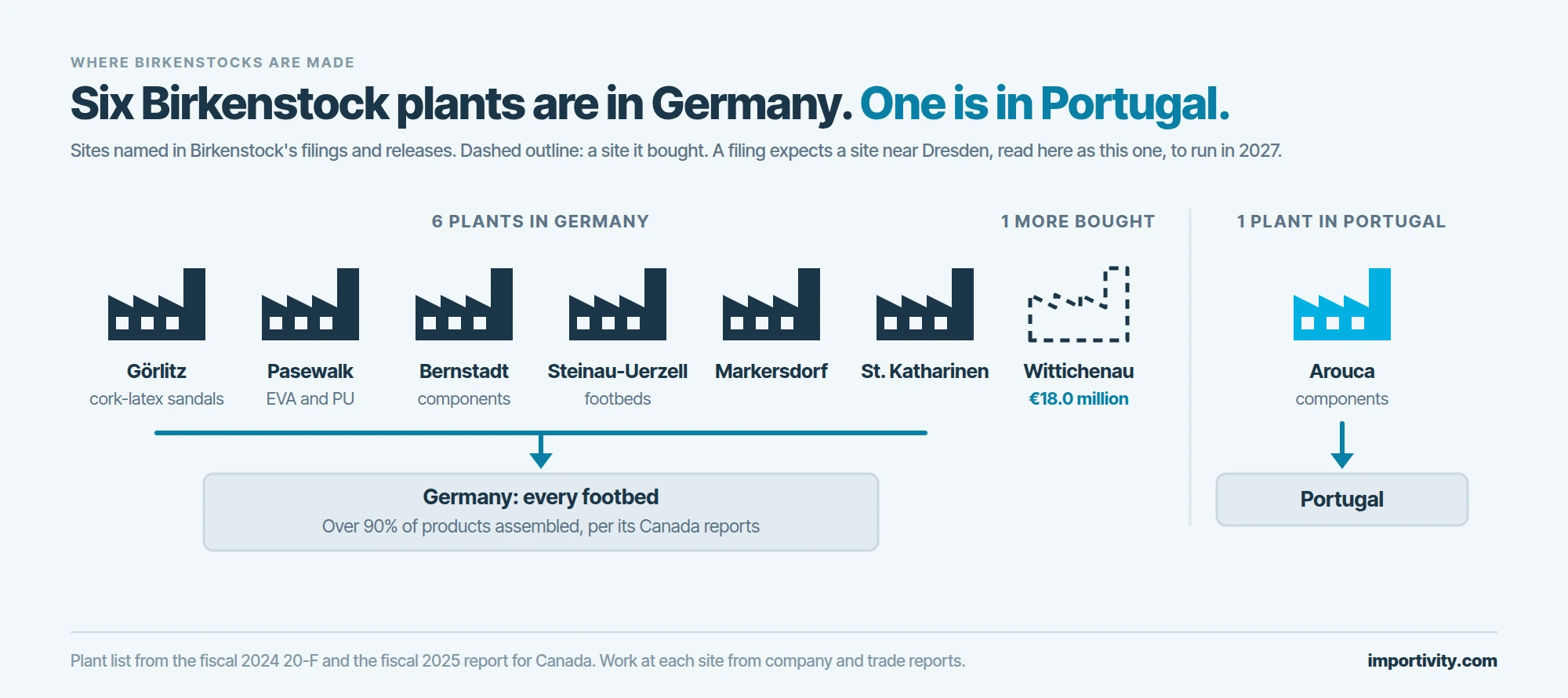
The plant count and the split of assembly come from other company documents. Birkenstock's supply chain report for Canada, covering October 2024 to September 2025, lists six production units in Germany and one in Portugal. Its Canada reports also say that it assembles over 90% of its products in Germany and produces the remainder elsewhere in Europe.
The company's page on production and manufacturing says that the vast majority of products are assembled in Germany and the remainder elsewhere in the EU, with supplemental component manufacturing in Portugal. We found no share of pairs for each plant and no list of the styles that are finished outside Germany.
By comparison, adidas outsources almost 100% of its production to independent manufacturers, according to its 2025 annual report. Birkenstock works more like LEGO, which also owns its factories, as our guide to where Legos are made explains.
What each Birkenstock factory does
Birkenstock's 20-F for fiscal 2024 names six manufacturing facilities in Germany and one component plant in Portugal. The company owned four of the German sites and the Portuguese plant, and it leased the other two. Press releases and trade reports describe the work at most of them.
| Factory | What is done there | Source |
|---|---|---|
| Görlitz, Germany | The largest site. Core cork-latex sandals | Company press releases. Owned, per the fiscal 2024 20-F |
| Pasewalk, Germany | EVA and PU production. Began operations in September 2023 | Company release, 2023. Owned |
| Bernstadt, Germany | Components such as uppers, buckles and rivets | One report on the site, publisher not confirmed. Owned |
| Steinau-Uerzell, Germany | Footbeds (a 2021 release announced new footbed facilities here) | Company release, 2021. Leased. The 20-F calls it Ürzell |
| St. Katharinen, Germany | Named as a manufacturing facility. We found no description of what it makes | Fiscal 2024 20-F. Owned |
| Markersdorf, Germany | Named as a manufacturing facility. We found no description of what it makes | Fiscal 2024 20-F. Leased |
| Arouca, Portugal | Components. Trade reports say it supplies uppers | Fiscal 2024 20-F. Owned |
| Wittichenau, Germany | Bought for €18.0 million. A filing expects a site near Dresden, which we read as this one, to become operational in 2027 | Fiscal 2025 20-F and later reports |
Görlitz is the largest site, and company releases describe it as the center of production for the core cork-latex sandals. Birkenstock said Görlitz would be converted completely to cork-latex production once Pasewalk took over its lines for EVA, a light foam, and polyurethane (PU).
Wittichenau is the newest addition. The 20-F for fiscal 2025 reports a September 2025 agreement to buy a production facility there. The six German facilities named in the fiscal 2024 filing do not include it. Other company reports describe a site near Dresden: one from September 2025 on its purchase for a net price of €18 million, and one filed in March 2026 that expects it to become operational in 2027. The passages of those reports that we found do not name the town. The month and the price match Wittichenau, so we read them as the same site.
Where the cork, latex and leather come from
The footbed is made in Germany, but not every material in a pair is German. The fiscal 2025 20-F says 95% of the cork Birkenstock used that year came from suppliers in Portugal.
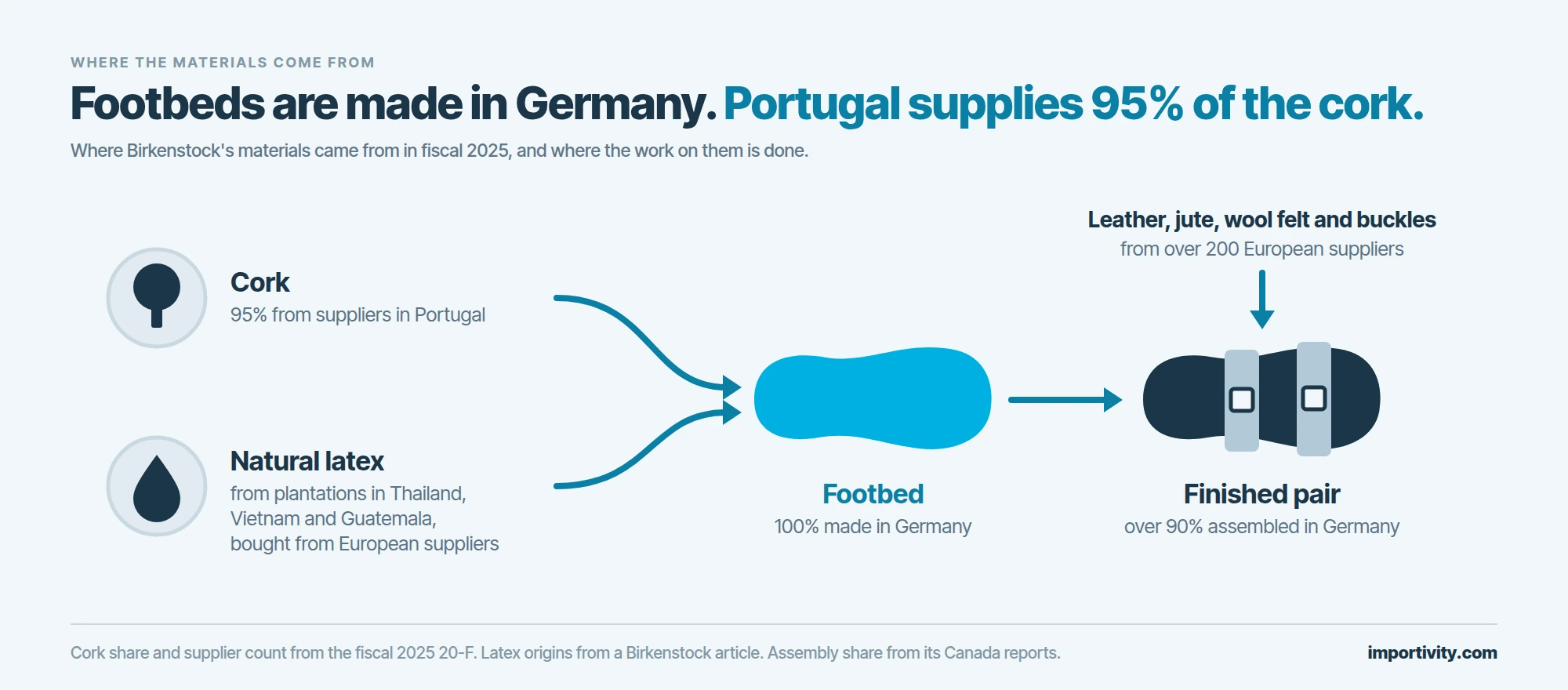
The same filing says leather, natural latex, jute, wool felt and buckles come from over 200 European suppliers, and it notes that jute and latex are not grown in Europe. An undated Birkenstock article on natural latex says the latex for its footbeds arrives by ship in Hamburg and Terneuzen from plantations in Thailand, Vietnam and Guatemala.
So the words "Made in Germany" describe where the footbed is made and where most pairs are assembled. They do not mean that every material is German. On its website, the company says its raw materials are predominantly sourced from Europe.
Are Birkenstocks made in China or the USA
No, according to the company. The 20-F policy keeps all manufacturing in the EU, and none of the seven plants in its filings is in China or the United States. A pair marked "Made in China" does not match Birkenstock's own description of its production.
What the print on the footbed tells you
Authenticity guides published by shoe retailers describe the same print on a genuine footbed: the size, a foot icon, the BIRKENSTOCK name and the words MADE IN GERMANY, with a series of numbers and letters stamped under the logo. These are retailer guides, and they are not Birkenstock documents. The mark is backed by two facts from the company's documents: every footbed is made in Germany, and over 90% of products are assembled there.
US law adds a second check. Under 19 U.S.C. 1304, most imported goods must show their country of origin in English, so a pair sold in a US store should carry an origin mark. Birkenstock's own advice on counterfeits is that the only way to be sure a pair is genuine is to buy it from an authorized Birkenstock retailer.
Who owns Birkenstock and where it is based
Birkenstock's origins date back to 1774, according to its filings. L Catterton, a private equity firm, acquired a majority stake in 2021 through affiliated entities. In October 2023, Birkenstock Holding plc listed its shares on the New York Stock Exchange under the symbol BIRK.
The listed company is a Jersey public limited company. Its registered office is in St Helier, Jersey, and its principal executive offices are at 1-2 Berkeley Square in London, according to its fiscal 2023 20-F. L Catterton kept most of the shares after the listing: a prospectus supplement from May 2025 said its affiliate would own about 63.67% of the shares after that sale. We found no newer ownership figure.
How Birkenstock is adding capacity
Birkenstock sold over 38 million pairs in fiscal 2025, up over 12% from the year before, on revenue of about €2.1 billion. On its earnings call of December 18, 2025, management said the company was already capacity constrained and aimed to increase its capacity in units by roughly 10%. Three recent projects are:
- Pasewalk, Germany. The plant began operations on September 5, 2023, after about 17 months of construction. In its release on the opening, Birkenstock put the investment at around €110 million, more than a third above the original plan, and called it by far the largest single investment in the company's history.
- Arouca, Portugal. Trade reports say Birkenstock bought a supplier in Arouca in 2022 and renamed it Birkenstock Portugal. In March 2024, Portugal Global reported a €15 million investment in a new factory of 13,000 square meters in the São Domingos Industrial Zone, due to be completed by December 2024.
- Wittichenau, Germany. A quarterly report tied €18.0 million of additions in the three months to December 31, 2025 to the purchase of the production and logistics facility there. As noted above, a report filed in March 2026 expects a planned site near Dresden, which we read as this one, to become operational in 2027.
For the quarter that ended June 30, 2026, the company's results release reported about €26 million of capital expenditure, primarily to add production capacity and to expand its retail operations.
All of this capacity is in Europe, so the pairs Birkenstock sells in the US are imported. On the December 2025 call, the company said additional US tariffs had put about 100 basis points of pressure on its margins in fiscal 2025.
Can a small brand use these factories
We found no sign that Birkenstock's plants make shoes for other brands, and in December 2025 the company said it was already capacity constrained. A small brand that wants a cork-footbed sandal has it made by a contract shoe factory. These parts of Birkenstock's setup still apply at small scale:
- Start where the cork is. Portugal supplied 95% of Birkenstock's cork in fiscal 2025, and Birkenstock's only plant outside Germany is there. Portugal also exports most of the shoes it makes. APICCAPS, the Portuguese footwear association, counts about 1,500 firms and 40,000 jobs in the country's footwear cluster, which also covers components and leather goods. The country exported 68 million pairs worth €1.718 billion in 2025, and APICCAPS says about 90% of production is exported.
- Compare a quote from another region. About 99% of the shoes sold in the US are imported. Our guide to American manufactured shoes covers what the remaining US factories make and what they charge.
- Use a stock footbed or sole first. Molded parts need tooling in every size. Shoemakers Academy, a footwear development school cited in our adidas guide, prices rubber outsole molds at $1,500 to $2,000 per size, with ten or more sizes needed. Ask each factory which footbeds and outsoles it already has tooling for.
- Plan for the minimum. The same school puts the usual factory minimum at around 500 pairs per model or colorway. Our US shoes guide puts first orders at semi-handmade factories at 500 to 1,000 pairs. Our guide to what MOQ means shows how the minimum sets your unit price.
- Ask where each material comes from. Birkenstock buys from over 200 European suppliers and still uses latex and jute that are not grown in Europe. Ask the factory to name the origin of the cork, the latex, the leather and the buckles, and write each material into your tech pack.
- Decide the origin mark early. Birkenstock's "Made in Germany" mark is backed by where the work is done: every footbed is made in Germany, and its Canada reports say over 90% of products are assembled there. Imported shoes sold in the US must show their country of origin, so choose the country of manufacture before you design the footbed print or the box.
- Price the duty before you choose a country. Shoes made in the EU pay US import duty, and Birkenstock told investors that additional US tariffs reduced its margins in fiscal 2025. Our guide to tariff stacking shows how the duty layers add up on one entry.
If you want a sandal or shoe made, send us your design and order size. Importivity helps US brands find and vet factories, run quality control, arrange shipping and handle tariffs. See our manufacturer sourcing page for the first of those steps.
Frequently Asked Questions
Are Birkenstocks made in China?
No, according to the company. Birkenstock's Form 20-F for fiscal 2025 says all footbed production and engineering take place in Germany and all manufacturing takes place in the EU. Its filings name six plants in Germany and one component plant in Arouca, Portugal, and none in China. A pair marked Made in China does not match that description, and Birkenstock advises buying only from authorized retailers.
Are Birkenstocks made in the USA?
No. Birkenstock's filings name six manufacturing plants in Germany and one component plant in Portugal, and none in the United States. Its policy, stated in the Form 20-F for fiscal 2025, keeps all manufacturing in the EU. Pairs sold in US stores are imported, and US law requires most imported goods to show their country of origin.
Are all Birkenstocks made in Germany?
Every footbed is. In fiscal 2025, Birkenstock made 100% of its footbeds in its German factories. For finished products, the company's supply chain reports for Canada say it assembles over 90% of them in Germany and produces the remainder elsewhere in Europe. Its only plant outside Germany is a component plant in Arouca, Portugal.
Who makes Birkenstocks?
Birkenstock makes them in its own plants. Its fiscal 2024 Form 20-F names six manufacturing facilities in Germany, at Görlitz, Pasewalk, Bernstadt, Ürzell, St. Katharinen and Markersdorf, and one component plant in Arouca, Portugal. A 2021 company release calls the Ürzell site Steinau-Uerzell. The company also bought a facility in Wittichenau, Germany. A later filing expects a site near Dresden, which we read as the same site, to become operational in 2027.
Who owns Birkenstock?
Birkenstock Holding plc is listed on the New York Stock Exchange under the symbol BIRK. L Catterton, a private equity firm, acquired a majority stake in 2021 through affiliated entities, and the company listed its shares in October 2023. A prospectus supplement from May 2025 said the L Catterton affiliate would own about 63.67% of the shares after that sale.
About the author
Jordan Lewis
Chief Operating Officer, Importivity
Runs Importivity's sourcing operations across China, Vietnam, Mexico and India, from supplier negotiation through delivery to the client's door.
Press and media inquiries: press@importivity.com