
Packing List Template (Word, Excel, Google Sheets)

This packing list template is a free one-page form in Excel, Word and PDF, with no sign-up. A packing list is the carton-by-carton list that is sent with the commercial invoice: it says what is in each carton, how many cartons there are, and what they weigh and measure.
Download the template
- Excel (.xlsx): the totals work themselves out. It also opens in Google Sheets.
- Word (.docx): a clean form to type into.
- PDF: to print and fill in by hand.
This page is for an importer, an exporter or an operations person at a brand who has to send or check a packing list for a shipment to the United States. It explains every field in the order the form prints it, shows a filled-in example and lists the mistakes to check for. The rules it cites are 19 CFR 141.86, 19 CFR 142.3 and 19 U.S.C. 1481. The quoted sentences come from search results for those rules in November 2026. The fields with no rule behind them follow trade practice and our guide to shipping marks and carton labels. This page explains a document and is not legal or customs advice. Ask a customs broker to confirm anything you are unsure about.
What the packing list template includes
The form is one US Letter page, wider than it is tall, because the carton table has 14 columns. It has five parts from top to bottom. The drawing below marks the six boxes to check first, because each one repeats something printed on the cartons or written on the commercial invoice.
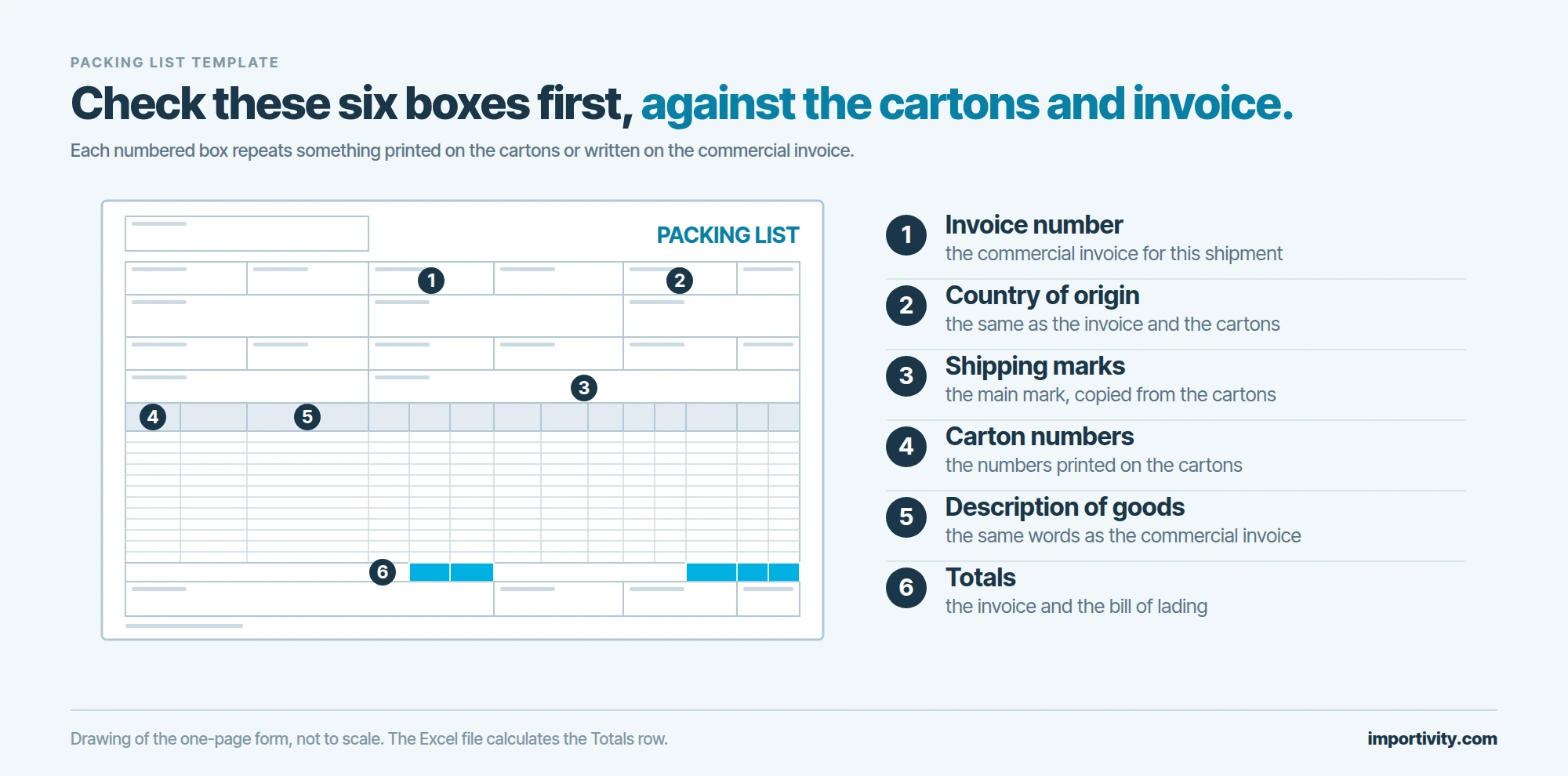
- Title row. A box at the top left for your logo or company name, next to the title PACKING LIST.
- Reference row. Six boxes, from the packing list number to the page number.
- Parties and transport. Who ships, who buys and who receives the goods, then the ports, the carrier, the container and the shipping marks.
- Carton table. 12 rows and a Totals row. Each row covers one group of identical cartons.
- Sign-off. Notes, the person who prepared the list, a signature and a date.
The Excel file has three sheets: Packing list, How to fill it in, and Example. The cells you type in are shaded light gray. The calculated cells are white with bold numbers, and they stay empty until the cells they read are filled in, so a blank form prints with no zeros. The file has no macros, no password and no sheet protection. Its formulas are basic ones such as SUM and IF, which Google Sheets also has. To use the file there, upload it to Google Drive and open it with Sheets.
The Word file and the two-page PDF hold the same form, followed by a page of instructions. In both, the calculated boxes are blank for you to fill in by hand.
How to fill in a packing list, field by field
The seller or shipper fills in the packing list and sends it with the commercial invoice. The table follows the form from top left to bottom right and uses the field names printed on it. Where a rule asks for a field, the last column names the paragraph of 19 CFR 141.86, the US Customs regulation on invoices. Where it says practice, no rule we found asks for the field. Where it says formula, the Excel file works the figure out.
| Field | What to write | Rule or reason |
|---|---|---|
| Top of the form | ||
| Your logo or company name | The logo or name of the seller or shipper, which issues the packing list. | Practice |
| Packing list number, Date | The shipper's own number for this packing list and the date it is issued. | Practice |
| Invoice number | The number of the commercial invoice for the same shipment. | The invoice carries the same number |
| Purchase order number | The buyer's PO number, as printed on the cartons. | Practice |
| Country of origin | The country where the goods were made. | Should read the same as the invoice and the cartons |
| Page | Number every page, for example 1 of 2. | Practice |
| Seller or shipper (name, address, country) | The company that packed and shipped the goods. | Practice |
| Buyer (name, address, country) | The company that bought the goods. | Practice |
| Consignee (ship to), if not the buyer | Only when the goods go to someone other than the buyer, such as a warehouse or 3PL. | Practice |
| Port of loading, Port of discharge | The port or airport where the goods are loaded, then the one where they are unloaded. | Practice |
| Final destination | The city of the warehouse the goods go to after the port. | Practice |
| Carrier and vessel or flight | The shipping line or airline, and the vessel name and voyage or the flight number. | Practice |
| Bill of lading or air waybill number | The transport document number. Leave it blank if it has not been issued yet. | Practice |
| Ship date | The date the goods leave the port of loading. | Practice |
| Container and seal numbers | For a full container, both numbers. Leave it blank for loose cargo. | Practice |
| Shipping marks (the main mark as printed on the cartons) | Copy the main mark exactly: consignee code, PO number, destination, carton numbers and country of origin. | 141.86(a)(3), marks and numbers of the packages |
| Cartons | ||
| Carton numbers | The carton numbers this row covers, for example 1-150. They must match the numbers printed on the cartons. | 141.86(a)(3) |
| Item number | The buyer's item number or SKU, as printed on the side mark. | Practice |
| Description of goods | What is inside these cartons, in the same words as the commercial invoice. | 141.86(e), what each package contains |
| Quantity per carton, Cartons | How many units are in one carton, then how many cartons this row covers. | Practice |
| Total quantity | Calculated: quantity per carton x cartons. | Formula |
| Net weight per carton (kg) | The weight of the goods in one carton, without the outer carton. | Practice |
| Gross weight per carton (kg) | The weight of one packed carton. | Practice |
| Length (cm), Width (cm), Height (cm) | The outside size of one carton in centimeters. | The volume formula reads these cells |
| Total net weight (kg), Total gross weight (kg) | Calculated: weight per carton x cartons. | Formula |
| Volume (CBM) | Calculated in cubic meters: length x width x height (cm) / 1,000,000 x cartons. | Formula |
| Totals | Calculated: total cartons, quantity, net weight, gross weight and volume. | Formula |
| Sign-off | ||
| Notes | What the forwarder or the warehouse needs to know, such as pallets or fragile goods. | Practice |
| Prepared by (name and title) | The person at the shipper who prepared the packing list. | Practice |
| Signature, Date | Signed by hand, or signed and stamped by the shipper, with the date of signing. | Practice |
A filled-in packing list example
The Example sheet in the Excel file is filled in for one made-up order: 5,000 vacuum insulated tumblers, packed 20 to a carton, going from a seller in Shenzhen, China to a warehouse in Austin, Texas. Every company, person and number on that sheet is invented.
- Cartons 1-150. Item TMB-20-BLK, the black tumbler. 20 per carton in 150 cartons makes 3,000 pieces. Each carton weighs 8.40 kg net and 9.60 kg gross, so the row totals are 1,260.00 kg net and 1,440.00 kg gross. The volume is 6.162 CBM.
- Cartons 151-250. Item TMB-20-WHT, the white tumbler. 20 per carton in 100 cartons makes 2,000 pieces, 840.00 kg net and 960.00 kg gross. The volume is 4.108 CBM.
- Totals. 250 cartons, 5,000 pieces, 2,100.00 kg net, 2,400.00 kg gross and 10.270 CBM.
The volume column works like this. Every carton in the example is 47 x 38 x 23 cm. Multiplied together that is 41,078 cubic centimeters, and dividing by 1,000,000 gives 0.041078 cubic meters for one carton. Times 150 cartons, the first row comes to 6.162 CBM, shown to three decimals.
The shipping marks box on the example says EXB / EB-PO-1001 / LONG BEACH / C/NO. 1-250 / MADE IN CHINA, the main mark copied from the cartons. Its PO number is the one in the purchase order number box. The container box says "Loose cargo (LCL), no container number", because LCL cartons share a container with other shippers' cargo. At 10.270 CBM the order is below the 13 to 15 cubic meters where, according to our guide to FCL and LCL shipping, a full container usually becomes the cheaper choice.
Packing list mistakes to catch before the goods ship
A packing list should agree with the cartons, the commercial invoice and the bill of lading. The first three mistakes below break that. The last three make the Excel totals wrong.
- Marks or carton numbers that do not match the cartons. The shipping marks box and the first column must show what is printed on the cartons. Our shipping marks guide explains that LCL cartons are sorted by their marks at a container freight station, and that the packing list is how anyone holding the papers finds a given carton.
- A description that differs from the commercial invoice. Use the same words on both. 19 CFR 141.86(e) asks the invoice to state what each package contains, and the packing list is how the invoice does that.
- Totals that differ from the invoice or the bill of lading. Our commercial invoice form has a box for the total packages and the gross weight, and both must match the packing list. Our bill of lading guide says the package count, weight and volume on a draft bill should equal the packing list totals.
- A shipment total typed into a per-carton column. The weight columns ask for the weight of one carton. The Excel file multiplies it by the number of cartons, so a shipment total typed there is multiplied again.
- Inches or pounds. The form asks for centimeters and kilograms. The volume formula divides cubic centimeters by 1,000,000, so a carton size typed in inches gives a wrong CBM figure.
- One row for cartons that are not identical. A row has one quantity per carton, one weight and one carton size. Cartons that differ in any of these need their own row.
Where the packing list sits among the shipping documents
The seller or shipper writes the packing list when the goods are packed and sends it with the commercial invoice. On the Example sheet it is dated Sep 22, 2026, and the ship date is Sep 25, 2026. The drawing below puts it in order with the other documents for one shipment and names who writes each.
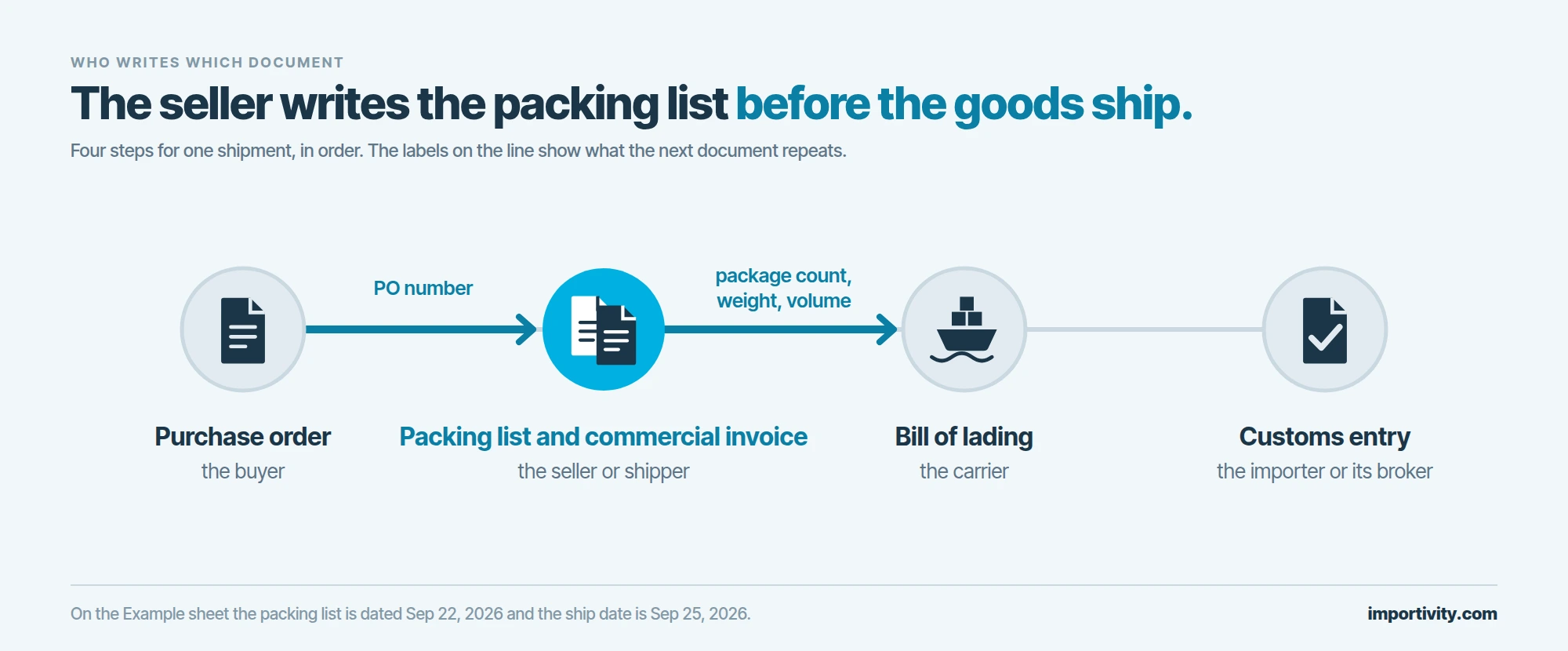
- Purchase order. The buyer writes it first. The packing list repeats its PO number.
- Packing list and commercial invoice. The seller or shipper writes both. They share the invoice number, the descriptions, the number of packages and the gross weight. Our commercial invoice template is the form that goes with this one.
- Bill of lading. The carrier issues it from details the shipper sends. Its package count, weight and volume should equal the packing list.
- Customs entry. The importer, or a customs broker acting for it, files it with US Customs and Border Protection (CBP).
Is a packing list required by US Customs?
We found no CBP form for a packing list and no CBP page that sets its fields. Two rules we found mention it. 19 CFR 141.86(e), under the heading "Packing list", says: "Each invoice must state in adequate detail what merchandise is contained in each individual package." 19 CFR 142.3, which lists the documents filed to get a shipment released, includes "A packing list, where appropriate." Your customs broker can tell you whether your entry needs one. The statute on invoices, 19 U.S.C. 1481, also asks for "the marks and numbers of the packages in which the merchandise is packed". On this form they go in the shipping marks box and the carton numbers column.
If a factory is packing your order
A buyer does not write the packing list, but it can check one. Ask the factory for a draft when packing is finished and before the cartons leave, then compare it with four things:
- The purchase order. Item numbers, the quantity of each item and the total quantity should be what you ordered.
- The carton marks. The shipping marks box should repeat the main mark in your carton spec. The carton numbers should run across the whole order without starting again for each item, as cartons 1-150 and 151-250 do in the example.
- The inspection report. If you booked a pre-shipment inspection, the inspector counted the packed cartons. That count should equal the Totals row.
- The commercial invoice. Ask the factory to make both documents from one carton list, so the invoice number, the descriptions and the totals agree.
Then send the total gross weight and the total CBM to your freight forwarder. LCL freight is charged per cubic meter, so a wrong carton size changes the freight quote.
Importivity helps US brands find and vet factories and run quality control. We also handle shipping and tariffs. If you want that help with an order, see our shipping and logistics service or send us your product and order details.
Frequently Asked Questions
Who prepares the packing list?
The seller or shipper prepares the packing list, because it packed the cartons and knows what is in each one. It sends the packing list with the commercial invoice. The buyer does not write it, but can ask for a draft before the goods ship and check it against the purchase order and the carton marks.
Is a packing list required by US Customs?
19 CFR 141.86(e) says each invoice must state in adequate detail what merchandise is contained in each individual package, and a packing list is how an invoice does that. 19 CFR 142.3 lists a packing list, where appropriate, among the documents filed to get a shipment released. We found no CBP form for a packing list. Your customs broker can tell you whether your entry needs one.
What is the difference between a packing list and a commercial invoice?
A commercial invoice records the sale: the parties, the goods, the prices and the totals, and US Customs uses it at entry. A packing list records how the goods are packed: the carton numbers and the quantity per carton, then the weight and size of each carton. This template has no price column. The two must agree on the invoice number, the descriptions, the number of packages and the gross weight.
Does a packing list need a signature or a stamp?
The template has boxes for the name and title of the person who prepared it, a signature and a date. The shipper signs by hand, or signs and stamps it. The sentence of 19 CFR 141.86(e) that we found says nothing about a signature or a stamp. Your buyer or its bank may set its own requirement, so ask them whether they want a signature, a stamp or both.
How do you calculate CBM on a packing list?
Multiply the outside length, width and height of one carton in centimeters, divide by 1,000,000 to get cubic meters, then multiply by the number of cartons. In the template's example a carton of 47 x 38 x 23 cm is 0.041078 cubic meters, and 150 cartons come to 6.162 CBM. The Excel file does this in the Volume (CBM) column.
About the author
Jordan Lewis
Chief Operating Officer, Importivity
Runs Importivity's sourcing operations across China, Vietnam, Mexico and India, from supplier negotiation through delivery to the client's door.
Press and media inquiries: press@importivity.com