














HTS code classification is the process of assigning a specific 10-digit number from the Harmonized Tariff Schedule of the United States to every product you import. That number determines your duty rate, whether you face antidumping or countervailing duties, and which trade-remedy tariffs — Section 301, Section 232, and others — apply to your shipment. Get it right and your landed cost is predictable. Get it wrong and you could owe back duties, interest, and penalties going back five years.
The short version: HTS codes are not optional, they are not interchangeable with Schedule B codes, and “close enough” is not a legal standard CBP recognizes. Every imported product must be classified under a specific provision, and that classification has a right answer — even when the answer is genuinely ambiguous. This article walks you through how the system works, how to classify methodically, and what to do when you are not sure.
If you are also thinking about ways to reduce what you owe, it helps to first understand import taxes and duties at a structural level — because classification, valuation, and country of origin are all levers, and HTS codes are the first one you touch.
HTS vs. HS Codes vs. Schedule B: What Actually Differs
The Harmonized System (HS) is an international product nomenclature maintained by the World Customs Organization. It covers the first six digits of any tariff code and is shared by roughly 200 countries. When a supplier in China, Vietnam, or Mexico puts a six-digit code on a commercial invoice, they are using HS.
The U.S. extends that six-digit base in two ways:
- HTS codes (import): The Harmonized Tariff Schedule of the United States adds digits 7–10 for imports. These extra digits reflect U.S.-specific duty rates, quota categories, and special program eligibility. Published and maintained by the U.S. International Trade Commission (USITC), updated annually.
- Schedule B codes (export): Maintained by the Census Bureau, Schedule B codes share the same first six digits as HTS codes but the last four digits can diverge. You use Schedule B when filing Electronic Export Information through AES — not when classifying imports.
In practice, many importers incorrectly use Schedule B codes on their entry filings. The two are often identical at the 10-digit level, but not always — and CBP enforces HTS, not Schedule B, for imports. Your customs broker should always be working from the HTS.
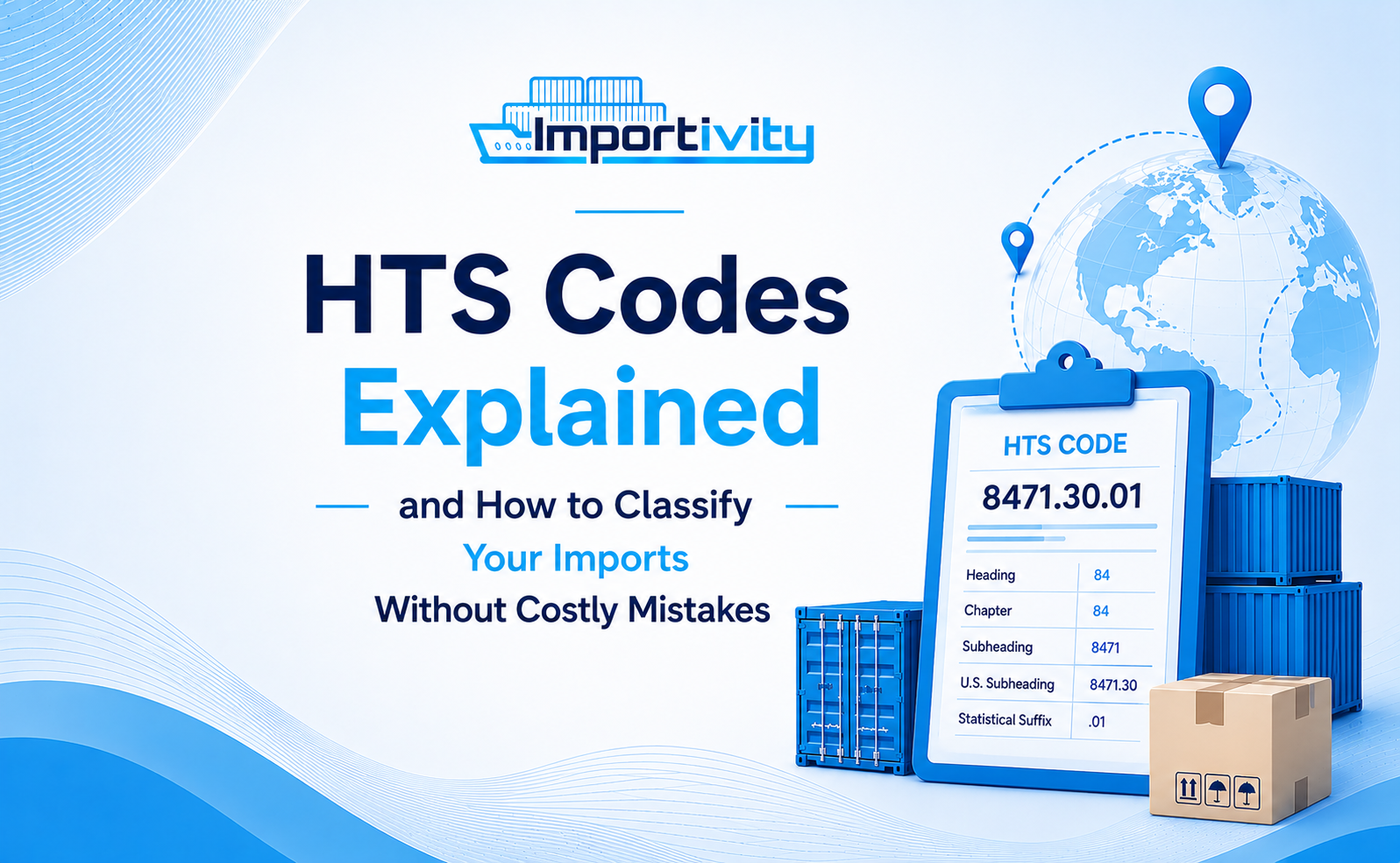
How the 10-Digit U.S. HTS Is Structured
The HTS is organized hierarchically. Each layer narrows the classification from broad category to specific product. Here is how to read a 10-digit code, using stainless steel travel mugs as an example:
| Component | Digits | Example: 7323.93.0060 | What It Describes |
|---|---|---|---|
| Chapter | 1–2 | 73 | Articles of iron or steel |
| Heading | 3–4 | 7323 | Table, kitchen, or household articles of iron or steel |
| Subheading (HS) | 5–6 | 7323.93 | Of stainless steel (shared internationally) |
| U.S. Subheading | 7–8 | 7323.93.00 | Further U.S. subdivision |
| Statistical Suffix | 9–10 | 7323.93.0060 | U.S. statistical reporting category |
The duty rate attaches at the 8-digit level. The statistical suffix (digits 9–10) is required on entry filings but does not change the duty rate — it exists for trade data collection. Still, filing the wrong statistical suffix is a technical violation and can trigger a request for information.
Key takeaway: Your supplier’s six-digit HS code is a starting point, not a finished classification. You must extend it to 10 digits using the current U.S. HTS, and the correct extension depends entirely on the product’s specific characteristics.
Why Classification Controls Your Duty Rate
Different HTS codes carry different general rates of duty — from 0% on many industrial inputs to 20–30% or more on some consumer goods. On top of that general rate, you may owe:
- Section 301 tariffs on Chinese-origin goods, currently ranging from 7.5% to 100% depending on the product list.
- Section 232 tariffs on steel and aluminum imports (25% and 10% respectively, with some country exemptions).
- Antidumping and countervailing duties (AD/CVD), which can be extremely high — sometimes exceeding 200% — and apply to specific HTS codes from specific countries.
- Special program eligibility such as GSP, USMCA, or other FTA preference rates, all of which are tied to specific HTS provisions.
Misclassifying a product into a lower-duty code — whether intentional or accidental — does not reduce your liability. CBP can reliquidate entries up to four years after the date of entry (five years in fraud cases), assess back duties with interest, and add penalties of up to four times the unpaid duty. The fact that your supplier gave you the code, or your previous broker used it for three years, is not a legal defense.
Correct classification also matters on the upside. Many importers overpay because they are using a conservative or vague heading when a more specific one carries a lower rate or qualifies for a trade preference. Overpaying is legal but expensive — and it is far more common than most importers realize.
The General Rules of Interpretation in Plain English
The HTS is not self-executing — you cannot simply search for your product name and take the first result. Classification follows six General Rules of Interpretation (GRIs), applied in strict order. Here is what they actually mean:
- GRI 1 — Use the headings and notes first. The titles of sections, chapters, and headings are for reference only. Classification is determined by the text of the headings and any relevant legal notes. Most products should be classifiable at GRI 1 without going further.
- GRI 2 — Incomplete or unassembled goods; mixtures. An incomplete article is classified as if it were complete, provided it has the essential character of the finished product. Mixtures of materials go to the most specific applicable heading.
- GRI 3 — When two or more headings could apply. The most specific description wins. If that does not resolve it, the heading that covers the material giving the product its essential character controls. Last resort: use the heading that appears last numerically.
- GRI 4 — Goods not elsewhere classified. Classify with the goods most similar in character or use.
- GRI 5 — Packing and cases. Cases and containers specifically designed for the article are classified with it if they are suitable for long-term use and normally sold with the article.
- GRI 6 — Applies GRIs 1–5 to subheadings. You classify at the heading level first, then apply the same logic to determine the correct subheading.
In practice, most disputes occur at GRI 3 — particularly the “essential character” test. CBP and the courts have ruled on essential character based on weight, value, role in function, and other factors, and the answers are not always intuitive. A product that is primarily plastic but has a critical steel component may still be classified as plastic if the plastic defines how it is used.
The Real Cost of Misclassification
CBP has three main ways to catch misclassification: automated targeting at time of entry, post-entry audits (CF-28 requests for information and CF-29 notices of action), and full compliance audits under the Focused Assessment program. The Focused Assessment is reserved for importers flagged as higher risk — typically mid-to-large volume — but CF-28/29s happen across all importer profiles.
Common customs documentation mistakes compound the problem. If your commercial invoice describes the product in vague or ambiguous terms, CBP examiners will use that ambiguity against you — classifying under the provision that generates the highest duty when the product description does not clearly support a lower one.
The financial exposure from a misclassification audit is not just the duty difference. It includes:
- Back duties on all affected entries within the look-back period
- Interest on unpaid duties (currently around 8% per year)
- Penalties — negligence is 20% of unpaid duty, gross negligence is 40%, fraud is up to four times the total duty
- Legal and broker fees to respond to the audit and file any protests
- Potential seizure of goods in serious cases
For a brand importing $2M/year of goods with a 5-percentage-point duty understatement on a product subject to Section 301 tariffs, the four-year exposure before penalties can easily exceed $400,000. That is not a hypothetical — it is the math.
How Binding Rulings Work
If you have a genuinely ambiguous product — something that could plausibly fall under two or more headings — you can ask CBP for a binding ruling before you import. The ruling is issued by CBP’s National Commodity Specialist Division and is legally binding on all ports of entry for as long as it remains in effect.
The process:
- Submit a ruling request to rulings.cbp.gov with a complete product description, photos or samples if the product is novel, and your proposed classification with legal arguments.
- CBP typically responds within 30–90 days, though complex rulings can take longer.
- The ruling is published in the Customs Ruling Online Search System (CROSS) database, where you can also search for rulings on similar products before you file your own.
A few things to understand: a binding ruling locks you into the classification it provides, even if you later discover a lower-duty alternative. And if CBP issues a ruling that differs from what you proposed, you are bound by their ruling — though you can protest it. Binding rulings are valuable for high-volume or high-stakes products, but they are not always necessary. For products with clear classifications, a well-documented internal classification with a knowledgeable broker is sufficient.
The deeper point: Binding rulings are most valuable when you are building a multi-year import program. For a one-time order, the cost of the ruling process may not be worth it — but for a product line you plan to import repeatedly, the certainty is worth the time investment.
A Step-by-Step Classification Process
Here is how to approach classification methodically rather than guessing from a product description:
- Define the product precisely. Material composition, function, end use, how it is sold (retail vs. bulk), country of origin, and any relevant processing. The more specific, the better.
- Check the Section and Chapter notes. The HTS begins with General Notes and then Legal Notes for each Section and Chapter. These notes exclude certain products from headings and include others — they are legally binding and override heading titles.
- Identify candidate headings. Use the USITC’s online HTS search (hts.usitc.gov) to find plausible headings. Look at the actual text, not just the summary.
- Apply the GRIs in order. If GRI 1 resolves it, you are done. If not, work through GRIs 2 and 3 with the specific product facts.
- Search CROSS for precedent. CBP’s ruling database has hundreds of thousands of published rulings. Search for your product type and read how CBP classified similar items. Consistent prior rulings on the same product type are strong evidence — though not binding on you unless you request your own.
- Document your rationale. Record the headings you considered, why you eliminated them, and the specific GRI rule you applied. This documentation is your defense in an audit.
- Verify the current duty rate and any additional tariffs. Use the General column for most-favored-nation (MFN) duty rates, and check the Special column for FTA preference rates. Then cross-check against the active Section 301, 232, and AD/CVD lists.
If you want to reduce your overall duty burden once you have the correct classification, the next step is evaluating tariff mitigation strategies — which may include first sale valuation, bonded warehouses, foreign trade zones, or engineering the product to shift its classification legitimately.
Frequently Asked Questions
Can I use my supplier’s HS code as my HTS code?
Only the first six digits are likely to match. Your supplier’s six-digit HS code is a useful starting point for finding the right chapter and heading, but the last four digits of your 10-digit U.S. HTS code are determined by the U.S. tariff schedule — not your supplier’s country’s classification. You must verify the full 10-digit code yourself or with your broker using the current USITC HTS.
What happens if my broker classifies my goods incorrectly?
You, the importer of record, are legally responsible for the accuracy of your customs entries — not your broker. Your broker acts as your agent, and errors made by your broker are treated as your errors by CBP. This does not mean you have no recourse against a negligent broker, but it does mean you cannot use broker error as a defense against CBP. You should review your broker’s classifications, especially for high-duty or high-volume products.
How often do HTS codes change?
The USITC revises the HTS annually, typically effective January 1. Major structural revisions (driven by WCO updates to the underlying HS) happen every five years — the most recent was in 2022. Additional duty columns like Section 301 lists are updated through separate regulatory processes and can change at any time with relatively short notice. If you are importing a product regularly, it is worth checking the current HTS at the start of each year and after any announced trade action.
Is it legal to engineer a product to get a lower HTS code?
Yes, with important caveats. Legitimate product design changes that genuinely shift what a product is — its material, function, or composition — can result in a different and lower-duty classification. This is called tariff engineering and it is legal. What is not legal is misrepresenting a product’s characteristics to claim a classification it does not actually qualify for. The line is drawn at the facts: if the product genuinely meets the requirements of the lower-duty heading, you can classify it there. If it does not, falsely claiming it does is fraud.
What is the difference between a CF-28 and a CF-29?
A CF-28 (Request for Information) is CBP asking you to provide documentation or clarification about an entry — it is an inquiry, not a finding. A CF-29 (Notice of Action) is CBP informing you of a proposed or completed action, such as a rate advance (they are going to increase your duty rate on a specific entry). You have 20 days to respond to a CF-28 and to protest a CF-29. Both should be treated seriously — they often precede a broader review of your import history.